 |
|
|
 space/space.
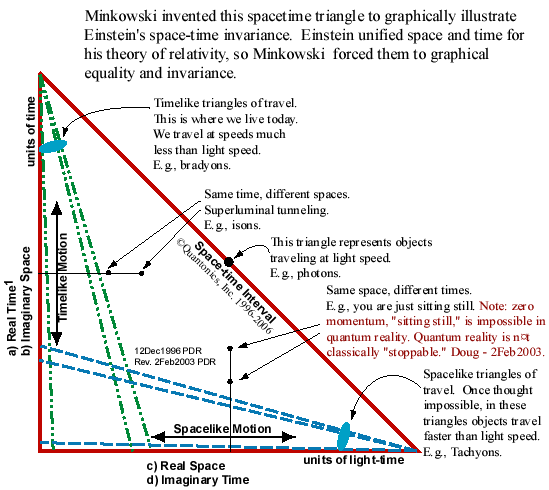
are classical. His mindset when he developed this idea was classical. So was Einstein's. Both are essential SOMites. and show their identity. We are amazed because he did not perceive their underlying deeper structure, i.e., flux. We choose to believe Einstein's Classical Thing-king Methods (CTMs) put blinders on him. Had he perceived flux as their deeper structure, we think he would have seen flux as deeper structure for both mass and gravity too!  Now we know Einstein was wr¤ng (i.e., incomplete in his thing-king). But then one must ask, "What else did he perceive wrongly/incompletely? And why?" His model of time was classical. He failed to see time and space as spawn of flux. He perceived reality as a formal, deterministic, analytic function of homogeneous time. He saw all real, substantial objects as y = f(t)! tunneling of quantons. See, among others, our brief on Raymond Chiao's FTL work nearby. In that review, I did not say so, but it is worth your while to note that Chiao's quantons travel superluminally through his barrier. The number he quotes of 1.7 times light speed will go up as he increases his barrier thickness! Why? Because a quanton spends less time traveling in actuality. It travels a further actual distance (increased barrier thickness) in nonactuality at a superluminal rate. twixt two quantons separated at least 10 kilometers. Superluminal means no latency. Correlations are instantaneous! (Search on Nicolas Gisin and Anton Zeilinger to learn more.) "you/we are just standing still." Physicists call this "zero momentum." This is a faux pas. This is one of classicists' greatest failures of thought: that reality can "stand still," is "stoppable." Quantum realihty issi abs¤lute flux. Thus realihty cann¤t st¤p. I(ht)-y¤u(wæ) cann¤t stand stihll. Einstein assumes that space is a proxy for time, that time is essentially space/space.This mandate for space-time identity is a classical naïvety. Why? Classical notions of 'space' can "stand still" due space's classical analyticity. But if you think about it (do n¤t thingk about it), you may see that time is non-classically analytic: time is unstoppable! In our Quantonics efforts to fathom time's quantum depths, we have found that time is n¤t just another spatial dimension. Rather, in Quantonics, tihmæ issi heter¤gene¤us, anihmatæ, EIMA, quantum fluxings.
First of all, try to ponder what time is yourself. It is, in physial reality, one of, if not the most difficult memes to understand. We think our omnifficulties understanding time are a large part of our omnifficulties understanding quantum reality. But why do classicists appear to n¤t understand time? Irving Stein answered it best in our view: classicists "have no coherent description of change," thus saying essentially that classicists refuse to accept change as a quantum meme of heterogeneous emergence. Instead, they insist that change must be objective, unicontextual (OGC), and unilogical (OGT) in a subject-object metaphysics (SOM). Also see our What Is Wrong with SOM's Logic. |
|
Please note that Doug's original of this hypercomplex phase diagram was drawn by him durationally over several years from about April, 1992 through about December (late), 1996. In 1996, Doug was just leaving a Directorship in a large diesel engine manufacturer in southern Indiana to start Quantonics. Their whole process is dialectical and their thermodynamics are all classically bogus, but they still do not understand that. Doug was hired to be their "creative director," but they as a company have no creative blood flowing, i.e., in any sense of quantum~reality. Their leadership is essentially Harvard-Marxian socialist: wholly antithetic quantum~reality, folks. Activity on this page is exploding. A few of Earth's folk appear to be ready for some, however minor, quantum~changings! This page's hit rate has been growing steadily since Doug first published it as startup of our Quantonics website in February, 1998. Thank you! People most interested in Minkowski's hypercomplex "triangle," and hopefully Doug's remarks below...surprisingly to Doug...are not from USA. Most of you are from Middle-East and Eastern Europe. Great! USA has given up on a lot of important memes like real education. Marxists have taken over and ruined public and tertiary academe. USA is dying! As we watch. Maybe we'll learn a lesson, and perhaps not. Anyway, a huge number of you are interested in how this diagram came about. That happened as part of Doug's research process in starting Quantonics. Doug's purpose was to show that Einstein blew it! Just like Aristotle, just like Plato, just like Buridan, and Aquinas, and Newton, and countless other classical nitwits...all of them blew it. All classicists have blown it and are still blowing it. Why? They believe reality is objective, state-ic, material, formal, canonic, mechanical, rational, analytic...all of which rolls up into a very old and very dead term: dialectic. Trouble is, reality is quantum and NOT dialectical. Quantum~reality is alive. Dialectical reality is dead. That explains succinctly why West and western thought is passé, extinct. This page is part of Doug's effort in using accumulated extensive research evidence to show that. Specifically, if you want to follow Doug's footsteps in this local page's regard, see Fred Alan Wolf's Parallel Universes, Chapter 12, p. 120 of that text a 1988 first edition by Simon and Schuster. Doug first reviewed that text, fairly thoroughly, in 1992. Subsequently, Doug kept going back to it for reference material and learning. In 1996, Doug wrote these words in mast page of Chapter 12: "I spent two days - December 11-12, 1996 on this chapter. Still don't understand completely. I think Wolf could have used a clearer format." Over a period of 4-6 years, Doug drew said graphic above and gradually improved it over many subsequent years, results of which you see in this page. A huge mistake Wolf makes in his text narrative in Chapter 12 is to claim as Einstein did that time stands still at light speed. Assumption which produces said claim is bogus: that approximately 1014 cycles per unit spatial reference is fastest clock in our universe. That is simply wrong! Fastest known clock in quantum~reality, Planck's rate, is at least 29 orders of magnitude above that. So any photon traveling in deep space twixt galaxies is still aging. That is a quantum~relativistic essential you must understand. Simply, even at light speed, nothing stops: all keeps changing fast and everywhere and completely!!! Doug. Actually light's flux is so slow, that we cannot use light to see a vast amount of our universe. Imagine a bookcase about 15 kilometers high. A credit card is about 789 microns thick. Bookcase height is what we cannot see directly with our eyes. Credit card thickness is what we can see! All numbers are very coarse... Too, you must understand, for example, that Earth is moving around Sol at about 18 miles per second, Sol is moving around our Milky Way at about 180 miles per second. Nothing in reality stops! Nothing in reality can achieve "zero momentum," even relativistically. All is in absolute flux and absolute change borne of that flux: quantum~flux. If reality were stopped, your favorite swing...wouldn't. Doug. This page is a good starting place for classical vis-à-vis quantum understanding, but it will not fill your psychic~pneumatic plate! Try Zeno next and Doug's A Quantum Pendulum. Best to you, and thank you for all these fabulous hits! Doug - 8Apr2010. |
 D2
(km)
D2
(km)