|
"The press is no substitute for institutions.
It is like the beam of a searchlight that moves restlessly about,
bringing one episode and then another out of darkness into vision.
Men cannot do the work of the world by this light alone. They
cannot govern society by episodes, incidents, and eruptions.
It is only when they work by a steady light of their own, that
the press, when it is turned upon them, reveals a situation intelligible
enough for a popular decision."
|
Hope all you of Western Culture had lovely celebrations as apropos. Our Thanksgiving was calorific to say a least!
Beth and I are preparing for our Christmas holiday. We just planted 17 new trees around two sides of our home's periphery. They are perfect for Christmas decorations. We do not have their electrical outlets installed yet (next year), but we put big red velvet bows on each of them. They look cheery and inviting. We decorated most of our home's interior with several trees, garland, lights, Christmas critters, etc. Beth loves to do holiday decorating, so we have changes throughout each year. Lots of DQ here. We also installed some of those icicle lights on our deck. Talk about technology — each 14' string has 150 lights and a controller which allows eight different still or flashing-dimming-brightening light display options. And imagine each uP in each controller probably has more computing power than Moore School's original ENIAC (University Pennsylvania, 1943-6), a John Mauchly design. Where ENIAC (Electronic Numerical Integrator and Computer) weighed 50 tons (18,000 vacuum tubes) and required a 30x50 foot room, our little icicle light controls are smaller than a package of cigarettes and weigh a couple of ounces. Too, they probably contain many more than 18,000 transistor gates. And guess what? Each string of lights was on sale for $5.00, half-off!
We were headed for Florida's Keys for a Christmas break, but our friends in Coral Springs need surgery on 20Dec2000, so we canceled those plans. Beth will travel with her Mother to Naples, though, so she will spend some times in sunny climes. I'll be here working on Quantonics stuff. (Go imagine. J)
We planned a new top page and site reorganization for 2001, but we just have not had adequate time or resources.
We are working on a 3D copper model (from 16 oz. non-annealed sheet) for our new 2001+ arches, but Doug's metal-working skills need much practice and great assists from DQ. We are gradually developing custom tools to help our shaping, bending, soldering, etc. Eventually many of our models will appear as metal art in copper with gold and silver inlays, gold leaf, silver leaf, et al.
As many of you now know, our completion of our Bergson review of his Creative Evolution occurred 26Nov2000. From beginning to tentative completion required almost three solid months of effort. But enlightenment opportunity there is huge for our Quantonics community, and we urge you to partake. We do this both for our own and your global enlightenment. Just enjoy it, please! We offer a plethora of newer quantumesque memes.
A superb example is a very important Bergsonian meme of classical negation as classically subjective. (Wow! Can you believe Doug just wrote that? Better read that again!) See his Topic 39, page 291, and our highlights and remarks there. Here is another potent example of how Millennium III's quantum tsunami shall upset classicism's philosophical and scientific apple carts. Times are nigh for classicism's pugilistic wall of shame, its massive deign of feign, to crumble. After you read this, you will never say "not" again without a sense of concern about what you mean. (Catalysed by Bergson's stimulus, we are now saying that English 'not' is much more of an offender to semantic intention than 'the.' Also see our QQA on thelogos.)
Too, we added Bergson's I-cubed depicted with quantum extensions, to our Bergson's I-cubed as Quantonic semiotics.
So, those of you close to our efforts on our review of William James Sidis' The Animate and the Inanimate can see we are making progress. Our attempts to understand Bergson's view of many times is bearing fruit and should culminate in our next review of Bergson's Time and Free Will. We will start that review soon.
In interim...
Recently we found material about anthropologists which appear to us as more quantum affective and qualitative, more like Metaphysics of Quality, so we shared those with Pirsig.
You may recall Pirsig wrote much about (in Lila) inadequacies of modern 'objective' quantitative anthropology founded by Franz Boas, Columbia University's first professor in Anthropology in 1899. Pirsig juxtaposed Dusenberry and other more quantum, qualitative anthropologists to Boas and his ilk.
First, we copied an article from Science News (see 9Sep2000 issue), by Bruce Bower, titled 'The Forager King,' about Colin Turnbull. Turnbull was an anthropologist which appeared to us as more qualitative than most others.
More recently, in addition to that article we sent a copy of Shweder's book review to Pirsig also. It is a book reviewed in Science, titled Available Light. Available Light was written and published (Princeton UP) earlier in 2000 by Clifford Geertz. Richard A. Shweder reviewed it under a heading Anthropology in Science's 24Nov2000 issue, page 1511.
Pirsig responded with an informative letter regarding his long-ago personal acquaintances with Colin Turnbull. We hope to show you that letter on our Quantonics site soon. It is a revelation — absolutely fascinating! Pirsig does not agree, entirely, with our assessment of Turnbull.
Anyway, prior to doing our next review (third of four reviews) of Bergson's Time and Free Will, we want to read Geertz' Available Light and consider it for a brief review here in Quantonics. We need that as a break from Bergson's high intellectual, philosophical and metaphysical intensities.
...out interim.
When we finish that brief Geertz review, we will do our much longer review of Bergson's Time and Free Will, followed by a review of his Matter and Memory. Then we will update our quantum temporal perspectives in Quantonics using Bergson's, et al., many times. To do a superb review of Sidis' AIA, we also need to carry a quantum manys theme into thermodynamics. Any of you who have read or scanned Sidis' AIA know that he quantum-appropriately disavows Maxwell's second law. We think he did or should have disavowed all of Maxwell's laws as thoroughly and ineptly classical. Maxwell incorrectly assumed a classical unilogical homogeneous analytic reality. As a result he found reality closed and thus conserved. That lead to his perception of only one class of entropy: posentropy. Sidis hints at more classes of entropy (i.e., efficiencies above, below, and at 100%) and more-than rants at Maxwell's problematics. Now, with multiple (many) times, entropies, etc., we may commence looking at reversibility as plural too. I.e., following Pirsig's many truths and Bergson's and Dirac's many times, we may abundantly consider a new meme of 'many reversibilities.' Our review of Sidis' AIA will extend magnificently our own Quantonic heuristics and quantum intuitions. Please join us in your own magnificent heuristics experiences.
Added some links and brief comments to Sidis' 'Unconscious Intelligence.'
A young friend of ours at University of Florida who is a regular Quantonics visitor and emailer made some cogent comments and asked some potent questions re: our ad lib review of William James Sidis' 'Unconscious Intelligence.' We hope to share that dialogue with you before mid-December, 2000. Our ufl.edu friend offers a first critique of our review of that WJS work. We imagine many of you have similar reactions, but have not queried us about our approach. This dialogue may be helpful to you in ferreting our unsubtle intentions. See A Doublet Dialogue Twixt Bret and Doug.
During November we made several updates to our Coined Quantonic Terms.
We also made an important update to our to Problematic Pirsigean Memes. It is on quantum measurement and Quality Events. See page top.
We added narcolepsy as another class of quantum psychological manifestation to our More Evidence for our Quantum Stage Minds.
We also added narcolepsy and several other updates to our Classical Quantum Tells.
Added updated links to Gyula Klima's new site location at Fordham. Also offer connections there to allow you to join his new forum on Medieval Logic. See our Hughes on Buridan Review. Please note that scholars examining Medieval Logic are interested in that logic's impact on culture in Medieval times. They are (apparently) not as interested as we are in what is problematic with that logic as it impacts modern culture and Millennium III's culture. In a real sense, we are antithetic their efforts. Why? When we ask them to think about classical logics' problematics, they have to admit that it is very closed and limited and in general inadequate for modern use and pedagogy. So in essence, these medievalists are scholars of histories, somewhat disregarding nows and futures.
See new additions at our Quantonics Art Archive.
Unsure how you feel (although some of you made it VERY unambiguous) about what is happening with our USA's presidential 'elections.' J We thought it might be interesting to try a quantum both-and approach to our USA presidency. See our Suggestions for a new model of USA presidency to help resolve our recent 'presidential' election tribulations.
We hope to see all of you here again next year, in 2001. Happiest of New Years to all of you in our Quantonics community!
See you in January! Our December News, as is our custom will appear in our new 2001 News.
We wish you blessings of cohesive enlightenment and openness.
Thanks for reading,
Doug.
We have received our early flu virus attack!
Unfortunately, it coincided with our trip to Tacoma, WA for Puget Sound's century Planck Symposium. We had to cancel our trip and we are still suffering from this awful virus.
Dr. Stein presented a paper. He may make that available on his web site, so you may want to check there. Search on Irving Stein.
We spent most of October, 2000 working on our review of Henri Bergson's Creative Evolution. It is a large book, but it is excellent. We think it will help all students of Quantonics develop a much larger group of sensibilities regarding quantum times or heterogeneous time. Expect to see our completion of Chapter IV during week of 6Nov2000.
Those of you interested in our Quantum Stages' Perceptions of Illusory Stairways should take another look there. We added narcolepsy to our other two 'tells:' autism, and schizophrenia. Also, we modified our Stairways Möbius to wrap-extend stairways 720o around that strip.
We also added 'narcolepsy' to our list of classical quantum tells.
As soon as we finish Bergson's Creative Evolution, we will start our review of his Time and Free Will. After that, there is only one more Bergson text to go, and then we can distill our view of heterogeneous times. During 2001 we shall restart our review of WJS' AIA. We know you are anxious for us to get this done. So are we.
For fun, we are currently reading Max Frisch's Homo Faber, and William Logue's Charles Renouvier, Philosopher of Liberty. You may recall that Renouvier's views caused William James to convert from monism to pluralism during 1870s. James dedicated his last book, Some Problems of Philosophy, to Renouvier. That text and Bergson's four texts are crucial inputs to our review of WJS' AIA.
Renouvier was extraordinarily interested in a politics of individual liberty. James shows us how quantum, indeterminate pluralism is one good solution to SOM's (i.e., monism's) innate antitheses of individual liberty. For a hint of this see our Prereview Comments.
Are many of you intuiting SOM's continuing death throes as they manifest in USA politics? One major tell is a relentless and inutile battle twixt left and right for political hegemony. Isn't it intuitive that global political hegemony and individual liberty are antithetical?
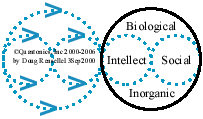
You may recall this paragraph which Doug wrote in his Lila Review about Pirsig's Metaphysics of Quality:
"Second, {Pirsig} develops a beautiful framework consisting of four value layers: intellect, social, biological, and inorganic. Intellect is his highest value layer and inorganic is [its] lowest. He breaks [his] four layers into two groups: subject and object. [] top two layers correspond to subject and [] bottom two layers correspond to object. Each layer in [Pirsig's] hierarchy has moral precedence over [its lower] other. Intellect has [] highest moral precedence followed by social, biological, then inorganic. It is moral for [] higher of two layers to dominate [its lower ] other. It is immoral for a lower layer to dominate a higher layer. This is a profound discovery and for me it is [a] new value ethics. I see world legal structures eventually adopting this ethical system." Brackets remove Doug's thelogos.
Now consider how recent 20th century technical breakthroughs have affected legal systems. We are finding that our classical legal systems no longer work! We are putting innocent people in jail and keeping them there even after we know and have clinical and forensic evidence of their innocence. Why? One word: "SOM!" SOM drives a need for political power and hegemony.
Here is another recent quote of Doug's words in his review of Boris Sidis' Philistine and Genius, Chapter VII, p. 44, explaining why SOM is at fault and why SOM will fail to retain its societal hegemony:
"In our USA, attorneys are sophists (which we admire) who use ESQ 'laws' to exercise their hegemony (which we despise). Governments, corporations, institutions, organizations, and people adhere 'legal...One Law Fits All...' hegemony. Why? Because most of them are SOMites. They do not (yet) intuit sophisms' quantum reality — its Many Isles of Law/Truth.
"ESQ [One Absolute Truth, One Absolute Law, One Global Context] legal templates, sophistically interpreted, are attorneys' great esoterikos, their anti-exegeisthai. Attorneys' innate hypocrisy twixt theory (One Truth Fits All) and practice (sophist paralogism) is why ancient Greeks like Plato and Aristotle hated sophists! Attorneys practice natural quantum law, while they claim a theoretic ESQ ideal. Attorneys stand in sophism and belie their SOMitic 'one-size-fits-all' monism. Modern politicos call it 'spin.' Attorneys 'spin' law, and as such it 'solicits' mere opinion, mere hegemonic convenience, not local islandic legal truth. Attorneys can make 'law' whatever they need it to be.
"For too long, society has been blind, but an enlightenment is near... Nature's evolute pluralism guarantees it.
"But this pseudabsolute, hegemonous control is both 'law' and government's Achilles heel. That very 'pseudabsolute' assures r-evolutionary instability. Better, it assures eventual extinction of its practitioners.
"Boris hates these templates! He tells us they guarantee social engineering ineptness. Both templates and social engineering and its innate ineptness guarantee plug-ins who can only flip burgers.
"While any organization's or individual's anchor of absolute hegemonic stasis drags, their constituents sail away on quantum reality's sea of relentless flux. Static behavior is behavior to be disdained and ignored. Static anything is stuff to be disdained and ignored. Stuckness iso yuckness! Boris claims even more: "It is evil."
"Were governments, businesses, schools, academia (E.g., to dump Newton and Aristotle!), et al., to eschew ESQ, individual autonomy could again grasp freedom's reins. But in quantum reality we must accept a balance of both dynamis and stasis.
"How much of each? That question need not be asked if we could all be individually responsible and autonomous. I see that as an interim asymptote. We are gradually moving toward it. Our internet is a piece. Virtual, OSS work is another, and so on...much ESQ is fading now... "
Well, back to nose drops, cough medicine, and pain relievers. Hopefully this flu bug will find its nemesis in my immune system.
See you in December!
Thanks for reading,
Doug.
We are less than one month away from our Planck Symposium! Soon we will be able to meet face to face with Dr. Stein.
We spent most of September continuing our efforts on our WJS AIA review. We are working on our next Bergson review. Bergson's Creative Evolution is our prime focus now. We will deliver Chapter I next Monday, October 9, 2000. Just Chapter I alone is ~100 pages.
We are learning much from Bergson. Especially we are learning about his view of heterogeneous time. See this graphic of Classical Homogeneous Time vis-à-vis Quantum Heterogeneous Time.
Bergson's concept of duration is consistent with our previous Quantonic view of time except for one new nuance: his duration requires that extinct patterns of value persist isotropically in nonactuality as isoflux. (We are using Quantonics lingo to restate Bergson's memes.) Note how nicely this fits with our model of a quanton. Bergson's memory persistence appears at odds with what Pirsig says in Lila, but we like Bergson's memes. They appear to align more closely with what we think we know about quantum reality.
Actual SPoVs appear in our quanton's right side: what we call "actuality." Bergson's duration requires that SPoV entropy accumulates in our quanton's left side, or what we call "nonactuality." There are other similarities, but what we are finding thus far is that our quantons, amazingly, represent Bergson's meme of duration. Here is a table we made to help us and you compare how different scientific views and philosophers' perspectives 'divide' reality:
| Non-Classical Philosopher/ Metphysics/ Science: |
|
|||||||
|
Nonapparent |
o g i c |
|
o g i c |
Apparent Reality: | ||||
| Bergson, Henri Louis |
|
|||||||
|
Flux |
|
|
|
Analysis | ||||
| James, William |
"...interpenetrate and melt together..." |
|||||||
|
Flux |
|
|
|
Concept | ||||
| Physics, Quantum |
 quanton(quantum_nonactuality quanton(quantum_nonactuality quantum_actuality) quantum_actuality) |
|||||||
|
VES, QVF |
|
|
|
PES, PEF | ||||
| Pirsig, Robert M. |
|
|||||||
|
|
|
|
SQ | |||||
| Quantonics |
|
|||||||
|
Nonactuality |
|
|
|
Actuality | ||||
| Sidis, William James |
Reserve Energy??? |
|
|
|
??? | |||
| Stein, Dr. Irving |
??? |
|
|
|
Space | |||
It is worth your while to consider Bergson's uniqueness shown above. His view is that we may either intellectually sympathize with objective reality (i.e., enter objects) or we may not sympathize and thus remain 'outside' objects. This Bergsonian percept does not match what we know about quantum reality. Notice our Me logic under Bergson, above. Juxtapose his view with our Quantonics view that we always compenetrate (a kind of radical both/and Bergsonian sympathy) reality's actual and n¤nactual c¤mplements.
Bergson offers us many new memetic surprises! One example is how we view reproduction. We may think of that as a biological process. Then too, we may think of reproduction as manufacturing. What is important for us here in Quantonics is answering this question: What do new memes of reproduction offer humanity for Millennium III? Classical manufacturing technique has a goal of ~perfect replication of manufactured items. Modern mass customization techniques have a goal of using many ~perfect standard components to produce one-off items just as quickly or faster than classical technique. Now let's move one more step into a fascinating memetic manufacturing future. Our next generation of manufacturing techniques will begin (already have begun) tending toward customization by actual, individual product evolution. To accomplish this feat on any scale requires that we rid ourselves of antique classical approaches and adpot new Quantonic and quantum approaches.
Without a quanton meme or some analogue of it, antique, formal, radically mechanistic manufacturing processes whose goal is product evolution simply will not work. There is an evolute-axiom worth noting here as told to us countless times by Bergson, James, and Mae-wan Ho: classical concepts and ideas provide no intrinsic means of self evolution. Examples: OSes cannot evolve themselves (they are innately designed not to), Intel and AMD uPs' hardware cannot evolve themselves, etc. Why? They adhere antique, classical, formal predicate logic rules—and those rules preclude even a glimmer of self-evolution. Now compare our quantons to those antique formal objects. Quantons innately interrelate: themselves, their sympathetic c¤mplementary co-insides, and a subset of other nonsympathetic actual reality. All the while they can adjust and grow. Artificial quantons can do these pragma interrelationships.
But at this point in our evolution of artificial quantons they still have a weakness: they still cannot have utile pragma interrelationships with nonactuality to an extent which we know physical actuality, and especially biological actuality, do. Why? We do not yet know how to exploit nonactulality's unlimited possibilities. In our Flash section we note some examples where we actually do get an 'assist' from nonactuality. Also at top of page in our Classical Quantum Tells, we list a couple of other examples.
To begin imagining some challenges here, attempt to visualize how some primitive quanton can grow itself—extend itself. If you take some time to think about that, you probably will have one of two reactions: if you are a classicist, you will simply say, "That's absurd, impossible, unreasonable, and nonsense," and if you are a student of Quantonics or some close approximation to it, you will say, "This is going to be incredibly challenging, and we have a long way to go to make this happen."
We experience much interest in Quantonics regarding this topic. To help you begin to see some challenges that lie ahead we decided to do a quickie review of Discover Magazine's June, 1998 article on 'The Darwin Chip.' Hope you find it useful. As we have told Matt, Cheri, and a few other entrepreneurs, we are working now on perceptual models of what we call "evaluons" which will be able to accomplish some of these feats.
Also we just received our first batch of copper sheet which we will use to do some related 3D artistic models of some relevant memes. Some of these may appear on our Quantonics, Inc. segment of our site within a couple of months. Watch for them.
Some of you may have seen our answers to AAAS' Questionnaire on Ethics. This is another exercise on our part to use Pirsig's MoQ to address ethical issues as patterns of Value, and not simple predicate logic dichons. Note its tight correlation with our March, 1999 QQA on ethics.
Be sure to check out September's updates to our One is the Onliest. And if you haven't already seen it, take a look at our Planck and Quality Events Juxtaposed.
Finally, using all our recent work on homogeneous time vis-à-vis heterogeneous times we arrived at a new plateau. We think we can now show that a historical view of "A Quantum Measurement Problem" arises from a classical perspective of time as both analytic and homogeneous. We asked Nick Herbert (author of a superb book titled, Quantum Reality) if we could quote his excellent section on von Neumann's efforts to solve "the measurement problem." Herbert told us we are "go!" We also will quote part of Jim Baggott's awesome The Meaning of Quantum Theory on that same von Neumann topic. Our result, we think, offers great value. Our result shows that measurement has no fixed location as classicists insist. Rather, quantum measurement has many locations, quantum plural. Take another look at our new Classical Homogeneous Time vis-à-vis Quantum Heterogeneous Time graphic and see if you agree. Our new page describing a new way to view A Quantum Measurement Problem will appear here on our Quantonics site 9Oct2000. Also, we are continuing efforts on our quantum/classical dictionary. That is an enormous task.
See you in November!
Thanks for reading,
Doug.
Caveat: If you feel lazy now, it would be better not to proceed. August, 2000's TQS News may strain your gray matter significantly. However, you will have much fun, and learn much new animate In-Form-At-I-On about a new philosophy and science of interrelationships called "Quantonics."
We must announce to you with great excitement a perceptual breakthrough we experienced during August. It is relevant to, and an offshoot of, our efforts on our review of WJS' The Animate (DQ) and the Inanimate (SQ).
As you read about our fresh new r-evolutionary advance, keep in mind our new map of reality which is a quanton(nonactuality,actuality). It will also be to your advantage to consider a new Quantonics web page about Absoluteness as Uncertainty Interrelationships Twixt Con(m)sistency and Completeness.
Our breakthrough is that we have managed to innovate a new animate perceptual meme, a new quanton — a new model of reality's smallest constituents — which represents and subsumes some older classical concepts:
OK, you ask, "Doug, what is Quantonics' new animate perceptual meme?" J Since you asked, ta-dah:
YEee gads! What be that?
Well, you probably recognize our 2D static symbol of our Planck quanton; however, we have animated it to show you crudely (we say "crudely" because it is in 2D and reality is omnimensional) what a real Planck quanton does: it fluxes! That is why we say, "Flux is crux!" Reality is flux, and what you see is our model of its smallest constituent of quantum (un)certainty. Another limitation in our animation artwork is — in reality — our Planck 'h' vector is rotating 1043 events each second! (~3x1034 times faster than our AMD cpu!)
What is powerful about our new Quantonics notation is it represents reality's smallest actual constituent. All actuality builds from our Planck quanton. You are made of countless Planck quantons in a massive aggregation. And every one of those quantons is asynchronously fluxing at 1043 events each second! And every one of those Planck quantons which make you and everything else in actuality commingles (see 'face of change' on our reality map above) Vacuum Energy Space, thus commingling all of actuality with both itself and its c¤mplementary n¤nactuality.(i.e., VES).
Interesting Aside:
In Science News' 26Aug2000 issue, an article titled 'Seeking the Mother of All Matter,' by Peter Weiss, describes new successful experiments at Long Island, NY's RHIC (Relativistic Heavy Ion Collider; 3.8 kilometer tunnel; 99.99% speed of light achievable for gold ions).
Simply, SN's article essentially describes scientists' first successes at puncturing VES. Weiss refers VES as "the quantum vacuum." His comment under a graphic of a mathematical model says, "Particles erupt out of empty space after heat from a computer-simulated, gold-gold nuclear collision destroys the vacuum's unseen structure."
Weiss describes our Quantonic ontology and quanton emergence which we show in this new Quantonics web page: Quantonic Ontology and Emergence.
Weiss' article describes humanity's first successful attempts to experimentally penetrate and access VES. In Quantonics, our heuristic is that nature already does this for us.
A great example is sonoluminescence. A more familiar example is biological emergence and evolution which creates and grows new actuality from both actuality and VES/nonactuality. Another superb example is one Mae-wan Ho showed us of animal limb flexure as tapping part of VES' energy to offer a zeroentropy/negentropy 'assist' to animal work effort. How does Mae-wan tell us that happens? She says it is via a quantum both/and of both individual/local autonomy and global (cohesion) coherence and partial coherence in biological life forms.
There are many of these quantum tells which nature offers us as clues to her vast and open quantum reality.
Why are classical objectivists blind to nature's quantum tells? They use CTMs! We need to help them learn to use QTMs!
Search these other Quantonics web pages for 'sonolumin' to find more information (Also use Google on our top page to search for sonoluminescence and Claudia Eberlein.), and read our review of Mae-wan's the Rainbow and the Worm:
Quantum Tells (See: Claudia Eberlein)
1999 News (See: Claudia Eberlein)
Our 1996 White Paper on Next Millennium
Quantum Flux Links
Quantum Essence/Qtx_MAC_HTML/Level_3_TQS_2000_News.html
/Qtx_MAC_HTML/Level_3_TQS_2002_News.html
/Qtx_MAC_HTML/Level_3_TQS_2005_News_Jul.html
/Qtx_MAC_HTML/Level_6_QTO_Quantum_Essence.html
/Qtx_MAC_HTML/Nonparticle_QED_Scintilla.html
/Qtx_MAC_HTML/Review_A_Beautiful_Mind.html
/Qtx_MAC_HTML/Revu_Satinover_Qtm_Brain.html
/Qtx_MAC_HTML/What_Is_Wrong_with_Probability_as_Value.html
To focus your search look for Claudia Eberlein, a physicist who first conjectured sonoluminescence as natural penetration of VES. If nature can do it without a multi-Billion$ RHIC, then maybe you and I can do it too — hmmm...? Very interesting!
More interesting: we already do! I.e., we already commingle and compenetrate VES! VES is in us and we are in VES! We and all of actuality are borne of VES just as our Quantonic Emergence Ontology above shows! But VES doesn't classically and objectively just dump us as material substance into reality. Instead VES keeps us and all of actuality immersed in its unbelievably powerful omniflux.
Our conjecture is that quantum biology will lead a pathway to humanity's first managed access to reality's quantum vacuum flux. Mae-wan Ho (if she ever gets off that stupid anti-GM political tour she's currently on), Brian Josephson, and their ilk, et al., will show us how. We think 'particle' physicists will not succeed until they begin looking at reality as a non-particulate, non-objective quantum cohesive yet (paralogically) individually autonomous whole.
:End Interesting Aside
Figure 1 represents what physicists usually and classically depict as e=hv. As you can see they use classical inanimate mathematical symbols to represent 'e' energy, 'h' Planck's constant, and 'v' frequency.
They also use a classical equals sign which insists on an objective identity twixt left and right sides of their classical, formal e=hv proposition. Their physical identity demands that e, h, and v, 'hold still' while physicists and mathematicians manipulate those symbols. Thus e, h, and v become inanimate still snapshots of animate reality. They become exclusive. They become independent. They become static. They conceive 'v' represents flux. But Aristotelian and Newtonian objective 'v' itself cannot classically flux. Our Quantonic version of physicists' e=hv is:
|
ePlanck |
|
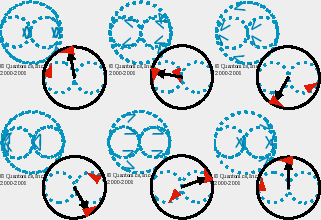 |
It is important to understand that these Quantonic notions and notations do not really show reality. They are attempts at more realistic modeling of reality. Take a brief moment to ponder that last sentence. Distinguish classicism's e=hv as a model of reality, and our Quantonics notation in Figure 2 as modeling reality. (Thanks to Dan Glover for this prescient observation on our Quanto email list.) Our notation is, in Pirsigean MoQese, "more highly evolved intellectual patterns of value," which offer a 'better' modeling of reality.
As you may deign to perceive, our Sidis efforts continue to push us into legacy classical problematics which confound our efforts to explain (exegesis) and publicize (make exoteric) new (In-Form-ed, a la Dr. Irving Stein) and evolved quantum memes. Those issues include:
Just as a brief review, let's juxtapose classical foundational assumptions of both physics and mathematics. Let's see if there are 'objective' similarities. Both mathematics and physics foundations are based on 'obvious' objective assumptions. Here is a little table to show some of those assumptions side-by-side:
| Classical Mathematics: | Classical Physics: |
| '1' exists as an ideal concept | Can use mathematics to analyze reality |
| '1' is an analytic concept | Mass is measurable but undefinable |
| 1=1 is an analytic concept (i.e., identities exist) | Length is measurable but undefinable |
| '1-1' exists as an ideal concept (i.e., 'zero' exists) | Time is measurable but undefinable |
| ('1-1')/('1-1') is undefinable as an ideal concept | Gravity is measurable but undefinable |
| etc. | etc. |
As you can see, classical mathematics depends heavily upon concepts of unity, zeroness, and identity. Without those concepts, classical mathematics crumbles. Then consider science and physics' profound dependence upon mathematics to study and model reality. Without considering extensive problematics of formal propositional logic we begin to glimmer how mathematics and thus science and physics are in problematic situations of their own.
Our Quantonic heuristic is that quantum nature offers us no physi of either oneness or zeroness. Certainly, nature offers us no physi of identity! Ditto infinity, tautology, etc.
"Doug, how can you say that?"
Look at our Quantonic representation of a nonphysically expressable '1' below:
|
'1' |
|
|
Quantum reality's best opportunity to express a physical 'one' is shown in Figure 3. But it cannot do that. Right side numerator and denominator quantons are stochastically never 'same.' They will always differ by at least a Planck quantum uncertainty.
Taking an example from our web page on Absoluteness as Uncertainty:
We said that ideal classical mathematical integer constancy demands axiomatic statements shown below, but given our new animate quanton meme for '1' can we retain those axioms? Let's show our old partial set of classical axioms side-by-side with newer r-evolutionary statements using our new meme as more highly evolved and thus more real -
Classical Assumptions On Existence of 'One:' Quantonic Assumptions on Uncertainty of 'Oneness:'
- A classical assumption that an ideal logical/physical constant, one (1), exists.
- No physical and absolutely quantum certain 'one' exists. 'e' as actuality's smallest constituent comtext 'exists.'
- A classical assumption that ideal logical/physical manipulations of one (1) exist:
- A Quantonic assumption that physical manipulations of 'e' exist, but not using classical notation:
- 1/1 iso 1 (note how '/' is an ideal dichonic classical functor)
- Uncertainty(e/e iso 1) is >> e. Implication: '1' does not exist.
- 1*1 iso 1 (note how '*' is an ideal dichonic classical functor)
- e*e is some animate and thus quantum uncertain interrelationship of two quantons
- 1+1 iso 2 (inference of induction and counting; note how '+' is an ideal dichonic classical functor)
- e+e is some animate and thus quantum uncertain interrelationship of two quantons
- 1-1 iso 0 (inherent definition of zero; note how '-' is an ideal dichonic classical functor)
- Physical (actual) quantum zero does not exist. See first bullet at this level. Note an apparent implication of nonexistent quantum physical infinities.
(Just as assumptions of classical formal mathematics generate paradice, too they generate illusions of infinity, et al.)
- 1 = 1 iso classical ideal identity (note how '=' is an ideal and tautologous classical copulum)
- Physical (actual) quantum identity does not exist. Ideal tautologies do not exist. See first bullet at this level.
- d'1'/dt = 0 (1st derivative of '1' a 'constant' is zero; assumes homogeneous time)
- Quantum derivatives are dflux/dflux & exist.
(Note: Times, Masses, Lengths, and Gravities are quantonic interrelationships among various types of quantum flux, e.g.:
- Isocoherent, (fluxU)
- Coherent, (fluxLcoherent)
- Partially Coherent, (fluxLmixed)
- Decoherent, (fluxLdecoherent)
- etc.
Where U is 'unlatched,' and L is 'latched.')
- (1-1)/(1-1) iso undefined (Isn't this amazing?)
- (e-e)/(e-e) is defined as uncertainty interrelationships (quantons).
- Classical reality depends upon logical/physical integer constants.
Too, all classical 'constant' rational and irrational numbers, including 'natural' numbers, derive from other classical 'constants' (often integer). Examples are 3.1415926..., 2.71828..., 1.61803..., 4.6692019..., etc.
Clearly, classical mathematics tends to look more and more like exclusive intellectual solipsist gratification.
- Quantum actuality generates no physical integer 'constants.' As you will see in our language issues below, we will suggest that classicalese 'constant' should be replaced by more quantumese 'comstant.'
- All quantum numbers are uncertain. An easy way to see this is reality
,
).
You may choose to perceive that what we have shown above has almost unfathomable outcomes for Western culture, philosophy, science, mathematics, language, and so on...
Well, that's our August, 2000 innovation! Hope you found Value in this important work.
Our efforts on recent QQAs focus on language issues which arise from work like that we showed you above. We temporarily stopped work on those QQAs until we can catch our breath and allow some jelling of our many new memes. We want you to have some percept of where we are headed, and here are a few examples of that work which builds from our May and June 2000 QQAs.
Language:
Language Issue: Classicalese Quantonics Quantumese Thelogos Classical Thing-king Methods (CTMs) are innately unilogical. CTMs focus on or intensify classical objects as unique, separable, isolable, local, reducible, and unilaterally and unicontextually observable. Thus we see in Classical languages extreme overuse of 'the' to intensify objective lingual monads. Thelogos is a powerful tell that a writer or speaker is living in SOMland and using classicalese. Quantonics Think-king Modes (QTMs) are intrinsically paralogical. Most classical uses of 'the' are wasted, so often we can just delete them. Others may require reordering words in a sentence or use of articles, i.e., indefinite/quantum_uncertain articles, or possessives. Semantic value increases dramatically when one eliminates classical thelogos from one's works. Absence of thelogos is a powerful tell that a writer or speaker has escaped SOMland and entered a new domain of think-king. Examples:
- "the tree" (implies 'one' tree)
- "the map"
- "the apple"
- "the food"
- "the mathematicians"
- "the whatever"
- etc.
Examples:
- "[] tree"
- "a map"
- "an apple"
- "our food"
- "some mathematicians"
- "(m)any whatever"
- etc.
Classical homogeneous time
vis-à-vis
Quantum heterogeneous time
CTMs tend to rigidly model reality as a continuous, causal, quantitative, analytic monism (i.e., a one-ISM). Their language reflects that. CTMs see classical reality as one global truth (OGT) in one global context (OGC). As a result CTMs see one time — homogeneous time. From one time, CTMs infer one past and one future. Huge, flawed philosophical, scientific, and practical consequences follow. QTMs are modeling reality as a quantal, stochastic, affective, qualitative plurality. QTM language uses plurals much more extensively than CTMs (this is a great tell). QTMs describe quantum reality as many truths in many contexts. QTMs see many times — heterogeneous times. QTMs use that basis to conclude reality is an ensemble of many times' pragmas, and thus QTMs infer many pasts and many futures. Abundant, improved philosophical, scientific, and practical consequences follow. Examples:
- "what happens next?"
- "in the future"
- "in the past"
- "if then" (note: one cause-one effect)
- "now"
- "when"
- etc.
Examples:
- "whatings happen(ings) nextings"
- "in futures," or "in a future"
- "in pasts," or "in a past"
- "ifs thens" (infer: "affects-outcomes")
- "nows" (infer: "many nows")
- "whens"
- etc.
Classical excluded-middle intensive prefix
vis-à-vis
Quantum included-middle intensive prefix
CTMs tend to use a lingual prefix 'con' to perpetuate biformal objective dichotomies and a mindset of opposition and division (objective "diversity"). It is our position that this method of thing-king arises mostly from Greek legacy, especially Aristotle's methods of thing-king and syllogistic logic. QTMs emphasize lingual use of 'com' in place of most classical uses of 'con.' Our intent is to emphasize 'com' as signifying quantum included-middle comtextual interrelationships. Examples:
- "con"
- "context"
- "consistent"
- "convert"
- "contra"
- "constant"
- etc.
Examples:
- "com"
- "comtext"
- "comsistent"
- "comvert"
- "comtra"
- "comstant"
- etc.
Classical objective unilogical induction
vis-à-vis
Quantum ensemble paralogical evolution
CTMs tend to encourage deterministic thing-king. Pirsig's example is "A causes B." Note singular A. Note singular B. Here we see classical SOM CTM's unilogic. One A. One B. And most importantly one context for A and B. QTMs will allow us to escape classical legacy analytics, induction, etc. Pirsig's example is "Bs value preconditions As." We modified Pirsig's words to plurals. Many As. Many Bs. Here we see Pirsigean and quantumesque paralogic of many truths in many contexts. Examples:
- "infinitely divisible homogeneous quantity" (Mae-wan Ho, quoting/paraphrasing Bergson in her, the Rainbow and the Worm)
- "singular monolithic holism"
- "cause-effect"
- "quantitative properties"
- "one past one future" (homogeneous time)
- etc.
Examples:
- "indivisible heterogeneous Quality" (Mae-wan Ho, quoting/paraphrasing Bergson in her, the Rainbow and the Worm)
- "plural quantal cohesion"
- "affects-outcomes"
- "qualitative interrelationships"
- "many pasts, futures" (heterogeneous time)
- etc.
Clearly, as this table shows, Western cultures' languages will be dramatically affected by impending quantum innovations.
Here are new web pages introduced during August, 2000 on our site:
Problematic Einsteinian Memes
Absoluteness as C¤mplementary Interrelationships Twixt Completeness and Consistency
Stairways as Evidence of our Quantum Stages (This page is HOT! Many folk are interested in this new way of perceiving.)
Emergence of Quantonic Spin Interrelationships (This shows our Quantonic ontology for emergence a la RHIC above.)
Richard Rieben, a globe-trotting author friend of ours recently wrote to us to announce his new book on 'Liberty.' Check it out at his site. Richard, a la Robert Pirsig, is an adventurer par excellence! He rode his bike through most of Malaysia. Then he wrote his most recent book. Now he tells us he is off to ride his bike through South America. Wish him well, will you?
See you in October!
Thanks for reading,
Doug.
Breaking news!!! Just five minutes ago (it is now 16:24 CDT, 1Aug2000) received an email from Dr. Stein! His paper was accepted and he will be attending that Planck Symposium! That means we will have some face time!!!
Whew!! Almost glad July is over. But you may note that it was our coolest July, in some parts of USA, since 1918! Most farmers are happy as can be with extraordinary crops and critters.
We recall early '70s when same folk who now say we have global warming told us we were having global COOLING! Remember their "Snow Blitz?" Our sense is that Earth's climate is so dramatically affected by its Sun, our solar system's locus in its Milky Way galactic orbit, and so on, as to diminish humankind's affects to negligible. Clearly, some scientists seek a kind of political hegemony inappropriate their disciplines. We took a look at EPA's web site and found global environment numbers which appear intentionally distorted and malinterpreted. We almost chose to raise a stink about it, but decided our current work is more important. Our caveat to you: beware EPA reports! EPA's motivations are not scientific.
This month's newsletter is a long one. Main reason is a pair of emails twixt Doug and Dr. Stein on FTL! Worth your time if these topics interest YOU reader!
Our efforts on our WJS AIA review continue, but they have become quite diffuse. Time is a nontrivial concept. Most of us treat it as though it is trivial, though. Our journey to learn more about time has taken us through countless references and texts. Still, we find few folk who question classical interpretations of time. Almost all scientists view time conceptually as unitemporal and homogeneous. Very few authors whom we read see time as plural and heterogeneous. Some famous quantum physicists intuit time's heterogeneity. Dirac, as we have shown you last month, intuited "many times." Mae-wan Ho and her stated admiration for Henri Bergson believes time is heterogeneous. William James, William James Sidis' (WJS') godfather, intuited plural reality and thus very fundamentally anticipated (incompletely) quantum reality and quantum heterogeneous time. But few others share their views.
David Deutsch in his book The Fabric of Reality (see our review of it) told us that he could explain all real concepts by placing them in a framework and then belied his own method and declared time "inexplicable." If you read our work here to any extent, you know that we also point out that classical physics' foundations share other "inexplicables:" mass, length, and gravity. (But also note that Dr. Irving Stein has developed a new quantum ontology which gives these inexplicables essence of flux, essence of both/and included-middle dynamis.)
Our efforts to review WJS AIA is bearing extraordinary fruit! We are learning that almost all classical 'methods' are full of — no — burgeoning with fundamental and foundational problems!
We know that quantum reality is plural, so we almost have to assume that time is plural/heterogeneous too. We can intuit further that mass, length and gravity — as our graphic last month hinted — are plural too. That is our dilemma, just now. Going with heterogeneous time requires that we innovate new Quantonic percepts of time. And while we are at it, to be more consistent, we need to at least consider how our assumptions coobsfect mass, length and gravity too. One huge semantic impact we can show you simply like this:
| From: | To: |
| Mass | Masses |
| Length | Lengths |
| Time | Times |
| Gravity | Gravities |
From now on, if we adopt these assumptions, mass is no longer homogeneous! No physical entity may be considered as one monolithic mass! Ditto length. No longer may any entity be thought of as holistically unitemporal. Instead every entity must be seen as massively parallel clocks running at their own separate and distinct rates (all derivative of ubiquitous and asynchronous and massively parallel fundamental Planck actions or 'clock ticks'). Ditto gravities.
As you can see, this is very, very different from our popular conceptions of classical uni-time's arrow, without even considering issues of reversibility, etc. Classical time, if our (Dirac's, Mae-wan's, Bergson's, Renouvier's, James', and Quantonics', et al.) intuitions are correct, is an extremely naïve perspective of reality's quantum clock(s).
So these new, innovative patterns of Value are what we seek. Those patterns are what we are working on. How long will it take? Dunno.
— — —
Newsworthy is our recent decision to attend a quantum symposium later this year. Some great quantum pioneers will present papers which will help us with our efforts here. We invited Dr. Stein to go and meet with us there. He decided to submit his own paper for presentation, and if accepted he will meet us there.
Gavin, from Australia, started an interesting thread on our Quanto list. He wanted to show how he thought Sartre is very much like Pirsig. After a lengthy dialog, we were able to show resoundingly that Sartre and Pirsig are very unalike. To show our results concisely, we added a column to our ISM Extremes which we prepared for our William James Some Problems of Philosophy review. We added a column for existentialism. To help Gavin and other Quantos we did an H5W (i.e., How, why, what, who, when, where) for three kinds of reasoning: dialectic, analytic, and rhetoric.
Aside:
Tomonaga's book on spin which we referred here last month has Tomonaga claiming his philosophical mentor is Tikaro Nishida. We are reading one of Nishida's texts (Last Writings, Nothingness and the Religious World View) now to see how Tomonaga can refer to Nishida's philosophy as quantum. Nishida adds new terms to our list of kinds of reasoning, including: synoptic, logistic, and paradoxical (agonistic). Nishida also refers dialectic as "sublational" reasoning and declares agonistic reasoning unique kin of dialectic. We see no mention yet of rhetoric as a means of reasoning, but we have only scanned his text. See p. 142.
End aside.
Those results from our Gavin dialogue fitted nicely into our efforts to show how English language is inadequate as a language for discussions of quantum reality during Millennium III. If you follow our Quantonic Questions and Answers, you know that we started a series of QQAs on this topic in May. Our July QQA (due on/after 22Jul2000) contains our results from our dialogue with Gavin. Also, you may wish to see our May and June QQAs to review or prepare for July.
Interest in recent Faster Than Light news is growing rapidly. You may wish to see our evolving report on FTL here, and watch for more (and other very interesting, e.g., antigravity, Heisenberg history, et al.) detail in our Flash scientific reports. Dr. Stein and I currently have a tête-à-tête ongoing on this subject. Here is a recent email from him on his views of that famous article which appeared in Nature's 20Jul2000 issue, titled 'Faster than a speeding photon.' Following his email to me is a preliminary response to him regarding my concerns and caveats:
Subject: Faster than light photons. Nature 20Jul2000. Date: Fri, 21 Jul 2000 09:24:14 -0700 From: Irving Stein <irvingstein@flameproof.fire> To: "NOFLAMEqtx{at}earthlink{dot}netNOSPAM" <NOFLAMEqtx{at}earthlink{dot}netNOSPAM> (Reader — We composed a compatible email subject title above. Our bold emphasis below. [Our brackets.] Doug.)
Dear Doug,
For your information:
Below, is the last paragraph of the article in the scientific journal, Nature, (July 2000) by the experimenters themselves. (I think that I once responded to you when I thought you were rather hasty in your conclusions from newspaper reports on this work.)
The implication of what they are saying is that certain assumed but subtle conclusions from special relativity and the nature of time and causality have been found to be unwarranted. One of the interesting things they are concluding, which already can be inferred from quantum mechanics (and I like to think much more clearly from my work) is that which occurs in the future which is based on the past is not information since it is nothing new; information can never be based on the past; that is, information is that which is always new. (see their complete article) In fact that is how we can define time. The opposite is classical physics; what they have shown is simply the affirmation that the world is quantum, that is, no preference. The concept of non-preference results in the concept of nonspace, [where] there is no time, but imaginary time, that is, order in the complex domain. Only when measurements are made, which then transform nonspace (sometimes) into space and the classical world, which is our phenomena, does time arise, as does [Planck moment incremental] determinacy and classical information.
[Consider Stein's 'time' as 'times.' Doug believes quantum determinacy is ensemble determinacy and is only 'determinate' for a Planck moment where a 'choice' is made 'what' to do for that Planck moment. That choice may have little or no deterministic 'effect' on subsequent choices, thus denying classical determinism, cause and effect, and induction. Note that Stein tells us his nonspace is a complex conjugate domain of actuality. In a Quantonics' domain, this is part of what we call "actuality." Why? Because complex patterns of value are both classical and thus (Pirsigean) static patterns of value. In Quantonics, actuality's c¤mplement is n¤nactuality, a sort of 'isoconjugate' of actuality. Thus you can see that our mapping of Stein's nonspace, in our review of his book, to Pirsig's DQ is somewhat amiss. Next paragraph Stein quotes Wang's article. See our original Map of Reality (December, 1998) where we mapped Stein's nonspace as part of Quantonic nonactuality and a more recent Millennium III Map of Reality (December, 1999) where that problem is corrected. You can see evolution of our thinking depicted very well in those two maps which we prepared one year apart.]
"Finally, we note that the observed superluminal light pulse propagation is not at odds with causality or special relativity. In fact, the very existence of the lossless anomalous dispersion region given in equation (1) is a result of the Kramers–Kronig relation which itself is based on the causality requirements of electromagnetic responses 3, 5. Remarkably, the signal velocity 4 of a light pulse, defined as the velocity at which the half point of the pulse front travels, also exceeds the speed of light in a vacuum, c, in the present experiment. It has also been suggested 4, 16 that the true speed at which information is carried by a light pulse should be defined as the "frontal" velocity of a step-function-shaped signal which has been shown not to exceed c (ref. 4). The implications of the present experiment on signal propagation and its speed will be further analysed, particularly for the case when the light pulse consists of only a few photons." [Here Stein quotes very last paragraph of Wang's paper. Superscripts are notes. See article online at www.nature.com. We have not finished our review of said paper yet. Our preliminary scan of it evoked our response to Dr. Stein below. Notice how our perception of time(s) and other physical 'measurables' is crucial to how we assess both experimental results and how an experiment is prepared. We believe a unitemporal perception distorts experimental results. So you can see reader, our work on time(s) is crucial beyond our considerations of it for our review of WJS' AIA.]
As ever,
Irv
Thanks Dr. Stein! His response is absolutely superb! It is exceptional. His new quantum ontology works! You see in his letter to us its pragmatic and successful application.
We responded with preliminary remarks:
Subject: Re: My preliminary efforts on Wang's paper. Date: Wed, 26 Jul 2000 16:05:21 -0500 From: Doug Renselle <NOFLAMEqtx{at}earthlink{dot}netNOSPAM> To: Irving Stein <irvingstein@flameproof.fire> (Reader, we deleted some off-topic paragraphs. We corrected minor typos which occurred in our original email to Stein. Our brackets and bold emphasis as corrections.)
Hello Dr. Stein!
<snip>
On to our topic at hand...
I have been looking at Nature's 20Jul2000 online issue of Wang's paper. Just now my hard copy edition arrived in USnail.
If you do not mind, before reading his paper diligently and replying to your comments on how superluminality relates your work, I want to 'define' some terms as I see them. Here is a list of terms whose semantics — from my personal context — I want to share. Hopefully this sharing may aid our mutual understanding:
1) Cause-effect
2) Coherence, Quantum
3) Measurement/Event
4) Reversibility
5) Superluminality
6) Time
7) Velocity1) Cause-effect: I think cause-effect may only hold for single Planck-action events. However, quantum ontology disallows certain knowledge (i.e., past and current attempts to say specifically where, when, how, etc. an event occurs) of those single events. So, philosophically, I deny cause-effect as a viable meme. (I am following similar logic as you used on p. 79 of your book.)
2) Coherence, Quantum: Quantum ontology appears to demand integer spin quantum numbers (including zero) for coherence. E.g., Nature Magazine's 25May2000 issue, 'letters to nature' titled, A triplet of differently shaped spin-zero states in the nucleus of 186Pb. See p. 430, Vol 405. This article discloses spin zero states in nuclei of atoms. I think this is first time for scientists to disclose this. Other examples of coherence are bosons (spin 1), BECs (spin depends on constituents), gravitons (speculation of spin 2), etc. I see your Quantum Schrödinger Object's nonpreferential walk (in a unidimensional, bi-directional model) as a type of quantum coherence, or your particulate dual of 'wave coherence.'
3) Measurement/Event: Quantum ontology denies any precise location and timing (i.e., quantum uncertainty) of events. See 1) above.
4) Reversibility: I see reversibility as possible only in quantum coherence. What kinds of coherence? Isocoherence (in Steinian nonspace [Reader, this is a faux pas on Doug's part! Doug reverted mentally to his December, 1998 Map of Reality. See above. Doug should have declined comment on 'isocoherence,' or corrected to his December, 1999 Map of Reality.]), partial coherence (both nonspace [nonactuality] and space [actuality] compenetrating), and coherence. I see decoherent numbers as irreversible. (However, I believe there are ways similar to those described in Nature's recent Schrödinger Cat letter that we can move from decoherence to partial or other coherence.) This allows a quantum ontology which says quantum reality is both reversible and not reversible and selectable under certain conditions, which is what we appear to observe. Classical objects are 'usually' classically irreversible, then, as [James Clerk] Maxwell found. Now, however, we can begin to see three classes of entropy: posentropy, zeroentropy, and negentropy, latter two offering selectable reversibility of varying kinds (depending on partial or full coherence, and which quantum numbers). Dr. Stein, I am using 'quantum numbers' just as a way of naming differing (unlimited) 'possibilities.' I see quantum numbers as a classical concept.
5) Superluminality: I throw out lightspeed as a reference. Ultimate superluminality is zero latency 'teleportation/tunneling' in Steinian [non]space [via nonactuality or what we call VES]. (I perceive tunneling as occurring via a 'short-circuit' or 'warp' via Steinian nonspace [i.e., Quantonics' nonactuality].)
6) Time: Classical time is homogeneous. In a manner that classical minds perceive one global truth in one global context, too they see one time which is either perfectly 'reversible' or nonreversibly Maxwellian. I see time more as Mae-wan Ho, Henri Louis Bergson, et al., see it, i.e., as plural and heterogeneous. Just as a quantum ontology demands many heterogeneous islands of truth so does it demand many heterogeneous times. (For me personally, ditto: mass, length, and gravity.)
7) Velocity: To me, negative velocity only has meaning when we speak of coherent systems which are reversible. Your Schrödinger object's both/and unidimensional walk to me, is reversible.
Also, I found Wang's discussions of light velocity multiples akin that old conundrum, "If it is zero degrees today and twice as cold tomorrow, how cold is it tomorrow?"
I felt great ease with your recent comments of your views of Wang's paper. It felt as though I were reading your book again. I need to do that! Someday it will be recognized for its huge value to quantum science.
I will spend most of tomorrow (27Jul2000) reviewing and commenting Wang's paper. I'll email you late tomorrow or first thing Friday morning.
Kind regards,
Doug.
==
In Quantonics
The Quantonics Society
www.quantonics.com
==
"Many Pi's are MoQ's quantum knives,
circle over diameter no cut derives,
unlike SOM's whose scission's crux,
Quality Events latch and unlatch flux." 22Feb2000, Doug Renselle
As you may deign to allude, reader, our work is making good progress. We are thankful for Dr. Stein's consideration of our memes. We are thankful that this GREAT Internet made it possible for us to find his book a couple of years ago. Look what that single event has wrought!
Next month watch for our new web page titled 'Quantum Definitions.' Many words and phrases we use here will be defined using Doug's Quantonics interpretations of them. Better, Doug will juxtapose old classical (anti-)definitions which have become passé. You need to know these so that you can become suspicious of their (mis-)uses by 'scientific' types.
Grab your Quantonic surf board! That quantum tsunami is closing fast...
See you here again in early September, 2000!
Doug.
Hello Quantonics site visitors! Thanks for stopping by!
Another busy, interesting and productive month has passed.
Hope you enjoy your USA July 4th holiday. Beth and I will spend this one at home, tending wild flower gardens, our veggy garden, and our many wild birds. Our favorite bird which visits here often is subspecies Mockingbird. They are incredible in multiple ways: their displays (vertical bounce jumps, with flutter down, in repetitive loops), their repertoires of other birds songs (we have heard at least 10s of songs), their colors (longitudinal stripes midunderwing, both wings; edge stripes undertail, both sides of tail), and their rake-variable tails.
Last month we dumped quite a lot of material on you. This month, we will give a brief update and then cover some interesting new material (new to us) on time and how it relates to Quantonics and our William James Sidis investigations.
We found a great way to grab our white board art directly to our LAN. We bought a product called eBeam. See www.e-beam.com. It uses four electronic markers and an eraser to allow one to draw pictures on a white board. As one draws a picture, same picture appears on local computer screen. We are using a 4'x6' white board and it works fine. We especially like eBeam's customer interface. It is true quality!
Installation is a breeze, guided only by a small card with about 6 pictures on each side. Follow numbered pictures to install eBeam — fast and easy. And it works! It works better than anticipated.
eBeam allows multiple participants to draw on same white board both virtually and locally, both over your LAN and over WWW Internet!
If you are in business, and worry about high Value customer interrelationships, a purchase of eBeam is a great way to learn and emulate. Its purchase price is a bargain just for what you can learn about selling and delivering your own products.
We continue our work on support research for WJS' AIA review. We are part way through our review of Hesse's Magister Ludi. Here is our graphical review of that big book:
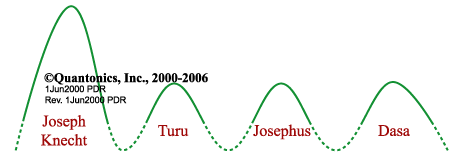
As you can see, Hesse's book describes four of his protagonist's quantum nonactuality (dashed green wave) to actuality (solid green wave) to nonactuality... recursive transitions. Knecht's transition to Turu bears strong resemblance to Nicholas Cage's transition to humanity in that great video, City of Angels, except Hesse does not describe Knecht's isobeing twixt Knecht and Turu. This graphic is a good review, for its extreme brevity, and its extreme clarity in capturing essence of Magister Ludi. Hesse (though he is a classicist of massive rote learning) intuits some quantum fundamentals and some Pirsigean aspects of Quality, especially balance twixt Dynamic and Static Quality as depicted in our graphic above. Knecht's poems are superb. Here is one which matches our graphic almost perfectly (Our parenthetical.):
Those of you familiar with Robert Frost may feel recognition's chill of déjà vu: i.e., one may experience vivid hues of Frost's Reluctance. Last verse of Reluctance, similar to Knecht's Stages above, is essentially a description of quantum reality and Pirsig's MoQ:
Our quantum waves above depicting Magister Ludi's transitions are drifting waves of seasons...
Consider how Frost juxtaposes a classical "Was it ever less than a treason," with more quantum "To go with the drift...To yield...And bow and accept..." relentless, recursive, commingling, ubiquitous, plural, and paralogical quantum flux.
We hear this every day. "Quantum thinking is absurd, unreasonable, nonsense, etc." Classicists just do not accept quantum reality, and consider "treasonous," a heresy those who do. But in five or fewer generations, those classicists will be gone or in an extreme minority of holdouts.
Unsure when we will finish our Hesse review, but we recommend that you read his book. No wonder it won a 1946 Nobel prize for literature.
For our WJS AIA review, we are focusing on alternate views of time. As you know, we are now reviewing Bergson's other works. Bergson claims classicism's legacy view of monistic, homogeneous, analytic time is unreal, indeed about as naïve and simplistic as one can make any model of reality. This simplicity is a critical success factor for classicism's ongoing but dying hegemony over Western cultures. Hegemonists call classical naivete "horse sense," or "common sense." That's exactly what it is, all right! No, now we know, they're all wrong!
Mae-wan Ho introduced us to Bergson and his pluralistic, heterogeneous, stochastic views of time. We saw a parallel twixt these "many times," and Pirsigean MoQ's "many truths," each relevant to quantum both local included-middle-and nonlocal contexts. Now we have additional evidence that quantum plural paralogism is modeling reality notably 'better' than classicism's analytic monist unilogism.
Classicism says there is one time, period. All classical motion and change is a classical object, y=f(t), i.e., object 'y' is a function of time, 't.'
Pirsig's MoQ, quantum science (a la Dirac), Henri Louis Bergson, Mae-wan Ho, William James, and others intuit and infer that real time is heterogeneous.
It is important to note that Einstein's theories of relativity both depend on a classical homogeneous time meme to work. If others' views of time hold true, much of 'relativity,' will have to change dramatically or become scientifically and philosophically extinct.
To keep our quantum intuitions sharp, we regularly read challenging books on quantum theory, quantum mechanics (both matrix and wave), quantum science (biology, nanology, cosmology, communications, transport, etc.), quantum metaphysics, and quantum philosophy. We are currently reading Sin-itiro Tomonaga's, 1979 original in Japanese, The Story of Spin. We just finished lecture 6. Near its end we experienced another of those almost stroke-like quantum déjà vus. Allow us to quote Tomonaga:
... (bottom of page 110, top of page 111, 1st edition English translation, 1997, The University of Chicago Press)
"For these reasons Pauli deemed that, just as in the Heisenberg-Pauli paper, we should treat the Dirac equation as a field equation rather than as an equation for probability amplitude. Dirac, apparently, did not care for Pauli taking Dirac's equation as the field equation and proposed in his new theoretical formulation of the many-electron problem published in 1932, which later came to be called the many-time theory, to use the probability amplitude y in the coordinate system [however, in order to make y relativistic we extend the concept of coordinates in the wave function by assigning a different time for each electron, hence y(x1,t1,x2,t2,x3,t3...)]." (Tomonaga's brackets. Our bold and color emphasis. Our italics on Tomonaga's and/or his translator's thelogosis.)
Now it behooves us to compare what Tomonaga/Dirac wrote above vis-à-vis how classicists write it: y(x1,x2,x3,...,t).
Now, reader, you may see why we sense this as an almost epiphanous déjà vu. Here, we can see so clearly SOM-classicism's homogeneous unitemporal mindset — we see SOM's CTMs, in spades! SOM-classicism says all SOM objects (in this case, a many electron/object problem) march to a homogeneous time! Quantum reality, quantum nature disavows that classical edict. Pirsig, Mae-wan, Bergson, James, et al., gave us good and valued mentorship via quality pluralistic ('many') memes.
But what are we discovering in our Quantonics research? Are only truth, context, and time quantum-plural memes? No! Our heuristic is that all quantum numbers are quantum-plural! So we can say, "...many truths, many contexts, many times, many spaces/lengths, many masses/energies, many gravities, many spins, many charges, many ???, and so on..." And in quantum reality when we put all of or some of manys together, we get both a new 'one' and its 'many of manys.' Further, some aspects of many commingle other aspects of manys! Further, our new 'one' may or may not commingle other quantum ensembles (i.e., ones/systems/manys) to a greater or lesser extent. We call this a quantum-included-middle. It is Pirsig's "direct experience," or Platt Holden's "edge of now," or Harry Connick Jr.'s, "corner of close and soon," from his recording of Forever, For Now. We also call it "face of change." It is also source and agency of Heisenberg's quantum uncertainty interrelationships.
And what is crux of all these manys? From whence these manys?
Flux! That is why we in Quantonics say, m, l, t, g are all functions
of flux! I.e., mass/energyf(flux), length/spacef(flux), timef(flux), gravityf(flux).
In working on our WJS AIA review we developed some graphics which align with Tomonaga's words above. We want to share those with you. Our first is a graphic we just did (using eBeam plus Illustrator to superpose clean semiotics over draft eBeam sketch) based upon our reading of Tomonaga's lecture 6. Two others are ones we did six months ago as part of a new web page on heterogeneous time and how it relates to WJS' concepts in his AIA:
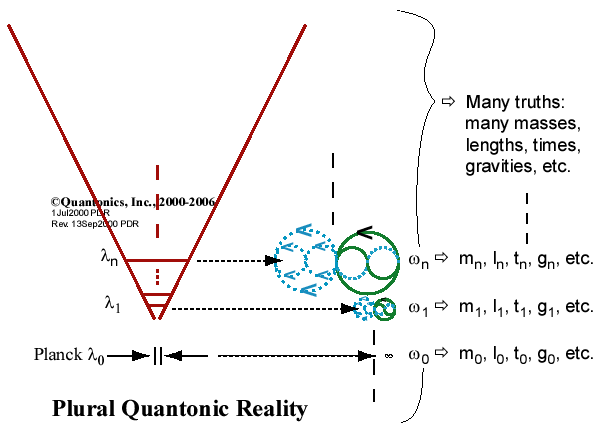
Here we show two of our Quantonics' Tao quantons borne of quantum isoflux (big red V, Value, with quantum isoflux wavelengths shown). We also show how mass, length, time, and gravity are all borne of this same flux and are 'functions' of (we actually call them quantum numbers) this flux. We do not show quanton ensembles. But if we did, you may imagine their increasing mass/energy as new quantons aggregate. You may also imagine their incredible varieties as infinite variations, of quantum numbers in countless aggregates of quantonic constituents, manifest and change. (Quantons shown are both fermions. We are developing Tao quanton semiotics for both bosons and anti-gravity fermions. Tomonaga's book is critical to our capabilities to do this. If you are interested in quantum science in even a marginal way, we highly recommend that you read his book. Dr. Stein, you too! J)
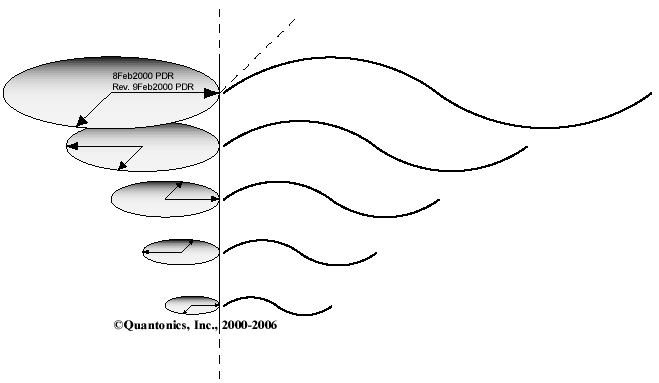
Reader, this graphic just shows Bergsonian heterogeneous times as clocks, each clock with its own period local to its quantum context.
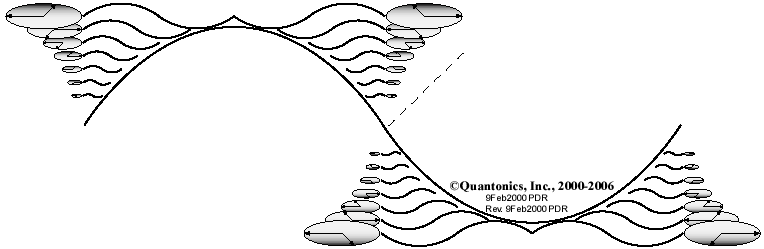
Here, Doug let his imagination go on a heuristic meme howl. We see his artistic version of a wave/flux-borne quantum reality of many time aggregate ensembles riding reality's quantum tsunami. OK, OK! Artistic largesse, yes! But it isn't too far off from what nature 'shows' us, is it? Just watch leaves on trees blowing in a gentle breeze, or eddies and ripples of water in a stream or ocean.
I felt like we needed a change of pace. Hope you like this month's effort.
Thanks again for your continued patronage here, and thanks for reading.
Do a little every day to bring out more of your quantum being...you shall need it...to survive...reality's imminent quantum tsunami.
See you here again in early August, 2000!
Doug.
Hello Quantonics site visitors! Thanks for stopping by!
Another busy, interesting and productive month has passed.
Hope you enjoyed your USA Memorial Day holiday. Beth and I spent a long, quiet, restful weekend in a quaint little cottage on Kentucky Lake.
We are making progress on base-building for our William James Sidis' The Animate and the Inanimate (AIA) book review. As you know we have completed these reviews as part of our base-building: Bergson's An Introduction to Metaphysics, William James' Some Problems of Philosophy, and Boris Sidis' Philistine and Genius (see below). As more base-building we plan reviews of other Bergson works (all of them, i.e., three more, as far as we know). We have not decided yet, but we may also spend significant effort in Boris' other works extracting his views on 'reserve energy,' which is a meme that plays a huge role in WJS' AIA. Boris Sidis and William James apparently invented their popular and almost over-used phrase 'reserve energy,' independently. (Claimed by Boris. On page 319, of Boris Sidis' 1922 book, Nervous Ills, he says, "In a later chapter I take up the subject of subconscious reserve energy advanced by [William] James and myself, independently." Our bold.) Boris' and James' views of this meme are crucial to our understanding WJS and his own innovative thoughts. Here is an example of what Boris taught his son, William about reserve energy:
"Those organisms that will best effect such an economy of energy will be the fittest to survive...This economizing becomes absolutely indispensable to the life-existence of higher organisms, the environment of which is always highly complex. The reduction of psychomotor activity to the least amount of psycho-physiological energy expenditure, in other words, to the minimum of consciousness, is the law of psychomotor life in general and of the highest representation of that life in particular." (Our bold.) Page 245, Multiple Personality, by Boris Sidis, 1905.
Both Sidises and James apparently intuited a non-classical view of classical Maxwellian entropy! Where James Clerk Maxwell only saw positive entropy (posentropy) as 'real,' both Sidises and William James apparently intuited a trichotomous entropy:
- posentropy (classical view - <100% conservative energy efficiency via an assumption of universal explicate closure),
- zeroentropy (quantum view - 100% anti-conservative energy efficiency via an assumption of natural implicate openness), and
- negentropy (quantum view - >100% anti-conservative energy efficiency via an assumption of natural implicate openness).
Classical Thing-king Methods (CTMs) deny both quantum views! Quantonic Think-king Modes (QTMs) accept all three views and subsume classical posentropy as part of a larger meme of reality's total, multiversal, cohesive, and c¤mplementary entropy.
As CTMs tell us and C. P. Snow distills so eloquently, a classical view guarantees (paraphrased), "You cannot win, you cannot break even, and you are not allowed to leave the game." Those effects derive from Maxwell's three laws of thermodynamics which arise from a classical adherence to only posentropy as 'real.' When we add two other elements of our entropy trichotomy, and kick CTMs out of our minds, C. P. Snow's extreme negatives depart and quantum enlightenment displaces them. As we say, "Dump your old CTMs, and adopt newer and 'better' QTMs." Doug.
Henri Louis Bergson, William James, Boris Sidis, and William James Sidis intuited such!
Clearly, both Sidises and James had to intuit quantum included-middle 'admixtures/superpositions' of all three kinds of entropy to apply reserve energy to their views and empirics of reality. (In support, we think Bergson did too. We know Mae-wan Ho does.) In our review of James' own Some Problems of Philosophy, we show many instances where he manifested such apparent intuition(s).
As you may choose to see, our hands are full in this William James Sidis AIA review base-building project!
April, 2000 QQA - This Quantonic Question and Answer may eventually become one of our most important contributions to Quantonics, Pirsig's MoQ, and quantum science. It compares SOM, CR, and MoQ in new and incredible ways. This page is worth your time and effort! Also, you want to be prepared for a similar experience on next month's QQA. We have already started work on it, and it will be a very powerful implement in your Quantonics toolbox. We commence a long journey of exposing SOM language's vast encumbrances of thinking mode innovation. Niels Bohr was right! In spades! We do have a language problem! SOM language is a major contributor to why 'modern' classical philosophy, science, and mathematics are as Pirsig says, "Stuck!" It is clear now that we need a new language for Millennium III.
Our recent efforts expose potential new candidate MoQites for our Famous MoQites list: William James, Friedrich Wilhelm Nietzsche, Giordano Bruno, etc. None of these is a perfect MoQite fit, but they overlap Pirsig's MoQ philosophy significantly! Pirsig speaks often of James, but makes no mention of Bruno nor Nietzsche. Nietzsche's nihilism appears as an intermediate step in a process of evolution from SOM to MoQ. In a sense, he is telling us CR is nihilism. We can almost agree. See our intermediate Philosophical Battle Winner. At a later time, we will provide a comparison of Bruno's personal philosophy and MoQ. Below we refer a web page which will allow you to do that now if you wish.
John M., a disgruntled site visitor, recently wrote us and claimed that our assessments of Parmenides are unfair and possibly shallow. John told us he is writing Pirsig to complain about our and his pronouncements. This will be interesting to follow. We hope Pirsig contacts us with his own comments and rebuttal. We told John that we use our following references to depict Parmenides:
Here is John's letter to us:
"Hi Doug: I'm a new kid on the block and your quantonics has caught my attention. I have been a fan of Pirsig's since 1992, and I wrote him a letter today c/o William Morrow Co. in NY to thank him for all that he has written including his 95 address in Brussels, of which I was not aware until I read your page. I told him that I thought you had given Parmenides a bum rap in one of you items - I can't remember where it was at the moment. In any event, take a new look at Parmenides at www.thelostartofparmenides.com. He was not a materialist. John."
We responded to John thus:
"Hello John,
"We are delighted you found our Quantonics web site! Thanks for taking time to write to us.
"Parmenides appears in many places on our site. You can find which ones by using Google on our top page and by doing a search something like this: "quantonics"+parmenides. I think that will pick up most of our URLs which contain comments re: Parmenides. (We use 'Parmenidean' too, so you may want to limit your search pattern to 'parmenid.')
"We source at least these references to make our comments about Parmenides:
1) Pirsig's ZMM.
2) Plato's Parmenides dialogue.
3) Microsoft Bookshelf (CD-ROM version)
4) The Cambridge Dictionary of Philosophy - Excellent!
5) HDF Kitto's, The Greeks (e.g., see p. 181, of his 256
page Penguin paperback)
6) A Presocratics Reader, by Curd & McKirahan, Jr.
"Greeks had what we think was a fundamental flaw based on an implicit assumption: They assumed reality is bivalent. Thus, we have Greek di-alogs. Unfortunately for their primitive thinking, reality is not bivalent!
"I think that was Pirsig's main point! That is what he spoke of when he wrote of SOM's 'knife.'
[To see most examples of Pirsig/Phædrus on uses and interpretations of his analytical knife, see ZMM, pp. 66, 69, 70, 85, 191, 196, 208, 209, 212, 215, and 332 of 373 total pages of Bantam paperback. If you visit these pages discretely, we recommend reading at least one prior and one subsequent page to improve Pirsig's intended local context for semantic. Also, we can say to you unambiguously that these pages uncloak MoQ fundamentals very well. From these primal percepts, Pirsig develops his whole new Metaphysics of Quality.]
"Thanks for writing, John.
"Many truths to you,
"Doug."
Dr. Irving Stein, author of The Concept of Object as the Foundation of Physics, which we reviewed wrote us a letter which stimulated us to ask if he wanted it published on our site. You may see it here. Subsequent correspondence with Dr. Stein has been voluminous, and when he authorizes us to do so, we will publish nuggets of that correspondence on this web site. Essentially, Doug and Dr. Stein do not concur on many points, but we do agree that our disagreements arise from differences in our perspectives of reality. To exemplify these differences (from Doug's perspective) look at these quotes from Dr. David Finkelstein's forward to Gary Zukav's Dancing Wu Li Masters:
(Finkelstein and David Foulis are two superb quantum logicians. See one of Foulis' papers on our Quantonics site here. A great Finkelstein paper/discussion is available on WWW. Use Google on our top page to search for "beneath gauge"+finkelstein.)
Finkelstein quotes (possibly paraphrases) von Neumann's Mathematical Foundation of Quantum Mechanics. His quotes align quite well Doug's pair of lists of our (apparent) distinguishing attributes, but much more simply:
Finkelstein says von Neumann wrote -
"1. Quantum mechanics deals with propositions defined by processes of
preparation and observation involving subject and object and obeying a new
logic; not with objective properties of the object alone. [or]"2. Quantum mechanics deals with objective properties of the object alone,
obeying the old logic, but they jump in a random way when an observation is
made."
Finkelstein comments:
"Most working physicists seem to see one of these ways (the second) and not the other. Perhaps personality can determine the direction of science. I think there are 'thing' minds [e.g., Newton, Einstein, Bohr, Bohm, Albert, Deutsch, etc.] and 'people' minds [e.g., Huygens, de Broglie, Schrödinger, d'Espagnat, Ho, Capra, etc.]."
[Doug note: Finkelstein's remarks above are not von Neumann quotes. Instead, Finkelstein distills two ways of working in quantum science or what von Neumann called "quantum mechanics:" Above 1. corresponds to Finkelstein's distillation of Schrödinger’s wave quantum mechanics, and 2. corresponds to a more Bohrian/Copenhagen/Heisenberg-Born-Jordan matrix quantum mechanics. See Chapter I of von Neumann's text. In Quantonics, we adhere our saying, "Flux is crux!" Thus you can see why we adhere a more subjective wave quantum mechanics view over a Bohrian, more objective matrix quantum mechanics view. These two views pretty much distinguish contextual differences you will see in discussions twixt Dr. Stein and Doug. See Doug's two lists below.]
Doug told Dr. Stein, he was amazed to see this after what he had just written to Dr. Stein in a previous email. von Neumann wrote those two comparisons in 1932! Yet they capture essentials of what Doug was trying to say in his comparisons of Doug and Dr. Stein.
Simply: Where Dr. Stein apparently sees reality more classically and more objectively [i.e., a more matrix quantum mechanics view], Doug sees reality as a commingling of both subject and object [i.e., a more wave quantum mechanics view]. Amazing! Déjà vu!
(Reader, you should note that Doug's review of Stein's book has a table in it comparing Stein's terminology to Pirsig's own from his Metaphysics of Quality (MoQ).)
In a prior letter [before Doug saw Finkelstein's remarks on von Neumann] to Dr. Stein, Doug distilled their two perspectives (as Doug sees them) thus:
1. Dr. Stein, evolving toward quantum pluralism, with some classical legacy:
(Dr. Stein: How did Doug do? Is Doug close? Or did Doug completely misrepresent your position?) Dr. Stein did not specifically answer these questions.
2. Doug, an avowed quantum paralogist (described using Stein's terms "space" and "nonspace"):
So, if Doug's incomplete lists of comparisons even approximate actuality, he and Dr. Stein have many differences. Any and all of these contribute to their difficulties in communication.
Doug sees those two lists as their, "Two different contexts." Doug also calls them, "Two differing quantum islands of truth."
We added a few important and heuristic paragraphs to our Decidable Gödel Meme. See our Aside: Quantum Reality steps into our rationale.
We continue our reading of Hesse's Magister Ludi. Now we know how it won a 1946 Nobel Prize for literature. It appears to be an effort to predict a future which we are apparently now experiencing. More later, after we finish this incredible book.
New pages we added to our Quantonics web site during May, 2000 include our review of Boris Sidis' book, Philistine and Genius. It is a book about his and his family's tribulations with static educational, media, and governmental bureaucracies regarding his son's progress as a human being in their newly adopted USA. Here are individual pages of our review for your convenient access here:
Boris Sidis did not provide chapter titles for his book, Philistine and Genius. So we in Quantonics invented chapter titles which you see below. Those titles are our copyrighted material. ©Quantonics, Inc., 2000-2006.
| Doug's Prereview | Some Boris Sidis background and other relevant stuff. |
| Chapter I | The Problem with Education: It is very unGreek. Pages 1-6 |
| Chapter II | Back to Fundamentals & Classical Greek Philosophy. Pages 7-11 |
| Chapter III | Back to Fundamentals — Minus The Savage Beast. Pages 12-21 |
| Chapter IV | BtF — Minus Collegial & Corporate Barbarities. Pages 22-28 |
| Chapter V | Recognize Evils & Evoke Natural Evolute Selection. Pages 29-34 |
| Chapter VI | Unblinder The Evils of Ignorant & Shallow Optimism. Pages 35-38 |
| Chapter VII | Pseudagogue Pedants Promulgating Prosaic Plug-ins. Pages 39-44 |
| Chapter VIII | Business & Educational Bureaucracies Choke Education. Pages 45-55 |
| Chapter IX | Help Children Tap Their Reserve Energy: Flux is Crux! Pages 56-60 |
| Chapter X | Break Habits not Children: Nurture Inquiry & Change. Pages 61-66 |
| Chapter XI | Whens to Commence Nurturing Flux is Crux? Pages 67-69 |
| Chapter XII | Academia Perpetuates Kids' Absent Love of Knowledge. Pages 70-73 |
| Chapter XIII | In Lieu of Vested Academia, Grow Your Own Intellect! Pages 74-78 |
| Chapter XIV | Say No! to Academic Game Sports & Social Correctness. Pages 79-83 |
| Chapter XV | Drive Out Academic Social-Barbarism's Fear of Thought! Pages 84-90 |
| Chapter XVI | Nurture Mutable Memes; Vaccinate Microbes of Myopia. Pages 91-96 |
| Chapter XVII | Cases of Stases — Yuckness of Stuckness. Pages 97-103 |
| Chapter XVIII | Mothers & Fathers It's Up to You — Be Change Agents! Pages 104-105 |
| Index | No index provided. Eventually, we will build an index. |
Finally, we end on a sour note. Over several years we heard sparse but growing references to "Bruno." More recently, both William James, and Boris Sidis used his name in their books which we have reviewed here in Quantonics. We decided to investigate. What we found is not a nice story. Bruno was an extraordinary intellect, much similar to other martyrs we tell you about here in Quantonics. See for yourself, and see if you concur with our visceral reaction to Giordano Bruno's martyrdom by Pope Clement VIII who authorized Bruno's capture, imprisonment (7+years), torture, and execution (burned at a stake), for his heresy (choice) against Catholic Inquisition dogma. Our reading on Bruno depicts him as another candidate MoQite. Makes one query oneself: "Would those same 'Christians' burn us at a stake too — for what we think?" Indeed, we surmise, they would! Beware, practitioners of QTMs! We take our own lives in our own hands — for what we think!
From next-next to last paragraph in our link above:
"On January 20, 1600, the Pope ordered Bruno to be delivered over to the Inquisition. He was called into the audience chamber, forced to kneel as he listened to his sentence, and then given over to his executioners with the usual request that he be punished without the shedding of blood, which meant that he was to be burned at the stake. After listening unmoved to his sentence, Bruno rose to his full height, looked his executioners in the eye, and spoke his last sentence on earth. 'It is with far greater fear that you pronounce, than I receive, this sentence.'"
Thanks again for your continued patronage here, and thanks for reading.
See you here again in early July, 2000!
Doug.
Hello Quantonics site visitors! Thanks for stopping by!
We almost made our prediction of finishing our review of William James' Some Problems of Philosophy. All of it is 'complete' except for a hyper-linked index which will make it much easier for you to find James' own terms in various contexts and our comments re: William James Sidis, Quantonics, Pirsig's MoQ, quantum science, etc.
But all chapters are now available and fairly well reviewed.
For those of you who want a tour de force of monist (objectivist/rational/ideal) vis-à-vis pluralist (quantum) philosophy this is just for you. We think this is one of our most powerful reviews in terms of its capability to teach and compare basic philosophical views of reality. It is biased in terms of our attempts to find favorable comparisons among James' own innate quantum sensitivities and Sidis', Pirsig's, Bergson's, quantum science's, and Quantonics' predilections.
Best way to look at our review of James' Some Problems of Philosophy is via our top page link. Some of you like to link our new pages directly from our news, so we duplicate those links here for your convenience.
| Doug's Prereview | Some William James Sidis background and other relevant stuff. |
| Dedication | To Charles Renouvier, page v |
| Introduction | By Ellen Kappy Suckiel, page vii |
| Prefatory Note | By Henry James, Jr., page xiii-xiv |
| Chapter I | Philosophy and Its Critics, page 3 |
| Chapter II | The Problem of Metaphysics, page 29 |
| Chapter III | The Problem of Being, page 38 |
| Chapter IV | Percept and Concept — The Import of Concepts, page 47 |
| Chapter V | Percept and Concept — The Abuse of Concepts, page 75 |
| Chapter VI | Percept and Concept — Some Corollaries, page 98 |
| Chapter VII | The One and the Many, page 113 |
| Chapter VIII | The One and the Many (continued) — Values and Defects, page 135 |
| Chapter IX | The Problem of Novelty, page 147 |
| Chapter X | Novelty and the Infinite — The Conceptual View, page 154 |
| Chapter XI | Novelty and the Infinite — The Perceptual View, page 166 |
| Chapter XII | Novelty and Causation — The Conceptual View, page 189 |
| Chapter XIII | Novelty and Causation — The Perceptual View, page 208 |
| Appendix | Faith and the Right to Believe, page 221 |
| Index | page 233 Note! This is not ready yet, as of 1May2000. |
| ISM Extremes | Doug's table comparing universals, principles, and qualities, etc. |
We also have some other links which we have not shown as part of our news prior:
That concludes our web site page additions and updates for April, 2000. Watch for our review of Boris Sidis' Philistine & Genius during May.
Regarding our Quanto email list, we decided to start over with a new list of subscribers. Those of you who are interested in joining Quanto, know these caveats: We will assess your knowledge of Pirsig's MoQ and other topics familiar here in Quantonics before allowing membership. Quanto is not for casual viewing, visiting, and vestigial verbiage. We want our Quantos to concentrate on Quantonics and topics and interests therein, especially Pirsig's MoQ and how it relates to quantum science.
Thanks again for your continued patronage here, and thanks for reading.
See you here again in early June, 2000!
Doug.
Those of you with great interest in William James Sidis and his work probably shared his 102nd birthday on 1APR2000. We did too! Happy birthday Bill!
Beth and I just returned from a one month tour of USA's great West. We visited Bozeman, Montana, where some of you may recall Robert M. Pirsig's Quality Chautauqua began. In a college classroom there, his mandate was to teach students "Quality," and how to do quality writing. But when he thought about it, he found that academia does not teach quality, nor does it know how to teach quality. Academia, instead, teaches rote and static knowledge. Thus was his long adventure begun: to understand quality and to attempt to define it, while recognizing that once defined, Quality is lost. To know Quality without losing one's own Quality, Pirsig invented his Metaphysics of Quality.
Now you know how Quantonics arrived on Earth's scene: Doug became obsessed with Pirsig's MoQ, and here we are. Quantonics is our own Chautauqua: learning and extending Pirsig's works, and perhaps more valuable, we are attempting to help you learn Pirsig's MoQ too.
After Bozeman, Beth and I visited Aberdeen, Washington, Port Angeles, Washington. Then we moved down Oregon's coast to Tillamook, and week of March 15-21 we stayed in Yachats, Oregon which is south of Newport. Yachats is an Indian name pronounced by locals Ya' hats.
Ocean views here are superb and La Nina is wreaking her own havoc on local weather and beach conditions.
You might ask why we are here. Doug wants a seasonal abode with an ocean view to do his fall and winter writing. Carmel is fine for spring and summer, but we think Yachats may be our ultimate winter destination. People here are superb. Most have some American Indian blood and it shows. Quality is very high here compared to Indiana and East from there. We are amazed at friendliness, service levels and local attitudes here. Pirsig told us that Americans' cultural foundations received their quality mostly from American Indians, not from Western Europeans. William James Sidis learned and said essentially similar things about American Indians. Anyway, we feel close to our Pacific Ocean's beauty, sound, power and Dynamic Quality. We feel part of this great state of Oregon. Perhaps it is just in Doug's blood since he was born in Milwaukie, Oregon (a southern suburb of Portland). Sadly, over several decades we have watched Midwest values in an accelerating decline. We are ready for change — change for 'better.'
It is somewhat disconcerting first time one sees a sign 'tsunami evacuation route.' They are nearly ubiquitous on Oregon's and Washington's coasts.
Feeding sea gulls was one of our fun experiences at various view points. They love almost anything you can offer, and we always keep an 8-stack of saltines at ready. Sea gull slobber is a most surprising thing. They appear to salivate profusely at even a suggestion of food. They are great catchers! Doug learned to hurl saltines vertically almost like a frisbee. Timed reasonably, many gulls can catch them mid-flight. Older gulls are better at this it seems. Too, seagulls can hover briefly, enhancing your ability to target their powerful beaks.
During our trip, Doug has read William James' last book, one published posthumously and titled, Some Problems of Philosophy. Previously, we read some of his older works and found it difficult to see why both Pirsig and Sidis had such good things to say about him. Our interpretations of his earlier works showed a nearly pure SOMite whose objectivism was transparent. In his last work he makes very clear what happened. William James lived from 1842 to 1910. He did not start writing Some Problems of Philosophy, until 1909 and was still working on it when he died. In it he tells of his dramatic conversion from monism to pluralism. It happened in 1870s when James first read Charles Renouvier's, Essais de Critique Générale. It appears that subsequently, James also read Renouvier's Le Personnalisme (1903), his Esquisse d'unne Classification des Systèmes, and his Derniers entretiens - Renouvier's last and most impressive work dictated while dying at age 88. James says Renouvier was "Plutarchian" in his final effort.
James' pluralism appeared most forcefully in his final work, and it is zealous. Also, clearly, James knew Boris Sidis and became William's godfather after his conversion to pluralism. Apparently, too, Pirsig read James' works on pluralism, and found much resonance with his own Metaphysics of Quality. Interestingly, James quotes Henri Louis Bergson quite often in, Some Problems of Philosophy. Having just finished a review of Bergson's An Introduction to Metaphysics, we recognized James' Bergson quotes immediately.
To make a simple comparison, students of Quantonics may view monism as what Pirsig calls SOM (Subject-Object Metaphysics) and pluralism as Pirsig's own MoQ (Metaphysics of Quality).
Basing our decision on James' unambiguous memes in his Some Problems of Philosophy, we can say he was/is an intuitive MoQite. Indeed, he uses terms 'quantum,' and 'quanta' often and almost arrives at some prescient quantum epiphanies apparently without any knowledge of that vast and challenging subject matter. We might almost call him, "...one of Earth's earliest quantum mechanics!"
Early in April, 2000, we will add William James to our Famous MoQites. Here, just now, we will say to all students of Quantonics that James' last book is mandatory reading for us. We should have a review of it on our Quantonics site before end of April, 2000.
James deals with a plethora of philosophical problems which distinguish monism and pluralism and show monism's own facile and inept Aristotelian underpinnings. Classical monism is essential substance-based, causal objectivism. It brooks no Venn with quantum reality. It denies heterogeneity, novelty, change, unknown, emersion, nonlinearity, discontinuity, stochasticity, included middle, and on and on and on... James uses parables, metaphor, and simile to eke out [objective] monism's vast and problematic fissures. His only weakness is monism's and SOM's legacy grip on his vocabulary and primal thinking modes. We think he made true progress escaping monism's evil prison, and captured most of his thoughts about why, how, and what one must do to accomplish that task in his last, but most important work. It is a great and fun read. [26Jun2001 rev - A retrospective view: Since we wrote these words over a year ago, we made much progress in discovering essential quantum both-all/ands of monism-pluralism. We direct those interested to our recent Pirsig's vis-à-vis Bergson's Perspectives of Monism-Pluralism.]
Weakness? We found no comprehensive coverage of James' own concept of time. We need that input for our imminent review of William James Sidis' The Animate and the Inanimate. However, we did find Boris Sidis' Philistine and Genius (about Boris' self-defensive trials and tribulations regarding WJS and malicious media attacks on father and son). We will review that for you next, and should have it completed by this time next month.
Thanks again for your continued patronage here, and thanks for reading.
See you here again in early May, 2000!
Doug.
JFebruary, 2000 News:
Hello Quantonics site visitors! Thanks for stopping by!
Our progress on William James Sidis' book, The Animate and the Inanimate, (AIA) continues. We finished our quick review of Henri Bergson's, An Introduction to Metaphysics. It helped us much with an alternative, more quantumesque view of time. But we have three more of his works to read and review in support of Sidis' AIA. Probably, we will provide reviews for each of those. We are reading/reviewing Bergson's Creative Evolution just now. Simultaneously, we are reading/reviewing William James' posthumously published, Some Problems of Philosophy. Many of you know that WJS is William James' namesake and that William James was Sidis' godfather and Boris Sidis' mentor. This James book is a superb one for those of you who are interested both in WJS and Robert M. Pirsig's works, as it shows James most highly evolved concepts on philosophy. It contains things he hesitated to say in public due to their (at that time - early 20th century) concepts which were almost considered philosophical blasphemy. It fits well with our review efforts on AIA.
Just today, 1Jan2000, we received Dan Mahony's most recent issue of his SIDIS-L email list. We encourage you to subscribe to his list at www.sidis.net. Many folk are helping Dan with his online publication of Sidis' works. We want to help, but our burdens here are already beyond our abilities to handle them all, so we hope some of you will pitch in with Dan and his Sidis list. Write Dan and tell him you want to join his list, and ask for his latest issue. Please, if you found out about Dan here, in Quantonics, please tell him that. As a web master, it is good to know who your friends are.
In Dan's latest email, he says interest in Sidis is exploding! Our original transcription of WJS' Unconscious Intelligence is being published in some very unusual and esoteric languages!
During February, 2000 we added these new pages to our Quantonics web site:
| Intro to Metaphysics | Review of Bergson's foundation text. Support for our Sidis AIA review. |
| SOM's Box | This graphic shows how SOMites get 'stuck' in a closed, limited classical reality. Perhaps even more interesting is how SOMites, once they perceive reality as a closed box, use their knives to cut it up into more, infinitely reducible, boxes — all 'inside' SOM's one box, its One Global Truth, One Global (homogeneous) Time, etc. |
| Classical Quantum Tells | A partial list of classical observables which 'expose' quantum reality to us. |
| Quantons Make Water Waves | A Quantonic solution to Feynman's problem of wind making water waves grow. |
If you have not read Bergson, we highly recommend our first link above. You will find much resonance with Pirsig's works.
SOM's Box above, is a companion to our many other links on SOM, but it goes especially well with SOM's Reality Loop. See our top page for other links to SOM's concepts, limitations, etc.
Link three above will grow over time. We will add more sources/references to those 'tells' we already identified. We will also expand what we mean by each 'tell.' Be aware, that our best model of reality today is a quantum model. Given that, everything we know and do not know is essentially 'quantum.' That means you are quantum, your behaviors and thoughts are quantum. A point which Sidis missed in his Unconscious Intelligence (and our review of it) is that both our conscious and our unconscious are 'quantum.' Indeed, in Quantonics, we say our minds are Quantum Stages. Now let's put that in light of William James Sidis! WJS apparently didn't know it, but he was/is 'quantum' too. As such, his mind was/is a Quantum Stage. We intuit and infer that WJS learned from both William James and his father, Boris how to use his Quantum Stage to tap what William James called "reserve energy." Here is a brief list of synonyms for 'reserve energy:'
| Reserve Energy Synonym: | References or Sources: |
| Dynamic Quality | Pirsig's c¤mplement of Static Quality |
| ether | Old classical, preclassical interpretations; 'disproved' by Michelson/Morley |
| free energy | Bernhard Haisch, et al. |
| mana | Primitive tribes' perception of immaterial, and often privileged power |
| negentropy | Schrödinger, et al. (From 'entropy,' 1868 German word; see JC Maxwell) |
| n¤nactuality | Quantonics c¤mplement of actuality |
| nonspace | Irving Stein's complement of space |
| possibilities | Many sources, e.g., Zohar |
| potentia | See Aristotle, et al. |
| pure state | Some quantum interpretations |
| Quantum Vacuum Energy | Some quantum interpretations |
| Quantum Vacuum Flux | Some quantum interpretations |
| the unknown | Mostly classical interpretations |
| undifferentiated...continuum | F.S.C. Northrop, et al. (See Pirsig's SODV) |
| unmeasured phenomena | Pirsig on Bohr in SODV |
| vacuum space | both classical and quantum physics |
| Vacuum Energy Space | Some quantum interpretations |
| Zero Point Energy | Some cosmological and free energy interpretations |
Our review effort continues with these authors' works in priority relevant to our AIA review:
Creative Evolution, HL Bergson (foundation for AIA review)
Some Problems of Philosophy, William James (foundation
for AIA review)
Matter and Memory, HL Bergson (foundation for AIA review)
Time and Free Will, HL Bergson (foundation for AIA review)
The Animate and the Inanimate, WJS (top priority)
Philosophical Investigations, Ludwig Wittgenstein (An MoQite
candidate...appears to have classical predilections)
The Glass Bead Game, Hermann Hesse (Sidis relevant via
Sam Rosenberg, et al.)
Conceptual Foundations of Quantum Mechanics, Bernard d'Espagnat
(Superb, but nontrivial...Pirsig letter on this!)
Quantum Philosophy, Roland Omnès (A classical work...only
worthwhile as another view of SOM)
That's it for this month!
Beth and I are going hunting for our future Winter digs, so our site will see little activity during March. We will continue our review efforts as time is available. Our March news will likely be sparse.
Thanks again for your continued patronage here, and thanks for reading.
See you here again in early March, 2000!
Doug.
J
January, 2000 News:
Talk about a non-event! Millennium III's beginning started with, believe it or not, THE USUAL! All that hype! For naught! In our hearts we knew that, didn't we? But hope abounds. We held hope in reserve that some new marvelous awakening might bring instant enlightenment...
Well, reality just doesn't always do what we want now, does it? J
Beth and I celebrated year 2000's entrée with good companionship, food and libations.
On New Year's Day we were back at it, pursuing our own destinies, sating our own spiritual and intellectual desires. And so it goes...
Mr. William James Sidis, sir, when we started working on your book, The Animate and the Inanimate, we had no idea what you had in store for us! Your book plumbs great depths and wide spans of both spirit and intellect. What a gift, sir. What a blessing to us all. But to review it, to say one is going to review it — and then to do a review — now those are two different levels of effort.
We are having to walk our talk. And, guess what? It is not a simple, nor cushy task.
We spent all of January laying foundation for a review of Sidis' last two chapters. We want to show all of you an overview of what Sidis accomplished, and what he feels are objections to his work. But to do that required a serious study of time as a meme. We had to consider what Sidis meant by reversibility in terms of his view of time and then compare that to other, more quantum views of time. This time/reversibility study took us on a long and bifurcated journey, which we will not relate here. It involved reviews of some of our prior work including our work on Mae-wan Ho's book the Rainbow and the Worm and Irving Stein's book The Concept of Object as the Foundation of Physics, plus Hesse's The Glass Bead Game, Henri Bergson's innovative view of time recommended to us by Mae-wan Ho, Paul Davies' About Time, Henri Poincaré's statements about time from his Science and Hypothesis, Howard L. Resnikoff's information entropy view of time from his The Illusion of Reality, David Foulis' paper A Half Century of Quantum Logic — What Have we Learned?, et al.
We are covering much ground, but sense payback will be large. We should be capable of reviewing Sidis' book with good foundations on views of time and time as a source/nonsource of a viable theory of reversibility.
What about time? Is our classical view of time good? Classically, yes. From a quantum reality perspective, no!
Quantum reality demands a new view of time. But as Stein warns us, we do not yet have a quantum ontology — how can we have a new quantum view of time without a quantum ontology? (Our classical ontology is Newtonian.)
We have to try different ideas and see how they work. Just like nature, our process of metaphysical innovation has to be evolutionary.
For now, Henri Bergson's view of time is about as good as we can find. Using his ideas and embellishing those with some of our own, we created a superb table (next link below) which compares classical time and quantum time using memes affected by our (legacy and newer Quantonic) view(s) of time. This document is, in our opinion, crucial to our review of William James Sidis' The Animate and the Inanimate (acronym: AIA). For each meme, we will be able, as we review his work, to create a third column showing Sidis' own time memes (inferred by us, we cannot possibly know exactly what he thought or intuited, although now and then we sense he is helping). See our link below titled, Quantonic vis-à-vis Classical Time.
We devoted almost all of our new site development work for January, 2000 to Sidis and our review of AIA.
Here are our new pages added in January:
Quantonic vis-à-vis Classical Time — contains a table comparing classical and quantum/Quantonic time memes
This link connects you to these additional new web pages:
| SOM Reality Loop | Bergson gave us a clue with his, "vicious circle." |
| Classical Time: Past-Future | You probably see time something like this. |
| Minkowsky's Relativistic Space-Time Triangle | A relativistic, yet still classical, view of space-time |
| Quantum/Quantonic Time | Our own tentative heuristic of many times. (Incomplete.) |
| Famous MoQites | See our Sidis-related nomination of Bergson as an MoQite. |
Relevant to a quantum theory of reversibility, and how it relates to Sidis' own Theory of Reversibility, we added these pages:
Quanton C¤mplements and Some of Their Interrelationships
This link connects you to this additional small, but invaluable page:
| Flux Artifacts | - Coherent, decoherent, partially coherent m,l,t,g as flux. |
And here is just one page we are working on which provides precursory direction for consideration of reserve energy, a concept Sidis' inherited from his mentor, philosopher William James.
Quantum vis-à-vis Classical Wavelength
You may, if you wish, visualize quantum wavelength as depicted by our big red 'V' as isotropic flux wavelength which is a metaphor of reserve energy flux wavelength. You should also make these connections: William James Sidis as namesake of William James, William James as avid admirer of Henri Bergson, Boris Sidis' use of reserve energy concepts in his practice of psychology and psychoanalysis and in his teaching of his son William James Sidis, reserve energy as Bergson's élan vital, and Pirsig's DQ as a powerful philosophical metaphor of reserve energy, élan vital, and quantum vacuum energy space.
We currently have Sidis' Preface and his first four chapters partially reviewed. We are reviewing his last two chapters which we will show you first to set a tone and tenor for a full book review. Several new pages are on entropy and new views of entropy, similar to how we are addressing new views of time.
That pretty much covers our Sidis progress for January. All other work on our Quantonics site is pretty much on hold except for minor revisions and terminology and acronym changes/updates.
We also added these pages unrelated to our Sidis book review effort:
A Dialogue Twixt Jon and Doug — This dialogue is not part of our usual Quantos email list posts.
A New Quantonic Arches Prototype for Year 2001 — This is a work in progress. Watch for changes.
That's it for our new work finished in January of 2000.
Thanks again for your continued patronage here, and thanks for reading.
See you here again in early March, 2000!
Doug.
J
December, 1999 News:
We hope all of you had terrific holidays with an abundance of shared joy.
1999 has been an excellent year for The Quantonics Society. Our work to technically affirm much of Pirsig's work in his, Zen and the Art of Motorcycle Maintenance, Lila, and Subjects, Objects, Data and Values continues to pay enormous dividends for us and our site visitors. Regarding our work on William James Sidis' legacy, Pirsig has personally commended us and encouraged our continued effort. Thank you, Sir!
Work represented on our TQS web site at year end 1999:
f(flux)
|
|
|
|
|
...
Surely, all of you William James Sidis enthusiasts (there are many of you) want to know how we are doing on our review of his, The Animate and the Inanimate. Yes, we promised our review before year-end 1999. We want to do a superb review for you, but we have run into difficulties in at least these areas:
In addition to identifying and commencing work on those significant challenges, we added extensively to our William James Sidis memorabilia, including:
We started our Quantonics email list, nicknamed 'Quanto.' Our list experiences fits and starts, but our listmates are superb MoQites. We finished part of our initial list of 26 MoQ Assumptions. We published a few example emails for you to consider and help you decide whether you want to join our list. If you request a subscription, please be aware that we expect you to provide a brief 3-5 line autobiography. We want to know you, just a bit. If you want total anonymity, Quanto is not for you, or you may fib!
We completed January through August, 1999 Quantonics Questions and Answers. Then, due to burdens of other site work, especially our efforts on WJS, d'Espagnat, Wittgenstein, Omnes, Umberto Eco, et al., we decided to demote our QQAs until we catch up. If you have not checked those out, we recommend at least these: March1999 and June1999. Our March QQA has important material on MoQ ethics compared to classical ethics. Our June QQA shows one tiny symptom of massively greater linguistic diseases metastasizing in SOM classical language.
In addition to our above accomplishments we also:
Note: For those of you concerned, we tentatively put Sophists under Famous CRites. Once we ascertain their sophism is not ethically relative, we can move them to Famous MoQites. More work to do here. Pirsig is non-specific on this issue in ZMM. We want to believe they were multi-local-contextualists, but we do not know yet, for sure.
Finally, as though that were not enough, we want to make another reading recommendation to you. Paul O'Donnell, a frequent visitor to our Quantonics site saw our review of Sam Rosenberg's work on WJS. During a lengthy dialogue, Paul recommended Hermann Hesse's, The Glass Bead Game (originally titled, Magister Ludi). It is a Nobel prize winner (Literature, 1946)! Paul's recommendation is marvelous! Thank you Paul! We are about half way through Hesse's introduction, and we experience awe and spellbinding nexuses to almost all topics of interest here in Quantonics. Read it if you can!
We wish a happy year 2000 for all of you!
Thanks again for your continued patronage here, and thanks for reading.
See you here again in early February, 2000!
Doug.
J