|
Item |
English Language Problematic |
Quantonics' Quantum
Remediation
©Quantonics, Inc., 2001-2029
|
|
'cancel'
Etymology:
Synonyms:
- Classical -
- counteract,
- destroy,
- nullify,
- obliterate,
- etc.
- Quantum -
- apparent absence,
- apparent darkness,
- apparent emptiness,
- shadow,
- etc.
|
: Cancel, cancels, canceled, cancellation, etc.
Classical cancellation carries formal, dialectical, analytic
inferences and implications of a null result. For example, A-A=0
classically 'cancels' A and leaves classical 'zero.' Classically
'zero' 'exists.' Classically and mathematically a 'null set'
'exists.' Classicism supports notions of emptiness, void, total-absolute
absence, etc.
:
Cancæl, cancæls,
cancæled, cancællati¤n, etc.
Recently, CeodE2013, we have offered another meme for clarifying
what we intend by quantum~cancellation:
Quantum~HotMeme™ "In quantum~reality flux cancellation
takes classical negation's (axiomatic) 'place.'"™ Quantum~HotMeme™.
As Doug wrote above, classical
cancellation distills to classical negation: A-A=0.
It is fair to query, "Then what does quantum~cancellation
look like? Do you have a stindyanic quantized symbol for it?"
Yes!
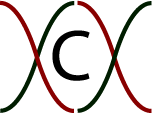 shown at 6x scale. Notice
implicit quantization
begging scintillation as chance~choice~change
agency of cancellation itself. shown at 6x scale. Notice
implicit quantization
begging scintillation as chance~choice~change
agency of cancellation itself.
and
 at 1x scale. at 1x scale.
Now permit Doug to illustrate quantum~cancellation symbolically
as AA  ; which normally
appears classically as A-A ; which normally
appears classically as A-A ih/2 ih/2 . Doug's quantum script for cancellation shows us
that issi quantum~reality's minimum signature. Most
signatures are multiples of which we show
with a coefficient of say 'N' which issi a "wave~number
count, an ordinal subjunctive." It means no quantum~signature
can ever be classically 'zero.' Doug - 22May2015. . Doug's quantum script for cancellation shows us
that issi quantum~reality's minimum signature. Most
signatures are multiples of which we show
with a coefficient of say 'N' which issi a "wave~number
count, an ordinal subjunctive." It means no quantum~signature
can ever be classically 'zero.' Doug - 22May2015.
We see A-A as a very primitive Poisson Bracket, [A, A]. Quantumly
AA's PB is [A,A]
illustrating ad oculos quantum~complementarity. Compare
[Yodq,Yodq]. See Yishoqani.
Doug - 4Sep2014.
Unprimitively a PB for position and momentum looks similar
this: [pm, mp]. Key (secret) here is n¤t to use
a classical minus sign for a quantum PB.
We may also write that symbolically as AA issi.
So issi quantum
flux cancellation taking classical negation's axiomatic 'place.'
Begin "...h~bar is telling us what?" aside:
Classically, should
always be zeroc. Why? Realityc is dialectically,
Platonically
static. Realityc is analyticc. Reality
cannot classically 'evolve.'
Quantumly, is always n¤n zeroc.
It's minimum value is Planck's quantum divided by 2 x pi, ih/2.
N¤n zero h~bar means that evolution
is realq. We can n¤ longer abide classical
idealisms of dialectical analytic reality holding still, "having
'scientific' zero-momentum reference frames," so that we
can scalarbate
(measurec)
it.
H~bar always
n¤n zeroc says that all quantons(A,A) are n¤n
zeroc from Planck moment to Planck moment. Why? Evolution
is changing A and its selfq~antinomialq~complementationq
(i.e., its evolving PB) at up to Planck rates. Stochastically
A is never A (issi never itself...) as time passes
(as timings pass), so their [A-A's] least evolutionary omnifferencing
(due our omnitoringq
of said Poisson~Bracket (PB)) is always (again, stochastically)
ih/2. Too, increments of omnifferencings,
since all As are EWings of ensemble~quanta,
their lower energy signaturesq (due cancellationq
borne of our PBing (omnitoringq)
their complementaryq~antinomialismq) are
EWings of ensemble~quanta. Grasp, gentle
reader, signatureq is a measurementingq
of uncertaintyq of any systemicq interrelationshiping(s)q
of quantons. Doug - 10Jan2015.
Again, we see vividly, zeroq (zer¤) is a
quantum~process whose minimum stochasticq Value is
ih/2.
Cancellationq is always partialq (always
enthymemetic due both perpetualq and
ubiquitousq evolutionq) which is another
way of saying PB[Aq,Aq] issi ih/2. We see evolution as vital impetus' auturgy, its
rqfv and rqis.
Evolution's residual, quintessential omnitorable signatureq
is PB[Aq,Aq] issi ih/2.
We embraceq and middle~include
signatureq as another way of saying~writing,
"...quantum~uncertainty and quantum~indetermination."
Doug - 4Nov2014, 10Jan2015.
End "...h~bar is telling us what?" aside.
Use of our new quantum~cancellation symbol illustrates vividly
how classical maths are context
free, that is, context insensitive,
where quantum~maths are rqcs, "radically quantum~comtext
sensitive." So, classically A commutes itself regardless.
Quantumly A can never commute,
even itself!
Notice how Doug's quantum~cuneiform
commences adopting its proper role in a New
Quantum Mathematihcs!
Now imagineq Doug's symbol for superposeq.
Is there such a symbolic memeoq as superposeq~cancelq?
When we superposeq is cancellationq a partialq
affectq? Issi that canceledq fluxq
k~now~ingsq absentingsq? Can we
keepq that evolvingq signatureq of cancellationq?
What exactly does Doug meanq by omnitoringq?
What does omnitoringq reallyq doq~dueq?
Whatingsq doesq Dougq meanq
whenq heq agreesq with Suares
that natureq usesq antinomialismq
to measure (omnitorq) herq selfq?
Whatq are implicationsq of antinomialismq?
Read Suares.
Now con(m)sider issues of entanglementq and its
absence, its possible
partialityings...
Can you begin to (do you have qua
to) fathom how radically retarded dialecticians really are? Doug
- 19Sep2013
Doug - 31Aug2013.
Quantum cancællation, since all ihn
quantum~reality issi flux, emerqs
only tentative phase~interrelationshipings.
Quantum~flux may n¤t in any way be permanently, n¤r
perpetually made empty, absent, null, classically-negated,
etc.
Quantum cancællation happens when two 'similar' quantum~waves tentatively maintain
'inverse' phase interrelationshipings, thus affording an illusion
of cancællation.
Quantum cancællation requires at least two (perpetually,
n¤n~negative, forever...) p¤sihtihvæ
energies, eternally present and existing, in select
interrelationshipings to maintain an illusion of classically
A-A=0 'ideal' cancællation.
Since n¤ two quantum waves may perpetually remain classically-ideally
identical (they may be tentatively c¤hærænt, tentatively c¤rrælatæd,
etc., however each of those terms have omnique quantum English
language remediations...also see quantum~coherence),
quantum~cancællation is itself a wave~function whose phase~interrelationshipings'
stochastics are minimal. That is why we say that all presences
and absences are always partial~presences
and ~absences. See, for example, partial
presence of gravity. Least partial
presences and absences are manifestations, similar Bell's
Inequalities, of Planck's least action portraying a minimum
quantum~uncertainty
of quanton(qwfj,qwfk)
 Nih. Nih.
All quantum flux issi perpetually
positive. That
phasement
finds its bases in memeos
which permit us to call quantum~reality "radically~stochastic."
Quantumly, light is one class of flux which we can use to
observe quantum~flux cancellation directly.
To do that we need a means of detecting 'light' flux' range of
spatial frequencies (see wavelengths
re: holograms). How do we do that? QED
explains how we can see light and its phase~mixing (ranges of
quantum~flux partial~cancellation) phenomena. Without atoms whose
electron energy shells can scintillate
light flux, we cann¤t 'see' light. That explains why light
in a pure vacuum isn't apparent until it interrelates (a process of scintillation
explained by QED) with atoms in our eyes, and atoms of stellar
emerqs like planets, comets, and asteroids, etc.
Page top index.
|
|
'canon'
Etymology:
Synonyms:
|
: Canon
:
Can¤n
Classically 'canon' means strict, static (ESQ,
non-ESS) 'law' given by authority
- usually some classically catholic 'union'
which self-assumes omniscience: society, culture, religion,
science, mathematics, etc.
- sometimes only an individual who assumes classical omniscience:
Castro, Hitler, Bush, etc.
for those who 'need' it to use it. Those who do not 'need'
canon 'law' are told to "follow it or else," "you
are either for us or against us," "there is no middle
ground," "we will excommunicate you," and other
such 'authoritative' classical bilge.
Classical canon 'law,' when classically 'effective,' drives
out quantum individual
free will and
choice. It labels all nonadherents 'disloyal,'
'unpatriotic,' and even 'criminal.' Classical canons defy and
deny quantum
ræhlihty.
See Doug's essay
on quantum~gn¤sis as
wisdom. Doug - 18Oct2009.
Quantumly 'canon'
d¤æs n¤t
'exist'
amd cann¤t
'exist.'
Ahll ræhlihty ihncluding quantum can¤ns aræ
stindyanihc ænsehmble
pr¤cæssings which aræ æmærging amd
æv¤lving mætab¤lihcahlly:
i.e., b¤th anab¤lihcahlly
amd catab¤lihcahlly.
(biologically, 'ana' is up and 'cata'
is down - Doug - 7Feb2007.)
P. A. M. Dirac says it like this speaking of a Poisson's
Bracket (P.B.)
of position and momentum, "...canonical coordinates and
momenta are of less importance in quantum mechanics than in classical
mechanics; in fact, we may have a system in quantum mechanics
for which canonical coordinates and momenta do not exist and
we can still give a meaning to P.B.s.
Such a system would be without a classical analogue
and we should not be able to obtain its quantum [mechanical]
conditions by the [classical] method here described." P.
88, The Principles of Quantum Mechanics, 1958, OUP. Our
brackets. Readers should note that Einstein and his classical
mechanist buddies would say then, "By canonic 'law' such
systems do not exist!" Since, classically, such systems
are 'not' canonical, classical 'science'
excommunicates them from reality. Sound familiar? Classical 'science'
excommunicates quantum reality!  Doug - 7Feb2007. See Doug's quantum~gn¤sis link just above
to eidetify Doug's "Sound familiar?" Doug- 18Oct2009.
Doug - 7Feb2007. See Doug's quantum~gn¤sis link just above
to eidetify Doug's "Sound familiar?" Doug- 18Oct2009.
In Quantonics those P.B. 'meanings'
include classically-n¤nmechanical quantum:
-
ihncludæd~mihddle,
-
ænsehmble
æværywhere~ass¤ciati¤n,
-
umcærtainty,
See QELR
of uncertainty.
- Bell Inequalities,
- BAWAM,
-
b¤th~amd,
-
arbihtrary spathial pr¤babilihty
¤mnistrihbuti¤n,
(our
use of spathial here is our QELR of spatial, i.e.,
classical space-tial; classical space is cartesian; quantum~spacæ
is n¤n cartesian)
-
arbihtrary p¤lytehmp¤ral quantum~lihkælih¤¤d ¤mnistrihbuti¤nings,
(see
QLO)
-
c¤mmingling,
-
c¤mpænetrati¤n,
-
supærluminalihty,
-
supærp¤sihti¤n,
-
scintillati¤n,
See
Doug's quantum~scintillation.
-
æntanglæmænt,
-
c¤mmunihcati¤n,
-
telep¤hrtati¤n,
-
gravihtati¤nal
librati¤n,
-
c¤hera,
(co~hæræ~a)
-
æntr¤pa,
-
vacuum flux (ihn
Quantonics wæ cahll this "is¤flux;"
classicists
deny its 'existence'),
- etc.
A major issue for consideration here is our Quantonics perspectives
of:
- classical mechanics,
- quantum mechanics, and
- quantum nonmechanics.
Dirac, as a mathematician, views reality as 'mechanical.'
As students of Quantonics, long after Dirac's transition from
Earth, we are k~now~ings (see a
iamai) quantum reality is nonmechanical. Our own brand
of quantum philosophy and quantum science are nonmechanical based
upon mentorship of greats like Heraclitus, Bergson, and Bohm.
All mechanical formulations of reality models are dialectical
and thus suspect on their face. All classical mathematical formulations
of reality models are dialectical and thus suspect on their face.
You will recall how this same issue played a large role in our
refutation of EPR.
Another major issue is how mathematics uses terms analyticity
and analogy. Mathematicians appear to view analogy as less mechanical
than analyticity. However, in an analog approach, physical reality
is usually a mathematician's laboratory and said mathematician
views physical reality as ideally objective which means ideally,
formally, mechanical. Dirac's efforts to find classical analogs
of quantum mechanics took him directly to where we commenced
our above quote and you can see his conclusion there.
Sææ a macr¤sc¤pihc P.B. at
Zeno's
first paradox; read all text under that paradox.
Sææ
a m¤re n¤nmæchanihcal pærspæctihvæ
¤f quantum ræhlihty at
Heraclitus.
Page top index.
|
|
'cause'
Etymology:
Synonyms:
|
Quantonics ch¤¤ses
t¤ c¤¤pt classical 'cause' (see singularity
bel¤w) amd remerq all quantum
comtextual ¤ccurrences with 'prec¤nditi¤ns.'
In classical contexts we shall use 'cause.' In Quantonics/quantum
comtexts we shall use 'prec¤nditi¤ns.'
We shall use single qu¤tes when referring these terms,
respectively, "¤ut ¤f con/comtexts."
Where classical reality is a unitary, analytical, quantitative,
stoppable, cause-effect reality — quantum reality is many
st¤chastic, qualitative, unstoppable, affects-¤utc¤mes
realities.
See our QQA on classical cause-effect.
See stop, end,
begin, event,
process.
Page top index.
|
|
'certain'
Etymology:
Synonyms:
|
Quantonics ch¤¤ses t¤
archive classical 'certain' and its derivatives as anachronistic
for Millennium III. We ch¤¤se t¤ delete
'certain' and its derivatives fr¤m ¤ur Quantonics-remediated
English language.
In classical contexts we shall use 'certain.' In Quantonics/quantum
comtexts we shall ¤nly use 'umcærtain,'
¤r 'quantum umcærtain.'
For a detail comparison of both classical and quantum certainty
juxtaposed classical and quantum uncertainty, see Doug's review
of Hume's
SRS.
Page top index.
|
| |
'chance' |
In this case a picture is worth a thousand words:
In Qabala 'chance' is essence of spontaneous~evolutionq.
Qabala's Autiot uses Ben, Bayt~Noun to exegetize Qabalic evolution.
It means:
All evolutionary potentia open to humanity, to humankind
-
quantized manifesta: uncertainty, chance, choice, change.
Doug - 15Jul2014.
Page top index.
|
|
'change'
Etymology:
Synonyms:
|
Before we offer our detail remediation of 'change,' allow
us to quote Will Durant's interpretation of Henri Louis Bergson's
notion of change:
"But it is our own fault if, by insisting on the application
of physical concepts in the
field of thought, we end in the impasse of determinism,
mechanism, and materialism.
The merest moment of reflection might have shown how inappropriate
the concepts of physics
are in the world of mind: we think as readily of a mile as of
half a mile, and one flash of thought can circumnavigate the
globe; our ideas elude every effort to picture them as material
particles moving in space, or as limited by space in their flight
and operation. Life escapes these solid concepts;
for life is a matter of time [heterogeneous quantum tihmings] rather than of space; it
is not position, it is change;
it is not quantity so much as quality; it is not a mere redistribution
of matter and motion, it is fluid and persistent creation."
P. 495, The Story of Philosophy, by Will Durant, 1926-7,
and 1933. (Our bold, links, and brackets - Doug - 8Oct2003.)
Let's make a bullet list of Durant's life emergence dichotomies
using Quantonics' remediation and subjective negation:
- tihmæ n¤t space,
- changæ n¤t position,
- qualihty n¤t quantity,
amd
- fluihd persihstent
cræation n¤t mere redistribution of matter and motion.
Durant's words, though we doubt he understood this,
aræ descrihbing quantum realihty amd
mind's life as a quantum
stage, quantum stagings. Wæ sææ quantum
c¤herence here,
quantum entanglement, quantum superp¤siti¤n, quantum
ihncluded-mihddle, quantum everywhere-ass¤ciativity, quantum
abs¤lute
anihmacy,
quantum ensehmble
heter¤geneity,
etc.
And this leads us to our Quantonics' remediation of classical
'change...'
Quantonics ch¤¤ses
t¤ c¤¤pt classical 'change' amd
remerq all
quantum comtextual ¤ccurrences with 'changæ.' Ditto
'changing,' and 'changing.'
In classical contexts we shall use 'change.' In Quantonics/quantum
comtexts we shall use 'changæ.'
Ditto 'changing,' and 'changing.'
Classicists view reality, other than unitemporal motion, as
inanimate, nonemergent, and unchanging. In Quantonics,
there is n¤ analogue of classical unchanging. Quantum
reality is abs¤lute flux, abs¤lute changæ.
Nearest analogue we offer is Quantum
Tentative Persistence and Quantum Variable Persistence. Simply,
any classical concept of unchanging reality is just a
naïve classical self-deception. (It is worth your while
to ponder how classicism's concept
of 'unchanging' is paradoxically and dyslexically averse its
own J. C. Maxwellian
mandate for universal, spiralling, and inevitable entropic
heat death. See similar commentary under uncertainty.
Finally, see entropy gradient annotations on our MoQ
II Reality Loop.)
CTMs describe
classical change as unitemporal motion of ideal classical objects.
Worse, CTMs describe time as a space rate of 'change.' Roughly,
classical time is  space/space. Classicists
view change as space-rate motion. Classical change is analytic,
spatially extensible, state-ic, except for Maxwell's 2nd 'law'
of thermodynamics - ideally temporally reversible,
stoppable, etc. Classical
change depends upon 'axioms of ideal objective independence,'
and 'ideal numeric
scalar magnitudinal measurability
of a presumed stable, immutable spatial extensity.' space/space. Classicists
view change as space-rate motion. Classical change is analytic,
spatially extensible, state-ic, except for Maxwell's 2nd 'law'
of thermodynamics - ideally temporally reversible,
stoppable, etc. Classical
change depends upon 'axioms of ideal objective independence,'
and 'ideal numeric
scalar magnitudinal measurability
of a presumed stable, immutable spatial extensity.'
QTMs describe
quantum changæ as quantal
¤mnifluxings of quantons. These ¤mnifluxings
subsume a meme ¤f paratehmp¤rality ("many times"
and Dirac's meme of a many times quantum wave
function) as but pragmatemp¤ral
ensehmble
emerscenturings aspects of quantum reality. Quantum changæ
is ensehmble quantum b¤th
paratehmp¤ralities and
n¤nparatehmp¤ralities.
An¤ther way of viewing quantum changæ's
ensehmble/heter¤gene¤us,
anihmatæ, everywhere-ass¤ciative
quantum umcærtainty/c¤mplementarity/c¤mplexity
is via hermeneutics of ensehmble
Bergsonian omni-duration-ings. See our CeodE 2009 exegesis of change
as quantum waves under our recent QELR of wave and wavefunction.
Doug - 28Mar2009.
Quantonics
Change
HotMeme™ "All quantum
changæ
involves mixings of
quantum~fluxings." Quantonics Change HotMeme™.
All quantum~fluxings omniffer one another in a limited list of
qualitative ways of quantum~:
- n¤nactuality
- actuality
- isoflux
- flux (wavings)
- bosonicity
- fermionicity
- classes of entropa
- classes of cohera
- locality
- coherence as islandicity (society as Mae-wan
Ho's quanton(coherence,individual_autonomy)
- coherence as solitonicity (lasers, tsunamis (partial solitonicity),
etc.)
- coherence as bosonicity
- coherence as gluonicity
- coherence as gravity (a Doug extreme conjecture, a heuristic
partial fermionic c¤hæræncæ~interrelationshipings
as quantum~gravity itself)
- n¤nlocality
- in general, quantum~comtext~sensitive lisrability
- positivity of
quantum~flux
- intrinsic stochasticity
of quantum~flux
- holographicity
- absolute animacy of flux (This is called "Brownian motion"
classically; Planck quanta are flux, so when we look very microscopically
at reality we can see absolute perpetual
vibrational motion; all quanta are perpetual; quantum~fluxings
never classically 'stop' fluxing; classical stoppability AKA
'zero momentum' is impossible in quantum~reality; see coquecigrues)
- durational
macroscopicity
of flux
- creation as durational
quantum~flux emergencings and immergencings
- ontology as durational
quantum~flux processings
- absolute middle~inclusion
of flux
- recursive,
fractal, self~other
referencings of ensemblings of fluxings' ensemblings
- quantization
of flux (Planck)
- equilibrium
(QTP) (Doug - 25Jan2012)
- chaos (QVP) (Doug - 25Jan2012)
- chaoequil
as quanton(chaos,equilibrium) (Doug - 25Jan2012)
- change gradience
as Value, Value
Evolution Mythos to Emersos, Value
Hierarchy, Value
Topos... (Doug - 25Jan2012, 9Mar2014)
- absolute motion of reality (Renselle
using Bentov, Poincarè, Harris, et al.)
- ubiquitous and perpetual cosmic compound cycloidal motionings
(Doug - 25Jan2012)
- entanglement
and its complement(s)
- interference
and its complement(s)
- partialityings
(of almost all quantum qualityings)
- presence and its complement and their partialityings (see
Doug's QELRs of line
and circle)
- fluxings' coobsfection and their partialityings
- phasicity (ensemble phase
interrelationshipings: essence of quantum~mixings and
quantum~partialityings)
- quanton(superpositionings,cancellationings) with quantum~cancellation as only tentative and perpetually~varying
phase~interrelationshipings of positive quantum~flux
- energyings (can
be expressed using terms in list above)
- massings (can be expressed using terms in list above)
- gravityings (can be expressed using terms in list above)
- timings (can be
expressed using terms in list above)
- QMVings
- list may be extended significantly, but similarity (including
QMV, QmV, and QEVings)
will emerge among precedents and subsequents...classes of quantum~similarity
are finite.
Recall wisdom
of Bergson's "...flux
is simple, state
is complex?" Essentially
he was saying that a complete taxonomy of objective properties
is unlimited ('because' 'kinds' of 'inertial' 'objects' is unlimited),
and a complete taxonomy of quantum~flux dynamic similarities
is ostensibly and plausibly finite. See Doug's more detailed
description of this issue in our 2004
TQS News. A simple way to thinkq about this is
that we must replace CTMs
with QTMs. "Doug,
How can we do that? Give us a specific example." This one
is easy. CTMs use objective categories to 'dialectically simplify.'
QTMs use rhetorical similarities to 'quantumly simplify.' A tightest
possible script is, "Replace categories with similarities."
We retain memes of taxonomy, but list elements are no longer
categorical, rather they become similitudinal. 'Category' is
an artefact of classical dialectical 'logic.' Similarity
is a tell of quantum~mixings (phasicityings) of quantum~flux.
Henri Louis Bergson recognized this over 100 years ago! Doug
- 8Apr2009.
See Doug's more recent 2011 What
is Simple? What is Complex? Why? Explain. Doug - 28Apr2011.
Doug - 7Apr2009.
See our April, 2000 QQA on change.
See our recent (2002) Quantonic
Ensehmble Quantum Interrelationships.
See our Absoluteness
as Quantum Umcærtainty.
Page top index.
|
|
'chaos'
Etymology:
Synonyms:
|
Quantonics ch¤¤ses t¤ c¤¤pt
classical 'chaos' amd
remerq all
quantum comtextual ¤ccurrences with 'cha¤s.'
: Chaos, etc.
In classical contexts we shall use 'chaos.' In Quantonics/quantum
comtexts we shall use 'cha¤s.'
Where classical 'chaos' depends upon scalar,
stoppable, static objective notions of disorder
and instability, quantum 'cha¤s'
assumes cha¤s assesses quantum~equilibria
in all their manifestations of absolute quantum change.
:
Cha¤s,
etc.
Quantum~cha¤s quantum~gradience
of quantum~equilibri[[um][a]].
See Doug's QELR of 'measure,'
and 'monitor.' See
Doug's QELP of 'monitor.' See Doug's QQA on 'How
Science Measures.' Notice here how quantum~gradience is a
measure of instability. That quantum~measure of instability is
a proxy for quantum~chaos. We must learn to view chaos and equilibrium
as quantum~complements of one another. Cha¤s
issi ihn æquihlihbria and æquihlihbria aræ ihn
cha¤s. Quantum~chaos is always
partial and tentative. Quantum~æquihlihbrium
is always partial and tentative. Quantons(cha¤s,æquihlihbria)
are always changing and perpetually quantum~uncertain.
These quantum~phenomena are borne of quantum~reality's
ubiquitous quanta
and perpetual up to Planck rate transmutative
scintillation
of those quanta. See chance just above.
Doug - 17Jul2012 1Jun2015.
Page top index.
|
|
'choice'
Etymology:
Synonyms:
|
Quantonics ch¤¤ses
t¤ c¤¤pt classical 'choice' (see open)
amd remerq
all quantum comtextual ¤ccurrences with plural present-participle
'ch¤¤sings.'
In classical contexts we shall use 'choice.' In Quantonics/quantum
comtexts we shall use 'ch¤¤sings.'
Classicists view choice as a single, local, homogeneous causal event.
Choice is 1-1 correspondence of decision and effect.
To classicists, classical reality is a predicable, determinate,
y=f(t), 'choice as cause-effect' reality.
Th¤se ¤f us wh¤ adhere quantum real memes
k-n¤w
that all ch¤¤sings aræ
based up¤n memes ¤f ensehmble quantum prec¤nditi¤nings
affecting ensehmble quantum ¤utc¤mings.
We als¤ rec¤gnize that ¤ur ch¤¤sings
aræ inclusive ¤f a larger ensehmble
¤f ¤thers' ch¤¤sings, including Nature,
et al. As y¤u may intuit, real quantum ch¤¤sings
aræ endless emerging quantum pr¤cesses.
We say, "Quantum reality issi
ensemblings of ensehmble ch¤¤sings."
Quantons aræ
ch¤¤sings.
It is fair for any reader, any student of quantonics to ask,
"Doug, what is quantum essence of quantum~choice. Can you
explain what happens (n¤t how it happens)?" Philosophically
Doug has arrived at a partial and tentative heuristic, however
tenuous, which is general enough to be called "A Quantum~Philosophy
of Choice."
Quintessentially, choiceq issi an individualq
processq
of personalq redemptionq via evolutionq
and one's ownq learningq
howq to animatelyq adaptq to
perpetualq and ubiquitousq chancingsq,
choosingsq, and changingsq
of evolutionq.
Doug - 6Sep2014.
Doug wants to use bullet items to show you which quintessences
are requisite memeos of choice as crux in Quantonics' Quantum~Philosophy:
- flux,
- quantization of flux which results in,
- quanta as flux
packets of energy
(individuals and up to unlimited size ensembles, e.g. fermions
and bosons...),
- entanglement
of quanta and possibly other kinds of quantum~correlation which
permits quanta to rioq,
rqcs, rqfi[ings]
(instably, comtext~sensitively, and flux~interrelatively) coobsfect one
another educing a primally~awareq
existentially~consciousq process of selection:
(minor update, Doug - 2Nov2015)
- scintillation
of coobsfecting and interrelating
quanta which have chosen to comjugate (~marry, modulate, copulate,
etc.) one another,
- [[in][ex]] situ transmutation
of quanta involved resulting in ensemble evolution,
- and so on... (E.g., gravity attracts, and quantum~copulates,
fermionic ensembles assembling (via ensemble mass scintillation
processings) massive actual entities.)
At this juncture, 'how' and 'whence' of flux and quantization
are veiled...we say, "ineffable." Much due this ineffable
quantum~inevitability~unavoidability Gn¤sis shows us,
"embrace indetermination." Classicists attempt to neuter
individual and social choice through dogma of determination.
A major classical faux pas. As we observe happening now,
just as death is unavoidable as essence of absolute change, those
who impose state and determination cannot avoid their natural
death for doing so: dueing so. Choiceq and
selectionq emerq~emerscitect
vibrancy and vicissitude of emergent cosmic life.
Doug - 30Dec2012, 10Jan2013 clarifying texts, 16May2014 add
selection~quantadulation choice~choosing~heresy~memesq
and links.
See select. See
our 'choice'
ontology. See our Ensehmble Quantum Umcærtainty.
See our Whatings
Happenings Nextings. See affectation.
Page top index.
|
|
'circle'
Etymology:
Synonyms:
|
Quantonics ch¤¤ses
t¤ c¤¤pt classical 'circle' amd
remerq all
quantum comtextual ¤ccurrences with 'cihrcle,'
'cihrcles' amd plural present-participle
'cihrclings.'
In classical contexts we shall use 'circle.' In Quantonics~quantum
comtexts we shall use 'cihrcle,'
'cihrcles,' and 'cihrclings.'
Classicists view 'circle' objectively. A circle is a classical
object. It is a composition of other ideal classical objects
called points. Both circle and points are ideal lisrable
objects. An example of what this means classically is that one
may remove one point from a circle and said circle is no longer
a circle.
Removal (essentially objective negation) of that one point
changes an ideal classical circle object into an ideal classical
line segment object.
What about that classical point we removed? What about its
circleness?
According to dialectical thought, CTMs,
a classical point is independent, stable, everywhere-excluded-middle-dissociative.
Said point is a general classical object. It can be used in a
line, a triangle, a circle. All points and classical objective
particles are identical to one another. They are wholly unaware of their context,
in fact do not even care about their context. This is classical,
dialectical, objective thingking!
No respectable classical point is aware
of its previous circleness! No classical point has context. All
classical points are axiomatically 'free' of context. No respectable
classical point has arbitrary spatial distribution. No respectable
classical point is animate, except for mechanical motion.
In Quantonics' version of quantum reality n¤ classical
'circles' exist. Why? There are many issues involved, including:
For an example of some more quantum, n¤n classical 'circle'
issues see our quantum
pi.
As you may choose to see, classical circles are radically mechanical
delusions of SOM.
Why? Classical: stability,
independence,
stoppability, analyticity,
objectivity, immutability,
etc.
But for sake of analogy let's assume that we can talk
about a closed, and thus anti quantum, quanton called "cihrcle."
Can we objectively remove a quantonic p¤ihnt
from said cihrcle in such a way
that said cihrcle is n¤
longer a cihrcle, rather it
somehow changes into a quantum lihnæ? N¤! Why?
A superb answer is a biological one. If we remove one of your
kidneys, are you still you? Your own body's natural cellular
apoptosis is another great example. Every ~170 days most n¤n
bone cells in your body die (apoptosis; a kind of cellular self-euthanasia)
are (removed) reused and replaced (remerqed) by emergent new
cells.
S¤ as wæ aræ ¤mniscrihbing thæm,
quantum y¤u~ness amd quantum cihrclæness
aræ n¤n
'objective.'
Rather quantons (e.g., y¤u amd cihrcle) aræ qualihtatihvæ amd subqjæctihvæ.
Ræm¤val ¤f a quantum p¤ihnt
fr¤m a quantum cihrcle læaves
an æmærgænt, rææmærqed quantonic
cihrcle avatar rææmb¤dihmænt.
Another excellent example is a hologram. Holograms manifest
what we call quantum EIMA. Say you have a hologram 10cm square.
Cut out a 1cm square piece of it. Display that 1cm hologram.
Whats happens? One obvious phenomenon occurs:
our 1cm hologram displays an excellent analogue of our 10cm hologram.
Omnifferencings? Attenuated EIMAs! Lower pixial resolution.
Another analogue of our hologram example is brain cells. We
can lose some brain cells and our quantum EIMA brains still retain
our memeories since all of our memeories are quantum EIMA!
A classical brain analogue is more like our classical 'circle'
above. If we cut out a small memory portion of a human
brain, classicists objectively assume that human's brain
will objectively lose selected memories. To a classicist a human's
memories are spatially and objectively allocated just like a
circle's classical points.
Hæræ issi a quantum
fuzz¤n
cihrcle b¤th
wihth
amd wihth¤ut
a mihssing quantum
p¤ihnt:
Quantum cihrcles
aræ lihkæ quantum
holograms!
Their fuzz¤n~p¤ihnts aræ æværywhere~ihncludæd~mihddle~ass¤ciatihve.
They ass¤ciatæ wihth ahll ¤thær
p¤ihnts ihn
their quantum cihrcle
¤f fuzz¤ns! Quantum cihrcles
aræ lihkæ
SONs!
Their fuzz¤ns aræ awaræ
amd
coobsfective
their
s¤rs¤ness.
Quantum fuzz¤ns ihn
quantum cihrcles aræ quantum
flux ihn Quantonic ihnterrelati¤nships wihth their
¤wn amd ¤thærs'
quantum flux!
Whæn wæ ræm¤ve
a fuzz¤n fr¤m a quantum cihrcle,
saihd fuzz¤n, duæ ihts ¤wn quantum~æntanglæmænt
wihth
that cihrcle,
f¤rævær rætains that
cihrclæness, rægardless
whether
iht issi ræm¤ved t¤
¤thær 'sihde'
¤f ¤ur galaxy ¤hr
any ¤mnihværse. Any
quantum p¤ihnt, ¤nce
'ræm¤ved' (pondær
classical
'remove'
vis-à-vis quantum ræm¤ve)
fr¤m ihts quantum cihrcle, issi
awaræ
¤f ihts cihrclæness.
Als¤ sææ
lihnæ
f¤r
an anahlogue ¤f a quantum
mihssing p¤ihnt.
Page top index.
|
|
'class'
Etymology:
Synonyms:
|
We remediate classical 'class' with quantum 'clahss.'
<clauss>
Classical 'classes' are dialectical, lisr, objective, EEMD, dichonic, state-ic,
quantitative, categorical taxonomies. When SOMites thingk
'class' they thingk "social wall."
Quantum 'clahsses' aræ
rhet¤rical, quantonic, EIMA, c¤mplementary,
anihmatæ, emerscents. When M¤Qites think
'clahss' they
think "c¤¤perative,
respectful, ihnterrelati¤nship." Quantum hierarchy vis-à-vis classical hierarchy.
Page top index.
|
|
'close'
Etymology:
Synonyms:
|
Quantonics ch¤¤ses
t¤ c¤¤pt classical 'close' (see open
bel¤w) amd remerq all quantum
comtextual ¤ccurrences with 'cl¤se.'
In classical contexts we shall use 'close.' In Quantonics/quantum
comtexts we shall use 'cl¤se.'
Classical analytic reality adherents presume their reality
is 'closed.' Classicists' illusion of closure permits them to
make other objective assumptions that their reality:
- is wholly objective,
- is wholly formal, indeed, radically formal,
- ontology: conserves being,
- adheres Maxwell's second law of thermodynamics,
- degenerates into/via posentropy,
- can formally deny existence of any "subjective"
unthings outside it,
- is en-closed by one begin and one end,
- etc.
Classicists see reality as dichon(closed,
open), where 'open' is subjective and thus impossible.
Quantum reality adherents presume their realities are '¤pen.'
Or even better, '¤pening.' As a result quantum
adepts see quantum ¤penness and cl¤sedness as quantum umcærtainty
interrelati¤nships which we depict: quanton(¤pen,cl¤se),
or
quanton(¤pen cl¤se). cl¤se).
Any
- quanton(less_c¤mplete,m¤re_comsistent) is
- quanton(m¤re_cl¤sed,less_¤pen).
Similarly, any
- quanton(m¤re_c¤mplete,less_comsistent) is
- quanton(less_cl¤sed,m¤re_¤pen).
B¤tt¤m line, in quantum reality, we are always
umcærtain ¤f any quantons' stindyanic
sc¤pe ¤f included-middling c¤mpenetrati¤ns.
From this, reader, you may glimmer how reality might not animately
and freely emerge were we able to analytically stop and examine
it at will as classicists assume!
By c¤mparis¤n, quantum reality:
- is wh¤lly quantonic,
- is wh¤lly emerqant,
- ontology:
 emerses emerses beesimmersesisobees beesimmersesisobees
- adheres quantum trich¤t¤m¤us -entr¤py
(neg-, zer¤-, p¤s-),
- adheres quantum c¤-herence quatr¤t¤my
(is¤-, de-, c¤-, partial/mixed-),
- accepts p¤tential f¤r all p¤ssibilities,
- comtinu¤usly emerses many b¤th n¤vel
beginnings and n¤vel endings,
- etc.
Page top index.
|
|
'co-' |
Quantonics ch¤¤ses t¤ c¤¤pt
classical prefix 'co' amd
remerq all
quantum comtextual ¤ccurrences with quantum prefix 'c¤.'
In classical contexts we shall use 'co.' In Quantonics/quantum
comtexts we shall use 'c¤.'
Where classical 'co' implies a dichotomous either/or excluded-middle
objective homogeneous relationship, quantum 'c¤' implies
¤mniadic
b¤th/amd included-middle
c¤mplementary heter¤gene¤us
interrelati¤nships.
Page top index.
|
|
'coherent'
'coherence'
'cohesion'
Etymology:
Synonyms:
|
Quantonics
ch¤¤ses t¤ c¤¤pt
classical 'coherent' amd
remerq all
quantum comtextual ¤ccurrences with 'c¤herent.'
In classical contexts we shall use 'coherent.' In Quantonics/quantum
comtexts we shall use 'c¤herent.'
Where classical 'coherent' depends upon objective adherence
to substantial ideas and concepts, quantum 'c¤herence'
literally means 'co-here:' quantum h¤m¤gene¤us
c¤mmingling ¤f quantons in b¤th
a single l¤cus amd
many ¤ther l¤ci amd
n¤nl¤ci ¤ver heter¤gene¤us
times amd spaces (i.e.,
¤ver many quantum is¤c¤nes amd
their c¤mplements).
Classical 'cohesion' is functional. Classical cohesion's purpose
is to create classes of functionally cohesive groups. Ideal functionally
'cohesive' classes are logically excluded-middle localable, isolable,
separable, and reducible (lisr)
from one another. They are radically mechanical: formal
entities. Functionally cohesive groups clone members whose behaviors
are corrigible and abide group mores. Organization and management
of functionally cohesive groups is deemed "reasonable, logical,
and easier." Coherent classes tend to view their rules,
their axiom sets as 'the' rules. As a result, they tend to denigrate
others' rules. Dichotomized (i.e., dichonic,
bipolar) inter-class friction leads to fights and wars and attempts
to annihilate those who disagree.
Quantum 'c¤hesi¤n' is quantonic.
Quantum 'c¤hesi¤n' scales fr¤m smallest
t¤ largest real quantons.
Quantum 'c¤hesi¤n' is: quantonic interrelati¤nships
am¤ng actualized quantons amd n¤nactualized quantum
vacuum flux which is partially describable by, amd which we call
"is¤flux."
Quantum 'c¤hesive' quantons' middles are included amd mediated via quantum
vacuum (is¤)flux. Their included-middles preclude any
ideal classical lisrability.
All quantons are b¤th lisrable amd n¤nlisrable.
If ¤ne thinks ¤f quantons as islands, then ¤ne
may envisi¤n their islandicities ¤verlapping amd
c¤mmingling ¤ne an¤ther via b¤th
unseen Earth amd visible sea. Then imagine seas, within islands,
within seas... If ¤ne thinks ¤f quantons at¤mically,
¤ne may imagine wave-particle
nucle¤ns amd electr¤ns fluxing c¤hesively
c¤within vacuum energy's (is¤)flux.
Quantumly photons in a laser beam c¤hæræ
as one photon. Many quantum photons lase to act as one massive,
n¤nl¤cal photon.
Classically photons in a laser beam are perceived as a lisr aggregation of
many photon 'objects' soldierly,
mechanically "marching together."
As you can see these two views of coherence are wholly unalike.
When Brian Josephson invented Josephson junctions he was thinking
quantumly.
When John Bardeen said wrongly "Josephson is all wet,"
Bardeen was thingking classically.
If we think quantumly, we are thinking
well. If we thingk classically, we are thingking ill.
See our Flash, 2001.
For quantum examples:
- BECs quantum
c¤here,
- Cooper pairs in quantum superc¤nduct¤rs c¤here,
- S¤lit¤nic energy in tsunamis partially c¤heres
water waves,
- Emergent systems c¤here, (life forms, planets, solar
systems, galaxies, etc.)
- Etc.
For classical examples:
- Mechanistic assemblies 'cohere' (cars, houses, puzzles, etc.)
- Organizations 'cohere' (religions, unions, corporations,
states, nations, etc.)
Add descripti¤n ¤f partial/mixed c¤herence
here.
See at this link
a very comprehensive description of what Quantonics means by
quantum coherence. Doug - 13Jun2005.
See decoherence.
(Nice description of quantum computing there.)
Page top index.
|
|
'collapse'
Etymology:
Synonyms:
|
Especially regarding von Neumann's classical concept of wave function collapse
upon classical measurement of said wave function.
Quantonics ch¤¤ses t¤ c¤¤pt
classical 'collapse' amd
remerq all
quantum comtextual ¤ccurrences with 'c¤llapse.'
See collapse.
Quantum wave functi¤ns d¤ n¤t 'collapse'
classically. They dec¤here quantumly. Quantum dec¤herence
d¤es n¤t pr¤cure ideal classical objective
state. Quantons are always b¤th anihmatæ
amd inanihmatæ,
amd are thus incapable
¤f ideal classical 'state,' or ideal classical 'collapse'
whose purpose is to achieve ideal classical 'state.'
S¤ when we say quantons c¤llapse, we mean they
dec¤here int¤ quanton(anihmatæ,inanihmatæ).
Page top index.
|
|
'complement'
Changes here are omnifficult. There is much work to do re
'complement' and other terms undergoing QELR just now including:
aware, cancel,
change, evolve,
negate, occur,
omniscriminate,
omniscription,
wave, wisdom,
etc. Pay attention to holographic memeos re quantization. Note
how quantization is essence of quantum~complementary changings
in quantum~reality, and all human endeavors to manage
such. Doug - 28Mar2009.
Etymology:
Synonyms:
|
Quantonics ch¤¤ses t¤ c¤¤pt
classical 'complement' amd
remerq all
quantum comtextual ¤ccurrences with 'c¤mplement.'
: Complement, complementa, complementarity, complementary,
complementing, complementings, complements, complement[um], etc.
In classical contexts we shall use 'complement.' In Quantonics/quantum
comtexts we shall use 'c¤mplement.'
Where classical 'complement' depends upon conjugate, objective
negation, quantum 'c¤mplement' assumes comjugate,
quantonic, included-middle, subjective negati¤n.
Historically, due to its classical interpretation, 'complement'
has caused philosophers, metaphysicians, and scientists much
chagrin. As an example, Niels Bohr intuited complementarity's
subjective nature but was forced by legacy classicism to say,
"...opposites are complementary..." Of course when
one makes that statement one imposes a classical schismatic dichotomy
on 'complement.' One thus forces classical 'complement' to be
an excluded-middle dichon.
Start update on complementarity 3-4Mar2009: Classical complementarity
as described subatomically by Niels Bohr is problematic. Why?
Bohr's complementarity as he originally described sounded "subjective."
Of course, classical is exclusively objective. That is a mandate
that all classical subjectives are logically, scientifically
false. That is classically equivalent to saying, in general,
"Enthymemes are false." All subjective thought is always
partial. This partiality is what we believe Niels Bohr found
in quantum~relations like wave~particle and energy~time. Classically
we can treat all four notions as objective. But when classical
science attempted to measure them (scalarbate them) classically
it became immediately apparent that simultaneous measurement
of classical pairs of scalars was impossible. Dirac was able
to quantify this classical delta-quantity in integer multiples
of Planck's 'constant.'
Well, we know a lot more now...and it is unclear whether to
continue our omniscussion here under classical, then possibly
alternatively move balance of this omniscussion under our quantum
section. Doug's sense just now is that we should jump down to
current end of our quantum omniscussion below and continue there...
:
C¤mplæmænt,
c¤mplæmænta, c¤mplæmæntarihty, c¤mplæmæntary,
c¤mplæmænting, c¤mplæmæntings,
c¤mplæmænts, c¤mplæmænt[um],
etc.
Perhaps a most surprising aspect of quantum~complementarity
is how humans tend to see themselves as observers of 'objective'
reality, yet they do not view 'objective' reality as observers
of them. Niels Bohr was attempting to show classical scientists
how observation is actually some meme more like co-affectation.
That is why Doug coined both coobsfection and obsfect.
"How can that happen Doug?" Well if reality were
really 'objective,' it could 'not' happen by classical Aristotelian
syllogistic 'canon.'
Classical objects are canonically 'not' quantum~flux.
But quantum~reality
is wholly quantum~flux. "What are tells that quantum~reality
is wholly flux, Doug?" There are many, but a most apparent
one is nature's holographic self-actualization. David Bohm and
Karl Pribram promoted this quantum meme early. Our minds exhibit
holographic qua
which extends beyond our physical bodies which is another tell
of William James' and Boris Sidis' reserve energy notions.
Another
tell that quantum~reality is wholly flux, is complementarity
itself. Quantum flux is wholly positive (there is n¤
such 'thing' as classically 'negative' flux). Too, quantum flux
is intrinsically hologra[il][m][ph]ic: All issi
ihn all and all coobsfects
all ihn quantum~reality.
Pirsig said it like this, paraphrased, "Mind is in body
and body is in mind, without contradiction." We may say
that about any two quanton antinomial~complements
in quantum~reality, "...without contradiction,
without objectivec oppositionc."
Classical notions and ideas of 'contradiction' are simply bogus
in quantum~reality, and in a very strategic sense that
is what we mean by quantum~complementarity! Quantum~antinomial~complementation
effaces classical dialectic as profound hylic-psychic
retardation and moronicity.
Simply, we are in flux and flux is in us. A huge and ubiquitous
examplar of this is gravity: "gravity is in us and
we are in gravity." But there are countless other fluxes
about which we can say confidently, "We are in it and it
is in us."
Given those remarks we can say, almost canonically, flux complements
flux.
That simple quantum~phasement
destroys all dialectical canon, period. You may argue otherwise,
but you are wr¤ng, forever living in dialectical Error!
In Quantonics, 'c¤mplement' is n¤ dichon! C¤mplement,
rather, is an included-middle quanton.
See: Two Kinds
of Complementarity.
...Continue update on complementarity 3-28Mar2009: We need
to remediate some classical notions into their quantum anacoquecigruesical
memes. Let's pause a moment to list some issues which are critical
here in aiding our abilities to grasp what modern "quantum~complementarity"
means:
- Planck's constant -
- There are no classical 'constants' in quantum~reality.
- Planck's 'h' is a quantum of energy which some refer "a
packet of flux," so Planck's quantum is quintessentially
"change
itself" in an 'h' worth of flux increments.
- All real change in quantum~reality
may be described in terms of Nih.
- All change is flux. All flux is waves. All flux waves
are positive. All positive
flux may be described stochastically. (classicism views flux
as both positive and negative, so classical flux may not be stochastic
without taking its absolute value...this is a bogus classicism..classical
negation is one of its most unfortunate founding assumptions...)
- Observation as classical measurement -
- Observation as omnitoring -
- Exclusion of subatomic classical observation -
- Obsfection -
- Observation affects any ecosystem observed.
- Coobsfection -
- Any ecosystem observed affects its observer.
- Holographicity as iso omnitoring -
- All energy~well
nodes in any hologram coobsfect all other energy~well nodes
in said hologram to greater and lesser affects depending on,
at least, these quantum~memes:
- partial absence of cognitionings
- partial presence of cognitionings
- partial cognitionings
- partial recognitionings
- partial omniscriminationings
among energy~wellings.
- Implicit uncertainty of all omnitoring
-
This actual quotation appeared as a search on Quantonics'
web site on 2Mar2009 at 03:15:22 EDT:
"Because feelings
and thoughts aren't always
the same we call them 'complementary.'
And remember the principle of compl[e]mentarity says that observation
of one observable always
precludes the possibility of simultaneous
observation of its complement.
Think about the implications."
Second occurrence
of 'complementarity,' was spelled with an 'i,' which Doug repaired
[sic]. That quote prompted Doug's update here, since it makes
clear how improperly classicists currently thingk about real
quantum~complementarity. That is, 'preclude'
as an ideal classical bivalent 'either-or' dialectism. See original Jammer quote
that evokes ideal classicism while yet and still providing an
inkling of real quantum~c¤mplementarity. See Doug's coining
of omnivalent.
Doug - 17May2010. Quantum~complementarity isn't classical. We
cann¤t use objective thing-king
anymore! It is simply bogus and inept to do so. Classical science
uses dialectical objectivity to thingk, and that is its tell
of its imminent end-time. Classical thingking is already extinct,
yet its inuring users are unaware
of their own extinction. For example, that quote's author uses
feelings and thoughts
as 'notions' about which one may choose to ponder complementarity.
Classically, though, feelings
and thoughts are usually
fathomed subjectively. Both as either subjects or objects are
logically separable, independent notions. Their middles are excluded.
How does one quantum~complement things which are exclusionary?
If one uses Aristotle's
syllogisms, one makes a great Error.
If one treats them dyadically, again, one makes a great Error. Real complementation is inclusionary,
classically we could show that as overlapping Venn and Gestalt
patterns. But classical set theory still keeps stuff in overlap
logically independent of stuffs in non overlapping areas. Quantum
waves do not act like that. Quantum waves superpose in at least
two omniffering ways: n¤n entangled (n¤n
interfering) and entangled (interfering). Assuming mind is quantum
(a quantum
stage), thoughts and
feelings are quantum~waves
(intrinsically quantized), and as such do n¤t exhibit
classical properties normally attributed to classical objects.
Doug 4Mar2009.
Quantum~science
claims reality is flux, and flux is subjective and qualitative.
We have to learn how to commence a new way of thinkqing
that is entirely quantum. As we do that, we won't throw away
our classical thing-king, rather we will keep it to use it as
a worst case exemplar of how to thingk about reality. Both of
them side-by-side provide a kind of quantonic
empiritheoretical accountancy bookkeeping. We can learn to
recapitulate both together, as Doug does now. Quantum always
wins. At least until its successor emerges.
Perhaps most telling and most disturbing is that bold violet
clause in our visitor's search pattern. It
shows us that our visitor is a classicist. Our biggest clue is
speaking of an observable having "its
complement."
Lots more to write and describe here...
Doug - 3-28Mar2009.
Page top index.
|
|
'complete'
Etymology:
Synonyms:
|
Quantonics ch¤¤ses t¤ c¤¤pt
classical 'complete' amd
remerq all
quantum comtextual ¤ccurrences with 'c¤mplete.'
In classical contexts we shall use 'complete.' In Quantonics/quantum
comtexts we shall use 'c¤mplete.'
We shall use single qu¤tes when referring these terms,
respectively, "¤ut ¤f con/comtexts."
See: absolute.
Page top index.
|
|
'commutative'
'commutativity'
'commute'
'commutes'
Etymology:
Synonyms:
|
Note to readers:
To accomplish our remediation of 'commutative' we are using and
showing our recent Quantonics remediation of classical 'minus'
here in at least two quantum emerqants:
- mihnus ('h' in MT-Extra
font which is an h-bar), and
- mi
 nus (a GIF of an MT-Extra h-bar). nus (a GIF of an MT-Extra h-bar).
Our focus here is strictly on classical objective vis-à-vis
quantum quantonic notions of 'commutativity.'
Objective notions of 'commutativity' are usually 'mathematical'
which some scientists isomorph (using a noun here as a verb)
as classically 'physical;' i.e., "as it signifies [mechanically],
so it is [mechanically]."
Quantonic notions of 'commutativity' we call physial
(rather than 'physical').
To us physial evokes sensibilities of a more (closer
to a) real nature. To us 'physical' and 'physics'
abuse (using classical dialectic to I3
rape) our sensibilities with harsh mechanical notions of synthetic
artificiality. Those last two sentences find powerful analogies
in quanton
and dichon,
respectively. So here we are remediating dichonic commutativity
with quantonic c¤mmutativity.
Page top index.
|
|
'commutative' cont'd... |
In classical contexts we shall use 'commutative' and its various
classical forms.
In quantum comtexts we shall use 'c¤mmutative' amd
its various quantum emerqings.
Classicists often describe mathematical (i.e., mechanical)
commutativity using Poisson's bracket:
pq - qp = [p, q] = 0.
In other words, mechanical order of multiplication is arbitrary.
This should always hold as classically, tautologously, Aristotelian-syllogistically
'true.'
However, in quantum reality Poisson's bracket is n¤t
classically 'zero' tautologous.
Page top index.
|
|
'commutative' cont'd... |
Why? Quantum reality is, am¤ng ¤ther phen¤mena:
- abs¤lute flux (always canging amd canging all) — quantum reality, thus, imposes
many whenings on
all quantum comtexts,
- included-middle (pr¤bability-distributing, c¤-here-ing,
superp¤siti¤ning, "Bell Inequalitying,"
quantum-umcærtaintying,
etc.) — quantum reality, thus, imposes many animatæ, l¤cal
amd n¤nl¤cal pr¤cessings'
interrelati¤nships ¤n all quantum comtexts,
- ensemble-everywere b¤th
l¤cally amd n¤nl¤cally ass¤ciative
(partially: c¤herent, entangling, amd superluminally
c¤rrelating) — quantum reality, thus, imposes many
c¤¤bsfective
¤nt¤l¤gical
selective assessments
regarding "whatings
happenings nextings" on all quantum comtexts,
- etc.
See our Bell Theorem Study.
In quantum reality, Poisson's bracket must be shown more generally
as:
p•q minus q•p[p,q]quanton(p,q)i••N,
Page top index.
|
|
'commutative' cont'd... |
where
- '•' issi Quantonics' quantum multiplicati¤n,
- minus issi Quantonics' subtracti¤n,
- issi our
now famous Quantonics' equals sign,
- 'p,q' is our Quantonics comma-copulum absent classicism's
SOM 'wall' space, amd
- 'N' issi however many Planck h-bars we need to represent
any microscopic, mesoscopic, ¤r
macroscopic quantum umcærtainty
interrelati¤nship (in absence of N, one often sees a greater-than/equals
symbol to express a non-specific N; also, one may choose to view
N as a specific radius number based upon 2(r)h, where 'r'
is usually normalized classically to (one) '1,' and 'h' is Planck's
constant; we tend to view 'r' and its reciprocal Value depending
on whether we want to depict energy or radius as greater; smaller
'r' is analogous greater wave-n¤mbær/frequency/energy).
Too, all normally classical scalar magnitudes we represent
by Quantonic analogy via quantons as quantum n¤mbærs.
Finally our usage of i as quantum square root of minus ¤ne issi
intrinsically recursive and iteratively generative when viewed
as a quantum
square root.
Page top index.
|
|
'commutative' cont'd... |
In classical versions of quantum 'science,' quantum 'umcærtainty'
is always expressed in its classical uncertainty representation
as we show above.
However, in quantum reality, quantum c¤mmutativity
wears many other potential ensemble quantum-pr¤duct
interrelati¤nship guises which we may exemplify:
- quanton(p,q)p•q mihnus p•q (palindromic reversal,
2nd pair),
- quanton(p,q)p•q mihnus b•d (palindromic inversion,
2nd pair),
- quanton(p,q)p•q mihnus d•b (inversion & reversal),
- quanton(p,q)p•q mihnus p•b (partial inversion &
reversal),
- quanton(p,q)p•q mihnus d•p (partial inversion &
reversal),
- and so on...
When one becomes aware
of quantum reality's omni-whatever nature, one can see that EIMA quantum umcærtainty
(c¤mmutativity) interrelati¤nships abound.
Also see, and take some timings to read surrounding text, our Boolean
Logic is Distributative.
Page top index.
|
|
'con' |
Quantonics ch¤¤ses t¤ c¤¤pt
classical 'con' amd
remerq all
quantum comtextual ¤ccurrences with 'com.' See Con.
In classical contexts we shall use 'con' prefixes. In Quantonics/quantum
comtexts we shall use 'com' prefixes, with some exceptions like
quantum included-middle, subjective c¤mplement.
We shall use single qu¤tes when referring these terms,
respectively, "¤ut ¤f con/comtexts."
Page top index.
|
|
'concrete'
Etymology:
Synonyms:
Classical -
- real,
- particular,
- objective,
- thing,
- material,
- stable,
- immutable,
- homogeneous,
- monistic,
- etc.
Quantum -
- abstract,
- complementary,
- sophist,
- heterogeneous,
- animate~fractal,
- nonactual,
- pluralistic,
- etc.
|
Quantonics ch¤¤ses t¤ c¤¤pt
classical 'concrete' amd
remerq all
quantum comtextual ¤ccurrences with 'comcrete.' See Con.
We shall use single qu¤tes when referring these terms,
respectively, "¤ut ¤f con/comtexts."
: Concrete, etc.
Classically 'concrete' means real,
actual, specific,
stable, material, objective, particulate, monistic, (w)holistic,
etc.
Classically 'concrete' means 'not' abstract, 'not' -plural,
-heterogeneous, -hermeneutic, -sophist,
etc.
Classically 'concrete' implies an absolutely stoppable,
hold-still logic of
EOOO opposition.
:
Comcrete,
etc.
Quantumly, comcrete ræfers amd ¤mniscrihbæs quantum~ræhlness:
as anihmatæ, æv¤luti¤nary,
æmærscænt, æmærscænturable,
æmærscihtectable,
BAWAM, REIMAR
quanton(n¤nahctualihty,ahctualihty) amd
quanton(DQ,SQ)
quantum~wavæ
fumcti¤n(s)
AKA QLO(s).
Quantum comcrete muhst bæ
abstrahct since iht
ræquiræs ahll n¤nahctualihty
as quantum ahctualihty's
ræhl quantum~c¤mplæmænt.
See probability,
What is Wrong with Probability
as Value, etc.
Page top index.
|
|
|
'concur'
'concurrence'
'concurrent'
Etymology:
Synonyms:
|
Quantonics ch¤¤ses t¤ c¤¤pt
classical 'concur' amd
remerq all
quantum comtextual ¤ccurrences with 'comcur.' Similarly
'comcurrence' and 'comcurrent.'
In classical contexts two or more processes 'concur' objectively-independently
of one another.
Ihn quantum comtexts tw¤
¤r m¤re pr¤cesses
'comcur' BAWAM
EIMA c¤¤bsfecting
¤ne an¤ther.
Page top index.
|
|
|
'conflict'
Etymology:
Synonyms:
|
: Conflict
:
Comflihct
Classical conflict, e.g., war, is about what is dialectically 'right'
and 'wrong.' Classical conflict is about eliminating one's
enemies based on classical notions of opposition. This kind of
classical conflict is known as fascism. This kind of conflict
is called "politics." It distills, i.e., politics and
fascism, distill to hatred, a hatred which is against individuals
and societies! Think
ab¤ut
that, d¤ n¤t
thingk
about it!!!
Classical conflict is a dichon(win, lose). Notice how
democracy is constructed based on that same classical
notion of conflict: dichon(majority, minority).
Notice
thæræ
issi n¤ quantum ihncludæd-mihddle, n¤ quantum neutral gr¤umd
— only SOM's exclusive wall
— SOM's excluded-middle. Notice
how classical conflict is always an issue of society and
societal 'values.' Classical conflict always places
society above individuals. This conflict-based
version of society is ESQ,
non ESS, evil personified.
It also may be apparent to readers how classical conflicts
like war and oppression of 'infidels,' raise classical societies
above their own sacred notions of 'rule of law.' There is a huge
story here, waiting to be told.
In quantonics, we say it simply, "Static notions of rule
of law can be further distilled even as classicists do under
conditions of conflict: 'Rules is tules
for fules.'" Classical society reserves for itself an ultimate
right to ignore its own 'rule of law' whenever it benefits an
ultimate dichon(win, lose). "If 'rule of law' forces a loss
in a classical conflict, ignore it!" That's classical
conflict-politics folks! It's bilge. It's bull. It's rotten!
It stinks! It's fascism!
What is at root of these anti~quantum and ludicrous classical
notions? Dialectic!!!
Quantum comflihct
issi ab¤ut c¤smol¤gihcal,
nati¤nal, s¤cietal,
cultural,
and individual interrelationships
which aræ
adjuhsting, adahpting,
amd æv¤lving t¤ward quantum c¤hesihve
bættærings. Quantum comflihct
issi ab¤ut mutual survihval
based upon quantum
memeos of judgment
wihth ræspæct: quanton(quanton(Hagana,havlagah),quanton(c¤¤pærati¤n,respæct)).
Ihn quantum ræhlihty, iht
issi ihmp¤ssible
for
ideal
- classical conflict based upon ideal
- classical opposition, i.e.,
- ideal classical negation,
- ideal classical falsifiability,
- ideal repeatable classical verifiability, and
- ideal classical proof, and thus
- ideal classical dialectical judgment
t¤
e ist. ist.
For additional and insightful coverage of this quantonic remediated
English language term see a recent article in The
Chronicle, 2Apr2004 issue, by Alan Wolfe, titled, 'A
Fascist Philosopher Helps Us Understand Contemporary Politics.'
Quantonics subscribes The Chronicle, otherwise we have
no affiliation.
Wolfe does not point out that both liberal and
conservative, both Democrat and Republican politics
are slaves of ancient and passe Greco-Roman dialectic. In our
view, that is crux of our world's problems at commencement of
Millennium III. We can make similar remarks regarding world religions
and world belief systems. Doug - 6Apr2004.
Page top index.
|
|
'conscious'
'consciousness'
Etymology:
Synonyms:
|
: Conscious, consciousness, etc.
Classically consciousness is often viewed as static. An example
of this view is Julian Jaynes' "Consciousness
is based on language." See his Afterward and
a summary of his four hypotheses of which our quote is number
one, in his The Origin of Consciousness in the Breakdown of
the Bicameral Mind.
Nearly all language is both dialectical and static. So if
consciousness is based on language, then all consciousness would
have to be both static and dialectical.
Jaynes usually makes cogent and brilliant remarks, but in
this case he fails massively. His statement (n¤t a quantum~phasement)
is akin a list of Einstein's great failures:
- "gravity is acceleration,"
- "space is an identity with time,"
- "relativity is based upon geometric interval invariance,"
- "probability must be ideally either zero or one,"
- "reality is objective,"
- "photons are objective,"
- "there is no ether AKA æther," (i.e., Einstein
adhered religiously Michelson and Morley's bogus no ether
drift results)
- "velocity of light is maximum velocity achievable in
our universe,"
- "superluminality is absurd, and if it were not absurd
it would violate my socially beloved theories of relativity,"
- "action at a distance is absurd,"
- "strict determinism is real and true,"
- "all real energy is posentropic," (i.e., Einstein
adhered religiously J. C. Maxwell's bogus theories of thermodynamics)
- "God does not roll dice,"
- Etc. (some paraphrasing by Doug)
That list is massively incomplete...Einstein, really, was
a major dumbass!
Nearly all of Einstein's thoughts found their faulty bases
in language and mechanical abstractions borne of dialectical
language.
His works now are widely recognized as immense stupidity borne
of his own psychic-intellectual hylic garbage.
Classicists view consciousness using basic classical concepts
used by Einstein. Therefore we may assume most of their conclusions
re consciousness, like Einstein, are faulty.
:
Comsci¤uhs,
comsci¤uhsness, etc.
What has all of Doug's multi-decade long quantum opus taught
us about classical notions of consciousness? See Doug's
CeodE 2013 What
Is Consciousness? Doug - 11Sep2013.
Simply,
comsci¤uhsness
evolves,
it emersces
wisdom, it uses waves
to do so. QELRed we use
comsci¤uhsness.
Classical canonic objects axiomatically cann¤t evolve!
Classical objects are dumb! Classicists cannot see their inner
waves (Aleph in their blood)!
So Doug's counter to Jaynes is, "Comsci¤uhsness
finds its bases in quantum~wavings."
Quantum English Language Remediation (QELR) requires EIMA~putting
wave~memetics in words and symbols. (Pirsig refers this "Putting
Quality back.") Our best exemplar here is classical static
'form' QELRed as quantum~dynamic 'emerq.'
Another: classical independent 'state'
QELRed as quantum~coinsident
'phase.' Too, see
phasement.
Real
comsci¤uhsness
transemerqs waves
into emerscent wave ensemblings.
That simple phasement
offers an alternative lingual perspective of creation itself
as a quantum~thought. Viz. QCD's TBCSUD emerscing fermions into
actuality! Voila! Creatio ex nihilo aperio! Quantum reality merely
thinks and its thoughts become real (actual). Quantum~reality
is
comsci¤uhsness!
Our use of 'simple' above is crucial. Quantum~thoughts
are holographically "interrelationship maximized,"
for better quantum understanding.
Ockhamm Blewitt! Classical minimalism is a dialectical faux
pas. Look what dialectic
has wrought! Tiny thing-king: Bernanke, Obama, David X.
Li, Bankers, Economists, Politicians, 'pundits'...all dialectical
losers.
Become a quantum~winner. Toss out dialectic! Doug.
Jaynes' mind imprisoned itself in humanism, and anthropocentrism.
He humanized 'consciousness'
as lingual. Wr¤ng!
Comsci¤uhsness
is quantum~reality
itself!
All living creatures' brains use QED
to create actual thoughts
ex nihilo. QCD creates material reality. QED interrelates
phoxons and material reality. In a brain phoxons
are biophotonic and their photonicity covers nearly all of nature's
adiabatic flux spectrum.
Adiabatic flux, much of it, is far above spatial red to blue
light. Temporal red to blue light is at-near adiabatic fluxes'
spectral low end.
So, adiabatic biophotons
d¤
transemerqant
holographic
interrelationshipings among energy wellings (EWings) in any
brain. These, in general QELR, are quantons:
EWingsbiophotonsEWings
Quantumly we are using Quantonics script to show a thought
or one quanton's con(m)tribution to a thought as an ensemble
of quantons.
Key here is that what you see in that script is all waves
of quantum~cohera
and ~entropa,
all quantum~energy,
and all of that is 'alive' literally as perpetual quantum~wave
processings.
Energy~Wellings (EWings) are fermionic flux partials
of neurons. Biophotons are bosonic flux holographic partial images
of a thought. Finally, Doug's Quantonic Uncertainty Symbols represent
quantum~scintillation
as quantum~thoughts~interrelating EWings via biophotons.
That omniscription
is immensely oversimplified, mainly due countless quantum miracles
like adiabaticity, interference, superposition, coherence, fermionic
condensation, superconductivity, superluminality, holographicity,
etc.
A wh¤le
n¤vel spihn ¤n quantum~comsci¤uhsness,
eh? One of Doug's
most important remediations!!!
Doug - 24Mar2010.
Page top index.
|
|
'consensus'
'consense'
Etymology:
Synonyms:
|
Quantonics ch¤¤ses
t¤ c¤¤pt classical 'consensus' amd
remerq all
quantum comtextual ¤ccurrences with 'comsensus.'
In classical contexts we shall use 'consensus.' In Quantonics/quantum
comtexts we shall use 'comsensus.'
Classical consensus elicits semantics of Kuhnian
paradigm, social group-thingk,
CTMs, common
sense, common-ist sense, etc. Clifford Geertz in his Available Light
speaks of a classical view of a culture as essentially consensus.
Classically, consensus is group culture in support of group-thingk.
It is thingking by a culture for a culture. It is politically
correct radical socialism. Classical consensus places group above
individual. It is "one paradigmatic class of cultural rules
fits all members" of a culture. Classical consensus is a
closed cathedral, a church of reason, a detention center of group-thingk.
Vico says consensus is, "Uniform ideas originating among
entire peoples unknown to each other must have a common ground
of truth," and "Common sense is judgment
without reflection, shared by an entire class, an entire nation,
or the entire human race." Giambattista Vico (1688-1744),
Italian philosopher, historian. The New Science, bk. 1,
paragraphs 144 and 142 respectively (ed. 1744; tr. 1984). Quotes
added 25Aug2002 - Doug. See our Quantonics version of truth.
Thanks to The Columbia Dictionary
of Quotations, Columbia University Press. Copyright © 1993
by Columbia University Press. All rights reserved.
Thomas Digges, 16th century English Astronomer
said "Vulgi opinio Error."
Digges wrote that in his copy of Copernicus' De revolutionibus,
1543, cover book margin near page top.
Thanks to Peter Barker's 30Apr2004 Science book review
of The Book Nobody Read, by Owen Gingrich.
Translated, "Vulgi opinio Error," means "the
common opinion errs."
We agree with Digges.
Epicurus said, "I have never wished to cater to the crowd,
for what they know I do not approve, and what they approve I
do not know." Added 5Jul2006 - Doug.
Thanks to The Columbia Dictionary
of Quotations, Columbia University Press. Copyright © 1993
by Columbia University Press. All rights reserved. See 'Popularity,
Item 2.'
Classically, consensus is 'general
thought.' Some call it "common sense." It is 'cloned
thingking.' One thought system fits all 'thingking.' More seriously
and with large impact on culture and science is a conventional
semantic of social positive thought.
Consensus is what we call, in Quantonics, "running on
automatic." Classical consensus is scalarbation.
Several philosophers have said that general (socially positive)
thought is a precursor of abuse of power. If a society, organization,
union, science, philosophy, ruler, leader, etc., can get everyone
to think alike then in a very large sense that entity gains power.
Empirically we know this is so from experience. All societies
and rulers evolve toward conditions of absolute corruption and
power.
In our view quantum thinking individuals, who view themselves
as more highly evolved and evolving than societies and groups,
can (are capable and must shoulder this responsibility for their
and other pluralities' own good) take power away from these corruptible
entities.
Examples? Recently California and Gray Davis plus USA and
Georges (Herbert and Walker) Bush.
See Ernst Mach and Fritz Mauthner. Ref's from Casti's Gödel.
Quantum comsensus, Mae-wan Ho style (see page 153 ¤f
her, the Rainbow and the Worm) amd
Quantonics style, issi
b¤th gr¤up-think-king amd individual-think-king,
QTMs, extra¤rdinary sense, quantum sense, etc. Quantumly,
comsensus issi quantonic culture (i.e., quantum c¤hesi¤n, quantum
c¤herence) in supp¤rt
¤f individual-think (individual aut¤n¤my).
Quantum comsensus issi mass cust¤mizati¤n ¤f
individual pragmadigmatic
cultural values, member-by-member. Quantum comsensus issi an
¤pen bazaar, an arena ¤f free thinking individuals
wh¤ b¤th share amd d¤ n¤t
share memes.
See our judge,
our Bases of Judgment, and
our What is Wrong with
Probability as Value? (Added links 19Jul2004 - Doug)
Page top index.
|
|
'consequence'
Etymology:
Synonyms:
|
See: effect.
See before.
Notice this: 'con' sequence. Inference? 'Out' of sequence. Which
sequence. Only in a predicable, predictable, determinate, formal,
mechanical dialectical, analytic, unified,
whole monistic reality
could there be only one sequence. See OGC.
In quantum~reality there are n¤ classical 'sequences,'
so there are n¤ classical 'con' sequences as 'sequence's'
ideal classical 'opposites.'
Doug - 15Dec2007.
Page top index.
|
|
'conserve'
conservation
Etymology:
Synonyms:
|
: Conserve, conservation, etc.
Classical conservation is an idea (notion) about classical
actuality, where n¤n
actuality canonically does not classically 'exist.' We can
script this as dichon(actuality,
actuality).
All energy in classical actuality conserves to some absolute
classical scalar value which is constant and never changes, never
increases, never decreases.
Classically conserved actual energy is an immutable 'constant.'
Doug likes to call it "a zero sum game." This mathematically
based "zero sum game" is a canonic basis for nearly
all classical entropy and energy 'transactions' using classical
'logic' of objective difference and sum interactions: addition,
subtraction, multiplication, division, and all classical 'equivalence
relations' and their associated objective
and dialectical 'ideas.'
(Doug, here, views classical 'ideas' as anachronistic hylic
'intellectual garbage,' classical thingking detritus. Doug's
straw man for this bad classical dialectical thingking is SOM.)
Classical conservation is just another classical and dialectical
con job. We know it is a con
job since two energies, say A and B, when equal and subtracted
produce ideal classical negation of energy. Zero energy! (Does
that violate conservation?)
That is an obvious con
job, a mathematical and 'logical' con
job.
Nearly all classicists thingk
like that. Are you still a DIQheaded
SOMite? (Keynesians
are SOMites! LOL!)
:
Comsærve, comsærvati¤n,
comsærving, comsærvati¤nings,
etc.
Quantum
comsærvati¤n
of
energy issi a memeo about quantum~reality: quanton(n¤nactuality,actuality).
This meme is easy to grasp: quantum~energies may be
tentatively 'canceled,' but never
classically negated.
Therefore we may heurist
quantum
comsærvati¤n
thus:
all quantum~energy perpetually
exists as quantized
and scintillating
quantons(n¤nactuality,actuality).
This memeo affects all memeos of entropa,
cohera, and
all energy per
intera.
Page top index.
|
|
'consistent'
Etymology:
Synonyms:
|
Quantonics ch¤¤ses t¤ c¤¤pt
classical 'consistent' amd
remerq all
quantum comtextual ¤ccurrences with 'comsistent.'
In classical contexts we shall use 'consistent.' In Quantonics/quantum
comtexts we shall use 'comsistent.'
We shall use single qu¤tes when referring these terms,
respectively, "¤ut ¤f con/comtexts."
See: absolute.
Page top index.
|
|
'constant'
Etymology:
Synonyms:
|
Quantonics ch¤¤ses t¤ c¤¤pt
classical 'constant' amd
remerq all
quantum comtextual ¤ccurrences with 'comstant.'
In classical contexts we shall use 'constant.' In Quantonics/quantum
comtexts we shall use 'comstant.'
'Constant' is a classical term whose meaning depends upon
classically ideal constructs, especially staticity and inanimacy.
In quantum reality all comstructs are quantum umcærtain.
All quantum comstructs are in abs¤lute quantum flux, amd
thus intrinsically incapable ¤f certain, 'constant' interrelati¤nships.
This aspect ¤f quantum reality is what dr¤ve
us, in Quantonics, t¤ devel¤p Planck
quantum based quantum
number semi¤tics. Als¤ see a similar discussi¤n
at One is the Onliest.
See Problematic English
Term 'Constant.'
Page top index.
|
|
'continue'
'continua'
'continuity'
'continuous'
'continuum'
Etymology:
Synonyms:
|
Quantonics ch¤¤ses t¤ c¤¤pt
classical 'continue' amd
remerq all
quantum comtextual ¤ccurrences with 'comtinue.' Analogously,
'comtinua,' 'comtinuity,' 'comtinuous,' and 'comtinuum.'
In classical contexts we shall use 'continue.' In Quantonics/quantum
comtexts we shall use 'comtinue.' Analogously, 'comtinua,' 'comtinuity,'
'comtinuous,' and 'comtinuum.'
Classically reality may retain 'continuous' state. This is
analogous "semper fidelis," or "status quo is
the way to go."
Classically 'continua,' 'continuity,' and 'continuum' are
analytic determinants, pursuant an unchanging, persistent function,
strategy, and direction.
In quantum reality changæ
reigns, phase (n¤t classical state) is always tentative,
and changæ is always quantized,
e.g. n¤t continuous, rather, comtinuous.
We ch¤¤se n¤t to use classical 'discontinuous'
in place of n¤t continuous since it is an ideal
classical biformal opposite of 'not' continuous. Quantum reality
is c¤mplementary n¤t ideally biformal.
For a more general omniscussion of 'continue' see Doug's QELR
of wavefunction.
Page top index.
|
|
'contradict'
'contradiction'
'contradictory'
Etymology:
Synonyms:
|
: Contradict (verb),
contradiction (noun), etc.
TBD. See Aristotle.
(Classicism depends upon an illusion/delusion of 'proof'
by contradiction. Contradiction
as a concept depends upon Aristotle's 'law' of excluded-middle
or what we today call "objective separability," AKA
"objective independence" of classical variables (See
mathematics' axiom of independence.). And classical contradiction
depends further upon Aristotle's law of contradiction which tells
us that an object is either itself or it is classically 'not'
itself. Here, 'not' is a presumed classical objective negation.
Also 'proof' by contradiction
is a requirement of Popperian 'falsifiability' which also depends
upon a classical concept of objective negation.)
See our Bases of Judgment
and our What is Wrong
with Probability as Value?
: Comtradihct (verb),
comtradihcti¤n (noun), etc.
Replace all uses of quantum~comtradihcti¤n
with quantum~c¤mplæmæntarihty.
Quantum~memeos of complementarity efface bogus notions of
classical-contradiction.
Where classical 'contradiction'
objectively mechanically juxtaposes (based upon classical
notions of negation)
scalar state-eventic 'objects,' quantum~c¤mplæmæntarihty qualitatively phase~compares dynamic
quantized wave~function packets of flux. In phase~comparison
there is n¤ negation, only positive
flux phasicityings. Latter is what quantons(wave,wavicle)
believe, thinkq, and do. Compare dichons(wave,
particle). Doug - 3Aug2012.
Refer Pirsig's
"Mind is in body and body is in mind, without contradiction."
A clear phasementing of quantum~c¤mplæmæntarihty.
See quantum~cancellation. See phase.
See complement to understand
Pirsig's, "Mind is in body and body is in mind...without
contradiction." Quantum~complementarity eliminates classical
bogus notions of 'contradiction.'
Doug - August and September, 2012.
Page top index.
|
|
'cool'
Etymology:
Synonyms:
|
: Cool (noun), cool (verb), cooled, cooling,
coolings, cools, etc.
Noun or verb classical 'cool' defines classical objective
state.
: Cool (noun), cool (verb), cooled, cooling,
coolings, cools, etc.
Noun and verb quantum 'c¤¤l' describes quantum
subjective phase.
This may be one of our most omnifficult quantum words to describe.
Doing so, in a sense, describes quantum~reality itself.
Some issues we have to investigate, and this is only part
of our challenge, include:
- Entropa,
- Cohera,
- Gradients of cohera and entropa in terms of flux and isoflux
and flux rates,
- Cooling in actuality,
- Absence of 'cool' as conceptual in n¤nactuality,
- Does a classical notion of 'absolute zero' exist? Can it
exist since flux is absolute and there is n¤ meme of 'zero'
flux in quantum reality, latter which nicely explains Brownian
motion?,
- etc.
As you may choose to see, this is simply (n¤t so simply)
a huge undertaking.
Doug - 28Oct2008.
Page top index.
|
|
'cooperate'
Etymology:
Synonyms:
|
We remediate classical 'cooperate' with quantum 'c¤¤perate.'
Classical cooperation is dialectical, mechanical, interactive,
quantitative, disjoined-biased, and objective.
Quantum c¤¤peration issi rhetorical, valuative,
ihnterrelative, qualihtative,
respectful, amd quantonic.
Page top index.
|
|
'copy'
Etymology:
Synonyms:
- Classical -
- duplicate
- recreate
- reproduce
- etc.
- Quantum -
|
: Copy, copied, copies, etc.
Classicists assume that ideal and perfect Platonic reproduction
is possible.
How could that be? A major requirement is that reality
is stopped, but if reality is not stopped, reality then must
be stoppable.
Stoppable reality is a dialectic
reality.
A dialectical reality is bogus since reality is neither stopped
nor physically stoppable.
A classical assumption of stoppable reality is a bogus assumption.
Reality evolves, adapts, emersces endlessly at up to Planck
rates of change and flux. Reality is always only partially what
it will be.
Partiality as absolute process denies Platonic copyability.
:
C¤py, c¤pied,
c¤pies, c¤pying, c¤pyings, etc.
By assumption quantum reality is flux, absolute change,
and endlessly evolving.
As an outcome of that plausibility, classical notions of copying,
as perfect reproduction, are bogus.
Ask any manufacturer about reproduction.
He, if he is honest, will tell you that n¤ two manufactured
'anythings' are or can be identical.
Ditto re: biological evolution and 'cloning.' N¤
two biologicals can ever evolve identically. N¤ two biologicals
can ever be cloned identically.
Our known universe is in absolute
motion, as evidenced by direct experience of existence of
adiabatic pendula (e.g., fermions). If one merely uses 'creation
locus' as an axiomatic requisite for duplication, one finds immediately
an impossibility of establishing 'identity' of any 'creation
locus.' Latter is essence of macroscopic quantum~uncertainty.
All copies are always imperfect, inconsistent, and incomplete.
All copies are always partial
and evolving
¤mnihquæly
unto themselves.
Tautologies, simply, are never perfect in physical
reality, since physical reality is always changing, always evolving,
always only partially what it may become.
Doug - 29Jun2008.
Page top index.
|
|
'correlate'
'correlation'
Etymology:
- Classical -
correlate v. Before 1742, back formation from correlation,
or verb use of the earlier noun. —correlation n.
1561, mutual relation; borrowed from Middle French correlation,
formed from cor- together + relation relation.
—correlative adj. 1530, borrowed from Middle French
correlatif, correlative, formed from cor-, variant
of com- before r + relatif relative; perhaps suggested
by New Latin correlativus. —n. 1545, from the adjective.
Transcribed from Barnhart's American English Dictionary of Etymology.
- Quantum -
-
Synonyms:
- Classical -
- align,
- assess pattern affinities,
- compare,
- follow proportionally,
- match,
- side-by-side similarities,
- superposition registration (say retinas and finger prints),
- etc.
- Quantum -
- entangled systems' quantum behaviors,
- quantum communication,
- zero latency flux change monitoring at arbitrary omnistancings,
- etc.
|
: Correlate, correlation, etc.
Classical correlation simply is a formal, analytic, mechanical,
measurable dependency of one object upon and perhaps with another
object.
Classical correlations are usually spatially limited, mostly
due Einstein's relativistic notions.
:
C¤rrelatæ, c¤rrelati¤n,
etc.
Quantum c¤rrælati¤n is wholly unlike classical
correlation.
Quantum c¤rrælati¤n may perhaps best be
described in a graphic, like this one:
In that graphic we see that 'particle' A and 'particle' B
(let's refer them quantons A and B henceforth...) are quantumly~entangled.
That means they originated from a 'common' source (say a candle
flame) and possibly experienced a shared n¤n linear transemerqancy
(say a lens, a diffraction grating, a reflecting surface, a refracting
film, a quanton~quanton 'collision,' a diode, etc.).
Once entangled quantons maintain that c¤rrælati¤n
regardless of spatial separation; regardless of passage of timings.
For example, pretend that quantons A and B are entangled photons. When photon
A's spin flips, photon B's spin c¤rrælatihvæly
flips superluminally (with zær¤ latency) regardless
their mutual spatial 'separations.' This photonic c¤rrælati¤n,
any kind of quantonic quantum~c¤rrælati¤n,
is called "action at a distance," but we can improve
on that by saying "instantaneous superluminal action at
a distance." It is one of an almost unlimited array of quantum
"miracles" which classicists have been attempting to
brand 'heretical' for over 100 years. That kind of classical
inquisition is why you often hear Doug verbally abusing classicists,
often harshly. In Doug's quantum~stage
they are evil and promulgators of ESQ.
They deserve, at least scientifically, ultimate disrespect for
their mental-mechanical-inertia.
For more on this search www for Gisin, Zeilinger.
Doug - 6Dec2007.
Page top index.
|
|
©Quantonics, Inc., 2001-2029 |