
 i•
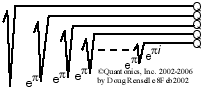
i• . From our Quantonics perspective
it looks like this:
. From our Quantonics perspective
it looks like this:
 |
||
|
p•m omnifferencings
m•p |
• |
|
 )
)
| DQ | - Dynamic Quality |
| MoQ | - Metaphysics of Quality (Pirsig) |
| MoQite | - An adherent of MoQ philosophy |
| MoQland | - Where MoQites philosophically reside |
| O | - Object |
| S | - Subject |
| SODV | - Subjects, Objects, Data, & Values |
| SOM | - Subject-Object Metaphysics |
| SOMite | - An adherent of SOM philosophy |
| SOMland | - Where SOMites philosophically reside |
| SPoV | - Static Pattern of Value |
| SQ | - Static Quality |
| ZMM | - Zen and the Art of Motorcycle Maintenance |
What is wrong with SOM's Boolean logic?
i•. From our Quantonics perspective
it looks like this: |
|
||
|
p•m omnifferencings
m•p |
• |
|
)
 ) classical naïveté!!
| Absolute | Deduction | Heterogeneous | n¤nl¤cal | Reducible |
| Affect | Definite | Homogeneous | No/Not/Negation | Reversible |
| Boolean | Determinate | Homology | Objective | Rhetoric |
| Causal | Dialectic | Ideal | Observable | Schism |
| Coherent | Divisible | Induction | One | Separable |
| Commingle | Distributive | Interrelationships | Paralogy | Tentative |
| C¤mplement | Effect | Isolable | Persistence | Time |
| Commutative | Equal | Length | Preference | Truth |
| Context | Factor[iz]able | l¤cal | Property | Uncertain |
| Contradict | Falsifiable | Many | Quantity | Value |
| Contrafactual | Gravity | Mass | Quality | Zero |
| Item | Term | Presumption |
| Absolute |
Definition: Absolute* ( Also see our Quantonics remediated absolute.)
SOM: SOM presumes that absolute truth is accessible by anthropocentric intellect using rational thought and logic. SOM presumes that, in general, an objective question about any SOM 'object' may be answered unambiguously either true or false. The concept of one universal, knowable truth is axiomatic to SOM. SOM's two prime axioms are:
MoQ: MoQ presumes that singular, absolute truth is n¤t comsistently accessible by finite sentient intellect. A meme of many truths is axiomatic to MoQ.
MoQ's meme of many truths, one may infer many comtexts. In MoQ we can show absolute truth is inaccessible via an uncertainty principle between comsistency and c¤mpleteness of any arbitrary comtext. Per Gödel's Incompleteness Theorems (see Decidable Gödel Meme at The Memes), a more c¤mplete comtext is less comsistent, and a more comsistent comtext is less c¤mplete. In MoQ, an absolute system must be simultaneously c¤mplete and comsistent. By a MoQ uncertainty principle, n¤ comtext is absolute, therefore finite sentient intellect may n¤t comsistently access or assess absolute truth. (Author's note: MoQ's DQ is undefined. We can describe it, but we cann¤t define it. DQ is n¤t a comtext. To make it a comtext would be to define it. MoQ's SQ constitutes l¤cal aggregations of SPoVs in l¤cal quantum comtexts.) |
|
| Boolean |
Definition: Boolean*
SOM: Classical binary logic is used almost exclusively as legacy SOM default rational thought technique. George C. Boole formalized classical binary logic in early-mid 19th century. Its predecessors include:
MoQ: MoQ subsumes Boolean logic as one of its many classes
of logic. From a MoQ perspective SOM thinking is so primitive
that we like to say, "SOM is just a lot of classical Boole."
Quantum reality, as an example, simply cann¤t be described using a very limited SOM-Boolean logic. MoQ on Aristotle's syllogism - Aristotle's laws have deluded SOMites for (~23) centuries! Given input from his antecedents: Parmenides, Plato, Socrates, etc., Aristotle based his syllogism on a Subject-Object reality scission (vis-à-vis a union of S-O and further augmentation as SQ in MoQ). His law of identity assumes ideal logical objects which are ideally measurable and observable, i.e., isolable, separable, individuate. This law holds only approximately in a macro realm and it does n¤t hold at all in a quantum realm. His law of contradiction does n¤t hold in general. Actualized physical patterns of value in a real multiverse commingle, interpenetrate and are actually co-within one another to a greater or lesser extent, in general. His law of an excluded middle does n¤t hold, again, in general for reasons already stated. Yet SOM's delusion goes on. MoQ will bring this delusion to an end during Earth's third millennium. MoQ on schism - MoQ mends SOM's Subject-Object reality schism by unifying all of SOM's S-Os as SQ. SQ constitutes all actualized reality as a single class called Static Patterns of Value. |
|
| Commingle |
Definition: commingle* verb commingled, commingling, commingles verb, intransitive
Synonyms - Interpenetrate, Co-within, etc. SOM: SOM assumes real stuff may be analysed into distinct, separate, individuate 'objective' parts. In SOM, these parts do not commingle or interpenetrate, nor are they co-within one another. Boolean and Aristotelian logics do not work, in general, on parts that commingle and interpenetrate. This conclusion permits aware SOMites to anticipate a collapse of our whole rational foundation of SOM as a premier Western philosophy! MoQ: MoQ assumes reality composes thus:
See our Map of a New Reality. MoQ further assumes that all of DQ commingles, interpenetrates and is co-within SQ. By extension all of SQ may commingle and interpenetrate itself via DQ. |
|
| Distributive |
Definition: distributive*
SOM: SOM assumes a single ascertainable truth in an unlimited universal context. SOM assumes de facto Boolean distributive logic. SOM assumes A*(B+C) = A*B+A*C. MoQ: MoQ assumes many truths and complex quantonic interrelationships among an unlimited number of multiversal comtexts. MoQ subsumes SOM's Boolean logic and also uses other types of n¤n-Boolean, n¤n-distributive logic including:
|
|
| Ideal |
Definition: ideal*
SOM: SOM's ideal is absolute truth in a knowable universe where value is an unworthy subspecies of that assumed absolute truth. MoQ: MoQ's ideal is absolute Quality in a forever changing and thus statically unknowable multiverse where Value reigns over many comtextually relative truths. Truth is a subspecies of Value in MoQ. In MoQ, truths are just one class of emerging and changing Static Patterns of Value. They come in infinite varieties. MoQ tells us that l¤cally, within very limited and less c¤mplete but more comsistent macroworld comtexts — l¤cal ideal, absolute truth may be approached, but n¤t achieved as a limit. This limited absolute truth is always subject to change imposed by DQ and competing islands of truth in MoQ reality. Truth is always a DQ-changeable Static Pattern of Value. (Author's note: SOM philosophy delivers bogus statements of fact. By contrast MoQ's Quality delivers emergence and change. As I said above, "Truth talks — Quality walks!" Doug Renselle.) See our SOM ISMs page on idealism. |
|
| Interrelationships |
Definition: interrelate* verb, transitive & intransitive
SOM: In SOM interrelationships are formal, determinate, classic-Boolean-logical, local, definable, known, etc. In SOM, interrelationships are limited. They may only exist between whole individuated 'objective' parts of larger wholes. SOM's requirement for Boolean logic constrains interrelationships among its parts of wholes. In our Quantonic view, SOM's Boolean requirement derives demonstrably from its underlying presumed philosophy of a subject-object schism. MoQ: In MoQ, interrelationships are quantonic. In MoQ, interrelationships are unlimited. SOM's idea of whole objective 'Parts' fades away and we replace it with Pirsig's Static Patterns of Value (SPoVs). In MoQ SPoVs may be co-within other l¤cal and n¤nl¤cal SPoVs, and they may affect other l¤cal and n¤nl¤cal SPoVs with which they are both co-within and n¤t co-within. SPoVs in MoQ are described and affected by both their observable latching into actuality and their unseeable DQ c¤mplements of which there may be an infinity. We show some n¤n-distributive and other characteristics of quantonic uncertainty interrelationships like this:
Here we see each pair of terms shares complex combinations of uncertainty, c¤mplementarity, complexity, etc. See our new pages on Quantonic notation:
These are dichotomies based upon classical bivalent thought. Space after comma is significant. It shows SOM's classical, innate, Aristotelian assumption of objective locus, separation, isolability, individuicity, analyticity, etc. Not to be cute, but we could show another type of SOM logic like this: fuzz(true, false). In this case fuzzy logic simply moves us from bivalence to infinite-valued SOM logic. Neither approaches quantum logic's more realistic: islandic, n¤n-distributive omnivalence. SOM sees its substance based S-O dichotomy as either/or. Take
any adjective in SOM and consider how SOM interprets it: either/or,
versus, contradictory, opposite, etc. SOM's dialectic cuts all
its language into primitive, bipolar, naive, Church of Reason
pairs. SOM disallows any included middle. A SOM 'thing' is either
evil or good, right or wrong, black or white, up or down, true
or false, etc. SOM is versus thinking. SOM dialectically denies
anything can be both good and evil. |
|
| Isolable |
Definition: isolable* also isolatable ( Also see our Quantonics remediated isolate.)
Synonyms - Separate, Individuate, etc. SOM: SOM assumes its constituent 'objective' parts are isolable, separate, individuate and characterized by properties each part possesses. MoQ: MoQ assumes SQ (all SPoVs in actual reality) is n¤n-isolable from DQ. DQ creates and changes all SPoVs in SQ and thus forms interrelationships among all SPoVs in SQ. MoQ assumes both DQ is in SQ and SQ is in DQ. |
|
| l¤cal |
Definition: l¤cal* ( Also see our Quantonics remediated l¤cal.)
Author's note: in quantum science, we say that l¤cal affects are mediated and that they diminish with distance (i.e., inverse square, et al.). Einstein imposed a requirement that 'local' interactions are limited to light speed, or to say it another way, he told us superluminal interactions are "unreasonable." SOM: In SOM, constituent 'objective' parts are local, and unaffected by properties of nonlocal parts. MoQ: In MoQ, l¤cal and n¤nl¤cal are quantons, with quantonic interrelationships, i.e., quanton(l¤cal,n¤nl¤cal). Static Patterns of Value in MoQ have potential affective interrelationships with all of MoQ reality l¤cally and n¤nl¤cally (latter corresponds to action-at-a-distance also called superluminality in quantum science). |
|
| N¤nl¤cal |
Definition: n¤nl¤cal ( Also see our Quantonics remediated n¤nl¤cal.)
SOM: SOM assumes no action-at-a-distance. Therefore, no nonlocal part may affect any other nonlocal part. MoQ: MoQ assumes all (i.e., DQ-SQ, SQ-DQ, and SQ-SQ) interactions and interrelationships may be both l¤cal and n¤nl¤cal. |
|
| Objective |
Definition: objective* ( Also see our Quantonics remediated object.)
SOM: SOM assumes reality divides into no more than two categories, variously known as: substance-nonsubstance, object-subject, matter-mind, etc. SOM presumes factual, analytic truth flows from unilateral observation of local, isolable properties of local, isolable SOM objects. SOM presumes its objective realm's complement, its subjective realm, offers no objective properties which one may observe, thus its subjective realm is unclassifiable and offers no objective value. MoQ: MoQ reality unifies SOM's subjects and objects into a single class of patterns which constitute one of two MoQ categories: Static Quality. In MoQ use of words 'subjective' and 'objective' only takes users back into SOMland. We try to avoid using these terms except when we are helping SOMites transition into MoQland. Instead of 'subject/object' we call MoQ's constituents of Static Quality, 'Static Patterns of Value (SPoVs).' MoQ presumes value emerges (mediated by DQ) from interpenetrating, co-within, commingling interrelationships among both quanton(l¤cal,n¤nl¤cal) and quanton(isolable,n¤nisolable) SPoVs. In MoQ reality, interrelationships among SPoVs are quantonic. Quantonic interrelationships express at least some following: uncertainty, c¤mplementarity, complexity, etc. |
|
| Observable |
Definition: observable* ( Also see our Quantonics version obsfect.)
SOM: SOM presumes all internal properties of all objects in objective reality are observable in local isolation. MoQ: MoQ presumes all Static Patterns of Value (SPoVs) in actual reality have potential, comtext-dependent quantonic interrelationships with all other SPoVs co-within and via DQ. When a comtext is chosen for observation of a SPoV its c¤mplement(s) are n¤t observable in that particular comtext, but may be observable in other comtext(s). |
|
| *Thanks to MicroSoft Bookshelf and The American Heritage Dictionary of English Language, Third Edition copyright © 1992 by Houghton Mifflin Company. Electronic version licensed from InfoSoft International, Inc. All rights reserved. Terms marked * are from these sources. |