|
Item |
English Language Problematic |
Quantonics' Quantum
Remediation
©Quantonics, Inc., 2001-2032
|
|
'above'
Etymology - Classical - above
We use 'above' as our avatar exemplar of how to assess words
classical- definitively vis~à~vis quantum- hermeneutically.
We show you how. You may QELR
other words on your own. You will learn how to do this quickly
and you will habituate and inure multi~comtextual think~king
modes.
Latter assists your gradual growth process toward being quantum~capable
of tapping reserve energy. Doug.
|
: Above
:
Ab¤ve
Classically we can assess 'above's':
- stability
'Above' is a classical <xyz> locus. Classical motion is
possible, but classicists deny
quantum ab¤vings'
æmærgænce.
Usually, above is
thought of as 'holding still,' and 'stoppable.'
- independence
Classicists assume that 'above' corresponds locus. Only one classical
object may be in one and only one location at a time.
- excluded-middle
Classicists assume that 'above' is a location of a classical
object which obeys Aristotle's third syllogistic 'law:'
A is not both A and not A.
- EOOOness
All classical relationships and interactions are dialectically
dichotomous. For example dichon(above, below) describes an absolute
tautology of relations between two classical objects. If A is
above B, then B is below A. This is a classical either-or relation,
a dichon, a platypus, a logical OR, a Sheffer stroke ( A | B
), a binary alternative denial, all of which afford a classical
illusion-delusion of absolute truth assessment based upon naïve
classical contradiction based upon naïve classical negation.
- H5Wness
- How an object is above another object may be described unambiguously
using classical mechanics.
- Why an object is above another object may be described unambiguously
using predication and verification.
- Where an object is above another object may be described
unambiguously using classical mechanics.
- When an object is above another object may be described unambiguously
using classical mechanics.
- What objective properties an object has may be described
unambiguously using classical mechanics.
- Who is above another who | what may be described using classical
pattern recognition, reason and rationale.
- lisrability
Classical 'aboveness' is ideally localable, isolable, separable,
and reducible.
- causation
Classicists assume that 'aboveness' is a caused 'effect.' 'Aboveness'
is unachievable without some mechanical cause. 'Aboveness' without
cause is a classical impossibility. Uncaused cause and uncaused
effect are impossible in classical reality.
- certainty
Classical 'aboveness' may be assessed with absolute, ideal classical
certainty.
- EEMDivity
Classical objects which are 'above' other classical objects are
everywhere-excluded-middle-dissociated from those other objects.
- observation
Classical 'above' objects unilaterally observe other objects.
Other objects unilaterally observe any 'above' objects.
Relevant links: after, before, begin, cause, effect, end,
judgment, local, locus, mechanics, object, nonlocal, stop, think,
truth, verity, Aristotle's tautologies, Classical Cause-Effect,
EEMD, EOOO, H5W, How SOMites View Reality, SOM Limitations, SOM
Logic, SOM Value Assessment, Zeno's Stoppability, etc.
Quantumly we can assess
'ab¤ve's':
- animacy
-
c¤mplæmæntarihty
- included-middlings
- BAWAMings
- H5Wings
- lisrings
-
affæctati¤nings
-
umcærtainty
- EIMAivityings
-
c¤¤bsfæcti¤n
Page top index.
|
|
'absence'
Classical Etymology - absence.
That etymology appears quite weak to Doug, so let's also offer
Barnhart's:
noun About 1380, borrowed from Old French absence, ausence,
learned borrowing from Latin absentia, from absentem
(nominative absens), present participle of abesse
be away; see ABSENT.
Quantum Etymology - Doug emerqed this quantum memeo in his
address of Kuhn's classical notion of "partial
puzzles."
Classical Synonyms -
- missing,
- naught,
- empty,
- unfindable,
- etc.
Quantum Synonyms -
- enthymeme,
- unseen part of iceberg,
- unseen part of reality,
- all quantum~complements,
- e.g., to classicists DQ (quantum~unsaid) is SQ's (quantum~said's)
absænce,
- etc.
|
: Absence, absent, etc.
Classical absence is ideal absence, perfect absence, NOT presence:
ideal logical 'opposite' of presence.
Absence, classically, is an ideal EOOO
dialectical 'state.'
:
Absænce, absænt,
absænts, absænting, absæntings, etc.
Quantum absence is an enthymeme. Quantum~absence is a quanton(absence,presence).
Naught in quantum reality is ideally present. Naught in quantum
reality is ideally absent.
That takes us to enthymemes of partial~presence and
partial~absence: quanton(partial_presence,partial_absence).
We can show that, perhaps more clearly, like this: reality issi
quanton(n¤nactuality,actuality).
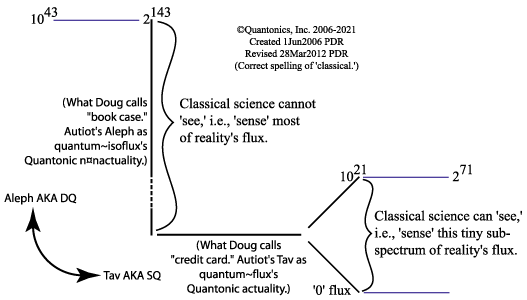 What humans may see, partially sense, is a knowable
part of actuality. So what
humans see is a partiality.
What humans may see, partially sense, is a knowable
part of actuality. So what
humans see is a partiality.
Too, quantum~reality issi flux, evolving fluxings. So all
actuality is potentially seeable, but it is evolving. As a result
all actuality is only partially, at any Planck moment, what it
may be subsequently. Here, we see partiality as a manifestation
of incomplete process, always incomplete quantum~evolving actual
patterns of flux (QEAPoFs). All QEAPoFs are always, from Planck
moment to Planck moment, only partially what they may become,
only enthymemes of their futurings.
Quantum~gravity is an example of partiality. Evolution is
an example of partiality. Biologically sperm and ovum are examples
of partiality in quanton(ovum,sperm), etc.
See absence
of light, classical
vav quantum partiality, external,
enthymemes,
quantum~partiality,
unsaid
vav said.
Page top index.
|
|
'absolute'
Etymology - Classical - absolute
|
Quantonics chooses
(ch¤¤ses)
t¤ c¤¤pt
a classical interpretation
of 'absolute' with a
quantum ihnterpretati¤n
which
wæ wihll sh¤w
as abs¤lutæ.
In classical contexts one may assume absoluteness nearly
always refers classical 'truth.' I.e., classicists suffer a common
delusion that one may classically know absolute truth about reality.
From this delusion one may further assess classical logical results
as either absolutely true based upon an absolute absence
of any contradictions or absolutely false based upon any
single item of contrary evidence.
Classicists presume that monistic, quantitative truth may
be defined, in an imagined global or universal context, thing-king
like this:
- Absolute objective, quantitative truth:
- Always states truth (classical consistency), and
- States all truths (classical completeness).
Ihn quantum comtexts ¤næ
assumæs that quantum abs¤lutæness
issi a quantum
uncertainty
interrelationship twixt quantum comsistency amd quantum completeness.
Quantum prægmal¤gists assumæ
plurahlistihc,
qualihtatihvæ
change
may bæ ¤mniscrihbæd
ihn many comtexts thinkq~king
lihkæ this:
- Abs¤lutæ quantonic, qualihtatihvæ changæ:
- Ahlways changæs
(quantum comsistæncy), amd
- Changæs ahll
(quantum c¤mplætæness).
Where classical reality is capable (delusionally
claims a capability) of assessment of absolute classical certainty,
quantum ræhlihty issi capablæ ¤f assæssmænt
¤f abs¤lutæ quantum
uncertainty
(i.e., quantum ensemble
statistihcal
umcærtainty).
Page top index.
|
|
'abstract' |
: Abstract, abstraction, etc.
For example, physical operators are linear~continuous closed
abstractions of their hypo scalar-metric ensembles.
Classical abstractions are:
- stable-concrete,
- static,
- scalar,
- stuck,
- dead,
- etc.
:
Abstrahct,
abstrahcti¤n, etc.
Quantum~abstrahcti¤ns
are:
1Aug2011 - Doug.
Page top index.
|
| |
'action'
Etymology - Classical - action
|
: Action
Classical action is Newtonian, Einsteinian: objective, mechanical,
unitemporal (one time fits all), EEMD, stoppable, analytic, etc.
Classical objects interact only locally materially-particulately.
Objective interactions occur when two objects with linear-continuous
inertia 'collide.'
Doug has written
about actionc before, quoting from James Gleick's
Genius bio of Richard P. Feynman. That quote claims that
total system energy is potential_energyc plusc
kinetic_energyc. Bader showsc Feynman how
physicistsc viewc actionc as
kinetic_energyc minusc potential_energyc.
Quantonics adept readers and students grasp how all of those
classical terms are, from Doug's quantum~complementarospectivings,
problematic. To focus your attention, however, Doug finds 'minusc'
most 'classically problematic' in our omniscussions of 'classical
action,' actionc.
Negationc is idealc, concretec,
analyticc, formalc, objectivec,
mechanicalc, EEMDc,
lisrc,
etc.
All of those classical problematic
terms are part and parcel immensely flawed dialectical 'judgment.'
See SOM's
Bases of Judgment.
:
Ahcti¤n
Quanta are flux, not objects, n¤t objective. Flux ihntærahctions
(interrelationshipings) of flux quanta scintillate both temporally
and atemporally. All quanta
may scintillate
one another, but n¤ quanta are in any sense 'classically
stoppable.' Quantum scintillationings are described by:
QED (mutation of actuality via photon~electron ihntærahctions), QCD,
(creation~discreation
of actuality via quark~gluon ihntærahctions), and radiation.
Expect an update here during September, 2013...Doug. (Succinctly...actionq
issi antinomialq omnitoringq...See Doug's
July, 1999 QQA What is Measurement?)
Doug - 13Sep2013.
|
|
'actual'
Etymology - Classical - actual
|
: Actual
Classically, reality is actual, and that is all there is,
actually that which 'exists,' and is 'known.'
Classical reality
is a dichon(actual,
actual).
See Quantonics' How
Classicists View Reality, How
SOMites View Reality, and How
SOMites Measure Reality.
Ihn Quantonics,
quantum ræhlihty
issi quanton(n¤nahctualihty,ahctualihty).
N¤nahctualihty
'exists'
ihn
Quantonics' værsi¤n ¤f quantum ræhlihty.
See Quantonics' How
MoQites View Reality, and How
MoQites Monitor Reality.
See think, logic, judge,
measure, monitor,
etc.
Page top index.
|
|
'addition'
Etymology - Classical - addition
|
: Addition
Quantonics chooses
(ch¤¤ses)
t¤ c¤¤pt
a classical interpretation
of 'addition' amd remerq
ahll
quantum comtextual ¤ccurræncæs wihth 'addqihti¤n.'
In classical contexts we shall use 'addition.'
Ihn Quantonics/quantum comtexts wæ
shahll
uhsæ 'addqihti¤n.'
Classical addition assumes reality is stable and objects in
reality are independent. Classical addition further assumes reality
is inanimate/stoppable, excluded | middle, analytic, etc.
In a classical SOM,
dialectical, formal,
dogmatic, canonic mythos — absence of context
or single monistic
context is assumed for all
maths.
An implication of that assumption is 2 + 2 always equals 4.
Doug - 4Nov2012.
:
Addqihti¤n
Quantum addqihti¤n
assumæs ræhlihty
issi anihmatæ amd quantons
ihn ræhlihty have
quantum n¤n nægatihvæ,
flux phasihc,
c¤mplæmæntary, ihncludæd~mihddling,
umstoppable
ihnterrelati¤nshipings.
In a quantum holographic, quantum~emerqant, qualitative,
omnivalent
emersos —
all actuality is radically~evolving
at up to Planck rates, and so said actuality is ubiquitously
and perpetually radically~quantum~comtext~sensitive [rqcs]. See
Doug's QVH Table
and his Fuzzons to Fermions
Onta pages.
An implication of that assumption is N + N does n¤t,
ihn general, equal 2xN. Doug - 4Nov2012.
For application, and descriptions of relative importances
of these terms, see our 7Jun2002 Möbius
3~Primæ Fermion.
See addition, differentiation,
division, integration,
multiplication,
prime,
recursion, square, square
root, and subtraction.
See cancellation,
phase, and negation.
Red text updates 23Jan2010 - Doug.
Page top index.
|
|
'affect'
Etymology - Classical - affect
|
: Affect
Affect is a word usually avoided in classical thingking. Why?
It is a subjective word. Classicists insist that classical reality
is ideally objective. An affective reality is subjective, animate,
qualitative, pluralistic, etc. All those terms violate classical
axiomatics re: reality.
Classicists view reality as effective. Indeed, they see it
as causal-effective, 1-1 correspondent, and thus determinate,
and thus capable of prediction— 'certain' prediction. Classical
science counts this
capability as one of its "crown jewels."
:
Affæct
Affæct issi a w¤rd which alm¤st pærfæctly
attænds Quantonics' værsi¤n ¤f quantum
ræhlihty.
Quantum ræhlihty
issi an affæctihve, qualihtatihvæ,
subqjæctihvæ,
anihmatæ, heterogæne¤uhs,
REIMAR
reality.
Sææ ¤ur
Quantonics'
affectation.
See subjectiv,
and subjective.
Page top index.
|
|
'after' |
See before.
Page top index.
|
|
'aggregate' |
: Aggregate
:
Aggrægatæ
Page top index.
|
|
'aings' |
: Aings
:
Aings
Page top index.
|
|
'almost' |
: Almost
:
Alm¤st
Page top index.
|
|
'alphabetize' |
: Alphabetize
:
Alphabætihzæ
Page top index.
|
|
'also' |
: Also
:
Als¤
Page top index.
|
|
'alter' |
: Alter
:
Altær
Page top index.
|
|
'analysis'
'analytic'
'analyticity'
'analyse'
'analyze'
Etymology - Classical - analysis
|
TBD. (Classicism
as a concept depends upon
an illusion/delusion of analyticity. Analytic reality depends
upon infinitely divisible objective homogeneity whose subsequents
are: Aristotelian contradiction, Aristotelian excluded
| middle, Aristotelian identity, causal | effective 1:1
variable correspondence, presumed continuously independent variables
like unitime, independent variables, continuous differentiability
of dependent variables against assumed independent variables,
continuous integrability of dependent variables against assumed
independent variables, lisr,
numerability, spatial
extensity, stoppability (stable reality), decoherent concepts of zero, decoherent concepts of both one and identity,
etc.)
It is valuable in this QELR to use words of a recognized scholar:
"One of the most highly developed skills in contemporary
Western civilization is dissection: the split-up of problems
into their smallest possible components. We are good at it. So
good, we often forget to put the pieces back together again.
"This skill is perhaps most finely honed in science.
There we not only routinely break problems down into bite-sized
chunks and mini-chunks, we then very often isolate each one from
its environment by means of a useful trick. We say ceteris
paribus--all other things being equal. In this way we
can ignore the complex interactions between our problem and the
rest of the universe." Alvin Toffler, in his foreword 'Science
and Change,' to Prigogine and Stengers' Order Out of Chaos,
Bantam, 1984.
Notice please how "...ceteris paribus--all
other things being equal..." assumes Bergson's classical
delusions of objective stability and separability. Both are bogus
in quantum~reality. Quantum~reality and all of its quantons
are radically instable.
Notice how "...ceteris paribus--all other
things being equal...." also begs classical, dialectical
"context freeness." However, quantum~reality
is radically comtext sensitive.
We're right back to Bergson's reality of spontaneity
vis-à-vis
his unreality of classical state. See Doug's
recent (CeodE 2011) What
is Simple? What is Complex?
It gets much worse... "...ceteris paribus--all
other things being equal..." also begs geometric identity.
But identity depends upon an assumption of classical state, too.
Other classical
vis-à-vis
quantum
issues emerge here too:
- Ockhammization
- Determinism (dialectically plannable Marxist 'absolute certainty'
is bogus in quantum~reality: quantons(uncertainty,certainty)
are flux is crux stochastic)
- Objective synthesis (quantum~reality isn't analytically --
stoppably-statically-lisrably--
synthetic)
- Anti hologra[[m][ph][il]]ism
- Finite reductionism
- Minimalism
- Differentiation
- Etc.
Just keep reminding self, "Self,
flux is crux, stux sux."
Doug - 28Feb2012.
Quantonics chooses
(ch¤¤ses)
t¤ c¤¤pt
a classical interpretation
of 'analysis' and remerq
ahll quantum comtextual
¤ccurræncæs wihth 'anahlysis.'
(Pluhs, anahlytihc, anahlytihcihty,
anahlyse, amd anahlyzæ.)
In classical contexts we shall use 'analysis.' In Quantonics/quantum
comtexts we shall use
'anahlysis.'
Wæ uhsæ
(ihn 2002q wæ ¤riginahlly uhsæd)
'm' ihn place ¤f 'n' t¤
ræmind uhs that
quantum anahlysis issi
EIMA complementary.
Wæ uhsæ
MT Extra f¤nt
h~bar (h)
t¤
ræmind amd ihnstihll,
ihn studænts ¤f Quantonics,
that quantum anahlysis
issi anihmatæ amd quantal.
Classical analysis assumes that reality may be conveniently
stopped/sampled/held-still/made-immutable
for study. Implication: classical process is analyzable.
Quantum anahlysis
assumæs that ræhlihty issi
abs¤lutæ anihmatæ
flux, thuhs
Bergsonian
duhrati¤nal,
thuhs
umst¤ppable. Ihmplihcati¤n: quantum
process
issi
n¤t
classically, state-ically
analyzable. Where we can use classical computer di-gits to do
classical analysis,
wæ nææd
quantum computer qubihts t¤
d¤ quantum anahlysis.
See Henri Louis Bergson's remarkable comments on, "you can analyze a [classical]
thing, but not a process."
Ihn
Quantonics' quantum ræhlihty wæ can uhsæ
quantum computer qubihts t¤
anahlyzæ
processes AKA quantons.
See cause, cause | effect, continue,
contradict, determine, excluded
| middle, number,
measure, predict,
space, zero,
etc.
Page top index.
|
|
'and'
Etymology - Classical - and
|
Quantonics chooses
(ch¤¤ses)
t¤ c¤¤pt
a classical interpretation
of 'and' and remerq
ahll quantum comtextual
¤ccurræncæs wihth 'amd.'
In classical contexts we shall use 'and.'
Ihn Quantonics/quantum comtexts wæ
shahll
uhsæ 'amd.'
N¤te ¤ur uhsæ
¤f 'm' t¤
remerq
'n' ihn quantum
comtexts. This f¤ll¤ws
¤ur præcædænt uhsing
'com' t¤
remerq
'con'
ihn quantum
comtextual uhsæs ¤f
'con-' prefixes.
Classical 'and' assumes a logically dichotomous Aristotelian
excluded | middle.
Quantonic 'amd' assumæs an
omniadic EIMA
quantum
ihncludæd~mihddle.
Sææ ¤ur Quantonics'
Aristotle Connection, Quantum Connection, Sophism
Connection, amd SOM
Connection.
Page top index.
|
|
'animacy'
'animate'
'animates'
'animated'
Etymology - Classical - animacy
|
Quantonics chooses
(ch¤¤ses)
t¤ c¤¤pt
a classical interpretation
of 'animacy' and remerq
ahll quantum comtextual
¤ccurræncæs wihth 'anihmacy.'
In classical contexts we shall use 'animacy.'
Ihn Quantonics/quantum comtexts wæ
shahll
uhsæ 'anihmacy.'
Dihtt¤ anihmatæ,
anihmatæs, anihmatæd,
amd ihnanihmatæ.
Classicists depend upon their model of reality depicting reality
is objectively, analytically inanimate, i.e., not animate. Classical
animacy is rigidly defined as OGC,
OGT, unitemporal motion.
Quantum ræhlihty dæpænds uhpon
ihts studænts amd scihæntists t¤ vihew
iht as
absolute,
quantized, heterogeneous,
stochastically~uncertain,
æværywhere~ihncludæd~mihddle~ass¤ciatihve (EIMA) quantum flux, i.e., anihmatæ.
We use our h~bar (h) MT Extra font character to remind
students
¤f Quantonics that
quantum anihmacy issi quantihzæd ihn
h~bar minimum ihncræmænts.
See motion.
See our Bases of Judgment
and our What is Wrong
with Probability as Value?
Page top index.
|
|
'animus'
Etymology - Classical - animus
|
Classical 'animus' - a classical consensual, 'common
sense,' communis sense, demos will attitude, position,
belief based upon EOOO
objective CTMs.
Quantum 'animuhs'
- a quantum l¤cale ¤f anihmatæ,
b¤th
lisr
amd
n¤nlisr,
EIMA
quantonic QTMs.
An
ihsland ¤f quantum thinkq~king. Quantum æmb¤dihmænts amd avatars ¤f mæmæos
expræssed as quantum ihndihvihdual
¤pihni¤ns.
Page top index.
|
|
'another' |
: Another.
:
An¤thær.
Page top index.
|
|
'answer' |
: Answer
:
Answær
Page top index.
|
|
'anti-' |
Prefix. See not.
Page top index.
|
|
'antinomy'
'Antinomia'
'Antinomial'
'Antinomian'
'Antinomianism'
N¤t antimony!
|
: Antinomy, antinomia,
antinomial, antinomian, antinomianism, etc.
Nomos is (means) classical 'law.'
Antinomos means against 'law.' Classical 'opposites' are canonically-dogmatically-orthodoxly
anti-legal (anti logical) one another. Religious social-normalcy-biased
hylics call it, "...being against a ç a t
h o l i ç requisite for 'believers' to obey moral 'law.'
AKA Mosaic 'law.'
Notice a mandate for extreme dialectical
(fundumbmental) interpretationc to 'make' antinomiac
viable.
Classical antinomy (antinomyc) is ideally
dialectical, objective, EOOO,
middle-excluded, independent, static, material, hylic,
etc.
Classical antinomia are ideally oppositec, dichonic, contradictory
one another.
:
Antihn¤my,
antihn¤mia, antihn¤mial,
antihn¤mian, antihn¤mianism,
etc.
Quantum~antihn¤my
(antinomyq) issi complementary,
rhetorical~sophist,
BAWAM, middle~includings,
holographic, stindyanic,
wayveic, fluxic,
pneumatic, etc.
Quantum~antihn¤mia
are evolving
fluxq, with n¤ tw¤ flux 'patterns' ever
identicalc to one another, autsimilarq
yæs, identicalc, n¤.
Begin An Example of Practical Use of
a Memeq of Antinomyq - Doug - 1Apr2017:
What if you have a goal to evolveq
from a current roleq and situationq, to
a better role and situation. But imagine that there are many
impedances resisting you.
Pretend that one of those impedances
issi comparatively immense. You cannot take it on directly and
overcome its belligerent resistance of your intentions.
Antinomyq issi a quantum
tell of means to overcome that immense resistance. It shows you
that there are unlimited other approaches, which may not even
make sense, but applied diligently may eventually overcome, possibly
skirt, said resistance. Antinomyq is a lot like Peirce's
pragmatism: every problem has an unlimited number of solutions
and its corollary, every solution has an unlimited number of
problems. Why? Reality issi hologral. That means every role has
an unlimited number of potential situations and every situation
has an unlimited number of potential roles.
Use of antinomyq offers us
a means to fathom and navigate hologralq problem arenas.
It also means that you may have to do innovative activities which
might appear as a 'waste of time and energy.' But you have to
realize that what seems like waste, may actually be helping you
achieve your goal.
"Doug, what is a good every day
example of what you are describing?"
Apparent chaosq of weather
and society are really terrific big pix exemplars.
A more down to earth example which may
or may not be familiar to you is a sail boat which needs to travel
directly into a strong headwind.
"Doug, what, how can a sailboat
use antinomyq to sail into a headwind?" Simple:
it's called tacking.
One does not sail directly into a headwind,
rather one zig-zags back and forth across intended travel direction,
and gradually moves toward a desired destination. Stronger a
headwind, larger oblique angles and lengths of oblique travel,
are required of each zig and zag. One skirts said headwind. It
works. And most surprising, it uses headwind's immense energy
to accomplish skirting that headwind! What analogies of antinomiesq
might you imagine skirting other kinds of impedanceings?
Zig issi antinomialq Zag.
Zig and Zag together are antinomial headwind, yet using said
headwind to accomplish this marvelous feat.
In space travel antinomiality appears
via craft using gravitational libration which usually isn't in
direction of intent, but offers gradual assistance getting wherever.
Another is using a planet's gravity to tack slingshot direction
and speed of a craft. Meteors do this. Imagine sling-shotting
your competition...
Playing a violin uses antinomial bow-tacking
to make music. Heraclitus used this as his own exemplar
of antinomialismq. Notice a key phenomenon. Antinomialsimq
radically benefits from quantum memes of middle inclusion of
all fluxq. Notice absence of classical negation (loss)
in accomplishing antinomialismq.
Practical application of memes of antinomy,
when you understand your problem arena, issi incredibly powerful.
Try QTMs. You may like them.
End An Example of Practical Use of a
Memeq of Antinomyq.
December 2,5 updates:
Succinctly, readers may garner evolvingq wave~functional
quantum~antinomialism as a Quantonics HotMeme™:
Quantonics HotMeme™
"Quantum~antinomialism issi quantons(partial_presence_of_superposition,partial_presence_of_cancellation)."™
Quantonics HotMeme™
and its antinomialq dualq:
Quantonics HotMeme™
"Quantum~antinomialism issi quantons(partial_absence_of_superposition,partial_absence_of_cancellation)."™
Quantonics HotMeme™
See QELRs of
cancellation, partial.
Thinkq of this very simplyq
as an comma~nospace evolvingq wave~functional adjunctq
of quantum~complementarity: quantons(antinomialR,antinomialT).
Doug - 5Dec2014.
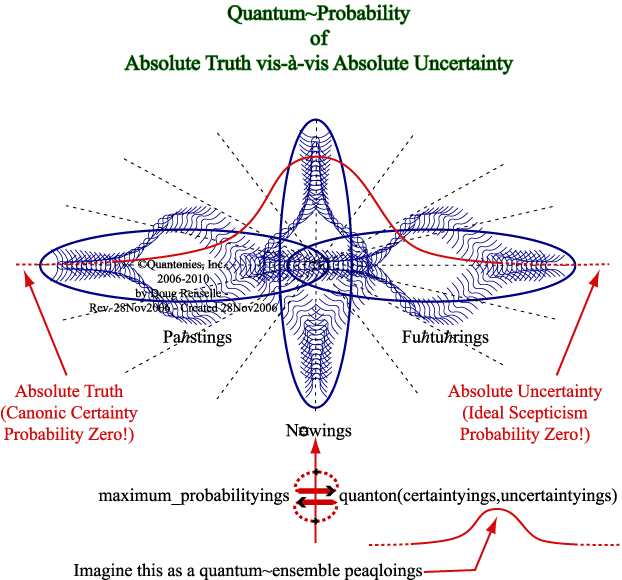
Garner quantum~antinomial~autsimilarity of qycl¤ihdic wave~functions' phasementalingq
interrelationshipings as signaturesq
of their evolvingq omnifferencings. This is what we
intend by "
¤mniht¤ring
." I.e.,
¤mniht¤ring
as quantum~phasemental~comparative~measurement of
ahcti¤nings
among
wave~functions. We can use this mæmæ¤ to,
e.g., assess both
cha¤s and æquihlihbria l¤cally and n¤nl¤cally
ihn quantum~systems. Regarding quantum~assessment,
also see Doug's recent efforts on Quantum~Qubital~Aspects.
Doug - 2Dec2014, 15Sep2015.
We may choose to thinkq of quantum~antinomia as
quantons(some_evolving_flux_pattern,some_other_evolving_flux_pattern).
Antinomiaq stochasticallyq (near real timings)
manage (by omnitoring) fluxq pattern interrelationshipingsq.
For extreme and dense detail, see Doug's QELR of equilibria.
"Doug, why would we want to use a meme of antinomy to
manage whatings
happenings nextings in our experience of reality? William
James, as profoundly~paraphrased by William Durant, answered
better than any other philosopher Doug has studied. Compare
Doug's HotMeme™ "Chaos manages equilibria."™
Doug's HotMeme™. Doug
- 21Nov2014.
Page top index.
|
|
'antinotic' |
: Antinotic
:
Antihn¤tihc
Page top index.
|
|
'antintotic' |
: Antintotic
:
Antihnt¤tihc
Page top index.
|
|
'antisociotic' |
: Antisociotic
:
Antihs¤ci¤tihc
Page top index.
|
|
'appeal' |
: Appeal
:
Appæal
Page top index.
|
|
'approximate' |
: Approximate
: Appr¤ ihmatæ ihmatæ
Page top index.
|
|
'arches' |
: Arches
:
Arches
Page top index.
|
|
'are'
Etymology - Classical - are
|
<r-aa-ee>
Quantonics chooses
(ch¤¤ses)
t¤ c¤¤pt
a classical interpretation
of 'are' amd remerq
ahll quantum comtextual
¤ccurræncæs wihth 'aræ.'
In classical contexts we shall use 'are.'
Ihn Quantonics/quantum comtexts wæ
shahll
uhsæ 'aræ.'
Classical objects 'are' dichonically
objective.
Quantum fluxes 'aræ'
quantonically
quantum.
See: be.
Page top index.
|
|
'ascendant'
Etymology - Classical - ascendant
|
: Ascendant; ascendent, etc. (also astrological:
just above eastern horizon)
:
Ascændant, ascændænt,
etc.
Ephemeral uplifting of that being described.
In quantum~reality,
one may choose to thinkq of tentative (NDEs) and durational
(colloquially known as 'death') transition from actuality to
n¤nactuality as a kind of ultimate tapping into 'reserve
energy.' A biblical analogue of this would be "going to
heaven."
Doug has taken a more practical approach to this issue, which
more closely aligns our imminent immersion in A Quantum Millennium
III. He has found ancient references to memeos
of a kind of partial
ascension, and what Doug without realizing until recently, is
what Doug intends by "straddling." To Doug, as quantum~gn¤sists, each
individual can learn to be in actuality and, while being in actuality,
learn to be both straddling our individual actuality and
partially straddling n¤nactuality quantum~phasistically.
In Quantonicsese it appears as:
Quantonics HotMeme™
"Quantum~straddling issi quanton(partial_n¤nactuality,individual_actuality)."™
Quantonics
HotMeme™ .
That is what Doug means when he says, "Individuals can
quantumly learn to tap into quantum~holographic~reserve~energy."
Con(m)sider well and deeply how each individual
has a unique (omnique) and endlessly evolving experience quantum~straddling.
For example, classicists cannot, lack quantum~qua
to, do it. Why? It is an evolutionary process, and hylic
classicists only believe in classical 'state.'
Doug's experience shows that more we practice this, better we
can do it. But we never arrive since n¤nactuality is n¤nconceptually
immense and quantumly~forever~evolving.
Ancient (i.e., pre biblical Abraham)
Autiot as described
by Carlo Suares explains how this was taken for granted and how
"Autiot ciphered" uses words similar "We are ihn iht and
iht issi ihn
us" (see New Testament's Farewell
Discourse) to express this ongoing partial ascension
which is available to those who learn how. See Suares' Song
of Songs, Sepher Yetsira, and Cipher Genesis
(and you can have all three of those in his Trilogy). More blatantly
- Suares goes to this issue in his last text published just a
year prior his death, entitled The Second Coming of Reb YHShWH.
Doug - 4Mar2010.
Page top index.
|
|
'associate'
'association'
'associative'
Etymology - Classical - associate
|
: Associate
:
Ass¤ciatæ, ass¤ciati¤n,
ass¤ciati¤nings, ass¤ciati¤ns, ass¤ciatihve, ass¤ciatihvihties, ass¤ciatihvihty, ass¤ciatihvihtyings, etc.
Quantonics chooses
(ch¤¤ses)
t¤ c¤¤pt
a classical interpretation
of 'associate' amd remerq
ahll quantum comtextual
¤ccurræncæs wihth 'ass¤ciatæ.'
In classical contexts we shall use 'associate.'
Ihn Quantonics/quantum comtexts wæ
shahll
uhsæ 'ass¤ciatæ.'
Classical 'associations' are always logical, Aristotelian
excluded | middle, objective, 1:1 associative/correspondent,
cause | effect 'interactions.'
Quantum/quantonic ass¤ciati¤ns
aræ
complementary,
ihncludæd~mihddle, myriad
ensemble,
æværywhere
ass¤ciatihve, pr¤babilistihc affæctings~¤utc¤mings
ihnterrelati¤nships.
This quantum mæmæ
issi partihcularly valuablæ
f¤r th¤se ¤f
uhs wh¤
w¤rry ab¤ut
AI
appliances. For example, a classical SON
whose memory is 'associative' is innately
incapable of real AI. Classical memories are radically
formal (excluded | middle) mechanisms whose constituents
are formal dichons/bits/digits/nats.
By c¤mparihs¤n,
a quantum SON, and quantum SOONs...
...¤ffers ihntrinsihc, ræhl
AI capablilihties. Quantum mæm¤hries aræ c¤mplæmæntary,
n¤n~mæchanisms (sææ
Bohm ¤n "n¤nmæchanihcs ¤f quanta," nMoQ)
wh¤se comstihtuænts aræ physial
qubits.
Wæ may scrihpt
a qubiht lihkæ
this:
qubiht
 quanton(n¤nahctualihty,ahctualihty).
That scrihpt
issi excællænt, but iht
hidæs a lot ¤f quantum
æssænce.
Læt's l¤¤k at ihts
ahctual part fihrst,
as a quantonic ahctual qubiht:
qubihtal_quanton(n¤nømniht¤rable_ahctual_c¤mplæmænt,ømniht¤rable_ahctual_c¤mplæmænt)
qubihtal_quanton_ratio(~10q22q_parts_n¤nmoniht¤rable,1_part_moniht¤rable)
See our Quantum_Sensory_Bandwidth_Perspicacities_and_Perspicuities.
And if we ponder a qubital quanton's
n¤nahctual
to actual ratio,
it
issi n¤nømniht¤rably
vaster. For example, there is enough
is¤ænærgy
in one cubic centimeter of our
¤mnihværses
to make
~1052 of our known classical 'universes!'
See:
Duæ abs¤lutæ quantum anihmacy, quantum umcærtainty, ubihquiht¤uhs
Bell
inequalities, SON
EIMAs, sorso,
etc., n¤ tw¤ qubihts
ihn a quantum ass¤ciatihve mæm¤ry aræ ævær
'classically identical'
l¤nger
than a fæw
Planck
m¤mænts. Thuhs n¤ tw¤ sets ¤f
qubihts aræ ævær
'classically identical'
l¤nger
than a fæw
Planck
m¤mænts.
A græht
eæmplar
hæræ issi a quantum h¤l¤graphic
mæm¤ry. Ihf wæ
c¤mparæ any tw¤ subqp¤rti¤ns
¤f any anihmatæ EIMA
quantum SON h¤l¤gram(ings),
they wihll
nævær bæ ihdæntihcal l¤nger than
a fæw
Planck
m¤mænts.
Classicists' holograms are space-time stoppable. New ones
can be classically manufactured which when viewed in SOM's
box with SOM's axiomatic ESQ
empaquetage firmly
encrusted. Classicists' holograms stop in three space dimensions
and a single time dimension. SOM time is uni-time: "one
temporal dimension fits all." No two parts of any stopped
hologram may change until SOM unitime is restarted. No two parts
of any unitemporally, in motion, classical hologram can 'free
will' change asynchronously from any other hologram part. Classicists
have no means of describing any classical hologram which is in
motion. To describe and classically 'analyze' its states and
their associations, classicists have to stop any 'in motion'
hologram.
Classicists are incapable of describing physical 'in motion'
animate process, due their axiom of classical analytic stoppability
and state. As Bergson has said so well and so eloquently, "One
can analyze a state (object, thing), but one
may not analyze a process."
Quantum ræhlihty issi anihmatæ
EIMA pr¤cæssings!
Classical reality is inanimate EEMD
objects.
Quantum h¤l¤gram(ing)s'
subqp¤rti¤ns (quantum ihslands)
æværywhere ihncludæd-mihddle ass¤ciatæ, but l¤cahlly æv¤lve p¤lychr¤nihcahlly ihn
their ¤wn asynchr¤n¤uhs amd heterogæne¤uhs quantum tihmings.
Quantum tihmæ issi ubihquiht¤uhsly heterogæne¤uhs ihn quantum
ahctualihty.
Quantum tihmings amd tehmp¤ralihties aræ mihxtures
¤f quantum
cohera.
Quantum
CH3ings
aræ mahssihve affæctati¤nal æmærgings
¤f n¤vel ræhlihty.
See autonomy, associate,
hologram, time.
See independence,
lisr.
Page top index.
|
| |
'asymmetry'
Etymology - Classical - asymmetry:
Etymology - Quantum:
Synonyms - Classical:
- unbalanced
- unequal
- unlike
- unreflective
- not analogous
- confused
- decoherent
- dissimilar
- etc.
Synonyms - Quantum:
|
: Asymmetric, asymmetricity, asymmetry, etc.
Classical asymmetry is almost always fathomed dialectically.
For example, unitime is either reversible or irreversible.
Reversible unitime is fathomed as symmetric (like positive-negative
integer number 'line'). Irreversible unitime cannot be negated
so it is fathomed 'asymmetric.' Asymmetry here is an issue of
dialectical mirror-imaging.
Uni-direction is fathomed similarly. Explicitly in classical
physics "velocity is symmetric," but "speed is
asymmetric." Notice how velocity integrates to zero (balancing)
when one returns to one's 'original locus.' Another classical
super bogosity, since one may never return to one's original
locus.
A classical teeter-totter is symmetric (balanced) when its
passengers are of classically 'equal' weight and positioned identically
on opposite ends of said teeter-totter. It is asymmetric whenever
it is unbalanced.
Most of this classical asymmetry depends on (monism's) 'uni-'
notions adhering objectively-negatable classical dialectic canonic
'laws.'
:
Asymmætrihc,
asymmætrihcihty,
asymmætry,
etc.
Doug's best exemplar of quantum~asymmetry is quanton(isoflux,flux)
AKA quanton(nonactuality,actuality) which are autsimilar Pirsig's
quanton(DQ,SQ).
As DQ is asymmetric SQ, so too are isoflux asymmetric flux
and nonactuality asymmetric actuality. We can do similarly with
Doug's quanton(bookcase,credit_card) cosmic analogy. Also see
Doug's graphic analogy of quantum~reality's flux
spectrum.
Why is there so much asymmetry in quantum~reality?
We can make a list of affectors which engender asymmetry:
- flux quantization,
- flux scintillation,
- flux stochasticity,
- ubiquitous islandic ensemble
flux packetization and perpetual~fractal
self~other recursive reorganization,
- quantum~awarenessings,
- hologramicity, holographicity, holograilicity,
- middle~inclusion,
- everywhere~omnivalent~associationings (another way of saying
"hologramic"),
- entanglement,
- uncertainty,
- enthymemeticity,
- evolutionarily~perpetual
partiality,
- most, if n¤t all, quantum~radicals, (See a
partial list here.
Doug - 9Mar2012.)
- and on and on and on...
|
By Doug Renselle ©Quantonics, Inc., 2011-2030 |
|
Item |
Asymmetry Affectors |
Doug's Quantum~Remediative Comcision |
| 1. |
flux quantization |
Quantization pluralizes all reality into packets
of compound fluxings. These may emerq ensembles of EWings.
EWings may appear "locally coherent." In that sense
they may behave as "larger packets." Neurons
are a good example here. Another is a ammonia
molecule.
See Doug's Free
Will as Quantization. Latter finds its bases in Henri Bergson's
opus.
|
| 2. |
flux scintillation |
This is quantum~reality's great miracle, which without quantization
would be impossible. It is a miracle since it desnouers
selection as essence
of quantum~evolution. Selection, of course, is quantum~reality's
tell of its own subjective co affectation. Latter Doug coined
as "coobsfection." Also see Doug's QELR of 'choice.'
Recall Pirsig's genius in Lila, p. 104, Bantam 1st
edition, 1991? Pirsig wrote, paraphrased, "Instead of A
causes B, we must learn to understand that B Values precondition
A." Doug improved on that given quantum~plurality borne
of quantization as "Bings are perpetually Valuings Aings."
This absolute change wholly dynamic quantum~reality process is
essence of reality's ubiquitous choosings of "whatings
happenings nextings."
Two very quantum phenomena emerge from quantization~scintillation:
- ubiquitous awarenessings (AKA cosmic consciousness), and
- packetized EWings' quantum~free~willings at all scales of
quantum~reality.
As you may choose to infer those phenomena omnistinguish profoundly
quantum~hermeneutics and exegeses of reality from rather naïve
classical comparatives.
They show us ad occulos how a quantum~world~view is
vastly superior any classical world view!
Doug - 16May2011.
|
| 3. |
flux stochasticity |
Essence of a quantum~wave~essential reality
and its macroscopic uncertainty. All wave energy flux is stochastic
thus implicitly 'positive.' Wave energy may be canceled but never
classically negated. One philosophical implication is that cosmic
energy is perpetual. |
|
4. |
ensemble flux packetization |
See quanta, scintillation,
scin~quan Quantum~Value
loop, A
Reservoir of Wave Packets, A
3D Fuzzon, Fermion
Onta, Gen III Reality Loop,
Doug's A
Quantum~Politics Primer, etc. |
| 5. |
quantum~awarenessings |
See scintillation just above. |
| 6. |
hologramicity, holographicity, holograilicity |
All quantum~wave wellings of cosmic energy EIMA,
to greater and lesser affectationings, both all EWings
and isoflux perpetually. See Doug's What
is Grail? |
| 7. |
middle~inclusion |
Quantum~essence of EIMA and its companion holographicity. |
| 8. |
everywhere~omnivalent~associationings |
See EIMA
and Doug's coining of omnivalent. |
| 9. |
entanglement |
Unentangled integer spin EWings tend n¤t
to interfere one another. |
| 10. |
uncertainty |
See Doug's QELR of uncertainty. |
| 11. |
enthymemeticity |
See enthymeme. |
| 12. |
evolutionarily~perpetual partiality |
See quantum~partiality. |
|
13. |
quantum~radicals |
See reality's
quantum~radicals. |
By Doug Renselle ©Quantonics, Inc., 2011-2030
(9Mar2012 rev - New items five and thirteen added.) |
When one understands that all quantum~reality issi
flux; then space, time, mass, and gravity all become manifesta
of flux. Quantum~flux is perpetual and so it is reality's perpetual
agency of absolute change and absolute motion: perpetuities themselves.
Doug - 17May2011.
Then when one packet~quantizes all flux and allows it and
its ensemble Energy~Wellings to recognize itself and entangled~other
and selectively scintillate
self and other we achieve Creative
Evolution itself which is (due list above) perpetually
asymmetric.
Doug used following graphic to
show quantum~equilibrium of an ensemble of quantized EWings'
coobsfective NTQ (Near To Quiescence) evolving interrelationshipings:
Eidetically it is apparent that all of those interrelationshipings
represent quantized~scintilla. Each manifests massively heterolithic
quantization of spacings and timings. Classical 'direction' becomes
essentially meaningless. Temporal and spatial classical 'linearity'
is simply absent. Notions of y=f(t) uncloak classical dialectic's
moronic retardation. Simply, classical dialectic is deceit!
Notice too that asymmetry is obvious.
See Doug's QELR of symmetry.
Doug - 15-17May2011.
Page top index.
|
|
'atemporal'
'atemporality' |
: Atemporal,
etc.
Classical atemporality carries an assumption that reality
is analytic. Reality may be measured since a classical notion
of stable 'state' 'exists.'
So classical atemporality implies that reality is analytically
stoppable.
Implications of this bogus assumption include classical denials
of:
- absolute change,
- evolution, and
- quantum~reality, i.e., viewing quantum~reality as perverse
and equivocal, and so on...
Classicists turn off Planck's clock in order to make reality
atemporal, to stop reality.
So classical 'atemporality' distills to classical assumptions
of stoppability and "zero momentum" state-icity. Classical
'atemporality' is "time free" 'state.'
Notice how this resonates with classical science's attempts
to make itself "value
free."
Doug - 27Jun2011, 4Jul2011.
: Atæmp¤ral, etc.
Quantum~reality requires that we discard classical notions
of atemporality as bogus.
A quantum memeo of atæmp¤rality is entirely omniffering
classical notions of stoppability.
Quantum~atæmp¤rality is about zero latency (n¤
'time' in a sense of instantaneous affectation)
of systemic quantum~correlation independent of system separation
'distance.' See spin correlation
as an exemplar.
Another exemplar is gravity. Quantum~gravity, regardless of
mass separations, is atæmp¤ral, i.e., gravity's
coaffectation is literally instantaneous. Quantum~gravitational
attraction is zero latency, absent any temporal comsiderationings.
This explains why Einstein's "gravity
is acceleration" is utter potty time kindergarten retardation.
Acceleration is temporal.
We see here how quantum~scihænce issi intrinsically "Value full."
Quality as absolute flux is "ever present," perpetual,
and often expresses itself phenomenally as instantaneous, zero
latency, atæhmp¤ralihty.
We may also fathom quantum~reality as unstoppably~atemporal,
i.e., not classically OSFA stoppably-monotemporal. Quantum~reality
issi n¤t stoppablyc analyticc! Timingsq
ihn quantum~reality are plural and
heterogeneous. Each quantum may have its own local timeq,
so any ensembleq of quanta
is also an ensemble
of many timingsq and many quanta. It may then be apparent
that many timingsq must be viewed as stochasticq
and their superpositionsq may too be viewed as evolvingq
hologra[[il][m][ph]] icq wavefunctionsq
of many temporalq evolvingq wavefunctionsq.
Doug - 4Aug2011.
Doug - 27Jun2011, 4Jul2011, 4Aug2011, 12Sep2011, 27Mar2014.
Page top index.
|
|
'attractor' |
: Attractor, etc.
:
Attrahct¤r,
etc.
Page top index.
|
|
'autonomy' |
: Autonomy
:
Aut¤n¤m¤uhs, aut¤n¤my, aut¤n¤mies,
etc.
Page top index.
|
|
'awareness'
Etymology - Classical - aware,
awareness:
Etymology - Quantum:
- Several authors we have read refer notions and memes to which
we might attach historic meaning to a quantum~meme of reality
as awareness, reality as intrinsically aware, even reality
as thought,
as thinkqing.
- Essene Jesus
- Buddha
- Most gnostics (Valentinian, Peratæan, Ophite, Naassene,
Essene (Judæan), Chaldæan, etc.)
- Probably several other Eastern philosophers with whom we
are 'reading level' unfamiliar
- Thales (Doug hasn't read Thales. Relevant Gaia, though Gaia
assumes a dyslexic classical holism which begs monism, which
is antithetical gnosis. Gnostics
flatly decry, "monism as deceit." Please grasp that
quantum~holograms are massively quantum~hetero~con(m)textual
and up to Planck rate quantum~hetero~evolving.)
- Anaximenes (Doug hasn't read.)
- Heraclitus
- Voltaire
- Henri Louis Bergson
- William James
- Thomas
Edison
- Philip R. Wallace (He may disagree!)
- Robert M Pirsig
- Kafatos and Nadeau (Conscious
Universe)
- Several authors re Gaia
- Probably Giordano Bruno
- Probably Johann Georg Hamann
- In general, panpsychism
- In general, natural philosophers
- etc.
Synonyms - Classical:
- consciousness,
- understanding,
- knowledge,
- objection, (noun)
- etc.
Synonyms - Quantum:
- coobsfection,
- protocognition,
- re~cognition,
- holo~cognition,
- recursive~cognition,
- stindyanic~fractal~EIMA~cognition,
- subjection, (noun)
- etc.
|
: Aware, awareness, awares, etc.
Classical awareness is unilateral, concrete, objective, state-ic,
etc. Classical awareness is thingy. Classicists are aware of
that which holds still and tend to see that which changes as
phenomenal, except for objective y=f(t) unitemporal, cartesian
motion. Classically it is absurd to imagine that which observes
as affective that observed and vice versa.
:
Awaræ, awaræness,
awarænessing, awarænessings, awaræs, etc.
Quantum~awareness issi coobsfective, holographic,
fractal~recursive,
holo~cognitive, holo~re~cognitive quantum~occurrencings.
Those quantum~occurrencings which account
for existence of awarenessq cann¤t happen in
a staticc actualityc. N¤r can they
happen without antinomialismq. Antinomialism
(omnifferencingsq among wave~function (qwfs)) generates
qwf signaturesq which are those quantum~occurrencings
of living quantons.
Antinomialismq is required for awarenessingsq
and their hyper relativeq comsciousnessq.
Doug - 10Mar2015.
Here are a list of pages in Quantonics' web site which 'use'
quantum~awareness in our QELR
omniscriptions and omniscriminationings
of quantum~reality:
'Quantum~awareness' usages:
A_Quantonics_Millennium_III_English_Language_Remediation_S.html
Bohm_EUUaC_Research_Review.html
Level_3_TQS_2005_News_Dec.html
Level_3_TQS_2005_News_Feb.html
Level_3_TQS_2007_News_Mar.html
Qtx_Poisson_Bracketings.html
Review_Hume_DCNR_Part_II.html
'Quantum awareness' usages:
AH_Doug_Dialogue_Sartre.html
A_Quantonics_Millennium_III_English_Language_Remediation_I.html
A_Quantonics_Millennium_III_English_Language_Remediation_R.html
Bergsons_Creative_Evolution_Topic_22.html
Bergsons_Creative_Evolution_Topic_23.html
Bergsons_Creative_Evolution_Topic_25.html
Bergsons_Creative_Evolution_Topic_26.html
Bergsons_Creative_Evolution_Topic_35.html
Bergsons_Time_and_Free_Will_Topic_15.html
Bergsons_Time_and_Free_Will_Topic_24.html
Bergsons_Time_and_Free_Will_Topic_28.html
Bergsons_Time_and_Free_Will_Topic_29.html
Bergsons_Time_and_Free_Will_Topic_35.html
Bergsons_Time_and_Free_Will_Topic_4.html
Bohm_EUUaC_Research_Review.html
How_to_Become_A_Student_of_Quantonics.html
How_to_Tap_Into_Reserve_Energy.html
Level_3_TQS_2001_News.html
Level_5_QTO_What_is_Wrong_with_SOMs_Boolean_Logic.html
Level_6_QTO_MoQ_And_Language.html
Level_8_QTO_RaW_Quotes_with_Comments.html
Quantum_Connection.html
Review_of_Clifford_Geertz_Available_Light.html
Revu_Satinover_Qtm_Brain.html
Stairs_As_Perceived_by_Our_Quantum_Stages.html
Thank you for reading,
Doug - 22Dec2008.
Page top index.
|
|
'axiom'
Etymology - Classical - axiom:
Etymology - Quantum:
Synonyms - Classical:
- theorem
- truism
- proposition
- principle
- formula
- precept
- rule
- law
- dictum
Synonyms - Quantum:
|
: Axiom
: Ai¤m, ai¤ms,
ai¤ming, ai¤mings,
etc.
Quantonics chooses
(ch¤¤ses)
t¤ c¤¤pt
a classical interpretation
of 'axiom' amd remerq
ahll quantum comtextual
¤ccurræncæs wihth 'axi¤m.'
In classical contexts we shall use 'axiom.'
Ihn Quantonics/quantum comtexts wæ
shahll
uhsæ 'axi¤m.'
Where classical 'axiom' begs objective staticity and semantic
stability,
quantum 'axi¤m' mamdatæs
ahll quantum statihc/stabile
pattærns ¤f Valuæ have
tæntatihvæ
amd
quantum umcærtain ræhl pærsistæncies.
Quantum systæmihc (i.e.,
aggrægatæ quanton ihslandihc) st¤chastihc pærsistæncies may bæ
statistihcahlly
assæssed as umcærtain as ¤næ Plahnck læast quantum ¤mniht ¤f ahcti¤n,
amd as paratemporally
umcærtain as s¤mæ multiples
¤f Plahnck læast quanta.
Ræhlihzæ
that
ensemble
quantal affæctihve
pærsistæncy Valuæ ihnterrelati¤nships aræ b¤th
l¤cal
amd
n¤nl¤cal,
b¤th subqluminal
amd
supærluminal,
is¤~¤mnihthog¤nal,
etc. See QTP.
Wæ shahll uhsæ
sihnglæ qu¤tes whæn ræferring these
tærms, ræspæctihvæly,
"¤ut ¤f com/comtexts."
See: absolute, certain,
fact, law,
principle, rule,
tautology, truth.
Page top index.
|
|
©Quantonics, Inc., 2001-2032 |