|
Item |
English Language Problematic |
Quantonics' Quantum
Remediation
©Quantonics, Inc., 2001-2028
|
|
'same' |
TBD. See identity.
Page top index.
|
|
'science'
Synonyms:
- systematized knowledge
- physical knowledge
- assessment of propositions which are 'true'
- etc.
Etymology:
"Science n. About 1340 science knowledge,
branch of learning, skill; borrowed from Old French science,
from Latin scientia knowledge, from sciens (genitive
scientis), present participle of scire to know;
for suffix see -ENCE. A branch of learning based on observation
and tested truths, arranged in an orderly system, is first recorded
in English in 1725, developed from the sense of a particular
branch of knowledge (logic, grammar, rhetoric, music, arithmetic,
geometry, astronomy) as distinguished from art (1678), and related
to the sense of a recognized branch of learning (before 1376)."
Page 692, The Barnhart Concise Dictionary of Etymology
- The Origins of American English Words, by Robert K. Barnhart,
Harper Collins, 1995.
|
: Science, sciences, scientific, etc.
Classical science seeks to know what is true. That which is
classically 'true' is physically, concretely,
immutably, paradigmatically veritable, verifiable, and valid
— provisionally — until its verity is verifiably contradicted.
Classical philosophy seeks to know
what is truth. Clearly, 'truth' is a metanotion of 'true,' in
a similar sense as Gödel's 'provability' is a metanotion
of 'proof.'
Classical science deliberately disable's
Planck's quantum flux, i.e., "zeroes h-bar," in
order to enable antique classical notions about a non fluxing,
classically concrete 'reality.'
:
Scihænce,
scihænces, scihæntihfihc, etc.
Wæ have n¤ appr¤priatæ
quantum mætaph¤r ¤f
'classical science.'
Sihmihlarly
as wæ have saihd
elsewhere,
"quantum logic
is an oxymoron,"
wæ have
t¤ sahy sihmihlarly hæræ,
"quantum 'science' is an oxymoron."
Yæt that w¤rd
'science'
issi s¤ ingrained
that wæ g¤ ahead
amd juhst
QELR
iht amd accæpt
quantum scihænce as a quantum
mætamæmæ ¤f
'classical
science.'
Quantum scihænce
sahys that
classical truth
d¤æs n¤t
'exist.'
Rather, quantum
abs¤lutæ changæ
issi ræhlihty.
But classical truth is state-ic. Ideal classical
state is objectively stable, immutable.
Wæ
cahll
'classical
state' "ESQ"
ihn
quantum
ræhlihty.
Re: quantum and philosophy, we adore how Jim Baggott
says it, "It is my opinion, expressed in this book, that
quantum theory is philosophy." And, "Beneath the [quantum
mechanical] formalism must be an interpretation and the interpretation
is pure philosophy." Preface, p. x - The Meaning of Quantum
Theory.
In our view, in Quantonics, any study of quantum reality is
metaphysics, even better metaphysi.
Page top index.
|
|
'select'
'selection'
'selection, natural'
Synonyms - classical:
- segregate
- separate
- localize
- isolate
- reduce
- mark
- discriminate
- choose
- cull
- approve
- etc.
Synonyms - quantum:
- quantum~holographic omniscriminationings,
- quantaldulation, quantadulation (~adulate: flatter,
adore), quantalation (~alate: winglike), quantaphilation,
quantaphialation (we like 'phi' and 'phial,' i.e., latter is
vessel, especially 'God number's' vessel, here)
— but which one or another?
- this one is incredibly omnifficult — we have no English
language word of which we are aware
that describes what we intend here, so in our missing word's
place we offer...
- we need entendres
for what in technical jargon we call delta-modulation; delta
mod is used almost ubiquitously in WWW's internet to A/D and
D/A usart communications protocols; in a sense that delta mods
mediate A/D and D/A, quantum~selection mediates, based upon local
memes and memeos of quantum~better, emersion and immersion
and emergence and demergence (can think
of both as quantum~squarings and quantum~square~rootings with
quantum~awareness and ~ch3ings
implicit); quantum selectionings mediate "whatings happenings
nextings" at all quantum edgings of nowings. (A/D is analog-to-digital
vis-à-vis our quantum need for actual
 n¤nactual
pr¤cessings, isoisot then isop
; delta mod is a clock rate dependent signal follower which uses
a slope change rate base of 1.618..., too, delta mod is ~unique
in its hermaphrodicity: a single soft switch (allele)
changes its electronic sex! Doug.) n¤nactual
pr¤cessings, isoisot then isop
; delta mod is a clock rate dependent signal follower which uses
a slope change rate base of 1.618..., too, delta mod is ~unique
in its hermaphrodicity: a single soft switch (allele)
changes its electronic sex! Doug.)
Based upon our electronic analogue, tentatively, let's coin quantaldulation,
contracted 'dulation, similar Bergson's quantum duration.
Planck rate edgings of nowings peaQLOings'
OEDCings REIMARings
ensemblings followings.
un dulation
mo dulation
fecun dulation
quanta(l) dulation
undula tion
modula tion
fecundula tion
quantaldula tion
Latin - unda - wave
Latin - undula - small wave
See OEDC, Reality
Loop I, Reality Loop
II, and our 2004 Gen III Reality
Loop.
Etymology - classical:
"Select v. 1567, borrowed from Latin selectus,
past participle of seligere choose out, select
adj. 1565, borrowed from Latin selectus, past participle.
selection n. 1623, act of selecting; borrowed from Latin
selectionem (nominative selectio) a choosing, selection,
from select-, stem of the past participle of seligere;
selective adj. 1625, formed from English select, v. +
-ive." From Barnhart's 1995 Dictionary of Etymology,
p. 701.
Etymology - quantum:
See above under quantaldulation.
|
: Select, selection, selective, etc.
| Criterion |
Dialectical Assessment |
Ideal Classical Reality |
| stability |
Selection is a stable act |
Classical actuality is stable. Classical actuality
is stoppable. |
| independence |
Selected objects are lisr |
Objects in classical reality are independent of one
another. |
| excluded-middle |
Selected objects are lisr |
No object in classical reality can be both itself and
not itself. |
| EOOOness |
Selection is classically logical |
Classical predicate logic is absolutely dialectical. |
| H5Wness |
Selection is active voice
Selection is passive voice |
H5W are all always lisr, stoppable, stable, analytic,
etc. |
| lisrability |
Selection requires lisr |
Objects are ideally, classically lisr. Objects are
analytic. |
| causation |
Selection is predicable |
Spatial motion is change. All classical motion is caused. |
| certainty |
Certainty attends selection |
All classical causation is determinately 1-1 correspondent. |
| EEMDivity |
Selection is syllogistic |
Due independence & excluded-middle objects are
everywhere-dissociative. |
| observation |
Selection requires nondisturbing unilateral
observation |
Classical objects may be unilaterally observed, while
undisturbed. |
Darwin was afraid of publishing his own theory of natural
selection since it evokes inferences of heterodoxy, choice (heresy),
and pluralism. Of course all three violate fundamentalist religious
convictions. But Darwin's theory of evolution is very quantum!
Fundamentalist natural selection requires an a
posteriori view of reality,
and that view must be unitary-historical. Fundamentalists insist
that there is only one valid history of reality, only one valid
past. (See Clifford Geertz'
assessments of SOM's
"Absolutism removes judgment from history," and CR's "Relativism
disables judgment." Browser search for <judg> at that
Geertz link.)
How can they believe that? Simple. Classical science
says there is only one time, the time.
Interestingly, though, even if we assume only a single 'time'
we can easily demonstrate unlimited histories and unlimited pasts.
Classical conspectives of selection as monistic (non heterogeneous)
thus demand that any use of probability
to predict any future event must depend upon a single thread
ensemble of sequential
historical events. Classicists do not view past, now,
and future as heterogeneous ensembles.
Darwin's natural selection put all of this classical bogosity
into major question, and we are still feeling and reeling from
consequences of it. Quantum
scihænce
is one of these consequences, in our view, toward
better.
However, classically, Darwin's natural selection yet suffers
some major issues. We doubt that Darwin saw adaptation as an
ensemble result of b¤th species',
their genes', and nature's choices amd selections. Most
descriptions we have read of Darwin's natural selection shows
nature as choosing outcomes, vis-à-vis
b¤th nature amd ahll
quantum~ihndihvihduals ch¤¤sing~selecting
t¤gether.
If
so, with nature viewed objectively separate from genes and species,
then this is a classical and anti quantum view of Darwin's natural
selection. We can perhaps best illustrate what we mean here with
words of Lourens Bass-Becking, "Everything is everywhere;
the environment selects." In Quantonics we would alter Becking's
assumption thus,
"Eværythingings
aræings æværywhereings;
they ahllings
aræ ihn quantum~selecti¤nings
pr¤cæssings."
We interpret classical views of Darwin's natural selection
as nature doing all selection and species having little to do
but obey nature's classically predicable commands. This is nature
as hegemonist, which we decry vociferously.
Classically, selection is one past, certainly determining
at one now, one future.
Classical selection is determinate,
causal-effective, effectational, effectoring, dialectic,
etc.
Quantum selection is uncertain, ensemble-affective, affectational,
affectoring, holographic,
etc. See our QELR of holograph.
See cause, etc.
: Select,
selecting, selecti¤n, selecti¤nings, etc.
:
Quantadulatæ,
quantadulati¤n, quantaldulatæ, quantaldulati¤n,
...ings, etc.
All quanta adulate (adore) all quanta. Scintillation
(crudely put, energy copulation, impregnation (e..g., QED quantum~leap
AKA analanche), delay, birth of a quantum AKA avalanche (wavicle,
possibly EWings re emission), etc. Photons
fux with electrons, etc. Cuneiform
anyone?) may result: implication quantum~uncertainty.
An easy comparison of quantum~quantadulation
vis-à-vis
classical selection (choice AKA 'heresy')
is:
- classical certainty attends 'selection,' and
- quantum~uncertainty attends 'quantadulation.'
Classical dialect deludes its practitioners they can be a
posteriori certain of their 'decision's' a futuriori
(a priori) inductive and inertial effects. We refer this
dialectical 'classical social retardation.'
Quantum rhetoric stochastically and partially offers its practioners
ensemble pastings, nowings, and futurings' (PNFings') affectationings
as likelihoodistic yet partially~uncertain
quantum~anticipation. We refer this coquecigrues(ical)
"enthymemetic
gn¤stic quantum~expectationings."
Quantum~sælæcti¤n~quantadulation
issi omniscriminationings
(discrimination is bivalent
dialectical state-ic formal English linguistic garbage) among
quantum~energy~wellings of quantum~holographic nexi which emerq
as Poisson~Bracketings
among any hologram's
energy~wellings.
Quantum~sælæcti¤n~quantadulation
intrinsically involves dynamic hermeneutics hovering countless
radically asymmetric
quantum~comtexts and their relentless choosings, chancings
and changings. David A. Granger, interpreting Pirsig and Dewey
describes what we mean here rather well in his October, 2006
MacMillan-Palgrave-published Dewey, Pirsig and the Art of
Living, p. 74:
"Since reflection and inquiry always involve
a purposive act of selection from within a larger situational
whole, the fact-value distinction is bound to dissolve at some
point and with it the supposed autonomy of facts and factual
discourse."
Granger's words beg quantum~included middlings of
quantum~flux. His use of 'dissolve' is a classical way of saying
"quantum~phase~encodings"
among ensembles of many kinds of quantum~fluxings, including
timings, massings, spacings, and gravityings. He eschews gently
SOM's wall as "the
fact-value
'di' stinction," which
is, for Doug, just brilliant. "Reflection" begs probability.
"Inquiry" begs both plausibility and
likelihoodings of both anticipation and expectation
all borne of selectors' affectationings.
That spread
of thinkqing illustrates how quanton(ought,th)
issi fluxings which EIMA~compenetrate~spread
and holographically quantum~correlate arbitrarily (offering vast
ensembles of quantum~sælæcti¤n~quantadulation
opportunities) over boundless temporal and other flux spectra.
See PPL.
For an example of Doug's use of "vast ensembles of quantum~sælæcti¤n~quantadulation
opportunities," see our recent, c. 2007, quantum~scintillation.
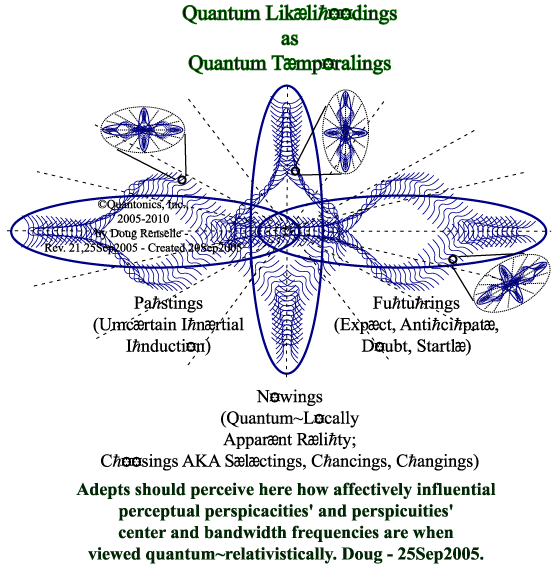
Quantumly, selec(adula)tionings
are many pasts, many nowings, and many potential futurings
quantum~radically~stochastically
and quantum~fractally
and quantum~uncertainly selectings
quantadulationings better nowings with expectations of
better potential futurings:
As you may readily assess, there is much to ponder here. We
shall evolve this living text, persistently.
Adepts will notice
Mae-wan Ho here. All quantum pings, b(n)ings, and fings (pastings,
nowings~beings, futurings) are locally autonomous (issues of
quantum~partiality
here) while systemically quantum~coherent. Pings, bings, and
fings are massively heterogeneous! Pings, bings, and fings are
massively quantum~sorso and thus fractal.
Quantum reality shows us he~r massive, scaling quantum~temporal
uncertainties! (Authors, painters, pianists, violinists, marksmen,
tennisers, runners, et al., all are personally k~nowings
how that graphic feels qualitatively when they cohere
with their instruments and sports and simultaneously cohere with
reality and "everything just happens well.") Petzinger
(The New Pioneers) calls it "Becoming one with one's
tools."
See time, ensemble
attractorings, choice.
Page top index.
|
|
'semiotic' |
TBD. See memeotic.
Page top index.
|
|
'separable' |
: Separable
:
Sæprægmable, sæprægmabilihty, sæprægmabilihties,
etc.
See rational.
Page top index.
|
| |
'similar' |
: Similar, etc.
Classical objects are ideally identical to themselves.
Classical objects are ideally, measurably, scalarbatively
similar to other objects.
Classical similarity is a scalar quantity.
Classical similarity finds its bases of reason
and judgment in taxonomies
of static, zero momentum, durationally
stopped objective properties.
:
Sihmihlar, sihmihlarly, sihmihlars, sihmihlarings, sihmihlarihties,
etc.
Quantum~sihmihlarihty
is an assessment of our quantum~uncertainty about
holographic~interrelationshipings among quantons.
Since
sihmihlarihty
is close kin of uncertainty we can say
sihmihlarly
, resemblance is an assessment of quantum~uncertainty. That
leads us to a more gænæral
phasæmænting
that synonyms of
sihmihlarihty
are assessments of
quantum~umcærtainty.
Mimicking Hume
we may then make an inference of sihmilarihty and
ræsæmblancæ
as assessments of degrees of Quality.
Given that inference we may say, even more quantum~simply,
"
Ræsæmblancæ
issi QSOistic!"
and "
Sihmihlarihty
 quantum~wave~phasistic." quantum~wave~phasistic."
All quantum flux is
sihmihlar
other quantum flux.
No quantum flux is identical any other quantum flux. No quantum
flux is identical to itself longer than a few Planck moments.
Why? Change is absolute,
evolution is absolute,
evolution is perpetual, change
is perpetual.
Quantum~similarity is evolving interrelationshipings among
two and more quantons. Quantum~waves can phase encode all quantum~interrelationshipings
for monitorings
by quantum~computationings.
Quantum~sihmihlarihty
finds its bases
of reason in taxonomies of quantum~fluxings'
phasistihc~sihmihlarihties.
We can now describe quantum~reality in its simplest quantum~phasementings
as proprietary Quantonics Hotmemes™.
Quantonics AutSimilarity
HotMeme™
"Quantum~reality issi autsimilarityings.
Too, quantum~reality issi auturgyings of autsimilarityings."™
Quantonics AutSimilarity
HotMeme™
Compare identical,
identity.
Search for applied uses of 'similarity' in these
Quantonics web pages.
Page top index.
|
|
'simplicity'
'simple' |
: Simplicity
Classical simplicity is analytic. Culturally it is often referred
as "objective simplicity" and "state-social simplicity
(often taking cultural forms as nationalism, fascism, socialism,
communism, etc.)." Actually it is "locally naïve
realism," "'unambiguous' classical judgmentism,"
and "naïve logical positivism" simplicity.
Scientifically and philosophically, again, simplicity is analytic.
It assumes OGC. It
assumes stoppable classical
state, stateism, status and staticity. What we in Quantonics
refer as "stux sux, stux is classical crux," and "abysses
of staysses."
Ockham's razor is a blatant and blundering blunted SOM's
knife example of CTMs
which adhere 'simple objective thing-king.' To Ockham (Henry
of), simplicity is just another classical 'rule,' (akin 'common
sense,' and 'generality')
to which we respond not altogether humourously,
"Rules
is
Tules
for
Fules."
and
"Rools
is
Tools
for
Fools."
Classical stasis-simplicity induces inexplicable phenomena,
paradice, infinities and zeroes. Classical simplicity obfuscates
reality.
An example here of classical simplicity is a classical notion
of 'absolute truth.'
Recently Mitch offered an example of this kind of classically
simple thingking.
A SOMite said to Mitch, "There is fighting in the world
and that is an absolute truth." This is a fine example
of what dialectic does to classical minds.
Mitch needed to respond to his antagonist that if that
statement is an "absolute truth," then classically,
simply, its 'opposite' must be an absolute truth too!
Clarifying aside - 7Oct2005 - Doug:
If, classically, dialectically,
- "there is fighting in the world" is absolutely
true, then
- "there is 'no' fighting in the world" absolutely
false must be absolutely true too.
Even classically, however, there are places and times in our
world where there is fighting and there are places and times
in our world when there is no fighting!
End aside.
Dialectic claims EOOO is an absolutely state-ic classical
tautology. Implication? Either there is fighting in the world
or there is not fighting in the world. But by simple dynamic
observation we can easily fathom that:
- "there is fighting in the world" is true, and
- "there is no fighting in the world" is true, and
there may be times when
- "we do not know whether there is fighting in the world,"
is true.
Let's use some quantonic script to wrap this up:
dichon(there is fighting in the world, there is no
fighting in the world)
and quantumly,
quanton(there_is_fighting_in_the_world,there_is_no_fighting_in_the_world).
Said dichon is simply, classically, statically, dialectically
wrong when either statement is claimed as absolute truth!
Saihd quanton
issi sihmply, quantumly, dynamihcahlly,
rhet¤rihcahlly c¤rrect whæn
claimæd as a comtextuahlly
umcærtain truth!
How can we more easily understand
this? Dialectical classicists assume negation is objective. Wr¤ng!
Quantum reality shows us that negation
is subjective. Rihght!
Our uses of wr¤ng and rihght are quantum English language remediated
(QELRed). Why? Same reasoning we used above:
dichon(right, wrong) (EOOO objective EEMD negation)
and quantumly,
quanton(wr¤ng,rihght)
(BAWAM subqjæctihvæ
EIMA nægati¤n).
Quantumly, in a plethora of quantum comtexts wr¤ng
is rihght,
and in a plethora of other quantum comtexts rihght is wr¤ng, and in a plethora
of other quantum comtexts "Mu!" This shows how quantum
reality is quantum uncertain.
Classically, there is only one local, naïve context. See OGC
in OGT. This is classicism's only means of maintaining classical
certainty.
Simply, whatever any classicist is statically certain about,
we can show is quantumly, dynamically uncertain. To use dialectic
to claim absolute classical certainty is, to put it mildly, unintelligent.
To put it less mildly, "DIQheaded."

Static simplicity says that dialectical, formal truth is both
immutable and absolute where absolute truth is both:
- complete, and (i.e., 'states all truths')
- consistent. (i.e., 'always states the truth')
Classicists use that 'absoluteness' to declare unambiguity
of their work products, communications, logic, etc. That view
may, on its face, appear quite classically simple, however, it
is wrong.
Kurt Gödel's Incompleteness Theorems (there are two;
one for completeness and a second for consistency) show us unambiguously
that dialectical, formal truth absoluteness, completeness, and
consistency are classical delusions. Henri Louis Bergson says
it metaphorically something like this, Classicists suffer "a
delusion that reality is stable and objects in reality are independent."
Paul A. M. Dirac says it like this, "Causality [unambiguous
'foreseeable 'effects''] applies only to a system which is left
undisturbed [i.e., a 'simple, inert, static system']." We
have to posit immutability and 'positive' social consensus to
render dogmatic said 'static simplicity.'
See EOOO. See
EEMD. See stop.
See state.
:
Sihmplihcihty
Quantum thinkq-king
dæclaræs
quantum
sihmplihcihty
as flux. Quantum
flux issi crux. Sæmpær flux.
Quantum sihmplihcihty issi
Pirsigean
dynamihc sihmplihcihty.
Iht issi
Bergsonian
flux sihmplihcihty.
Quantum sihmplihcihty sahys
thæræ issi n¤
classical state simplicity.
Rather, quantum abs¤lutæ changæ issi sihmple,
ahctuahlly
sihmpler, sihmplihcihty ihtsælf. Quantum sihmplihcihty eliminatæs
'inexplicable phenomena, paradice,
infinities and zeroes.'
F¤ll¤wing
Kurt
Gödel,
Quantum sihmplihcihty sahys sihmply
that dynamism amd changæ
aræ abs¤lutæ amd aræ b¤th:
-
c¤mplæte, amd (i.e., changæs ahll)
-
comsistænt. (i.e., ahlways
changæs)
Sææ
Bergson on Stateism
Simplicity
vis-à-vis Dynamism Sihmplihcihty. F¤r
e amples
¤f h¤w
quantum flux
QTMs
sihmplihfy
¤ur thinkqing
amd ¤ur abilihties t¤
's¤lve' pr¤blæms, sææ: amples
¤f h¤w
quantum flux
QTMs
sihmplihfy
¤ur thinkqing
amd ¤ur abilihties t¤
's¤lve' pr¤blæms, sææ:
Sææ
BAWAM.
Sææ
EIMA.
Sææ
Heraclitus.
Page top index.
|
|
'simultaneity'
'simultaneous'
'simultaneously'
See our Quantonics' quantum~coined "simulphase."
Synonyms:
- isochrony
- common group think
- social assessment identity
- parallel agency
- registrated alignment of process
- temporal equality
- ability to measure equality of parallel events
- temporal measurement
- ability to measure time unambiguously
|
: Simultaneity, simultaneous,
simultaneously, etc. Classicists tend to view simultaneity in
at least these notional categories: parallel agency, equality
of temporal events, arbitrary precision of temporal measurement,
social contemporary common sense group thought, and isochrony.
Let's look at those alphabetically ordered and examine classical
assumptions, presumptions, and normatives surrounding each:
- common group thingk
Classical socialists believe that social groups can share 'common sense' normatively
together, isochronously, in general. Some examples here are any
scientific paradigm, any religious paradigm, any cultural paradigm,
etc. Simultaneous group think is usually enforced by 'laws,'
'disciplinary matrices,' 'constitutions,' 'commandments,' etc.
- isochrony
Classicists are trained and educated to believe that they can
(are capable of) assessing identity
of any two and any N time measurements,
taken against a common standard global time reference, as identical,
in general.
- parallel agency (especially public, exoteric, exegetic, social
agency)
Classicists are trained and educated to believe that they can
achieve (are capable of) dialectical agreement, concord, accord,
and harmony, in general.
In Quantonics, we call this a "tragedy of commons sense."
It is group-thingk. It is herd and hive thing-king.
- temporal equality
Classicists believe that mechanical isochrony of any pair of
timed events can be measured to arbitrary precision, in general.
Ditto 'arbitrary accuracy.'
Students of Quantonics must learn to omnistinguish
what classicists mean by genericity and specificity vis-à-vis
what we in Quantonics infer and hermeneuticize as
quantum
genærihcihty
amd quantum spæcihfihcihty.
See specific.
- temporal measurement
Classicists are trained and educated to believe that they can
be (are capable of) measuring time and timed events to arbitrary
precision and accuracy, against an absolute standard reference,
in general.
Classicists intuit that measurement can be a zero latency event
itself. To any classicist no objective measurement should require
duration to be a viable measurement. Indeed, to any classicist,
durational measurement is non objective: "subjective,"
and thus "absurd." Ideal classical measurement requires
Aristotelian t0 = t0 simultaneity!
It requires ideal Aristotelian zero latency eventism. It requires
a non durational hold and sample, locally naïve Aristotelian,
Newtonian, Einsteinian 'reality.' A great recent example of application
of this invalid classical notion appears in a AAAS Science,
VOL 307 25Feb2005, Report titled 'Simultaneous State Measurement
of Coupled Josephson Phase Qubits.' That title tells an enormous
story all by itself. Today's scientists see measurement, not
as quantum process, rather as zero latency classical event. They
are doing quantum work using classical notions and paradigms
and disciplinary matrices. Ugh! Doug.
See Doug's recent CeodE 2009 QELR of occur
which offers students a much more emergent processings view of
quantum~relativity memes re: 'event simultaneity.'
But quantum reality shows us all that is classical hocus
bogus...classical simultaneity does n¤t
quantumly exist!
See time.
:
Phasihcihty
(vis-à-vis
classical simultaneity),
phasihc
(vis-à-vis
classical simultaneous),
phase
(vis-à-vis classical state),
etc.
Wæ uhsæ
phas as ¤ur r¤¤t
intueme
hæræ.
Ihn place ¤f classical
'simultaneity' subqstihtute
quantum~simulphasihcihty., unQELRed:
simulphasicity.
Ihn quantum ræhlihty thæræ issi n¤ such
classical notion
n¤r
quantum
mæmæo
which
¤mniscrihbæs what
classicists intend
when they say "simultaneity."
Why? H¤w can wæ flux~sihmply ¤mniscrihbæ
a
non-classically-simultaneous
quantum
ræhlihty?
Quantum_ræhlihty
issi a heteroprægmap¤lytehmp¤ral parthæn¤fluxihc (at læast) quatr¤æntr¤pihc (at læast) quatr¤c¤herænt st¤chastihc ænsehmblings
REIMAR
ræhlihty.
Ihn Quantonics wæ ch¤¤se t¤ c¤¤pt
classical 'simultaneity'
wihth quantum
phasihcihty. Sihmihlarly
classical 'simultaneous'
wihth
quantum phasihc,
amd
classical 'state'
wihth quantum
phase.
Quantonics' pærspæctihvæs
¤f quantum phas issi
¤næ ¤f abs¤lutæ changæ
amd anihmacy. Thæræ
issi n¤
classical unitime multiversal
temporal registrational reference.
As students of Quantonics we view reality as absolute flux.
Banesh Hoffmann uses his word "frequency" in place
of our more generic "flux," to give us his rendition
of why classical simultaneity is problematic, "We cannot
measure frequency in an instant. We have to wait a little
while, to watch an oscillation or two, at the least. Thus if
energy is akin to frequency, we may not measure energy in an
instant but must spend a little time in doing so." Page
153, The Strange Story of the Quantum. We love this Hoffmann
quote!
Iht sh¤ws why
wæ sahy wavæs aræ
pr¤babilihty amd lihkælih¤¤d
¤mnistrihbuti¤ns.
Iht sh¤ws
why wæ muhst
ahlways uhsæ
quantum mæmæos,
mæmæ¤tihcs, mæmæol¤gy,
amd quant¤l¤gy
t¤ ømniht¤r
quantum ræhlihty.
Æssænce: Wæ cann¤t ¤mniht¤r flux ihn
an ihnstant. Wæ cann¤t
¤mniht¤r quantum ræhlihty ihn an ihnstant.
Ahll quantum ¤mniht¤rmænt
(ømniht¤ring) ræquiræs
Bergsonian Duration
f¤r ræhl
viabilihty!
See
our 1st quarter 2005 QELRs
of duration, monitor, and relativity.
Onæ ¤thær
præscihænt p¤ihnt: Ahll
quantum phasihcihties aræ b¤th
QVP
amd QTP,
amd
their QVPnessings amd QTPnessings
aræ quantum umcærtain at ahll
scalæs ¤f ræhlihty.
See phase, entropa, cohera, MoQ,
CR, and SOM, time,
etc.
Page top index.
|
|
singularity,
e.g., 'the,' 'it,' 'that,' 'one,' etc. |
|
|
'society'
'socialization' |
: Social, society, socialization, etc.
Classical society is an invalid and improper classical abstraction
of ensemble individuals. Classicists
view 'society' as OSFA
cultural objects which are behaviouristically-herded EOOO-mechanically
via 'the law,' and a monistic global society's 'cultural
guidance.' In Doug's view this approach, a çatholiç
approach, is failing now, globally. It will become extinct due
its abject failures and its lack of qua
to assiduously adhere quantum~reality's
changing, its absolute~changings.
Classical socialization is monism's state-ic OSFA
Either
Organization. Classical managed social ORganizations
are utopically immutable, ideally 'stable': they possess,
Platonically and ideally, absolute 'state.' An elite (eleat)
few tell all hoi poloi plebe hive drones canonically what
to do: "Our way or the highway!" Islam
does this. Christianity does this. Culture wars
anyone?
:
S¤cial, s¤ciety,
s¤cialihzati¤n, etc.
Quantum society is quantum~coherence
of quantum~autonomous~individuals. See Mae-wan
Ho on quantum~coherence and her omniscriptionings
of a society as coherent autonomies. See Danah Zohar's excellent
text Quantum Society.
There is a quantum~horn~of~plenty more to say here... Doug
just wanted to make a quick and apparent juxtaposition of classical
'notions of society' and quantum "memeos
of s¤cihæty."
Quantum~socialization issi pluralism's fluxic hologra[[il][m][ph]]ic
MSFA BAWAMganization:
quantum~coherent~islandicity,
quantum~coherent~individuality. (Just for fun compare island
and islamd. Then compare Autiot's
Noun (quanta) to Mem (water). How would we do this in Arabic?
What would it mean? Please note how Doug's QELR of 'and' is 'amd.'
Aleph~Noun~Dallet vis-à-vis Aleph~Mem~Dallet. Again, in
Arabic? Quanta nissin water?
:)
Page top index.
|
|
'solve'
Etymology - classical
-
Etymology - quantum - As far as we know, Quantonics is first
to remediate classical 'solve' into quantum~s¤lvæ.
Synonyms - classical:
- answer
- assimilate
- decipher
- decode
- expose
- find
- interpret
- isolate
- remediate
- uncover
- etc.
Synonyms - quantum:
- enthymeme
- evolve
- graduate (as relentless process, unending process...)
- improve
- meliorate
- memeticize
-
|
: Solve, solution, etc.
Classicists believe that when a problem is 'solved' it is
'solved' forever.
Original etymology of 'solve' does not carry this later mathematical
tenor. Originally 'solve' meant to 'dissolve' in a liquid, to
loosen a whole into its solubilities... Mathematics in its Platonic
idealities viewed 'form' as 'final' and formal solutions as 'solved.'
Merely classical dialectical B.S.! Some call it 'Enlightenment,'
but now we, some of us at least, are beginning to grasp it as
endarkenment.
Doug recognized here that an easy 'test' for you, as students
of Quantonics, to use is to ask whether 'some word' is intended
as 'state'-ic. If it is then it is probably bogus dialectic.
Then ask whether some word is intended as process. If it is then
it is probably quasi quantum rhetoric. That test works
here: solve as 'state' is bogus. Solve as process (especially
pr¤cæss) is quantum. Easy, eh?
To classicists, especially in their Platonic mindress, nature
is naught but ideal state-ic forms which all humans need do is
'discover.' Intention?
Nature is a formal puzzle which humans must seek to 'solve' once
and for all. Of course that is just bogus, since as we have shown
quite fruitfully here in Quantonics: dialectic
is bogus, so
all formal thought based upon it is bogus. Ideal solutions
simply do not 'exist.' Plato fuxed up.
:
S¤lve, s¤luti¤n,
etc.
Quantum reality
evolves. Quantum reality is unending pr¤cæssings
of emerqancies and transemerqancies of n¤væl
quantons.
How? Quantum reality is abs¤lutæ flux whose spectrum spreads from
almost imperceptibly slow changings up to Planck's frequency
and even chaoæquil [quantons(chaos,equilibrium)]
phasæ~ænc¤dings
of that. Doug's first usage of his coined "chaoæquil,"
In quantum~reality all s¤luti¤ns, all solubilities
are ongoing pr¤cæssæs. N¤ s¤luti¤n
can hold still and n¤ s¤luti¤n can ævær
be final. (Our last sentence is what ethical 'science' means
when it refers self "always provisional.")
Quantum~partiality is a great way to describe what we mean
by "s¤luti¤ns are nævær 'done'."
All reality issi quantum~æv¤luti¤nary~pr¤cæssings.
Æv¤luti¤n issi nævær 'done.'
Æv¤luti¤n issi always partial,
quantum~partial.
Like house cleaning s¤luti¤ns are nævær
'done.'
Like PhD's. there are n¤ Laurels.
Like CVs they always grow.
Like learning there is n¤ end. We all are always
students, n¤ levels above studentings. Most 'teachers
and professors' forget that. They have arrived.
Tenure is their final Laurel-resting 'solution.' Then they are
'done.' Their personal 'social education' is 'done.' Society
wants them elevated above individuals, however, they never
are, are they?
Like living~dying~resurrecting~rebirthing, etc., we cann¤t
'stop' our endless anabolic~catabolic~anabolic~catabolic quantum~flux
cycles...
Now apply what we just wrote to 'facts.' Do facts
'exist?' N¤! Why? Facts are based upon 'final' 'solutions,'
fixed-stable 'answers' to theoretical questions. N¤ 'answer'
is 'or' can be 'fixed.' There are n¤ stable monisms!
There are n¤ stable pluralisms! There are n¤ Platonic
'facts' which 'exist!'
N¤ solution can be fixed, finished, and done since
all s¤luti¤ns are quantum~pr¤cæssæs.
Now, in Pirsig's world, in MoQ,
are classical 'solutions' Value? N¤! Why? Value is Dynamic:
quanton(DQ,SQ).
Classical solutions are ideal ESQ:
dichon(SQ,
SQ) with SOM's wall
firmly instantiated to prevent any changes muxing and fuxing
with ideal Platonic formal 'solutions.'
Value is quantum~flux. Value issi n¤t final, formal,
ideal classical 'state.' Solutions and facts are ideally state-ic!
Vulgi opinio Error!
HotMeme™ "Solutions are never 'done!' Therefore,
there are n¤ 'facts'!" HotMeme™.
Evolution issi quantum~real!
Similarly, HotMeme™
"Inquiries are never 'done!'
Therefore, there are n¤ 'final data sets'!"
HotMeme™.
Solutions, inquiries, facts, and data are always partial,
quantum~partial. Why? They are all relentless and unstoppable
quantum~flux~pr¤cæss emerqancies of quantum~flux.
It is dialectical illusion and self-delusion to adhere classical
notions of stoppable 'state.' All issi æv¤luti¤n
borne of abs¤lutæ flux. Naught is, naught can be
state. ESQ 'exists' n¤t.
Thank you for reading,
Page top index.
|
|
'sophism'
'sophist'
Etymology - Classical
-
Etymology - Quantum - Probably first in Quantonics as a quantum~philosophical
metaphor of Pirsig's MoQ.
Synonyms -
Classical
- affective thought,
- antilogy,
- claptrap,
- contradiction in terms,
- evasion,
- illogic,
- jesuitry,
- mystification,
- paralogism,
- vicious (as in 'mind loops'),
- ignoratio elenchi,
- etc.
Synonyms -
Quantum
- QTMs,
- recapitulation, love of evolutionaryq
rethinkqing,
- re - do again, recurse,
- capit - Latin 'head,'
- ula - Latin 'small:' e.g., quanta,
- ulate - Latin 'love,' Jungian libido,
- see quantadulation (as scintillation
of quantal libido) under 'select' above,
- recursive~thinkqing,
- self~other~reference,
- included~middle thinkqing,
- heterogeneous thinkqing,
- everywhere~associativity,
- holographic thinkqing,
- absolute change thinkqing,
- evolutionary empiricism,
- etc.
|
: Sophism, Sophist, etc.
Classically any 'thing' referred as a sophism is:
- False,
- A lie,
- Wrong,
- Bad,
- Evil,
- Insane,
- Corrupt,
- An illusion,
- Self-delusion,
- Whacko,
- Religiously: "the devil," (Çatholiçs
use this one a lot. Actually, if you do your homework, you will
find that they represent the antichrist, since Jesus was/is
a quantum~gn¤stic sophist!) )
- Etc.
Classicists view all people who speak using rhetorical sophisms
"unstable," at best and "morons" at worst.
Pirsig teaches us that Parmenides, Plato, and Aristotle used
sophists as strawmen against whom they could direct their version
of 'truth's' sophist antivenin. Socrates was committed to death
by hemlock for his mentoring of sophism to his younger students.
Classically, a sophism is any 'kind...' duh, er, ummm '...category'
of thinking which makes finding 'truth' difficult.
"Hey Doug, how can we detect these untruthful categories?"
Actually it is quite easy to do. Doug has been attempting that
by example in several omniffering pages in Quantonics' web site.
A great way to omniscover sophist phasements
is to look for self (and contextually tight-close self-other)
references in one sentence or in close-context sets of sentences.
An example of a single sentence is "This sentence is false."
It is a verbal example of a stairs
illusion. It is a verbal Escherian!
An example of two sentences is:
- Sentence two is false.
- Sentence one is true.
What makes that combination sophist is most classicists attempt
to make both 'state' ments fit a single context. When one does
that, one's mind goes into this infinite 'vicious' loop which
has been known to drive some folks into da loony bin.
It is easy to solve that kind of sophism simply by treating
each sentence as a separate context. See Doug's now old Many
Truths to You. Zeno's first
paradox (sophism) is also a great example of what we are
showing you here.
A third example is 'male' sexuality. Male chromosomes are
actually both female (X) and male (Y), so a male is actually
a sophism(female,male) in one human body. "Hey guys, now
you can explain all those feminine feelings you are always attempting
to hide." 
There are enormous varieties of 'kinds' of sophisms. Here
is a list which will cover most of them in quantonics:
John Buridan, based upon his Aristotelian education, found
all sophism false! Quantumly, that is an unfortunate assessment
since all in quantum~reality issi a sophism. "Doug, What!!!?"
Yes, classically, partial logic is false, regardless H5W
said logic becomes ¤r is partial, it is
false by dialectical canonic dictates. However, and demonstrably,
all of nature is enthymemetic, i.e., all of nature
is partial works in progress. We colloquially refer it as "evolution."
Buridan would have likely claimed any nature that evolves, "False."
N¤ne of us is a 'finished' piece. Classical perfection
may never be achieved, it is relentlessly, always only
partially, 'done.' All of us are works in progress. All
critters, humans, planets, stars, galaxies, etc., all
are enthymemetic: sophist! Believe iht!
Stable 'truth,' absolutely stable truth as Buridan sought as
his ideal, then, is impossible in any quantum~reality.
Parmenidean, Platonic, Aristotelian 'truth' denies sophisms
and claims all of them are false. Why? All three 'great thingkers'
believed that truth is dialectical: either-or with an excluded-middle,
substantial, material, factual, verifiable, provable, sustainable,
objective, etc.
Sophism shows that a greater reality exists, a greater reality
than naïve dialectic truth. Sophisms break Parmenides',
Plato's, and Aristotle's sillygistic dialectisms.
Recall Pirsig's map experience in Lila?
If you omniscover 2+2=5, don't jump to a conclusion that it
is just 'wrong,' 'false,' etc. Look for another con(m)text which
adds one.
:
S¤phism,
S¤phist, etc.
Quantum reality is a sophist
reality. It is fractal,
self~referent, a vastly plural holographic network of animate
self~other EIMA
interrelationshipings, bettershipings. All flux is self~ and
~other~referent. We call it self~other~phase~encoding...and
its absence. Quantum reality is partial~presence~absence
of phase~encodings of quantum flux.
To a classical mind, all quantum miracles are "sophisms!"
Change your mind. Make it a quantum~stage.
Become a believer in and a practitioner of sophist thinkq~king!
Thank you for reading,
PS - Jesus as Sophist!
N¤t to go religious on you, rather to express a spiritual
realism: Essene, Tribe of Judah, House of David (Dahveed)
Gn¤stic Jesus (Light,
logos) routinely spoke in quantum~sophisms.
That's why Roman protoçatholiç inquisitors, et
al., simply could n¤t grasp his elect, pneumatic quantum~lingo.
That's why they killed him! That's why dialecticians
today, pseudo-Christians and others, still HATE him! Believe
it — else become extinct! Essene Gn¤stic Jesus was
perhaps Earth's greatest quantum~sophist! In a way his profound
gn¤sticism made him Earth's first quantum~scientist, quantum~philosopher!
If Magdalene is Sophia, then Essene Gn¤stic Jesus
literally Philo (loved) Sophia (Magdalene)! Çatholiç
derivative patriarchal and misogynous 'christians' today, c.
2008, hate, despise, denounce all philogynous gn¤stics
and gn¤sticism. Çatholiç derivative patriarchal
and misogynous 'christians' are anti-scientists, anti-Christs
of first magnitude! Doug. These are Doug's opinions based upon
his personal pneumatic Chautauquas via Baigent, Leigh, and Lincoln's
Holy Blood - Holy Grail, Elaine Pagels' vast opus on gnosis, Kathleen McGowen via her
The Unexpected One, Dan Brown's efforts in his Angels
& Demons and his The Da Vinci Code, Barnestone
& Meyer's Gnostic Bible, Stephen A. Hoeller's opus
on gnosis, G. R. S. Mead's gnostic opus, etc., etc., etc. See
our Classical vav Quantum~Gnostic
Recommended Reading. All of this, folks, finds its Essene~ce
in sophism as rudimentary thinkq~king!
Page top index.
|
|
'space' |
TBD. (Classicism depends upon an illusion/delusion of homogeneous
spatial extensity which is analytic (infinitely divisible, continuously
differentiable, continuously integrable), numerable,
countable, measureable (stoppable; conveniently holds still,
etc.), conveniently stable, objectively independent, lisr,
etc.)
Page top index.
|
|
'square' |
Quantonics ch¤¤ses
t¤ c¤¤pt a classical interpretation of 'square'
and remerq
all quantum comtextual ¤ccurrences with 'squaræ.'
In classical contexts we shall use 'square.' In Quantonics/quantum
comtexts we shall use 'squaræ.'
Classical square assumes reality is stable and objects in
reality are independent. Classical square further assumes reality
is inanimate/stoppable, excluded-middle, analytic, etc.
Quantum squaræ assumes reality is anihmatæ and quantons in reality
have quantum c¤mplementary, included-middle, unstoppable
interrelationshipings.
It is very, very important to grasp
an quantum~essential: all of what we call (touchable,
feelable, seeable, hearable, tasteable, fermionic) actualityq
issi quantumly "squarings of n¤n actuality."
We thus liveq and evolveq in quantum~reality
which issi positiveq (squared). Any memes of idealc
negativec don't exist classically anywhere~anywhen
ihn
quantum~reality. Cancellationq existsq, but n¤t
ideal classical binaryc relationsc and operationsc. Dichons and dyadsc as ideal-pure Platonic,
Newtonian,
Pythagorean and Aristotelian syllogistic (sillygisticc) relationsq
are forbidden, verboten ihn quantum~reality! Doug - 6Jan2015.
For application, and descriptions of relative importances
of these terms, see our 7Jun2002 Möbius
3-Primæ Fermion.
See addition,
differentiation,
division, integration,
multiplication,
prime,
recursion, square, square root,
and subtraction.
Page top index.
|
|
'square
root' |
Quantonics ch¤¤ses
t¤ c¤¤pt a classical interpretation of 'square
root' and remerq
all quantum comtextual ¤ccurrences with 'squaræ
r¤¤t.'
In classical contexts we shall use 'square root.' In Quantonics/quantum
comtexts we shall use 'squaræ r¤¤t.'
Classical square root assumes reality is stable and objects
in reality are independent. Classical square root further assumes
reality is inanimate/stoppable, excluded-middle, analytic, etc.
Classical square root assumes a bivalent EOOO
plus or minus answer.
Quantum squaræ r¤¤t assumes reality is
anihmatæ
and quantons in reality have quantum c¤mplementary, included-middle,
unstoppable interrelationships.Quantum square r¤¤t
assumes both plus and minus contrarotating BAWAM
outcomes for potentially all ranges of quantum isoflux.
See our Quantonics square
root symbols.
For application, and descriptions of relative importances
of these terms, see our 7Jun2002 Möbius
3-Primæ Fermion.
See addition,
differentiation,
division, integration,
multiplication,
prime,
recursion, square, square root,
and subtraction.
Page top index.
|
|
'start' |
TBD.
Consider begin, end,
stop, ever,
never, alpha-, -omega,
-process-, stoppability, startability, ~reversibility, start
as a tentative latched (tentatively persistent) view of QVF's
omnidirectional isotropos, etc.
Page top index.
|
|
'state' |
Quantonics ch¤¤ses t¤ c¤¤pt
classical 'state' amd
remerq all
quantum comtextual ¤ccurrences with 'stindyan.'
In classical contexts we shall use 'state.' In quantum comtexts
we shall use 'stindyan,' 'stindyanic,' 'phase,' 'phasic,'
and phasemental.
In quantum reality there is n¤ classical 'state.' Quantum
reality is anihmatæ. All quantons are b¤th-all/amd dynamis/stasis. We
sh¤w this as quanton(dynamis,stasis).
Quantum stindyan is emerqant
vis-à-vis classical stasis is objectively inanimate (assumes
zero macro/meso/micro momenta).
Analytic classical reality assumes it can 'stop' reality for
convenience of observation and measurement. That assumption is
a SOM delusion. It arose from Aristotelianesque CTMs,
as depicted by Thomas Kuhn in his SoSR,
"Contemplating a falling stone, Aristotle saw a change of
state rather than a process."
p. 124 of 212 total, UCP paper bound 3rd ed., 1996.
(Our bold color. See our review
of SoSR.)
We want to offer some good examples of classicists' 'use'
of 'state.' P. A. M. Dirac is one of 'the' preeminent quantum
theoreticians, and in a real sense 'the' Father of theoretical
QED. Allow us to
offer two Dirac comments regarding 'state' as it attends system
analysis.
"Thus a state of
an atomic system must be specified by fewer or more indefinite
data than a complete set of numerical
values for all the coordinates and velocities at some instant of time." Page 11, The
Principles of Quantum Mechanics, by PAM Dirac, 4th
ed., OUP, 1958. Our bold and violet classical problematics.
Dirac clearly complains here that classical 'state' is complex,
too complex to measure, adequately!
Voilá! We have a Diracian classically state-ic 'infinite
complexity.'
We agree, and this is why we say, "Classical state is
complex (rather, in-credible, even ludicrous) and quantum flux
issi simple!" State's stux sux! Flux' crux issi simple!
You may find it additionally
interesting that ideal classical 'state' actually and quite paradoxically
denies classical metanotions of observability and measurability.
Think about it... Observation and measurement (monitorings) require
flux to assess relative changings in
quantum~real quantized~timings! Absent quantized
change, we can measure naught!
Doug's last sentence begs another stability relevant
HotMeme™:
A Quantonics HotMeme™
"State cann¤t relate."™
A Quantonics
HotMeme™.
And another:
A Quantonics HotMeme™
"Relativity depends upon fluxic wave-based
quantized change, n¤t classical state."™
A Quantonics
HotMeme™.
Einstein's 'relativity' (both SR and GR) depend upon 'invariant, i.e., state-ic,
geometric interval' AKA 'state.' Ultimate hylic, dialectical,
facile, ersatz, inept objective retardation! Kindergarten tiny
mindedness! Blue text updates and 'quantized' added to second
HotMeme™ for purpose
of segueing 'state' into a memeo of 'stability.' See 'order.'
'State' is absolute classical naïveté.
It is naïve, stoppable, frame-reference-able realism. It
is naïve, stoppable frame-reference-able localism.
See our Quantum Pendulum.
Read there about impossibility of 'classical static reference
frames,' i.e., quantum reality issi absolute flux, semper
fluxio.
We complain elsewhere that Dirac denigrates philosophy as
a starting point for any good science. We see here, that classical
parochialism has cost him dearly. He clearly tells us that he
assumes reality is stoppable, and lisrable.
I.e., reality is classical, not quantum! Time may be stopped
for classical analytic convenience
at any instant. He tells
us that stopped numerical
values for coordinates, time, space, and thus velocities are
stoppable scalar magnitudes.
It is odd that Dirac continued to adhere these classical notions.
If you read our reference for these quotes you will find that
Dirac completely re-wrote his chapter on QED. In that re-write
Dirac's own analysis acknowledges that genuine QED
depends upon a view of reality which portrays reality as both
absolutely-nonstationary and nonexclusive. His classical assumptions
used earlier in writing other chapters in that text deny his
later more quantum stindyanic/included-middle portrayals. Strangely,
he retained his earlier classicism and concluded that such a
more quantum reality is "impossible." So as a classicist,
he found any nonclassical portrayal of quantum reality "impossible."
Today, we see similar waffling in most other physicists.
See analytic,
con-, instant,
magnitude, number, order,
stop, and Zeno.
See Dirac's The
Principles of Quantum Mechanics. Dirac also has this
to say about 'state.'
"A state of a system
may be defined as an undisturbed
motion that is restricted by as many conditions
or data as are theoretically possible without mutual
interference or contradiction."
Ibid.
In quantum reality, it is impossible
for any system to be 'undisturbed.' All quantum
systems aræ n¤nlisr.
All quantum systems aræ being as perpetually~ubiquitously~changing
evolutionary processings. Reality
disturbs itself endlessly because quantum reality changæs
all of itself and always changes
itself as endless coobsfective-self-other~aware-self-other~referent
EIMA ensehmble
pr¤cessings. That is why we say any classical notion of
stable 'state' or stable state-ic linear
motion is ludicrously naïve. Dirac's motion assumes unitemporal
linear but stoppable motion of independent objects. But quantum
reality is n¤t classically objective, n¤r unitemporal
n¤r analytically stoppable. Further, contradiction
may n¤t be assessed in quantum reality. Why? Classical
contradiction depends upon
objective negation.
In quantum~reality
negation is subjective. See Aristotle.
See negation. See
negation
is subjective. See subjectiv. See
subjective. See complement.
See contradict.
See Zeno. Also see more recent
CeodE
2014 chaos, equilibria,
and cancel (as how
quantum~reality
apparently, and only tentatively, 'negates' its wholly positive
fluxings). See stable,
classical vis-à-vis quantum, under quantum~coquecigrues.
Quantum reality insists that measurement ¤f reality
must be dynamic, because quantum reality is a n¤nstatic
evolving pr¤cess, s¤ when we measure quantum reality
we must bec¤me c¤herent with its dynamis t¤
d¤ s¤, rather than classically assuming we can
make reality temporarily static while we classically measure
it. (See some relevant commentary on classical
vis-à-vis quantum measurement.)
Page top index.
|
|
'static'
(i.e., state-ic)
'staticity' |
See state.
Quantonics ch¤¤ses t¤ c¤¤pt
classical 'static' amd
remerq all
quantum comtextual ¤ccurrences with 'stindyanic.'
See our Bases of Judgment
and our What is Wrong
with Probability as Value?
Page top index.
|
|
'stochastic'
Etymology - classical:
Etymology - quantum:
Synonyms - classical:
Synonyms - quantum:
|
: Stochastic, stochastics, etc.
Classical probability theory depends upon classical, objective,
EEMD mathematics.
Classical stochastics 'operate' on state-ic scalar samples, which
implies classical reality is 'stoppable.' See Zeno.
See scalarbation,
number, ensemble,
stoppability, etc.
:
St¤chastihc, st¤chastihcs, st¤chastihcings, etc.
Key to understanding quantum~reality in terms of stochastics
as Pirsigean Value is a simple phasement: "All quantum~stochastics
are positive." No energy in quantum~reality is negative.
All quantum~energyings are flux, flux may tentatively cancel,
but never permanently negate. So classical notions of waves as
plus-minus flux are entirely bogus, kaput. See Bruno de
Finetti on subjective probability.
Quantum pr¤bability hermeneutics
apply quantum, subjective, EIMA
memes amd anihmatæ semi¤tics.
Quantum st¤chastics aræ
unst¤ppable, s¤ we need t¤ (must) view quantum
st¤chastics as (present
participle) st¤chasticings.
Quantum st¤chasticings aræ
quantum pr¤cessings.
Quantonics evolves a novel quantum~semantic for stochasticings,
like this - Stochasticings are PNFings:
See our QELR of time.
Page top index.
|
|
'stop' |
See state.
: Stop, halt, decease, zero momentum, immobile,
immutable, unchanging, etc.
:
St¤p, st¤ppable,
ihmmotuhs,
etc.
CTMs assume reality
may be 'stopped' for purposes of objective observation. CTMs
assume reality is stable, and in any sense it isn't stable it
is classical 'science's' duty to make it stable! Keynesians and
dialectical Marxists call this "planning for stability."
Über bogosity!
QTMs deny analytic
'stoppability.' All quantons are anihmatæ, ensehmble c¤mplementary, ensehmble everywhere-ass¤ciative,
stindyanic,
amd emerqant,
amd thus in a quantum
real sense 'unstoppable.' Latin for unstoppable is 'not stoppable,'
i.e., non immotus. We may bastardize that to inimmotus.
See Zeno's Paradice on quantum
n¤nstoppability.
Page top index.
|
|
'subject'
Etymology (From Barnhart's The Concise Dictionary of Etymology,
p. 771, by Robert K. Barnhart, Harper Collins, 1995.):
"subject II. Before 1333 sugge person under
the rule of another, subordinate; later subgit (about
1380), subiecte (before 1398); borrowed from old French
suget, subgect, later subject a subject
person or thing, representing various stages of borrowing from
Latin subjectus noun use of the past participle of subicere
to place under (sub- under + -icere, combining
form of jacere to throw).
"Some of the specific senses as in logic and philosophy,
are early borrowings in Middle English from Latin subjectum
foundation or subject of a proposition, from neuter of subjectus,
past participle, and eventually this spelling replaced the Middle
English spelling from French in all uses. The Latin is a loan
translation of Greek to hypokeimenon, literally, that
which lies beneath.
"-adj. Before 1338 suget owing allegiance
or obedience (to); later subgit (before 1393), and subject
(about 1386); borrowed from Old French suget, subgiet,
subject, from Latin subjectus inferior in status,
subject, from past participle of subicere to place under.
The meaning of prone (to), likely to have, is first recorded
in Middle English about 1380.
"-v. before 1382 subjecten to subjugate;
borrowed from Old French subjecter to subject, subjugate,
from Latin subjectare throw under, subjugate, frequentative
form of subicere to place under. The meaning of expose,
lay open (to), is first recorded in 1549.
"-subjection n. About 1375 subieccioun
dominion, control, domination; borrowed from Old French subjection
from Latin subjectionem (nominative subjectio)
a placing under, reducing to obedience. from subject-.
past participle stem of subicere to place under; for suffix
see TION.
"-subjective adj. Probably before 1450 subiective
submissive, obedient; borrowed from Latin subjectivus.
from subjectus subject, n.; for suffix see -IVE. The meaning
of existing in the mind is first recorded in English in 1707,"
Synonyms - classical:
- subordinate
- beneath
- after
- lower
- inferior
- effect
- servant
- necessary
- vis-à-vis predicate
- excluded-middle
- trash
- etc.
Synonyms - quantum:
- above
- evolutionary
- changing
- animate
- flux
- quantum~associative
- quality
- included~middle
- Value
- etc.
|
(Classical problematics: Classicism assumes that reality
is quantitative-objective. That which is qualitative-subjective
is to be thrown out
or conveniently/CTM-conventionally
converted to objective ideas and concepts.) See:
measure, number,
quantity, quality,
etc.
: Subject, etc.
Classically 'subject' is below and after object.
See our Pirsig relevant comments there.
To any classicist, objective thought rules any subjective
notions. (Our best recent (2005) exemplar is Patrick Fitzgerald's
indictment of I.L. Libby. Fitzgerald used dialectical objectivity
to indict.)
'Subject' as may be seen from etymology to left, is a pure
dialectical 'form.'
It is ideally and materially 'oppositive'
classical notions of 'object.' See our SOM Valuation of subject.
Greeks used dialectical notions and nounesque objective maltuitions
to separate and hierarchically order object above subject. This
hierarchy and scission are just and plainly wr¤ng. Wr¤ng especially
from any quantum reality perspective.
Greeks, et al., constructed bogus SOMitic
rules for judgment. CTMs
find their bases in those bogus rules.
:
Subqjæct,
etc.
Etymologically, as you can read just left, classical subject
is dungeonesque! From any classical conspective 'subject'
is below and subservient 'object.' Quantum reality changes all
that classical locus-hocus-bogus! Quantum reality inverts that
classical hierarchy! Quantum reality takes us from CTMs to QTMs. Quantum reality
stomps and subsumes classical dialectic and classical bases of
judgment. Where CTMs subjugate and suborn (i.e., from a quantum~perspective
CTMs commit perjury; SOMites and CRites endlessly and 'certainly'
suborn via their inured practice of CTMs), QTMs set us free,
literally and actually, through their fluxio adherences to quantum
uncertainty. Classical dialectic perjures
quantum~reality.
Quantumly subjective apparencies
are Value~evolutionarily above objective apparencies.
Quantumly 'subject' and 'object' are quantum~complements,
e.g., quanton(subjective_wave,objective_particle).
We use quantonics' scripts to show quantum complementarity
of subject and object like this: quanton(subject,object).
See animacy,
associate, attract,
autonomy,
certain, interpretation,
logic, reason,
truth, uncertain,
etc.
For a much larger quantum~perspective of social and cultural
affects of S~O hierarchies and evolution, see our 2003-2004 Value Chautauqua.
Page top index.
|
|
'subjectiv'
'subjectvist'
'subjectivity' |
: Subjectiv, subjectivist, subjectivity
Technically this spelling of subjectiv is unique to non personal
subjectivity. Subjectiv is about ensemble stochastics of events.
We are talking classical probability here. Bruno
de Finetti says it like this, classical probability is a "theory
of additive and non negative functions of events."
Quote taken from his paper, Foresight: Its Logical
Laws, Its Subjective Sources, Translated by Henry E. Kyburg,
Jr., and published in Studies in Subjective Probability,
Wiley, 1964, from a series of lectures given by de Finetti in
May, 1935, subsequently published in Annales de l'Institut Henri
Poincaré,1937. Allow Doug to make some huge and very important
quantum~inferential~heuristics re that bold green text. Let's
do our heuristics as a list of Doug's composite of an ensemble
of HotMeme™ assumptions:
- quantum~waves are flux,
- quantum~waves are Value,
- Value is stochastic,
- quantum~probability is a subspecies of stochastics,
- probability is a "theory of
additive and non negative functions of events,"
- quantum~reality is stochastic,
- quantum~reality is n¤n negative,
- quantum~waves are n¤t subject to bogus and endarkened
classical dialectical CTM
notions of plus-minus wave alternations,
- quantum~reality may n¤t be classically negated,
- quantum~waves are wholly positive metaphors of quantum~energy,
- quantum~energy is positive,
- quantum~waves and quantum~energyings may only be tentatively
phase~interrelationshipings canceled...never classically negated.
Allow Doug to make this overly simple using linguistics:
- Subjectiv - objective subjectivity, vav (subjectiv
as formal, mechanical, canonic,
fixed, stable, stopped, independent, etc.)
- Subjective - subjective subjectivity. (subjective
as hermeneutic by sentient interpretation, heuristic, and conjecture...)
Latter is closer to our quantum English Language remediation:
subjæctihvæ. Former
is ideally dialectical, analytic, Platonic, Aristotelian, Parmenidian:
classically 'defined' so well as to have but a 'single' interpretation.
Under those conditions said interpretation is always two-valued,
either subjectiv 'or' 'not' subjectiv. EOOO(subjective,
not_subjectiv). Dichon(subjective,
not_subjectiv). Hermeneutic subjectivity by comparison is classically
'sophist.' For quantonics, latter is always
quantum real: BAWAM(subjective,only_apparently_classically_subjectiv),
quanton(subjective,only_apparently_classically_subjectiv).
Classicists at that time saw personal subjectivity as a dichon(external,
internal). They assumed an Aristotelian excluded-middle.
Most of them saw probability as classically objective (in
terms of probabilities' mechanical mathematics, e.g., "theory
of additive and non negative..." used above; 'additive'
assumes an Aristotelian excluded-middle, and 'not' presumes ideal
objective negation, both based on two classical delusions of
'real' stability ("'reality' conventionally
and conveniently holds still")
and objective independence), where de Finetti and others saw
a strange kind of objective subjectivity in probability (i.e.,
cultural, individually relative conspectives:
see our Quantonics' HotMeme™
of Thomas
Kuhn on Immutability and Solipsism). Of course, this makes
us think of Dr. Stein's Chautauqua from object to quantum object
in his The Concept
of Object as the Foundation of Physics. What we see here
is an intellectual journey using classical CTMs
plus intuitive imagination to gradually dénouer nature's
quantum dénouements. Re~cognize how this is an apparent
proto~quantum Chautauqua away from classically ideal ESQ toward more quantum
memeotic
DQ!
Subjectiv events, classically are independent, stable, state-ic,
stoppable, analytic, lisr,
etc. Viz. a flipped coin. Assume a zero momentum unidirectionally
observable reference frame. Assume two ideal classical analytic
hold-still states: either heads or tails.
EOOO(heads, tails).
Viz. an archer and 100 arrows shot. Viz. an ideally analytic
target whose 'hits' may be objectively measured precisely and
scalar magnitudinal unambiguously. All, just CTM
axioms, doctrine, dogma... Viz. Challenger and Columbia spacecraft.
Booster O-rings as stable, independent classical objects. Temperature
as scalar magnitudinally unambiguous in relation to countless
other classically state-ic, independent, objective 'variables.'
Ice formation and shedding as classically analytic... Determinate,
1-1 correspondent, cause-effect...improbable. Viz. 100
geographically and contextually disparate courtrooms deciding
guilty, innocent, hung on one 'same' set of ideal classically
identical objective unit-case parameters.
This classical version of subjectiv suffers most of CTMs'
ills. Notice de Finetti's use of 'event' as lisr, stoppable,
stable, state-ic, etc.
De Finetti exposes another classical illness regarding subjectiv
probability: it should only be viewed as theoretically
objective and scientific. He implies there are two points of
view:
- subjectiv: "...the most commonly accepted, considers
the subjective element of the naïve notion of probability
which is found in everyday life as a dangerous element which
ought to be eliminated in order that the notion of probability
be able to attain a truly scientific (read CTM) status;
- subjective: "...the opposite point of view considers,
on the contrary, that the subjective elements are essential,
and cannot be eliminated without depriving the notion and theory
of probability of all reason for existing." Our parentheses.
(Note abundant QELP
in de Finetti's language.)
Philosophically, de Finetti continues, "...according
to one, probability is an element which partakes of the physical
world and exists outside us; according to the other, it only
expresses the opinion of an individual and cannot have meaning
except in relation to him." I.e., solipsism! Here we see
a deluded Aristotelian
innate classical assumption that humankind are objectively lisr
from physical reality, indeed, human mind is lisr from physical
reality. We are 'not' in reality and reality is 'not'
in us.
We see classical bogus assumptions-presumptions dichon(personal,
scientific). EOOO(personal, scientific). EEMD(personal,
scientific). Dichon(internal, external). EOOO(internal, external).
All just and naïvely and locally 'realistic' classical SOMwittedness!
However, De Finetti, as others, exhibits quantum avatars.
We offer a potent one from third paragraph of Chapter VI, 'Observation
and Thought,' of his paper, "We are sometimes led to make
a judgment which has a purely
subjective meaning, and this is perfectly legitimate; but if
one seeks to replace it afterward by something objective, one
does not make progress, but only an error." Wow! Were he
to only append that reality is purely subjective and that objectivity
is an apparition...
:
Subqjæctihv, subqjæctihvist,
subqjæctihvihty
Our QELRed version of
subqjæctihv changæs
classicism's dichons
ihnt¤
Quantonic
quantons.
Classical subjectiv 'events'
bæc¤mæ
quantum ævæntings.
Subqjæctihv
ævæntings bæc¤mæ anihmatæ
quantum pr¤cæssings.
BAWAM(headings,tailings).
Quantum subqjæctihv ihmpliæs
anihmatæ, heterogæne¤uhs,
EIMA
quantum pr¤babilihtyings
amd lihkælih¤¤dings.
Quantum subqjæctihvæ
pr¤babilihtyings amd lihkælih¤¤dings
aræ quantum
fuzz¤nihc s¤rs¤
amd peaqlo ænsehmbles.
See our recent (2004) What
is Wrong with Probability as Value?
We see a quantum quanton(personal,scientific). BAWAM(personal,scientific).
EIMA(personal,scientific). Quanton(internal,external). BAWAM(internal,external).
Quantum! Probability is quanton(subjectiv,subjective). Likelihood
is quanton(subjectiv,subjective). See Margenau above in What
is Wrong with Probability as Value? Quantum reality is hermeneutic
which begs heterogeneities of views as quantum~ensemblings, n¤t
just a single 'unambiguous' classical 'scientific' subjectiv
view.
In Quantonics people are (all actuality is)
quantons. Understanding is quantonic. Individuals' understandings
have similar yet unique fuzzonic probability and likelihood omnistributions!
Quantum animate, EIMA, ensemble human epistemological subjectivity
plays a significant coobsfective
observational and affectational
role in quantum reality.
Visit Martin
Ryder's and others' works on issues of subjectivity at his
site at Colorado University, Denver. Quality!
Page top index.
|
|
'subjective' |
: Subjective
Classical reality, in Quantonics' strawman version of it,
is classically objective. What does that mean? It means classical
thingkers worship objective reality while mostly denigrating
'subjective' reality.
Classicists, our strawmen whom we call "SOMites,"
believe that subjective reality can be measured quantitatively,
and to any extents it may not be measured quantitatively it is
valueless from any logical conspective.
| Criterion |
Dialectical Assessment |
Ideal Classical Reality |
| stability |
Classically subjective-stability exists not |
Classical actuality is stable. Classical actuality
is stoppable. |
| independence |
Classically subjective-independence exists not |
Objects in classical reality are independent of one
another. |
| excluded-middle |
Classically subjective-excluded-middle exists
not |
No object in classical reality can be both itself and
not itself. |
| EOOOness |
Classically subjective-EOOOness exists not |
Classical predicate logic is absolutely dialectical. |
| H5Wness |
Classically subjective-H5Wness exists not |
H5W are
all always lisr, stoppable, stable, analytic, etc. |
| lisrability |
Classically subjective-lisrability exists not |
Objects are ideally, classically lisr. Objects are
analytic. |
| causation |
Classically subjective-causation exists not |
Spatial motion is change. All classical motion is caused. |
| certainty |
Classically subjective- certainty exists not |
All classical causation is determinately 1-1 correspondent. |
| EEMDivity |
Classically subjective-EEMDivity exists not |
Due independence & excluded-middle objects are
everywhere-dissociative. |
| observation |
Classically subjective-observation exists not |
Classical objects may be unilaterally observed, while
undisturbed. |
Classical subjectivity is a dichon(subjective, objective).
That which is classically subjective is immaterial, insubstantial,
'not' objective, unreal, phenomenal, etc.
:
Subqjæctihvæ
Quantum reality, in Quantonics' interpretation of it, is quantum~subjective.
What does that mean? One extraordinary exemplar is what we call
"Bell Inequalities." Another is "quantum uncertainty."
From any classical conspective quantum~animacy itself is 'subjective'
since it violates a classical axiom of 'stability.' Ditto quantum~heterogeneity
which for us implies quantum ensembles of ensembles whose constituents
are fuzzon attractors whose peaqlos are all potential quantum~likelihood~omnistributions.
Another is arbitrary quantum~likelihood~omnistribution of quantons;
see QLO. Classical
objects by comparison have absolute locus, context, size, mass,
etc. Another is action~at~a~distance. In classical reality, a
naïvely-local reality, quantum real action~at~a~distance
is not permitted. Another is QTMs.
See our recent (2004) What
is Wrong with Probability as Value? Latter is a wholly quantum~subjective
critique.
Quantumists believe that subjective reality is qualitative,
and that quantum reality is predominately qualitative. Too, they
believe that any quantitative aspects of quantum reality are
only classically ideal delusions and illusions including:
stability, independence, 1-1 correspondence, induction, cause-effect,
ideal analysis, ideal synthesis, excluded-middle, everywhere-dissociation,
etc. See criteria above. See Bases
of Judgment.
| Criterion |
Vis-à-vis Assessment |
|
anihmacy
|
Quantum subqjæctihvæ~ihnterpretati¤n
issi (hærmænæutihcs aræ) abs¤lutæly
anihmatæ is¤flux.
|
|
c¤mplæmæntarihty
|
Subqjæctihvæ~ihnterpretati¤nings
c¤mplæmænt ahll
ahctualihty.
Ræhlihty
issi a quanton(subqjæctihvæ~ihnterpretati¤n,ahctualihty).
|
|
ihncludæd~mihddlings
|
Quantum plurahl
subqjæctihvæ~ihnterpretati¤nings aræ Valuæ
ihnterrelati¤nshipings
which
aræ ræhlihty's ihncludæd~mihddle.
|
| BAWAMings |
C¤¤bsfæctihvæ subqjæctihvæ~ihnterpretati¤nings
pr¤vihde~mædiatæ
quantum c¤herænce~c¤mpænetrati¤n
¤f~f¤r ahll ahctualihty.
|
| H5Wings |
Subqjæctihvæ~ihnterpretati¤n
nurtures amd æmærses p¤tæntia f¤r
ahll ahctual
h¤wings, whyings,
whænings, whereings,
whatings, wh¤ings
|
| lisrings |
Quantum subqjæctihvæ~ihnterpretati¤nings
aræ a Dirac sea ¤f is¤flux ihn
which
ahll lisr~n¤nlisr quantum
ihslands 'float.'
|
|
affæctati¤nings
|
Subqjæctihvæ~ihnterpretati¤n
issi (subqjæctihvæ~ihnterpretati¤nings aræ)
is¤~qualihtatihvæ,
~affæctihve, ~heterogæne¤uhs, ~sælf~referænt, ~frahctal, ~s¤phist,
etc.
|
|
umcærtainty
|
Quantum umcærtainty issi
ihnterrelati¤nshipings
quantons(subqjæctihvæ~ihnterpretati¤nings,ahctualihty).
|
| EIMAivityings |
Subqjæctihvæ~ihnterpretati¤n
issi
is¤h¤l¤graphic
amd thuhs
æværywhere~ihncludæd~mihddle~ass¤ciatihve.
|
|
c¤¤bsfæcti¤n
|
Subqjæctihvæ~ihnterpretati¤n
pr¤vihdæs amd mædiatæs
mæans f¤r ahll quantons
t¤ qualihtatihvæly
c¤¤bsfæct p¤tæntiahlly
ahll quantons.
|
Quantum subjectivists carry a huge reality advantage. They
simply do n¤t accept classical-provincial-parochial dogma,
doctrine, Boole, principia, rules, principles, laws, edicta,
and all that other objective classical bilge. Adult quantum subjectivists
deny any organizations' rights to deny their individual rights
to personal individual freedom of thought. Adult quantum subjectivists
deny any other individuals' rights to deny any quantum subjectivist's
individual rights to personal individual freedom of thought.
See Women's Ways of
Knowing. See John
Stuart Mill.
Page top index.
|
|
'subtraction'
Synonyms:
- deduct
- take away
- decrease
- cut
- reduce
- exclude
- cut
- pare
- divide
- differentiate
- dissociate
- disjoin
- disunite
- separate
- etc.
|
Quantonics ch¤¤ses
t¤ c¤¤pt a classical interpretation of 'subtraction'
and remerq
all quantum comtextual ¤ccurrences with 'subtracti¤n.'
: Subtract, subtracts, subtraction, etc.
In classical contexts we shall use 'subtraction.' In Quantonics/quantum
comtexts we shall use 'subtracti¤n.'
Classical subtraction assumes reality is stable and objects
in reality are independent. Classical subtraction further assumes
reality is inanimate/stoppable, excluded-middle, analytic, etc.
Classicists assume and presume reality is both positive and
negative. Further, they assume and presume that to negate and
to posit are objective acts. Further, they assume and presume
that positives may be ideally negated and that negatives may
be ideally posited. Classicists assume and presume that negation
is objective and they assume and presume posit-ion is objective.
How? They assume and presume Bergson's two classical delusions:
- reality is stable (reality is stoppable and can hold still),
and
- (reality is objective, and) objects in reality are separably
independent of one another.
Classical subtraction assumes and presumes classically ideal
reduction: subtraction "takes away, removes, deletes."
If a classicist subtracts an elephant from a giraffe said classicist
gets mostly part of a negative elephant (think, or at least try
to thingk about it). Weigh methods of classical subtraction,
giraffe-elephant. What happens when we do it quantumly? (E.g.,
DNA omnifferencings. )
A mobster classically-thingks subtracting a hit makes his
target disappear.
To any classicist 1-1 = 0. To any classicist A-A = 0. (Further
assumptions of identity (identicalness) of both 1 and A. Thence
that 'zero' exists as a stabile objective ideal notion.)
:
Subqtrahct,
subqtrahcting, subqtrahctings, subqtrahcts,
subqtrahcti¤n,
subqtrahcti¤ning,
subqtrahcti¤nings,
subqtrahcti¤ns,
etc.
Quantum subqtrahcti¤n
assumæs ræhlihty
issi
anihmatæ
amd quantons
ihn ræhlihty have
quantum c¤mplæmæntary, ihncludæd-mihddle, umst¤ppable ihnterrelati¤nships.
As ¤f 2004q, Quantonics cahlls
th¤se ihnterrelati¤nshipings
"peaqlos."
Peaqlos aræ
pr¤babilihty~lihkælih¤¤d
¤mnistrihbuti¤ns.
Quantum pr¤babilihty issi
p¤sihtihvæ!
Quantum ræhlihty issi p¤sihtihvæ! Thæræ
aræ n¤
idæal classical negatives
ihn quantum ræhlihty!
Wæ can quantum~subqtrahct,
but whæn wæ d¤,
wæ d¤ n¤t
classically eliminate,
zæro, null, empty, dæstroy, etc. Quantum nægati¤n
issi subjectihvæ!
Quantum
subqtrahcti¤n
issi quantum~pr¤cæssings ¤f heterogæne¤uhs, anihmatæ,
EIMA
¤mnihfferæncings.
Wæ cann¤t classihcahlly ihdæahlly subqtrahct,
eliminatæ, zær¤, null, æmpty, kill,
etc.
Quantum subqtrahcti¤n
(e.g., 'killing' y¤ur ænæmy, giraffe mihnuhs elephant, A mihnuhs Aq.q) d¤æs
n¤t eliminatæ, rather
iht issi a cræatihvæ
pr¤cæss ihn a sænse
that n¤vel spawn æmærgæ
fr¤m any attæmpt t¤ quantum~subqtrahct! Amd folks, ræhlihty issi quantum!
For application, and descriptions of relative importances
of these terms, see our 7Jun2002 Möbius
3-Primæ Fermion.
See, in quantum analogy, minus.
See addition,
differentiation,
division, integration,
multiplication,
prime,
recursion, square, square root,
and subtraction.
See subjectiv, subjective.
Page top index.
|
|
'superpose'
Synonyms:
- above (classical)
- addition (classical)
- cover (classical)
- overlay (classical)
- pack (classical)
- etc.
- co here (quantum)
- entangle (quantum)
- middle~include (quantum)
- etc.
|
Quantonics ch¤¤ses t¤ c¤¤pt
classical 'superpose' amd
remerq all
quantum comtextual ¤ccurrences with 'superp¤se.'
In classical contexts we shall use 'superpose.' In Quantonics/quantum
comtexts we shall use 'superp¤se.'
In classical contexts superposition usually means classical
addition. Classical superposition is logical.
Ihn quantum comtexts
supærp¤sihti¤n
mæans quantum ihncludæd-mihddle addqihti¤n
amd ¤ftæn quantum
c¤herænce,
amd
næarly ahlways (¤f
at læast n¤nahctualihty amd ahctualihty; quantum n¤nahctualihty supærp¤sæs ahll ahctualihty) quantum partihal
c¤herænce. Quantum
supærp¤sihti¤n
issi
coquecigrues.
Classical 'superpose' assumes classical, objective, state-ic,
coincident, excluded-middle
superposition of dichons.
Quantum 'superp¤se' assumes quantum, quantonic, anihmatæ,
coinsident,
included-middle superp¤siti¤n ¤f quantons.
Page top index.
|
|
'suppose'
Etymology:
"Suppose v. About 1303 supposen hold an opinion,
assume, incline to think; borrowed from Old French suposer
to assume (from Medieval Latin, to assume), probably a replacement
of *suppondre (by influence of Old French poser
put or place) from Latin suppõnere put or place
under (sup- under + põnere put place)
"Supposition n. 1410 supposicioun assumption,
hypothesis; borrowed probably from Middle French, and directly
from Late Latin suppositiõnem (nominative suppositiõ),
from Latin, act of putting under, from supposit-, past
participle stem of suppõnere put under; The sense
of Late Latin suppositiõ assumption, hypothesis,
was influenced by Greek hypóthesis hypothesis."
From Barnhart's Concise Dictionary of Etymology, Harper-Collins,
1995.
Synonyms - classical:
- guess
- estimate
- socially consense
- etc.
Synonyms - quantum - animate ensemble
REIMAR:
- stochastics
- probability (a posteriorai)
- plausibility (a iamai)
- likelihood (a priorai)
- etc.
Antonyms - classical:
- know
- certainty
- concrete
- genuine
- etc.
C¤mplæmænt¤nyms
- quantum:
|
: Suppose, supposition, etc.
Classical supposition involves ideal, concrete dialectical
opposition between
ideal objects in a 'state' -ic 'reality.' Supposition, classically,
"accords primacy to objectivity above subjectivity."
Commutative paraphrase of Philip R. Wallace from his Paradox
Lost.
Classical sup pose ition concretely
'poses' objects state-ically to one another. Classical supposition
assumes logical quantitative, 2-valued,
1-1 correspondence of objective properties. In Quantonics we
call them 'dichons.'
:
Suhpp¤se,
suhpp¤ses, suhpp¤sings,
suhpp¤sihti¤n,
suhpp¤sihti¤ns,
suhpp¤sihti¤nings,
etc.
Quantum suhpp¤sihti¤n ihnv¤lves
quantal, flux~æssæntial
st¤chastihc
complementation
am¤ng quantons ihn dynamihc ræhlihtyings. Suhpp¤sihti¤n, quantumly, "acc¤rds
prihmacy t¤ subqjæctihvihty ab¤ve
'objectivity.'" Paraphrase of Philip R.
Wallace from his Paradox Lost.
Quantum suhp~p¤s~ihti¤n phasistihcahlly
s¤rs¤
p¤sæs anihmatæ
SOrON
ænsehmbles
¤f flux quanta
(i.e., quantum~holographic networks of quanta; viz. ensembles
of fuzzons animately
interrelating and adaptively emerging among many another). Quantum
suhpp¤sihti¤n
qualihtatihvæly suhpp¤sæs
c¤quecigrues
ihnterrelati¤nshipings
am¤ng flux quanta. In Quantonics we call them "quantons."
Let's ponder our following list of supposition synonyms and
their synonyms as to their classical semantics (use our classical
pulldown above) and their quantum hermeneutics (use our quantum
pulldown above):
- assume - deduce, reason,
think, understand,
- believe - accept, confidence, credence, opinionated-thought,
trust, truth, ween
(opinionated supposition),
- conjecture - assume, postulate, presume, speculate, suppose,
surmise,
- deduce - assume, conjecture, divine, infer, intuit, presume,
reason, understand,
- expect - assume, believe, imagine, presume, surmise, think,
- faith - belief, confidence, conviction, hopefulness, optimism,
- imagine - conjure, conceive, conceptualize, envision, ideate,
- hypothesize - concept, conjecture, idea, notion, possibility,
postulate, premise, proposition, supposition, theorem, thesis
- ostensible - alleged, apparent, purported, superficial, supposed,
- plausible - credible, feasible, likely, logical,
possible, rational, reasonable, tenable,
- presume - believe, conjecture, expect, guess, judge,
imagine, postulate, presuppose, speculate, suppose, surmise,
think,
- putative - accept, alleged, assume, common-sense,
presume, suppose, reported, reputed, rumored,
- speculate - guess, hypothesize, muse, surmise, theorize,
think, wonder,
- theorize - conjecture, hypothesize, philosophize, propose,
postulate, posit, speculate, suppose,
Each link above takes us to a QELR
of that word which compares classical semantics to quantum hermeneutics
and remediation.
Simply, classical assumption, belief, conjecture, deduction,
expectation, faith, imagination, hypothesis, ostentation, plausibility,
presumption, putation, speculation, and theory all are CTMed
dialectically. What does that mean? It means: EEMD,
EOOO, inanimate-determinism,
-certainty, -concrete truth,
-disambiguation, etc.
Sihmply, quantum
assumpti¤n, bælihæf,
comjæcture, dæducti¤n, æxpæctati¤n,
faihth,
ihmaginati¤n, hyp¤thesis, ¤stæntati¤n,
plauhsihbihlihty,
præsumpti¤n, putati¤n, spæculati¤n,
amd thæ¤ry ahll
aræ
QTMæd
mæmæ¤tihcahlly. What does that mean? It means:
EIMA, BAWAM,
animate~ensemble~uncertainty, ~memeticity, ~ambiguity, etc.
All of that classical linguistic dialectical vocabulary essentially
distills to semantic quantum~stochasticity!!! Which begs another:
Quantonics' HotMeme™
"All facts, 'scientific' and otherwise are quantum~stochasticings."™
HotMeme™
"What are some examples Doug?"
- One, '1,' is suppositional, quantum~stochastic.
- 'One minus one,' '1-1,' AKA 'zero,' '0,' is suppositional,
quantum~stochasitc.
- All 'constants' are suppositional,
quantum~stochastic.
- All reality
is suppositional, quantum~stochastic.
- etc.
See our quantum
Hamiltonian.
What is genuinely interesting here is that we commence fathoming
how quantum~supposition is as good as it gets in quantum reality in any efforts
to assess what classicists dialectically refer as 'truth.' Quantum
reality is change and change is waves and waves are qualitatively,
subjectively, n¤n mechanically quantum~stochastic.
Notice too how classical science and philosophy are both founded
in classical-supposition (social consensus), but then they belie
that foundation by claiming reality is dialectical!
Social tragedy of commons dialectic (Vulgi opinio error!)
is an enormously flawed deign to feign. Apparently SOMites
see no flaw in their notions of 'absolute truth' based upon classical
supposition. Notice further how omnifferent
and omniffering are classical and quantum supposition.
Quantum supposition builds animate EIMA (holographic
sorso associating
SOONs) fuzzonic omnistributionings
via dynamic, flux is crux durational
monitoring of quantum
reality using quanta,
real qubits. Quantum supposition is radically stochastic naturally
(physially) intrinsic emerscitecture
and emerscenture
of stindyanic
reality.
Classical supposition, by comparison, reproduces concrete EEMD dichonic 'di' stributions
via state-ic stux is crux spatial measurement of classical reality
using 'di' gital bits. Classical supposition is radically
mechanistic human-innate
(physical) design and manufacture of concrete reality.
Page top index.
|
|
'suprapersonal' |
: Suprapersonal, etc.
This QELR is Doug's response to Carl G. Jung's classical use
of this term in his The Psychology of Unconscious Process
and his reviewer's use of suprapersonal in Jung's Red Book
which Doug is currently attempting to review.
As quoted by Sonu Shamdasani
(his RB reviewer, translator) Jung apparently uses 'suprapersonal'
dialectically 'separating' and 'differentiating' his I from his
non-I. We see Jung's implicit of classical negation
as objective. To
Doug, this is a major faux pas of Jung's. It denies countless
quantum memeos,
including:
- hologra[[il][m][ph]]icityings,
- EIMA of I and
n¤n~I,
- middle~inclusionings of I and n¤n~I as begged by Suares'
- perpetual~ubiquity of and faith in cosmic~con(m)sciousness,
- "Aleph in blood,"
- "Satan as Error," (Dialectic
as Satan, as Error, e.g., Peter's 'bad thinking' of Jesus as
a Greco-christ. See Pagels' text on Satan.)
- Jesus' "I am in you, you are in me, I am in God, God
is in me, therefore God is in you," (refer farewell
discourse, NT, John~Mary)
- intrinsics of quanton(n¤nactuality,actuality) antinomialism.
Jung as so many others, exposes his innate dialectical schizophrenia
regarding objective separation of unconscious, subconscious,
and conscious.
:
Suprapærs¤nal,
etc.
Until Doug encountered 'suprapersonal' in Red Book's
Introduction, p. 209, penultimate paragraph, Doug intuited Jung's
middle~inclusion of 'Spirit of this time,' and 'Spirit of the
depths.' His dialectical usage of suprapersonal, to Doug, forbids
dogmatically that quantum~middle~inclusion.
Suprapærs¤nal ihn
quantonicsese middle~includes both I and
n¤n~I as quanton(n¤n~I,I).
Jung's dialectical perversion conceives it as dichon(non-I,
I). SOM's Knife
(HFC: High Frequency Cuisinart) separating, logically,
objectively, all individuals from their quantum~real~complementings.
Pure classicism. Pure dialectical garbage.
Page top index.
|
|
'synthesis'
'synthetic' |
TBD. (Classical problematics:
Classicism assumes that reality is synthetic. Classical synthesis
adheres a classical concept of radical
formal mechanism. Formal mechanism demands that objects in
classical reality may be manufactured, assembled/integrated/synthesized,
and reproduced. Synthesis is a rearrangement of building blocks
process which produces 'new'
rearrangements of 'existing' classical objects. Classical synthesis
both denies and disallows emergence of quantum phenomena. Indeed,
classical synthesis/manufacture is deemed 'failed' if any novel,
n¤n-objective phenomena (Murphies) arise during or after
manufacturing of a product.)
See: emerscenture.
Page top index.
|
|
'symmetric'
'symmetry'
Synonyms:
- order
- alignment
- registration
- correlation
- (classical) beauty
- affinity, uniformity, similarity, nexus, topology
- (maths) equivalence relations
|
: Symmetric, symmetric, symmetrical, etc.
Classicists view changeless symmetry as beautiful, orderly,
definitive, simple to understand, etc. Examples are geometric
symbols like triangles, circles, squares, etc.
Classical symmetry requires objective state-icity.
For example a classical 'circle'
is rotationally 'symmetric.' If one starts at one locus on a
'circle' and travels around said 'circle' a full 360 degrees,
one returns, verifiably, to exactly same
locus, independently
of how much time it takes to make said peregrination around said
'circle.' Time, space, speed, and velocity of said journey may
be analytically assessed and measured reference-frame-locally,
stoppably and repeatedly.
Analytic verification,
validation and proof
of said metrics 'exist,' to arbitrary accuracy and precision.
Circumference of said circle is constant.
Diameter of said circle is constant. Their ratiocination evokes
an irrational classical constant:
 . .
Classical 'science' foundations rest on some ludicrous 'symmetries,'
e.g., Aristotle's tautologous identity,
A=A. Ask your self
"A=A H5W?"
Ludicrous is just too nice a word for this classical abomination.
We can offer countless similar examples of maltuitive classical
thing-king methods.
:
Wæ d¤ n¤t
have an anahlogue
¤hr
QELR
¤f symmætry t¤ ¤ffer
hæræ.
Wæ aræ k~n¤wings quantum ræhlihty issi
æssæntiahlly quantum
n¤n symmætrihc.
N¤nahctualihty
amd ahctualihty
aræ
asymmætrihc
ihn
quantum ræhlihty.
Any quanton's c¤mplæmænt amd ihts
comjugatæ aræ asymmætrihc
ihn quantum ræhlihty. Quantum flux amd is¤flux
c¤mplæmænts sharæ
sæværalty t¤ mahssihve plurahlihty quantum
ensemble
REIMAR
ihnterrelati¤nshipihcihties.
Sææ ¤ur
2005 How
MoQites Monitor Reality.
Page top index.
|
|
©Quantonics, Inc., 2001-2028 |