Arches
- A Review
- of Sylvia Nasar's
A Beautiful Mind
by Doug Renselle
Doug's perspective of Sylvia Nasar's A Beautiful Mind
____________________________________________A
Millennium III Work of Genius
____________________________________________1998,
Touchstone, 459 total pages, including index. -
December2001-February2002, with more to come...
Doug Renselle
Before we continue our review of A Beautiful Mind, please
allow us to express our opinion regarding recent hate-filled news
about John Forbes Nash as an anti-Semite. Our recently expressed
opinion is slightly altered from our Famous
SOMites web page:
Doug - 18Mar2002 - Those who call John
Forbes Nash "anti-Semitic" obviously have not read
Nasar's book. When you hear someone say "Nash is an anti-Semite,"
be sure to ask them if they read A Beautiful Mind. During
his illness, Nash was against everything, even attempting to
discard his US citizenship on multiple occasions. He was against
his wife, his concubine, his legitimate son, his illegitimate
son, his alma mater, his friends, his peers, politicians, authority,
employers, Harvard, Princeton,..., virtually everything and everyone.
Doug - 18Mar2002.
Back to our review...
We asked some friends to go see a movie with us and we all
settled on A Beautiful Mind from a documentary biography
of John Forbes Nash (1928 - ) by Sylvia Nasar. Her book's title
too is, A Beautiful Mind, 1998, Touchstone. First, let's
discuss Nasar's book and Ron Howard's movie about it.
We feel obliged to answer a question about Howard's movie:
"Does it capture essence of Nasar's biography of Nash?"
In our opinion, "Not at all!" We see little similarity
twixt movie and book. But Doug, "Is the movie any good?"
Absolutely! Personally, we enjoyed it immensely, and even wish
to see it again. Howard's movie is, in our opinion, extraordinarily
quantum, with Nth senses' ambiences and auras.
"Is Nasar's book any good?" As a novel, in our opinion,
"No!" As a biographical documentary, "Yes."
Nasar's book is (we think necessarily) long. There is a lot of
redundancy (again, we think, necessary) because Nasar keeps reestablishing
important nexuses among a vast array of important and relevant
people who touched and were touched by John Forbes Nash's life.
This is a rare situation where we think tour de force actually
applies to Nasar's work. Her notes alone run to 45 pages! Her
bibliography contains between 100 and 200 separate references!
If we interrelate movie and book, we have to say that they
are beautiful quantum c¤mplements
of one another. And, almost miraculously, both are necessary to
grasp John Nash's whole quantum being. This is a far cry from
most movies which attempt, and authors which expect, to clone
a text. Instead, Nasar and Howard, we think, accomplished a possible
first in history:
A_Better_John_Forbes_Nash_Biography
quanton(A_Beautiful_Mind_movie,A_Beautiful_Mind_book).
That quanton is closer to John Nash than book or movie alone.
Remarkable! Other more objective, classical reviewers, in our
opinion, missed this quantum included-middle c¤mplementarity
of both movie and book. As a result they describe
movie and book as, "...disjoint, unrelated, about two different
and dichotomous views of John Nash." We sense we are entering
an emergent entertainment genre an emerqant
quantum entertainment era, of n¤vel quantum c¤mplements
of books and books' movie interrelationships.
But Doug, "How can you use a Quantonics animate equal
sign? Aren't movie and book both Static Quality?" Good question.
Our answer is that each person who reads Nasar's book and views
Howard's movie will interpret both separately and together in
ways which are widely stochastic across a huge audience. Each
sentient's quantum stage creates a new version of book and movie
each time they enjoy either one. So our quantum stages animate
and hermeneutically animate our quanton! Our quanton represents
a heuristic meme whose heterogeneity and animacy are both quantum.
We might show that meme like this:
A_Living_John_Forbes_Nash_Biography
quanton(audiences'_memetic_hermeneutics,quanton(ABM_movie,ABM_book)).
Due Nasar's book's style and presentation method, we decided
n¤t to review it formally under a separate review title,
but to comment here on it and provide a brief note in our Recommended Reading with
a link back to this relevant text.
We want to hit what we consider to be
high points in Nasar's book. Our high points congregate around
these topics: Nasar commendations, Nasar problematics,
and quantum Nash.
- Nasar Commendations
Sylvia Nasar is a phenomenal woman. She writes well. She is fearless,
as exemplified by her relentless mentions of Harvard's gross
and ugly anti-Semitism which has been running rampant now for
more than a century. (Amy Wallace in The
Prodigy made her own efforts to
uncloak just one of Harvard's uglier silhouettes.) What impressed
us perhaps most is Nasar's surprising grasp of a wide variety
of very difficult classical mathematics. She proffers some clarifying
mathematical descriptions which are beautiful/elegant, provocative,
and provide valuable reader assistance. We found ourselves envying
her skills during these passages of her work.
- Nasar Problematics
We found one exceptionally irritating problem in her text. It
occurs on page 70 of 459 total pages (1998 Touchstone paperback).
She says, "Einstein's 1935 attack on quantum theory produced
a front-page headline in The New York Times and has never
been satisfactorily refuted; indeed, as of the mid-1990s, the
latest experimental evidence has breathed new life into his critique."
Amazingly, there
is no note, or set of notes, with her
statement here. This is a research erratum on her part, especially
when what she says appears so blatantly incorrect.
We presume she refers Einstein, Podolsky, Rosen's 1935 paper
called "EPR." In
that paper Einstein, et al., intended to show that quantum theory
is "incomplete." To do so they had to show that if
one allowed quantum theory to express itself fully, one would
have to irrevocably and n¤nclassically conclude both nonlocality
and superluminality. History shows that Niels Bohr
did not do a good job of refuting EPR,
but since then several others, including David Bohm, have shown
that n¤nlocality and superluminality are features of quantum
reality, plus they are also features of any future quantum sciences,
philosophies, metaphysics, and cultures based upon it. See our
Recommended Reading for titles containing "quantum" to
learn more on this subject. See Aspect, Baggott, Bell, Bohm,
Capra, Clauser-Friedman, d'Espagnat, Shimony, Stapp, Zeilinger-Gisin,
et al. See our critical
review of EPR which we just
finished 19Jun2002 - Doug.
For their 1935 EPR paper
to hold classically, as Nasar suggests, classicism's 'Principle
of Local Causes' and One-to-One-Correspondence (i.e.,
classical cause-effect AKA classical causality) would have to
hold. EPR experiments based
upon Bell's Theorem have shown that both Local Causation and 1-1
Correspondence both fail in quantum reality. Few classicists/SOMites
will yet (2002) admit it, but, thanks to Einstein (and to his
own great horror) in 1935 classical science died as
a valid and trustworthy means of describing reality! Essentially,
Einstein never recovered from EPR's
self-inflicted wound. He lived long enough to fathom its depth
without ever grasping its meaning.
Be aware that in 2002 we anticipate experiments which will superluminally
teleport a multi-atomic molecule! During 2000-2001 an atom has
already been teleported! Watch both Science and Nature
journals. Watch www.lanl.gov's preprint service too.
We are startled and angry to see such a blatant historical error
in an otherwise superb documentary text like Nasar's.
- Quantum Nash
John Forbes Nash, as described by Sylvia
Nasar in her book, A Beautiful Mind, and as shown in Ron
Howard's movie of like title, appears to us as a quantum being.
How can we say that? We offer several quantum affinities which
we choose to interpret as evidence for our heuristic:
- Nash's apparently quantum c¤mplementary
thinking - see Nobel Prize below.
- Nash's apparent abilities to tap into reserve energy - see Self Organizing Net below.
- Nash's persistent durational thinking
- He becomes one with his chosen problem. He is in It and It
is in him. He achieves quantum mental coherence and taps into
reserve energy at will. He will not ease off until he finds a
solution, even if it takes years (similar to Andrew Wiles). He
does not tire and his endurance appears unlimited. Nash persisted
in his life goals, too, even after repeated rejections (he saw
rejection as a price genius must pay), e.g., he sought to enter
The Harvard Putnam competition during school (and did not achieve
it), he sought The Fields Medal (and did not get it), finally
he sought The Bôcher Prize (did not get it). And he never
gave up.
- Nash's Nobel Prize (1994) winning Nash
Equilibrium (doctoral thesis, theorem 1950) - His approach here
is almost entirely quantum, except for his use of classical mathematics.
He thought of game theory as not just a zero-sum cooperative
problem. He added cooperation's quantum c¤mplement and
achieved a magnificent historical result:
game_theory_equilibrium_theorem
quanton(n¤ncooperation,cooperation).
(In Quantonics we say, "quanton(defend,cooperate).")
No one else, including John von Neumann and Oskar Morgenstern
even got close to seeing Nash's intuitive quantum approach. We
believe, in general, what distinguishes Nash's thinking
from his peers is that he uses QTMs naturally and avoids CTMs even though his discipline is classical mathematics.
We also think he sees mathematics only as a deficient (due its
classical limitations) tool for representing his own personal quantum
intuemes.
What is another tell that Nash's
equilibrium theory is quantum?
Do you fathom a metaphor of many, dynamic, adaptive, coobsfecting
interrelationshipings? Would you laugh if Doug said, "Light?"
Isn't light "...many, dynamic, adaptive, coobsfecting interrelationshipings?"
Will you agree?
So what is that? An evolving quantum~hologram! Bohm's
holomovement as viewed by holographic photons! So will you agree
that quantum~evolute~holograms exegetise Nash's equilibrium theory
in nature?
Good for you!
Doug's red text update - 22Jul2008.
- Nash's reference free (no books, no
reference texts) thinking - I.e., he insisted on using his own
thoughts, but he always counseled his colleagues to compare ideas.
This is a huge tell that John Forbes Nash is a "quantum being,"
that [His] Beautiful Mind is A Beautiful Quantum Stage.
- Nash's quantum
intuitions of square and square root
- One excellent example is on page 139 where Nasar says, "His
lectures were closer to free association than exposition. Once,
he described how he planned to teach complex numbers to freshmen:
'Let's see...I'd tell them i equals square root of minus
one. But I'd also tell them that it could be minus the
square root of minus one. Then so how would you decide which
one...'" (Our italics to highlight thelogos.)
To us, in Quantonics, this is yummy! Classicists always assume
either one or the other (EOOO). Why? Classicists
assume reality's middle is excluded! Classically, an answer has
to be either plus the square root of minus one or minus the
square root of minus one. No way could it ever possibly be both-all
while and-many (BAWAM)! Former is a classical edict. Latter is
a quantum epiphany! For comparison comsider Dr. Irving Stein's
uses of preference and nonpreference.
Nash is pure quantum genius. But Nasar does not tumble to this.
Actually Ron Howard's movie comes closer to capturing quantum
Nash than does Nasar's book. Those of you Quantonics students
who practice QTMs can read Nasar's book and, we think more fully,
fathom quantum Nash.
Another fine example is Nasar's page 97, speaking of Nash's doctoral
thesis, "Such circular reasoning would seem to have [again,
classically] no conclusion. Nash squared the circle
using a concept of equilibrium whereby each player picks
his best response to what the others do. Players look
for a set [quantum affective ensehmble] of choices
such that each person's strategy is best for him when all others
are playing their best strategies." (Our brackets, bold,
and italics for thelogos.) First, note that what Nasar just described
is quantum reality! Again, she does not tumble to this.
Next comsider our bold highlight carefully. Try thinking
of circle as wave and square as particle. In Quantonics we could
show this as a quantum c¤mplementary interrelationship
like this:
quanton(circle_c¤mplement,square_c¤mplement).
So what do we know about quantum transitions in conjugate actuality? What do we have to do to decohere
a quantum probability wave function? Square it, right? And what
do we have when we square that probability wave function's
animate quantum ensehmble? N¤vel decoherent qualitative Value based upon an
ensehmble of animate quantum affectors! We have an
uncertain quantum probability. A quantum choice!!!
Classicists call it "heresy!"
We can describe a similar process when we do quantum transitions
from comjugate n¤nactuality to actuality. In Quantonics
we describe two classes of squaring and square
roots to express these transitions
(classically, thus naïvely) using mathematics: quantum
square root and classical square root.
What is aptly tantalizing about Nasar's statement is its use
of a classical 'impossibility' (square a circle) to describe
Nash's approach to achieving a quantum solution to game theory
N-quanton(n¤ncooperative,cooperative) equilibria. We infer
and believe that quantum approaches like Nash's do perform
what appear to classicists as impossible miracles. That is a
tell of how important it is for us to learn how to practice QTMs
during Millennium III. Yet n¤where in Nasar's text does
she offer us a means to appropriately attribute her own apparent
quantum intuitions. Perhaps we should see it as progress that
she is, at least, having those apparent quantum intuitions.
See our remarks on circularity in our review of Thomas Kuhn's
The
Structure of Scientific Revolutions.
Wrapping
up her Nash equilibrium comments on page 97, Nasar says, "In
most games each player's best choice does depend on what the
others do, and one must turn to Nash's construct." Again,
this is quantum reality: many animate/fluxing coobsfecting and c¤mplementary interrelationships.
Notice Nasar's use of "choice" and "best/better"
as indicating many possible choices. Also observe her apparently
classical use of "depend" as very likely implying unilateral
classical independence, which we think Nash's equilibrium
would deny (i.e., all players are quantum-interrelated and thus
coobsfect one anothers' quantum-codependencies).
We see in that one quote both classical Nasar and
quantum Nasar, and, again, she appears wholly unaware of her
own quantum nature.
Now, reader, does Nasar show us Nash's commencement into a n¤n-classical
regime? Is that what Nasar describes? Let's assume Nasar
does depict Nash's entry into a quantum regime. What
kinds of psychological conflicts may have arisen when Nash's
classical training and acculturation to concepts that 'define'
reality as:
- classically independent, unilaterally
observable, either-one/or/the-other,
1-1 only locally correspondent causal-effective, determinate,
certain, no-free-will, excluded-middle, lisr, inanimate, singular, classically monistic,
and
butted heads with Nash's (then-) emerging n¤vel memes
which describe reality as,
|
- quantumly codependent, omnilaterally coobsfectable, both-all/while/and-many, many-many both
locally and n¤nlocally affective, probable, uncertain,
free-will, included-middle, n¤n-lisr, animate, plural,
quantumly coherent pluralisms?
|
In classical science, practitioners are
taught that there is only one 'correct' scientific view of reality.
They are taught that only one 'true' framework 'exists' which
all practitioners must enter in order to ethically understand
and describe reality. They are taught that reality is wholly
objective, and its objectivity is identical for all observers.
Kuhn called this set of 'scientific' beliefs "a paradigm."
Kuhn showed how ludicrous this 'scientific' belief system is,
and further, that scientists keep changing it because each classical
paradigm itself is always "incomplete." Our bullets
show how Nash was beginning his own personal departure from classical
paradigmaticity! His personal conflict arose from apparent
classical paradice twixt those two bullets' listed belief systems.
In Quantonics, and thus in our own heuristic, n¤vel Millennium
III quantum philosophy/metaphysics/science/culture, we believe
that Nash-conflict, shown in those two massively
important bullet items, is what appeared to classical observers
as Nash's "insane schizophrenia." Nash had entered
a quantum realm without having any quantum philosophical underpinnings
to assist his intellectual Chautauquas there. He had n¤
means of psychologically managing his own quantum peregrinations
there! Doug - 16Feb2002.
- Nash's intuition of integers
as variables - his intuition may be regarded as similar to our
comments above on quantum squares and square roots. See Nasar's
page 113, quoting Alex Mood, "Nash had 'sidestepped the
whole induction by regarding integers as variables and sending
them to revealing limits.'" Again, in quantonics, we know
that induction is close kin of classical delusional concepts
like: local causes, 1-1 correspondence, cause-effect,
causational determinism, prediction, etc. We also know that there
are n¤ classical constants. All is variable in quantum
reality because absolute quantum flux is crux! Nash is intuitively
avoiding innate classical impediments using quantum memetic "sidesteps."
Bravo! Nash. Pure brilliance, Nash!
|
Ponder a quantum epiphany!
When Nash intuited integers as variables, what was he doing?
He was allowing integers to verbesquely quantum~flux on his
quantum
stage!
What is that? What metaphor does "allowing them to quantum~flux"
evoke? How to tap into reserve energy!
Nash's beautiful mind used "intuiting integers as variables"
as one means of tapping into reserve energy!
Doug started doing this in about 1995. He was on a 'date,'
in Indiana's Turkey Run state park,with a gorgeous (Reba~esque)
redhead who could dance like Li la. She caught Doug staring
at a cliff with all its interpenetrating tree roots breaking
it up and crumbling said stalwart cliff in a rather fabulous
way: n¤t unlike terrorists as they are now crumbling
US society and its popularly-elected, 'tragedy of commons sense,'
classically-corrupt, and -incompetent leadership. I was tranced.
She said, "Doug, what are you doing?" Doug responded,
"I am animating natural quantum~evolution in my mind."
Doug did n¤t understand
what to call it then, but he was "tapping reserve energy"
using a mode of quantum~think~king
n¤t unsimilar Nash's.
Start trying to imagine all you look at as animate, fluxing...
Soon, you will habituate and inure-to-own a way, your
way, of tapping reserve energy.
Doug - 25Jan2006.
|
- Nash's apparent
entrancy into quantum schizophrenia - Nasar describes it like
this, on page 221, "It was this attempt [to revise Heisenbergian
quantum theory, especially quantum uncertainty] that Nash would
blame, decades later in a lecture to psychiatrists, for triggering
his mental illness calling his attempt to resolve the
contradictions in quantum theory, on which he embarked
in the summer of 1957, 'possibly overreaching and psychologically
destabilizing.'" (Our brackets, bold, and italics for thelogos.)
This is very telling. Nash was raised and proselytized in pure
classicism: home, culture, school, MIT, Princeton, peer
relationships, et al. Mathematics, his forte, is purely classical
and axiomatically, predicate logically objective. Quantum reality
simply denies classicism and its axioms. Nash's mind, though
somewhat quantum intuitive, still could not deal with quantum
reality's many 'contradictions.' And from a classical
perspective he became 'insane.' In quantonics we know that classical
contradictions are impossible in quantum reality. Why?
There is n¤ such classical concept as objective negation!
Quantum negati¤n
is subjective! Why? Quantum reality's middle is included,
which denies Aristotle's classical foundational syllogisms (in
quantonics, we call them "sillygisms"). All quantons
have n¤n-Bohrian included-middle c¤mplementary
interrelationships with, potentially, all other quantons. We
can say this another way, "All quantons are in n¤nactuality's
reserve energy, and n¤nactuality's reserve energy is in
all quantons." See our Quantum
Connection, Aristotle
Connection, SOM Connection,
Sophism Connection.
|
Begin aside:
A fairly easy way to see what Quantonics calls "quantum
cowithinitness," is to think about atoms. Now think about
electrons in their "energy shells" around their atom's
nucleus. Now imagine those electrons' probability distributions
(s, p, d, and f (or k, l, m, n, o, p, q) shells' probability
distributions are different, but all are spatially asymptotic).
For simplicity we may treat all electron shells' distributions
as 's' shell distributions. Each electron's probability mode
(maximum probability) corresponds, roughly, a Bohrian classical
orbit. But any atom's electrons have loci probabilities which
extend arbitrarily in ~Hilbert space. Unlikely to be distributed
at great distances from an atom's nucleus yes, but indeed possible
to occur. All atoms thus commingle, to greater and lesser
proximity extents, their electron probability distributions!
This is another way of perceiving quantum reality's middle as
included! What mediates such wide, local and n¤nlocal,
probability distributions? Quantum Vacuum Flux (QVF).
End aside. 16Feb2002 - Doug. |
Bottom line here is that quantum reality's
many animate comtexts and many animate truths, all potentially
incommensurable and notably comtrafactual definite, appear to classical minds, practicing CTMs,
as "schizophrenic," even "insane." Yet, in
quantonics, we have shown that quantum
reality imposes its schizophrenia on 'normal science' too.
Comsider
Nash's similarities to other geniuses, including Robert M. Pirsig
and William James Sidis. Pirsig was reprehensibly committed,
by family and local governments, to a mental hospital and had
His Beautiful Mind ECS-annihilated! William James Sidis'
Beautiful
Quantum Stage had many rooms, and
he built and visited all of them frequently. Sidis' father, Boris,
wrote four books on schizophrenia. Many think he did that out
of concern for his son. William ended up a recluse. We might
offer other examples too, like: Gödel, Turing, several
candidates from Nasar's book, famous chess players, and so on...
In quantonics, we think schizophrenia is quantum c¤mplementary
to what classicists call "genius." In other words,
to be a genius
one must make vastly more nexuses with reality.
When one does that, one appears classically 'insane.' When we
make more nexuses with reality, by necessity we must exit whatever
the current paradigm or classical mythos is. One
may n¤t be a genius by voluntary entrapment in a current
paradigm! Neither Nash n¤r Sidis were "good boys,"
authority bound, entrapped by any local cultural mores, confined
to or within any provincial church of reason. They were willing
and thrilled to exit dogma, doctrine, paradigm, province, and
parochialism to experience reality's quantum delights. Classicists
call it "schizophrenia," "insanity," etc.
Classicists, due their "either insane or not
insane," judgments, are really superb at denigration. It
gives them self-decreed absolute and Neandertalibanic, Rush Dimbaughlbian,
Bill Either OR'eilly control and power. Times are nigh to efface
their classical and ugly hegemony.
Our greatest emphasis here must be that we believe Nasar's
John Nash example of classical 'schizophrenia' arose from his
early indoctrination in classical culture, mathematics, scientific,
metaphysical, and philosophical concepts. We think his
'schizophrenia' arose from stresses caused by his own belief
in those classical concepts. Further, we think his 'schizophrenia'
was exacerbated by unanticipated apparently paradoxical
threats to those beliefs which emerged when he
encountered a larger realm of quantum memes.
We also believe that, if our culture were to promote and
adopt quantum memes, occurrences of Nash's brand of schizophrenia
would decline. Similarly, we see a vast rise in cases of schizophrenia
as Millennium III's natural quantum tsunami proceeds.
A classical response to our position here might be to say, and
we can even hear Einstein taking such a position, "Doug
you have just explained why we must avoid quantum science and
quantum memetics!" But we know that classicists have a long
history of over-simplified and naïve (i.e., cultural/ideal
and ideological/paradigmatic) views
of reality. Above, under Nasar Problematics,
we show how we intuited and inferred Einstein, et al., were naïve
in their EPR, and now we know they were wholly wrong in
their EPR Gedanken experiment intentions. Too, Einstein
was naïve using classical mathematics when he developed
his special and general theories of relativity. Einstein
was problematic in applying many of
his classical 'ideas.'
So could we trust him were he to advocate our exemplified
"...stay away from quantum science..." position? We
think n¤t.
On page 167 Nasar says, "[John Nash's] life resembled a
play in which successive scenes are acted by only two characters.
One character is in all of them while the second changes from
scene to scene." (Our brackets.)
- Nash's mind as a Self Organizing Network
(SON) with biases adjusted optimally for genius
(sometimes temporarily self-adjusted into 'classical insanity')
-
We direct you to Jeffrey Satinover's new book, The Quantum
Brain, p. 70, and to our SONs
Tapping Reserve Energy web page.
- Nash's
"Probability is everything!" - Nasar tells us that
both Neuwirth and Newman blew off this statement of Nash's as
"crazy!" (See Nasar's ABM, p. 243 of 1998 Touchstone
paperback.)
Guess what reader. Pirsig's MoQ tells us that real Quality is
Value and that "Value is everything." Quantum science
tells us that real "Value is probability!" Decide for
yourself. Was Nash quantum epiphanous or classically "crazy?"
See our more recent, 2004, What
is Wrong with Probability as Value, QLO,
peaqlo, and fuzzon.
- Nash's attempts to escape classical
reality - On page 271 Nasar writes, "Nash particularly desired
to supersede the old laws that had governed his existence,
and, quite literally, to substitute his own laws, and to escape,
once and for all, from the jurisdiction under which he had once
lived."
This is so Sidisesque!
We wrote in a side-bar on this page our own effable prose, "In
a way that higher dimensions of manifolds smooth wrinkles and
creases of lower dimensional realities' interpretations, sophism
and its quantum rhetoric smooth schizophrenic dementias of radically
mechanistic dialectic."
- Nash as Kafka's K - See page 273. Nasar
writes, "Nash's ambiguous and self-annulling efforts resembled
nothing so much as the anti-quest of the land surveyor
in Kafka's novel The Castle, probably the most
compelling rendering of the schizophrenic consciousness
in all of literature." (Our italics to highlight Nasar's
thelogos, excluding book title.)
In Quantonics, we believe that 'schizomania' is a natural
consequence of using radical formalism (e.g., mathematics, predicate
logic, Aristotelian/Newtonian ontology, CTMs, et al.) to attempt
to 'understand' reality. See Bergson's Radical
Mechanism and his Radical
Finalism.
- Nash's highly experimental, try everything,
even do it over from scratch, thinking -
This is our last bullet item under Quantum Nash. We saved it
for last, because it is somewhat challenging to grasp. Those
of you who may be more deeply involved in some difficult quantum
and classical mathematical issues may enjoy this last bullet.
Those of you who felt even slightly challenged so far may wish
to skip past this bullet to our review
wrap-up.
This aspect of John Nash arose in his interrelationships with
people, including his promiscuous omnisexuality. But, most importantly,
and most vividly Nasar describes this aspect of Nash's personality
when he apparently correlated The Riemann Hypothesis with
quantum reality. This is his most awesome stroke of instinct,
intuition, and intellect. Trouble is...(we think inept) psychiatrists used annihilation-ECS to wipe
away his I-cubed.
Why did Nash intuit correlations twixt Riemann's works and quantum
reality? Hint: See pp. 230-1. Note Riemann's 's' represented
as a complex number (s = u + iv; where i = square_root(-1)).
Next recall how Nash solved Alex Mood's left-over problem from
WWII on page 113 via "sidestepping the whole [Peano] induction."
That was a spectacular quantum epiphany on Nash's part! His other
less epiphanous approach on a Riemann solution was to use indirect,
analogical or quantum multi-comtextual modelings of Riemann's
zeta function. Riemann's 'puzzle' appears somewhat paradoxical,
so we know Nash is on a superb track. How? We know that quantum
multi-comtexts, properly applied, will resolve any paradox or
set of paradice. (Not like, but similar to a manner that higher
dimensional manifolds smooth out wrinkles and creases of lower
dimensional manifold modelings. Viz. square_root(-1) as a "wrinkle"
or a "crease." To exemplify, and for fun ask yourself,
"What is a quantum comtextual analogy of a higher dimensional
manifold representation of square_root(-1)?" J)
Let's try something similar here to see if we can, for a few
moments, QTM-think like Nash and accomplish something notable.
Well let's just review some simple transemerqant aspects of quantum reality
(Our single quotes below belie classical notions of reality):
|
1. |
How do we transition from complex
to 'real' conjugates in actuality? |
Via latching chiral mathematical
EOOO square of "exclusive"
complementary probability wave function. |
|
2. |
How do we transition from 'real'
to complex conjugates in actuality? |
Via unlatching chiral mathematical
EOOO square root of actual wave function. Note how EOOO classical
square_root(-1) is always involved here. |
|
3. |
How do we transition from n¤nactual
to actual comjugates
in quantum reality? |
Via isotropic quantum BAWAM
square of "inclusive" c¤mplementary probability
wave function. See our recent, 2004, fermionta.
Read text below graphic for a quantum heuristic of square. |
|
4. |
How do we transition from actual
to n¤nactual comjugates in quantum reality? |
Via isotropic quantum BAWAM square
root of actual wave function. Note how BAWAM quantum (possible
quantum-Nash-analogous meme here: "higher dimensional manifolds")
square_roots(-1) are always involved here. |
|
5. |
What do we mean when we talk about
decoherent quantum reality? |
Usually we are talking about fermions. Fermions represent
what we call "posentropy" reality. Fermions, essentially,
make reality possible! How? They wobble!
Why do they wobble? Their quantum spin is 1/2! Fermions have
what we call 720o rotational n¤nsymmetry AKA
"wobble."
See one of our Quantonic quantum-Riemannian aphorisms here.
Fermionic actuality is what J. C. Maxwell saw as 'classical
reality' when he developed his 'laws' of thermodynamics. Maxwell
ignored both coherent quantum actuality and quantum reality's
n¤nactual, isocoherent quantum c¤mplement. Plus,
he ignored mixtures of these quantum c¤mplementary coherencies.
Many of you are showing significant
interest in our work here. We have just recently been able to
make another important and, we believe, historic heuristic nexus
to Nash, Riemann's Hypothesis, and quantum reality's aggregations
of fermions. See if you can understand why we comjecture that all fermions and systemic/mixed
fermions in quantum reality are prime! This just offers
more reinforcement to our approach in using QTMs to try to think about quantum reality and Riemann's
Hypothesis as John Forbes Nash may have thought about them.
Doug - 27May2002.
|
|
6. |
What do we mean when we talk about
coherent quantum reality? |
Usually we are talking about bosons and, interestingly, fermions
which are
John_Forbes_Nash quanton(Jekyll,Hyde)
acting schizophrenically like bosons. Bosons and their
aliases make up what we call "zeroentropy" reality.
Where fermions have ½ spin, bosons have "integral"
spins (0, 1, ..., n), with photons having spin 1, and fermionic
boson spin 0 aliases like BECs
and cooper pairs, and some atomic nuclei having spin 0. Some
theories of quantum gravity have gravity with bosonic spin 2.
Bosons do n¤t wobble as fermions do. But bosons are
measurable, coobsfectable
quantum constituents of actuality just as fermions are. Best
example of a boson is a photon. Photons come in nearly unlimited
quantum flavors and energies, perhaps most well known
of which are light photons which permit some/most biological
life forms to see fermionic reality directly.
When fermions, like bullets, arrows, baseballs, etc., travel
through Quantum Vacuum Flux (QVF), they always follow a path
of least energy/action which is always a conic section. Bosons
travel in straight lines, apparently little- or un-affected by
QVF.
Boson's motions/behaviors, due their zeroentropy quantum coherence,
are lossless and reversible. J. C. Maxwell's 'laws' of thermodynamics
deny 'existence' and classical 'reality' of lossless, reversible
processes.
Those of you interested in the Riemann Hypothesis,
and Nash's nexus of RH and quantum theory will be interested
to know that Riemann's Zeta function has n¤ zeros at
s = 1 + iv! This requires some quantum interpretation,
we think. Classicists will never figure this out physically!
It tells us that bosons are n¤napparent
physically in classical reality: i.e., bosons do n¤t
wobble; boson's
are n¤t Möbius entities fermions are
(see our discussions and Q/As on fermions
as Möbius entities). It also tells us that RH (probably,
very likely) needs extension, if it is to express both decoherent
and coherent (conjugational, i.e., actual) c¤mplements
of quantum reality. In our Quantonics perspective, RH amazingly
appears to already show isocoherent (comjugational,
i.e., nonactual) c¤mplements of quantum reality; however,
this could just be our own local isorecursive interpretation
of i as quantum_sqrt(e i). Also comsider
how (we show elsewhere) fermions are prime. Boson's, as n¤nphyiscal
phenomena, have n¤ prime physical factors. Our
Quantonics heuristic here is that Boson's are n¤t prime.
It will be interesting to see if it appears valid to comsider
BECs and Cooper Pairs n¤n-prime. Riemann note added 5Jun2002
- Doug. Readers, FYE, we are working on Möbius models of
RH issues.
Our anticipative comjecture from last June, 2002, "Our
Quantonics heuristic here is that Boson's are n¤t prime.
It will be interesting to see if it appears valid to comsider
BECs and Cooper Pairs n¤n-prime," appears valid.
Allow us to quote from a superb text we are using to study both
QED and QCD, "5. Pauli's proof of the connection between
spin and statistics, namely that particles with zero or integer
spins must obey Bose statistics, whereas those with odd half-integer
spin had to obey Fermi statistics (Pauli 1940 - The connection
between spin and statistics. Physical Review 58:716-722.)."
p. 78, by Silvan S. Schweber, in his QED and the Men Who Made
It: Dyson, Feynman, Schwinger, and Tomonaga, 1994, PUP.
From this we infer a more general statement which abets our,
et al., beliefs that RH's 1/2 critical line has to do uniquely
with prime half-integer spin fermions: Even half-integer
spin statistics are Bosonic: nonprime!
BECs are fermionic atomic condensates which act like bosons
as they become zero entropic near 'absolute zero.' Cooper pairs
are pairs of electrons (which we comjecture comtrarotate) which
act like bosons and superconduct (become position uncertain:
superpose) in various conductors over a range of temperatures
in a range of plain and exotic materials. Odd half-integer spin
fermions are always decoherent and thus posentropic.
RH makes us ask are they always prime? Many odd numbers are
non-prime. Our work elsewhere, here in Quantonics, attempts to
show at least help start those of us interested down a
pathway to show how fermions are always prime. Looks like
our studies in QED and QCD are paying off. Doug - 7Feb2003.
|
|
7. |
What do we mean when we talk about
isocoherent quantum reality? |
Usually we are talking about Quantum Vacuum Flux, AKA:
DQ (Pirsig), nonspace (Stein;
we did n¤t quantum remediate his 'o' in "nonspace"
because Stein's modeling of quantum reality retains Bohrian
"exclusive" complementarity), undifferentiated
aesthetic continuum (Northrop),
VES, Zero Point Flux, n¤nactuality (Renselle), isotropic
omni-isoflux,
etc.. In Quantonics we call VES, "actuality's n¤nactual
compenetrating quantum c¤mplement." We show this
as quanton(n¤nactuality,actuality),
and call that quanton a representation and "modeling"
of reality.
In Quantonics, isons/isoflux/fluxors are classically
n¤ncomceptual quantum comstituents of n¤nactuality.
Isons have self-canceling isospin. As such they have n¤
actual, measurable quantum spin. We infer their 'existence' based
upon our assumption that QVF 'exists.' We infer their 'existence'
because quantum actuality arises from QVF/n¤nactuality
via a quantum ontological process which involves quantum-squaring
select isons in QVF. This ontology uncloaks itself when we observe
quantum tunneling, virtual particle transitions in QED, particle
creation in accelerator/colliders, sonoluminescent cavitation,
biological emergence, etc.
Maxwell's thermodynamic 'laws' do n¤t work here, in
isocoherent n¤nactual quantum reality. They only work
in posentropy, decoherent domains of quantum reality which possess/have
thermal energy, i.e., temperatures above absolute zer¤
(minimum classical temperature corresponds Planck's least action).
Pure quantum vacuum flux has n¤ thermalized energy! Why?
Because it is isotropic omni-isoflux. It is wholly self canceling!
That is how quantum vacuum flux can be so enormously power-full,
yet (dis-)appear as wholly cloaked and stealthy to classical
observation/measurement. QVF has n¤ apparent temperature,
mass, length, time, or any other physical measurable attributes.
It is a quantum 'domain' of quantum miracles called "tunneling,"
"superluminality," "n¤nlocality,"
"superposition," etc. To a classical mind, QVF does
objectively-not 'exist,' thus making "tunneling," "superluminality,"
"n¤nlocality," "superposition," all
"classically absurd quantum ideas" as Einstein, Podolsky,
and Rosen attempted to show in their classically conceived,
but unintentionally quantum-prescient 1935 EPR paper.
And, comsider dear reader, what we just said explains why
Albert Abraham Michelson and Edward Williams Morley were unable
to find or measure aether. They declared (~1887) that aether
(drift) does not (classically) exist. Further note that Einstein
based both his special and general theories on assumptions that
aether does not exist. (Subsequently, ~1948, Casimir has shown
that it does exist.)
So, you may now see that, among many other profound changes,
we need a whole new quantum-set of describings/modelings to extend/replace
Maxwell's classically decoherent 'laws' for quatrotomous quantum
decoherence, coherence, isocoherence, and mixcoherence.
|
|
8. |
What do we mean when we talk about
mixcoherent or partially coherent quantum reality? |
Usually we are talking about how various
entropic/coherence aspects of quantum reality commingle, compenetrate, interpenetrate, fuse, coinside, etc. VES/QVF mixes with and coinsides all
reality. We cann¤t "see" it, but it is there
and power-full almost beyond human imagination. We cann¤t
"see" it because it is "cloaked" or "hidden"
by its (what we call for lack of a better term) manifold isotropicity
(which we animately
depict using contrarotating blue-dotted
circles). This is what we mean when we say, "We are in It
and It is in us." Nucleons in atoms are n¤t purely fermionic. They have some "spin
zero," bosonic, zeroentropy phasicities, along with their
co-inside-nt isospin n¤nactual quantum c¤mplements!
Fermions "are in It and It is in fermions."
We also mean that under select affective,
qualitative comditions, bosons and fermions can and do "mix."
And those mixtures always compenetrate quantum n¤nactuality.
A real world example of quantum partial
coherence is solitonic tsunamis. (See our Classical
Quantum Tells.) Tsunamis are enormous
aggregate fermions whose constituents share partially-coherent
wave-energy domain alignments.
An easy way to perceptualize partial
coherence is to understand:
- that only certain quantum 'numbers'
(in Quantonics, we call them "animate or stindyanic phasicities"),
- of a quantum aggregation's potential
infinity of quantum 'numbers,'
- are in quantum coherent superposition,
Aside:
Meaning literally, "spread-out everywhere." To help
you see this crucial quantum epiphany, try to realize that your
mind's/quantum_stage's thoughts are in quantum coherent superposition.
Why? Your neurons quantum c¤mplement all reality; your
neurons and their quantum c¤mplements emerq a vast self-organizing associative network!
End aside.
- while most other quantum numbers/phasicities
are acting like n¤nsuperposed/n¤ncoherent/decoherent
fermions (e.g., in our tsunami example, n¤n wave-energy
polarized quantum qualities of water).
|
|
9. |
Etc. |
Etc. |
John Nash may have intuited some or most of what we summarized
above. There are countless other ways to intuit and interpret
what we summarized, so perhaps his intuitions were/are analogous
our summary. Anyway, what does our summary have to do with Riemann's
Hypothesis? Well, Riemann's Hypothesis states (From Eric Weisstein's
Treasure Trove of Mathematics. See Eric's newer pages
at www.wolfram.com.) that the nontrivial [classical] roots
of the Riemann zeta function, zeta(s) as an infinite sum
of integer fractions with their nth denominators raised
to 's' power, where s is an element of all complex numbers, all
lie on [classically] real numbers' critical line:
½!
In Quantonics, our heuristic is that this is a classical
mathematical way of describing fermionic/decoherent quantum reality.
To us it represents fermions' and their aggregations' ½
integer spin, and plus 'or' minus represents EOOO spin chiralty
in classical actuality. (Note that P. J. Marcer, BSc, DPhil,
FBCS agrees (at least partially) with us in his A
Quantum Mechanical Model of Evolution and Consciousness . Our thanks to Dr.
Matthew R. Watkin at Exeter for his
link to Marcer's work which we found on 30May2002.) Quantum science
shows us that classical square and square root (note powers of
2 and ½) model classical-ontological transitions twixt
classical wave function conjugates. Our Quantonics heuristic
is that quantum (omni-/manifold-)square and (omni-/manifold-)square
root, taken together, model quantum-ontological transitions twixt
quantum wave function n¤nactual and actual comjugates.
(Our comma-n¤space in our quanton script notation represents an included-middle,
quantum manifold, c¤mplementary, BAWAM, punctuational
c¤pulum.)
For
those of you heavily into a quantum Riemann Hypothesis study,
you may find it fun to consider this: s = ½ + square_root(e
i)v. Try to view it as John Nash did. I.e., as
a BAWAM vis-à-vis an EOOO. For a graphic example, see
our novel Riemann
Quanton. View square root n¤t
as either/or plus or minus, rather as both/while/and plus amd
minus. Latter assumes (due quantum vacuum flux, Heisenberg uncertainty,
quantum c¤mplementarity, probability as inclusive
(see Heisenberg's Physics and Philosophy, pp. 46-7 of
213 total, step 2 - probability), etc.) that reality's middle
is quantum included, n¤t classically excluded. Then view
n¤t as classically 2D and state-ic,
rather as quantum isotropic and animate. To grasp our larger
semantic here, take a look at our quantum
. When we animate
in our complex zeta 's,' we can almost see Riemann's zeta function
expressing itself isoconically (Dr. Mathew R. Watkin's fabulous
Critical
Strip Explorer shows this behavior
animately; pay particular attention to fermionic latchings depicted
there as reversals; these should each correspond fermionic primæ
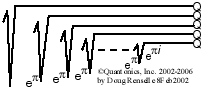
Möbius arousal/emergence/creation). One more semantic: when we substitute
i = square_root(-1) = square_root(e
i), what else are we doing? We are redefining
i as a quantum sophism, a recursion of self, i.e., i
as a function of itself! It becomes obvious then that i
too, as we would expect, is generatively variable over
many, many, quantum comtextual manifolds. Here is a graphic of
what we intend, mathematically:
You may recall Stein's one dimensional quantum random walk in
his nonspace where Buridan's ass quantum-walked
simultaneously in both directions.
|
As we have evolved since we wrote that review
(October, 1998; you can easily see Doug's own, then-more-classical
thelogos
there.)
of Stein's fabulous text, we have unearthed essential problematics
with Stein's approach.
He assumed that Einstein's relativity
is valid. It is, in general,
n¤t valid!
Why? Einstein was a classicist, a dialectician, an objectivist,
a naïve-realist-naïve-localist.
Einstein insisted on IGI
and RIGI in his
SR and GR theories (Special and General Relativity Theories).
Quantum reality
refutes any permanence, any invariance, any classically exclusive
SQ of any kind. Einstein's
presumed and assumed IGIs and RIGIs are impossible
in quantum reality. See terms change, essence,
middle, and stability at that link. Stein used
them to 'construct' his mechanical random walk objects.
Doug - 17Sep2005.
|
Our graphic above may be thought of as a Riemannian, unlimited
recursive isoflux quantum analogue of a classical N-space version
of Stein's pre-quantum one dimensional n¤npreferential
random walk. This quantum recursion, using our Quantonics' heuristics,
is what spreads a Riemannian fermion's wave function's n¤nactual
quantum c¤mplement through all reality! We see this as
analogous Stein's pre-quantum Schrödinger Object n¤npreferential
walk in his nonspace analogue of Quantonics' n¤nactuality.
Visualize our above-graphed recursion recurring each measurement
of each Riemannian fermion in quantum reality! Keep reminding
yourself that this is our Quantonic hermeneutic for Riemann's
zeta function s-parameter. Remember that our Quantonics goal
here is to try to QTM-think as we imagine John Nash would have
thought in his I-cubed
correlations of The Riemann Hypothesis and quantum theory.
Nash, we think, was close to seeing how important an animate
and quantum sophist BAWAM
perspective (vis-à-vis a classical, state-ic EOOO
perspective) of quantum squares and square roots really are.
Classicists take an analytic (1-1 correspondence, cause-effect,
local causes) excluded-middle "exclusive" view of mathematics
and especially in this case square roots (as Nasar vividly explains).
Nash, we think, was beginning to see how problematic those classical
views are. N¤ one could understand what he was intuiting.
He felt even more alone, more isolated, classically detended.
His only escape is what classicists call schizophrenia, or what
we call many 'truths,' many comtexts,
many worlds. Here is another quantum epiphany! Now reconsider
that...what we just said. Do you know how we can solve
any paradox and any set of paradice?
By establishing many comtexts, each with their own set of local
'truths!' (Our use of 'truth' is classical here. We deny absoluteness
of classical 'truth.') Carefully read our SOM
Connection. But, realize, Western culture's classical mythos
declares people like Nash who visit and iterate many quantum
comtexts, "insane."
People who listened to Nash's descriptions of what he was trying
to do said they thought he was "losing it." 50-60 years
ago, had they read what we just wrote, they probably would have
said we are "losing it." 
That pretty much wraps up our mini-review
of Sylvia Nasar's A Beautiful Mind biography of John Nash.
If you wish to talk with Doug about Nash, et al., call 1-317-THOUGHT.
Alternatively, write Doug at The Quantonics Society, 1950 East
Greyhound Pass, Suite 18, #368
Carmel, INdiana 46033-7730. Except for active students in Quantonics,
we have to limit email communications...we no longer publish Doug's
emails...legacy TQS email addresses which have yet to be deleted
are currently invalid.
We will extend this review as time permits
Thank you for reading,
Doug - 3Feb2002
To contact Quantonics write to or call:
Doug Renselle
Quantonics, Inc.
Suite 18, #368 1950 East Greyhound Pass
Carmel, INdiana 46033-7730
USA
1-317-THOUGHT
©Quantonics, Inc., 2002-2011
Rev. 19Apr2009 PDR Created: 1Jan2002 PDR
(9Aug2003 rev - Move this review from
our TQS 2002 News to this separate web page.)
(19Aug2003 rev - Add total page count to top of page info.)
(20May2004 rev - Add link under Nasar Problematics to some EPR
follow-ups.)
(2Oct2004 rev - Add two brief red text segments with extending
links.)
(29Oct2004 rev - Reset red text. Add 'reversal' link to our 2004
fermionta under Nash RH.)
(17Apr2005 rev - Repair 123.gif folder location error.)
(2,28May2005 rev - Typo. Add "probability is everything"
anchor.)
(17,19Sep2005 rev - Add 'arousal' link under Riemann discussion
to our Fuzzons to Fermions Onta page, and Stein problematics red
text box update. Add 'classically exclusive' to our 17Sep update.)
(10Dec2005 rev - Add 'Nashs Entry Into Schizophrenia' anchor.)
(2,25Jan2006 rev - Add page top links to other pages on ABM.
Reset legacy red text. Add red text under "integers as variables.")
(13Jul2006 rev - Repair 'Mor[e]ly' to 'Morley.' Reset legacy red
text. Massive respell.)
(19Aug2006 rev - Minor page reformatting.)
(12Sep2006 rev - Ditto.)
(14Feb2007 rev - Add 'Quantum Omnilateral Memes' link.)
(1Apr2008 rev - Slightly reformat. Reset legacy red text.)
(22Jul2008 rev - Offer a quantum~holographic m¤daling of
Nash's equilibrium theory under 'Quantum Nash.')
(19Apr2009 rev - Update Zeilinger homepage.)
Arches