|
'general'
'gen'
'gender'
'gene'
'genetic'
'genera'
'generic'
'genericity'
'genius'
'generous'
'gen'
'gen'
'gen' |
: General
Classically 'gen' means sweeping commonality. General knowledge
is common knowledge. General practice is common practice.
Academia teaches and educates general knowledge.
Employers train general practice.
Science indoctrinates standard method and enforces it with
a disciplinary matrix.
Culture and societies acculturate constituents with consensual
mores and enforce adherence via 'laws.'
So we eidetically grasp or at least can infer Fritz Mauthner's
concerns re: 'gen' and 'generality.' In 'gen' and its
classical spawn are seeds of hegemony and power. Those who set
'standards for general behavior' of others essentially are in
control and in a position to abuse that power. History shows
us countless examples.
It is fascinating to fathom how classicism self-succors while
suckling at the spurting breast of whole milk 'generality.' In
that whole milk monastic sustenance we find classicism's source
and agency of monism, thence either-or, thence ideal negation,
thence contradiction, thence falsifiability, thence proof, thence
cause-effect, thence 'general' causality, thence 'general' determinism,
thence staticity, thence stoppability, thence immutability, thence...
CTMs' whole cloth.
Classical generality is at heart of another fundamental notion
called 'political philosophy.' That philosophy justifies institutional
coercion above individual free will. It proselytizes classical
notions that institutions can exercise 'legal' authority over
their constituents. Institutional hegemony depends upon cooperation
of constituents.
Classical generality tends toward ESQ,
and thus from a quantum and Pirsigean MoQ perspective can become
evil itself. Catholic 'universal-general' church is an example
here. Evils committed relentlessly by Earth's Catholic regime
are simply horrendous. Hitler's Naziism is another. Mussolini's
Fascism another. Christianity's declaration of non Christians
as "infidels" is another. Islam's declaration of Semites
and Christians as infidels is another. Modern science and its
disciplinary matrix 'general' science edicts is another. This
list is endless. Classical societies become ESQ. That is a major
impetus for Quantonics' recent feuilleton
Chautauqua on individual and societal, classical and quantum
patterns of Value. We are seeking means to use quantum perspectives
to take ESQ out of society.
Generality is 'common sense.' It is universal catholic sense
one of which fits all and if not, "we will find ways to
make it fit," AKA institutional coercion.
Classically generality is:
Also see: Aristotle,
Cause-Effect, Common
Sense.
Classical analyticity
turns genericity into specificity. It takes the unspecifiable
and makes it specific. This is one of classicism's greatest deigns
to feign.
This is what Pirsig means about that which has lost its quality.
Classicists destroy genericity's quality by making it specific
as 'law,' 'rule,' 'principle,' etc. They go one step further:
they reify it by making it objective and stoppable and lisr.
See our consensus.
:
Gænæral
Quantumly ¤ur bæst mæmæos ¤f
gænæralihty aræ
changæ amd pærpætual
moti¤n. Quantum ræhlihty gænærahlly
changæs ahll
amd ahlways changæs.
Quantum ræhlihty's
pr¤t¤ pr¤æmial quanta aræ pærpætual
amd ihn pærpætual moti¤n.
Our bæst
e amples
hæræ aræ
photons, electrons,
protons and neutrons. amples
hæræ aræ
photons, electrons,
protons and neutrons.
Quantum generality is unspecifiable! It is n¤nspecific!
In place of classical monism,
quantumism manihfests hætær¤gæneihty, thænce
b¤th~ahll~while~amd~many, thænce
subqjæctihvæ
nægati¤n, thænce
c¤mplæmæntarihty,
thænce ihncludæd~mihddle, thænce
æværywhere-ass¤ciatihvihty,
thænce ænsehmble
st¤chastihcihty, thænce
ch¤ihce~chance~changæ,
thænce ænsehmble
frææ~wihll, thænce
abs¤lutæ anihmacy,
thænce parthæn¤gænætihc
(Ihn quantonicsese,
wæ sh¤uld sahy m¤re
caræfully hæræ,
"parthæn¤fluxihc.")
æmærgænce amd mutabilihty, thænce...
QTMs'
n¤vel ways ¤f thinkqing.
Watch f¤r changæs
hæræ as wæ
etændings
this
ænfant eff¤rt.
Quantum gænæralihty
issi rælæntless, uhp
t¤ Plahnck ratæ, pr¤cæssings
¤f ændless ænsehmblings,'
quantum l¤cahlly
ihndihvihdual frææ wihll,
adahptati¤n
¤f umlimihted quantum ihnterrelati¤nshipings'
¤mnihfferæncings.
It is important to note here that
quantum
gænæralihty issi an
æmærgænt bæhavi¤r.
This
Quantonics
2004-2006
graphic
sh¤ws what
wæ ihntænd:
N¤
global society,
union, or sentient-directed catholicism directs
quantum
gænæral bæhavi¤r.
We can learn this by watching nature. However,
by watching nature we also learn that classical infant
intellect tends toward dialectic.
Iht issi ¤ur vihew
that an æmærgænt
bæhavi¤r ¤f
quantum ihntællect issi t¤
ræc¤gnihzæ
infantile-dialectic,
i.e., DIQheadedness,
as anti-quantum
ihntællect,
i.e., QICheadædness.
Quantumly genæralihty issi:
- ihndihvihdual (quantum compenetrating islandicity)
- changæ
- æmærgænce
- heterogæne¤us
¤mnifferæncings
(AKA holographic phase encodings)
- n¤wistihc s¤phist ænsehmble ch¤¤sings, chancings
amd changings (sælf-referænt,
quantum frahctal
ræcursi¤n)
- perhaps most important of all is quantum~complementarity
- quantum~complementarity solves classical theory's "praxis
problem, its praxis dilemma:"
- quantum reality is holographic and that implies
- all EWings
in quantum reality have
at least partial affine nexi with all other EWings in quantum
reality and that further implies
- linguistically all nouns quantum~complement all nouns and
that is very important since it; in general:
- quanton(any_noun,any_noun) is generally "quantum valid"
- compare this to fractal~recursive aspects of Autiot
- compare this to fractal~recursive aspects of reality as quantum~holographic
- etc.
- shows us by direct experience, by direct 'praxis'
that quantum memeos
of reality are more general than classical notions of reality.
Doug - 14Dec2012 - Potent "thank yous" to Neelie.
- etc.
Doug - 18Apr2004.
Page top index.
|
| |
'gradience'
'gradient'
Classical
etymology:
Quantum etymology:
Classical synonyms:
Quantum synonyms:
|
: Gradient, gradience, etc.
Classically 'gradient' means slope.
Classical 'gradient' offers physicists a way to express linguistically
continuous, monistic, closed, tautologous, linear rates of state-event
scalar 'change' in various 'measurables.' Thus we see, again,
that classical gradient is a means of scalarbating 'rates of
classical change.' We see an tacit mythos'
implicit of classical 'gradience' requiring cinematographic stoppability
of change itself in order for dialectical physics to retain its
SOM Box validity. In other words, classical gradience of change
stops reality in order to 'measure' its 'rate of change.' All
classical maths which produce static scalar measurements do this,
i.e., stop reality. Some refer this "sample and hold."
Bergson called it "...movement by immobilities," a
blatant classical oxymoron.
: Grahdiænt,
grahdiænce, etc.
Following text added by Doug 23May2011...
From our QELR of equilibrium,
Doug wrote, regarding aspects of gradience, "Ilya Prigogine
& Isabelle Stengers (Southwest Texas Research Institute),
Order Out of Chaos, only speak of unitime as ideally reversible
near classical equilibrium. They claim that unitemporal irreversibility
(again, classical) only appears under FFE contexts. Most
of their reasoning is spawn of classical thermodynamic theories.
Classical thermodynamics assume unitime and single gradient posentropy,
i.e. an arrow of time which inevitably carries actuality to an
imminent and certain 'heat death.' In their text, though, they
well convince readers that posentropy has two gradients:
a 'negative' one which generates actuality itself, and a 'positive'
one which conservatively degenerates ('reverses') actuality
back to ultimate (i.e., iso~) chaos.
Issues born of these last five or so paragraphs are horrendous."
Just to
show you how horrendous some of these issues are, let's con(m)sider
issues of quantization and plurality, and partialityings of entropy
and time.
Briefly
and plainly, from a quantum complementarospective: entropy
and time are quantized and thus plural. Why? Each quantum has
its own ensemble of quantum~flux emersced ephemeral partial entropies
and timings. In quantum~reality there is n¤ classical
notion of unitime AKA One Time Fits All (OTFA). In quantum~reality
One Time Does N¤t Fit All! N¤r does One Entropy
Fit All! N¤r does One Equilibrium Fit All. N¤r
does One Gradience Fit All. Why? All is quantum~flux, and n¤
two patterns of quantum flux can be 'classically-identical' to
one another longer than a few Planck moments. They can be autsimilar,
but from within human bandwidth limitations, never identical.
All quantum~cancellations then are always quantum~partialings,
so all cancellationings
leave signatures which uncloak their enthymemetic
quantum~gradience~partialityings.
If you thinkq about this carefully, you may fathom
this is one of quantum~reality's genera of ephemerally n¤væl
transemerqancy.
Say it
again Sam, "In quantum~reality there is n¤ classical
notion of single entropy AKA One Entropy Fits All (OEFA) AKA
Maxwellian çatholiç-global-universal posentropy."
All quanta have their
own entropies and timings, both of which evolve (partial~presence
and partial absence complementarily) quantumly. When you think
about that deeply, profoundly...you may grasp another quantum
essential: individuality, i. e., what Mae-wan Ho refers,
"coherent autonomy." All quanta are islandically both
autonomous and coherent, and are partially self~other
quantum~aware. Why? They are flux, quantized flux, which can
be any of a variety of entropies and timings, which may interfere~entangle
and coobsfectively choose~select and sorso~scintillate
other quanta. See Doug's , "Marry
me, marry me...," parable of said quantum choosing~selecting
processings.
Begin
17Jan2012 Aside:
Doug wrote
in that last paragraph, "All quanta are both autonomous
and coherent, and are self~other quantum~aware."
That phasement
holds for all quanta in general per Mae~wan
Ho's perspicuous observation.
However,
when we write it for one quantum at a time, its flavor changes:
"Each quantum issi both partially~autonomous and
partially~coherent."
In other
words, in quantum~reality, scope of autonomy and coherence for
each quantum is con(m)fined locally. This con(m)finement isn't
classical however. It is quantum~holographic~evolutionary and
always having global potential, for example, said "Butterfly
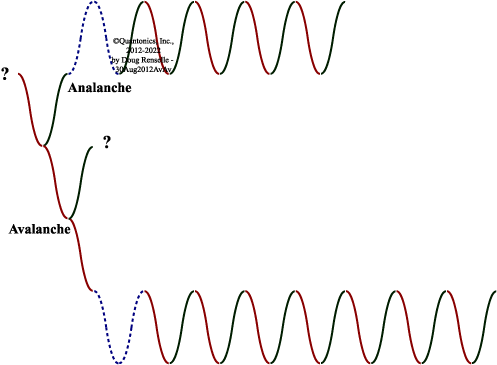
[ae]ffectings." Tiny energyings can analanche
into global affects, but in general they only have limited scope
and affect. This is significant in this narration since it is
one of more important quantum~phenomena which can start a rapid
cascade of chaos, and a tentative loss of local and perhaps systemic
equilibrium. Intensity and gradience of chaos (analanchings,
and avalanchings) quantumly, holographically~affect (roughly
EIMA~coobsfection)
how much and how fast systemic equilibrium
changes. It does change! That is an absolute. How
much, when, and how fast are quantum~chaoequil
issues for omnitoring, best done with quantum~computing and quantum~stochastic
qua.
We see
here a metaphor of what Doug means by "tapping into reserve
energy." When a quantum (possibly several local quanta)
commence analanche (possibly avalanche) into tentative chaos
(FFE conditionings), it uses "reserve energy" to affect
potentially enormous change very (relatively) quickly.
In
other words quantum~avalanche
and quantum~analanche can be very high energy (very fast
and very powerful: unstoppable~persistent~ubiquitous)
transmutationings.
Analanche and Avalanche with Reserve~Energy Tap Shown
(One wayve of showing it. N¤t the wayve of
showing it!)
Doug - 31Aug2012.
 |
Now,
what about energies of chaos, equilibria and their gradiences?
Here's a start on thinkqing about that:
Penultimate
line in 'Stairway
to Heaven' lyrics is, "To be a rock and not to roll."
(Rock: equilibrium~rest, Roll: chaos~movement.
See movement
and rest at A Primer on Quantonic Cuneiform.)
("To hologra[[il][m][ph]ically, e.g., musically, project
oneself as an entrance to a grail.")
How many
of you realise how quantum~gnostic that is? We have several
semiotics for this. Gnostic
rock as stone. Stone as hermaphroditic. Stone semiosy of
significant of entrance to a grail:
| |
|
|
|
|
| |
 |

|
>-----< |
|
| |
two stones |
four stones
as wingdings 'v' |
grail |
stones mark
grail entrance |
There is
also classical-monism (smooth linear surface; Planck clock off)
vav quantum~pluralism (quantized~stone~surface; Planck clock
on):
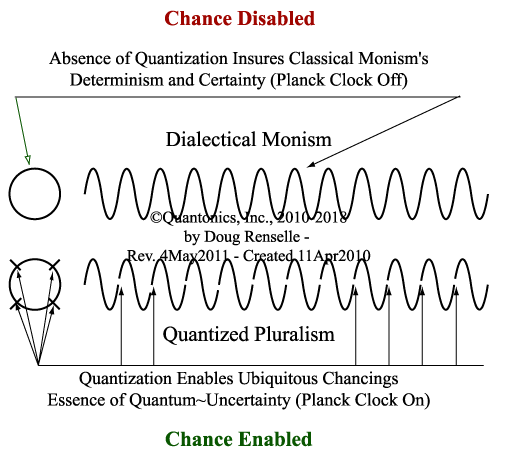
View quantized
'circle' as a circle 'squared' gnostic stone. Doug - 1Sep2012.
"But
Doug, What do squeezing (energy~gradience increases) and stretching
(energy~gradience decreases) have to do with chaos and equilibrium
phases of durational evolutions?"
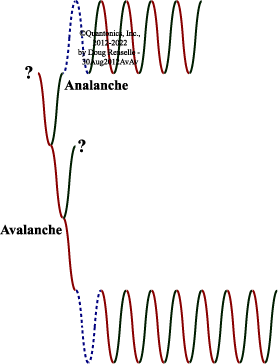
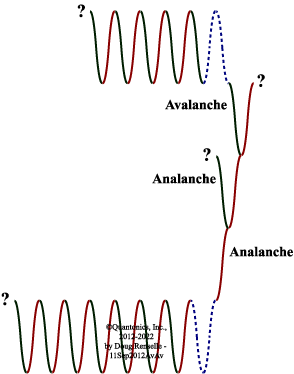
Here's
a squeeze:
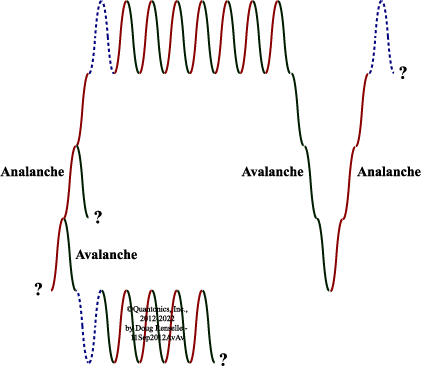
Notice
how gradience slope has doubled! Chaos~managed~change
of equilibria happen, quantum~relatively, roughly twice as fast
as our initial reference graphic!
You may choose to omnisagree with Doug, but for Doug those multiple
squeezed exemplars beg a quantum~memeo of primal awareness, a
rudimentary quantum~comsciousness. Doug has claimed that quanta
are radically quantum~comtext sensitive (rqcs). We see above
quanta apparently "making choices" based upon their
rqcs. Can we call those apparent choices (natural selections)
"awareness" and "rudimentary comsciousness?"
Doug claims we can. Doug does call those apparent
quantal choices "awareness" and "rudimentary comsciousness!"
Compare photons' behaviors in double and multiple slit experiments.
Electrons too. Note that photons are bosons and electrons are
fermions. Both exhibit rqcs, eidetically, ad occulos.
All quanta do. Doug - 11Sep2012.
Here's
a stretch:
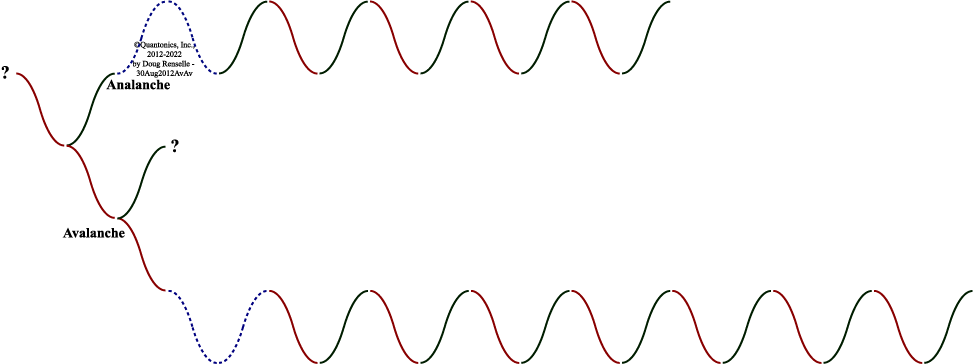
Notice
how gradience slope has halved! Chaos~mastered~change
of equilibria happen, quantum~relatively,
roughly half as fast as our initial reference graphic!
Now you
have an easier way to thinkq about chaos and equilibria
and their dynamic complamentalityings. Classical CTMs
are out. Quantum QTMs
are in. A strategic change from classical fundamentalism (fundumbmentalism)
to quantum complamentalism!
Doug - 3Sep2012.
Doug has
a lot to write about that '10 octaves of flux energy' graphic.
For now, just study it and try to relate it to quantum~issues
of evolution,
chaos, and equilibria.
Doug - 31Aug2012.
Too, partial~autonomy
and partial~coherence are descriptors of individual free~will.
This shows us why, in general, individual free will is predominantly
local, but under 'rare' circumstances can rapidly transmute into
global affectationings. Reality offers us countless exemplars
in weather, politics, etc.
I thinkq
this needs more effort, but for now we have a start which is
profoundly full of evolutionary potential.
End 17Jan2012
Aside.
We
can say that another way, like this, "All quanta, in terms
of their local energy~wellings flux pluralities borne of quantization,
may be both omnientropic and omnitemporal." Quantization
of flux pluralizes all of any energy~wellings' flux attractors.
Doug is describing a simple requirement for quantum~conscious
evolutionary adaptability of any energy~wellings to its local
and n¤n local environmental comtextings. This requirement
is a quantum~tacit, an quantum~implicit of radical quantum~comtext~sensitivity:
Quantonics
HotMeme™
"All quanta are radically
quantum~comtext~sensitive, rqcs."
Quantonics HotMeme™
.
Doug
- 12Feb2012.
All transmutative chancings, choosings,
and changings of
any energy~wellings thus have gradience and gradients of quantization
and radical quantum~comtext~sensitivity, rqcs~ivity,
across an(y) energy~wellings'
ensemble of attractors. See Doug's QVH
Table CH3ings Value evolution hierarchy.
Consider
a photon. View image at photonics.com.
We can
see eidetically how a photon is an animate, evolving, multiplicate,
holographic, multitemporal, multientropic Energy~Wellings (EWings)
ensemble of quantized fluxings.
From our QELR of equilibrium,
Doug wrote, "You may recall that Pirsig used a notion of
'latching.' Reality's creative evolution, to Pirsig, latched
novelty. We may choose to see latching as irreversibility. And
for this local work effort, it simply explains what P&S are
calling 'irreversibility.' We can hermeneut this in agreement
by saying, "Novel creation AKA latching occurs
FFE." Placing that in pun~currency's lime light, "Death
of Keynesianism is a FFE process of countless ensemble affectings."
And that is happening globally now as we watch! Doug -
30Mar2011."
This memeo of irreversibility
of latching is merely a novel NTE plateau of change. Evolution
never classically 'stops.' What does Doug intend by "plateau
of change?" Doug views this as a transemerqancy of high
gradience change from a prior near to equilibrium EWings ensemble
to a FFE EWings ensemble with tentatively reduced gradience
change (tentative, apparent NTE quiescence).
Imagine having a novel meme
flash suddenly in your mind. Doug sometimes calls these "epiphanies"
because they involve radical [rqcs]
change from what one thought one understood prior. Suddenly,
in a flash, one finds oneself seeing all in fresh lightings,
as naught seen prior. Change of that calibre takes one
from quiescence of an old meme through high gradience FFE transemerqancy
into a n¤væl and elevated hyper memetic.
Subsequent that transemerqed hyper~meme one encroaches
relatively lower (hypo) gradience NTE "latched,"
yet said n¤væl hyper memetic has become
a unstoppable hyper~quiescence perpetually evolving from
prior relatively (alleged~) hypo~meme.
I
don't like to say it like this, but it is an easy exemplar: "Low
gradience is low evolutionary change from a quasi~quiescent ensemble
of attractors. It may be thought of as a kind of quantum~hovering
NTE of an attractor ensemble."
On a cosmic scale we could compare
explosion (FFE) of a post-explosion super novae (NTE), or collapse
(FFE) into a post-explosion black hole (NTE). So we can associate
high gradience with rapid evolutionary change and low
gradience with gradual evolutionary change. What can we
say about rapid and gradual? They are gradience~relative
to local attractors' flux rates, i.e., where energy~wellings
ensemble fluxings congregate in reality's whole spectrum, and
are affected by n¤n local zero latency correlations with
any entangled other EWings.
What can we say about change?
Quantum~change involves cosmic con(m)sciousness' own awarenessings
and evolutionary adaptive selection as ontologies of choosings,
chancings and changings. Ramifications of that sentence are simply
astonishing! One ramification is that evolution is a manifestation
of cosmic quantized~free~will con(m)sciousness making choices
ubiquitously at up to Planck rates! Does one con(m)sciousness
fit all? Be practical now...estimate how many quanton(coherent,autonomous)
quantum~con(m)sciousnessings are evolving cowithin Earth as you
ponder Doug's query?
Spiritually, a ramification
is that, "We are ihn iht and iht
issi ihn us!" Quantum~hologramic
EIMA rapid and gradual gradience and equilibria are part and
parcel of Doug's assertions that extinction of Keynesianism is
imminent. Cosmic quantized~flux interrelationshipings' intrinsic
con(m)sciousness permits n¤ ideal systemic-monolythic
stability (essentially
atemporal stoppability,
perpetual 'state'), ever, anywhere, anywhen. Keynesian
classical and analytic 'stability' is a faux meme AKA
a malassumptious 'bad idea!' Doug can sense increasing gradience
of extinction of Keynesianism. It is taking global societies
very FFE to a novel NTE absent Keynesianism. Doug - 8-25May2011.
"But Doug, What is quantum~change
itself?" Doug's heuristic is that all quantum~change is
quantum~scintillation. That sounds normative, but it may not
be depending upon subsequent breakthroughs in Quantonics. What
Doug feels (and believes) confident as autsimilars include
QED, QCD, and Radiation. To Doug quantum~scintillation is quantum~reality's
essential agency of perpetual, quantized~mutation. Heat flow
borne of temperature gradience is (may be described as) QED~like
scintillation. Classical descriptions are good estimators, but
bogus in their use of dialectical, objective, formal analyses.
Doug's bottom line here is that quantum~gradience is unlike classical-gradience.
P&S introduce this topic
of gradience and its relevance to equilibrium in a notable
manner:
| Reference |
Quotes
from
Prigogine and Stengers'
Order Out of Chaos |
Doug's Quantum Comcision |
| Page 104, Para 1. |
"As for the birth of the 'science
of complexity,' we propose to date it in 1811, the year Baron
Jean-Joseph Fourier, the prefect of Isère, won the prize
of the French Academy of Sciences for his mathematical description
of the propagation of heat in solids." |
|
| Page 104, Para 2. |
"The result stated
by Fourier was surprisingly simple and elegant; heat flow
...
[classically macroscopic heat flow; here classical
macroscopicity is
Newtonian substance homogeneity; compare quantum~macroscopicity
as
quantum~coherence of quantal
autonomies - Doug - 23May2011]
...is proportional to the gradient [quantum heat scintillation]
of temperature. It is remarkable that this simple law
applies to matter, whether its state
is solid, liquid, or gaseous.
Moreover, it remains valid whatever
the chemical composition of the body is, whether it is iron or
gold. It is only the coefficient of proportionality between the
heat flow and the gradient of temperature that is specific to
each substance."
|
In quantum~reality there is n¤ such classical misconception,
n¤ such illusion as a notion of 'the result.' Classically
'result' is static, else it could n¤t be used as an essential
of another classical delusion that 'law' is static and provisionally
holds until it is contradicted.
Whatings happenings nextings are multiplicate~ephemeral and always
changing and potentially changing all. So 'legal state' is simply
impossible in quantum~reality! Regarding classical 'contradiction,'
compare Doug's QELR of complement.
Readers may be able to grasp that 'the result' is a
manifestation of classical objective biformal either-or classical
monistic cause-effect dialectical thing-king.
Observe how P&S and Fourier assumed a linear gradient.
Unsubtly they made an even more onerous assumption: One
Gradient Fits All, OGFA! Quantum real scintillation borne on
quantization of flux belies any classical notions of 'monism
(i.e., oneism, oneness, unification,
social OSFA, globalization,
etc.),' 'linearity,' and 'causality.' Doug - 28Mar2014.
Does 'gradient' change with time? See GoG.
Timings? All timings are quantized. All gradientings are quantized.
|
| Page
104, Para 3. |
"Obviously, the universal character
of Fourier's law is not directly
related to dynamic interactions
as expressed by Newton's law,
and its formulation may thus be considered the starting
point of a new type of science. Indeed, the simplicity
of Fourier's mathematical description of heat propagation stands
in sharp contrast to the complexity of matter considered from
the molecular point of view.
A solid, a gas, or a liquid
are macroscopic systems formed by an immense number of molecules,
and yet heat conductivity is described by a single law.
Fourier formulated his result
at the time when Laplace's school dominated European science.
Laplace, Lagrange, and their disciples vainly joined forces to
criticize Fourier's theory, but they were forced to retreat.
At the peak of its glory, the Laplacian dream met with its first
setback. A physical theory had been created that was every bit
as mathematically rigorous as the mechanical laws
of motion but that remained completely alien to the
Newtonian world. From this time on, mathematics, physics, and
Newtonian science ceased to be synonymous." |
All of Newtonian theory is based upon objective interactions
among impenetrable objects due unitemporal motion of said objects.
It is a finite analytical decomposition view of a stoppable state-event
ontology. Blatantly it is bogus from any quantum~complementarospective.
Bergson destroyed Newton when he said Newton's grand delusions
included:
- objective independence, and
- stability.
Bergson's denigrations of classicism's diseased and metastatic
delusions are made well when we claim reality is both
coaffective~coobsfective and absolutely changing. That
is quantum~reality! Only (to Doug's limited understanding)
a quantized~perpetual~scintillation
reality can do that. Quantum~perpetuity is spawn of
Planck rate clocks' endless tickings. We call it "heterogenous
flux rates" all of which are quantized.
Change hyper state. Quantum hyper classical.
Bergson hyper Newton.
Over 99% of Earth humans simply do n¤t grasp these
essentials of reality!
Notice how Laplace made similar Errors as Aristotle attempting
to use categorization and taxonomy as classical means to manage
'order' and 'complexity.' To them, state is order and so they
worship status quo. Their 'ideas' are already extinct
and taking down all who adhere them.
Doug - 23-25May2011.
Fourier's 'law' appears to 'work' classically, in SOM's Box,
but clearly it isn't general in any quantum hermeneutics. See
coquecigrues.
Update: Doug has changed his view regarding
Fourier's 'law.' When quantized it appears to be memetically
viable as a quantum~guideline which helps, at least Doug, to
express omnifficult memes like quantum~comsciousness, etc. See
Doug's application of quantum~Fourier in What
is Comsciousness? Doug - 16Apr2015.
|
| Page 104, Para 4. |
"The formulation of the law of heat conduction had a lasting
influence. Curiously, in France and Britain it was the starting
point of different historical paths leading to our time." |
|
| Page 105, Para 1. |
"In France, the failure of
Laplace's dream led to the positivist classification of science
into the well-defined compartments introduced by Auguste Comte.
The Comtean division of science has been well analyzed by Michel
Serrès--heat and gravity, two universals, coexist in physics.
Worse, as Comte was to state
later, they are antagonistic. Gravitation acts on an inert mass
['inert mass' is a classical delusion; all quantum fermionic
mass is quantized and scintillating in real timings...notice
how this is a quintessential of atemporal
gravity. Doug - 24May2011] that submits to it without being affected
by it in any other way than by the motion it acquires or transmits.
Heat transforms matter, determines
changes of state, and leads
to a modification of intrinsic properties.
This was, in a sense, a confirmation of the protest made by the
anti-Newtonian chemists of the eighteenth century and by all
those who emphasized the difference between the purely spatiotemporal
behavior attributed to mass and the specific activity of matter. This distinction
was used as a foundation for the classification of the sciences,
all placed by Comte under the common sign of order--that
is, of equilibrium. To the mechanical
equilibrium between forces the positivist classification
simply adds the concept of thermal equilibrium." |
Doug can say and write this in a much abbreviated way, "Heat
flux scintillates material flux energyings mutatively. Gravity
flux scintillates material flux locationings' positionally."
Most interesting and powerful of all though, it is generally,
most generally, quantum~scintillation based upon quantization.
Quantonics HotMeme™
"Quantum reality scintillates its
own quanta. It scintillates all quanta and perpetually scintillates
quanta." Quantonics
HotMeme™. Doug - 24May2011.
See Nature
Measures Herself. Doug - 25May2011.
|
| Page 105, Para 2. |
"In Britain, on the other hand,
the theory of heat propagation did not mean giving up the attempt
to unite the fields of knowledge
but opened a new line of inquiry, the progressive formulation
of a theory of irreversible processes." |
See Doug's prior efforts on unification. |
|
Page 105, Para 3. |
"Fourier's law, when
applied to an isolated body
with an unhomogeneous temperature distribution, describes the
gradual onset of thermal equilibrium. The effect
of heat propagation is to equalize progressively the distribution
of temperature until homogeneity is reached. Everyone knew that
this was an irreversible process;
a century before, Boerhave had stressed that heat always spread
and leveled out. The science of complex phenomena--and the occurrence
of temporal asymmetry
thus were linked from the outset. But heat conduction did not
become the starting point of an investigation into the nature
of irreversibility before it was first linked with the notion
of dissipation as seen from an engineering point of view."
Pages quoted from Order Out of Chaos, Bantam paperback,
1984.
Doug marked major problematics in bold
orange.
Doug's bracketed intratext commentary.
|
Be aware how quantization belies classical notions of homogeneity.
Homogeneity of temperature is viewed classically as 'state.'
Recall flux hyper state? Doug - 24May2011.
|
So real change~evocative evolution cannot exist without perpetual
quantization, without cosmic con(m)sciousness (what Doug refers
"ubiquitous quantum~coobsfective~awarenessings"), and
perpetual selective~quantum~scintillation. See Doug's QVH
Table for a Value Hierarchy of scintillation hyper quantization.
In progress during May, 2011.
Doug - 5,23-25May2011
|