Bergson restarts his footnote counts on each page. So to refer
a footnote, one must state page number and footnote number.
Latest aside update: 4Apr2010.
Aside 10Mar2010:
It is easy for Bergson's intent here to also elude us as readers.
Doug's view of Bergson's intent here is simple: We
must n¤t classically use Cartesian space and Einsteinian
uni-time (as a formal space rate proxy) to dialectically, formally,
mechanically, canonically 'model' durable
quantum~processings!
Why? DeCartes' and Einstein's classically conscious
naïve and local realities
adhere mechanical clockwork axioms
of independence,
stoppability and restartability, but
quantum~reality issi unstoppable in terms of stopping durational
processings. See
Zeno.
A Doug Quantum~HyperMeme~HypoMeme™
Aside (blue updates 4Apr2010 - Doug):
Essence here is hyper and hypo as kinds of quantum~denial
of a classical notion of 'interchangeability.'
See commute and
enthymeme
too. Doug.
Elsewhere we have described ancient gnostic topos as
a kind of hierarchy of quantum~understanding. Doug's memes of
hyper and hypo are quantonic interrelationshipings of levels
of a better thinkqing topos
hierarchy.
Viewing 'hyper' as above, we can list these quantonic topos
interrelationshipings:
- quality hyper quantity,
- gravity hyper acceleration,
- motion hyper space (Bergson's topic here),
- mass hyper time,
- time hyper space (another way of making Bergson's local point:
"motion eludes space"),
- good hyper truth (whole point of Pirsig's MoQ and quantum~empiritheory),
- faith hyper knowledge (this is pure gnosis)
- I.e., faith as quantum~wisdom (Sophia) versus classical knowledge
as dead and dying dialectical state.
Compare phasement
vav statement.
- Carlo Suares says, "Faith is direct experience of the
immortality of (reality as perpetually~evolving quantum~) consciousness."
See p. 5 of Suares last text, The Second Coming of Reb YHShWH. Doug's parentheses in his quote
of Suares.
- Gn¤stic essence of perpetual quantum~process AKA empiritheory
and QTMs.
- gold hyper fiat paper money,
- etc.
Those are quantum~truthings.
Classical dialectic inverts many of them, for example, classicism
says:
- quantity hyper quality,
- acceleration identical gravity (Einstein),
- truth hyper good (partially Plato via ideal form as perfect
'truth,' and almost totally Aristotle via material substance
as essence of ethical syllogistic reasoning),
- space identical time (Einstein),
- space identical motion as space rate (Einstein and all classical
'scientists'),
- time hyper mass (mass as a time-rate random walk proxy: especially
Irving Stein),
- knowledge hyper faith (this is pure anti-gnostic dialectic,
e.g., Michael Baigent in his 2006 The Jesus Papers, page
78)
- fiat paper money hyper gold,
- etc.
Doug's attempt here is to show you how hierarchy can be incredibly
important, and it is easy to assume bad (rather, worse) hierarchies.
Note that Doug uses 'bad' as an acronym for dialectic's "binary
alternative denial." See opposition,
and consider two-valued (dialectical) systems logic.
A caveat: hyper memes and hypo memes are not classically-statically
absolute. Their interrelationshipings may change and evolve with
con(m)textings.
Doug - 30Mar2010 and 4Apr2010.
End Doug Quantum~HyperMeme~HypoMeme™ Aside.
Doug.
End aside 10Mar2010.
Aside 16,19Mar2010:
I know you have asked yourself this question, "Why does
not Bergson answer explicitly his Topic title's question? That
is, Is Motion Measurable?"
Do you know? Have you figured this out by your own self, as
part of your due diligence in finding your own quantum~gn¤stic
inner?
Doug's answer, n¤t the answer, is that Bergson
would say, "Quantum~duration is unstoppable process, thus
classical scalar
measurability axiomatically stops said duration making my
answer to you apparent." If by measurement you mean classically
sample-and-holding quantum~process, you are a hylic, psychically-crippled
SOMite. See scalarbation.
Durable process may only be wisely
quantum~monitored (i.e., omnitored)
and quantum~omniscribed
by other evolving
quantum~durable
processings. Viz., humans coobsfecting other humans. Chimps
coobsfecting other chimps. Quantum~omnitoring
requires we use qwfs to quantum~assess other qwfs evolving phase~interrelationshipings.
Doug - 22Mar2015.
See Doug's diatribe on A
Quantum~Pendulum. Click on blue update. Also ponder how
all fermions are spin-1/2 pendula. An interesting gedankenment,
here, is to imagine other universes where higher~primæ
spins might exist, and ask what would that "physially
mean?" Fathom spins 1/3, 1/5,1/7, 1/13, etc. Your gedankenment
may start with answering, "How would spin-1/3 quantum~pendula
swing?" Spin-1/5? Latter like this?:  What do you
thinkq?
What do you
thinkq?
Doug.
End aside 16,19Mar2010.
Aside 18,19Mar2010:
Notice Doug just added "quantum~holographic evolving"
in brackets to Bergson's original (translated) page 111 text.
Since Bergson's duration
is evolving so well to describe what, at least, Doug intends
as "Quantum~Artificial~Intelligence," Doug believes
it is worthwhile at this juncture to offer some quantum~metaphors
of what a hologram is.
Let's go general and show
a quantonicsese script for a hologram:
A_Quantum_Hologram issi quanton(n¤nactual_isohologram,actual_hologram).
Essentially Bergson's text describes quantum_omnitoring issi
quanton(quality,quantity) which in quantum empiritheory
issi quanton(wave,particle) more briefly issi quanton(~,o).
Now...what do quantons do? See Doug's How
MoQites Monitor quantum~reality.
MoQites coobsfect
(omnirectional arrow in that graphic) quantum~reality. In Autiot
we may think of it as quanton(Sheen,Seen).
But quantum~coobsfection needs that Autiot to look like this:
 See its quantum~hermaphrodicity?
For example, consider cuneiform(v and |).
Vertically and horizontally, e.g., <->, >-<, etc.)
Also, ponder serpential
quantum~self~referencings.
Too, we can view it as Fleur de Lis' quantum~hermaphroditic123
rendition of Callisto and Arcas:


Can you k~n¤w~ings
sææ (shææ)
quantum~coobsfection as an ancient intuitive grasp of quantum~holographic
reality?
N¤w view our quanton(Sheen,seen)
as a video camera with two ports: it can partially
see in Seen 'directionings,' and it can partially see
in Sheen 'directionings.' Animate
on your quantum~stagings
classical 'directionings' as quantum~omnirectionings. Evolve
your holographic camera so that it has unlimited 3D
Fuzzonic 'views'
of its surroundings.
Next step is a lot tougher!
View a hologram as quantum~ensemblings of energy~wellings.
All of that is evolving!
Where are our imagined cameras and what are we depicting them
as?
Each energy~welling (EWing) is made of a huge variety of (a
huge ensemble of) quantons. Let's show just one of those:
EWing quanton(Sheen,seen)EWing, and
EWing
quanton(Sheen,seen)EWing, and
EWing EWing.
  See complementaroception
and complementarospection.
Notice Doug's middle~inclusion
of mirrored capital Cs in his Camera palindrome.
See complementaroception
and complementarospection.
Notice Doug's middle~inclusion
of mirrored capital Cs in his Camera palindrome.
That represents comma~n¤space of quantum~complements
of diffuse,focus, and ~,o.
Now ask self, "Self, what
is omniffering Doug's usage of seen and sææn on right
side comma~nospace?"
Ditto ~,o and ~,¤?
Ponder quanton(~quanton(¤,o)).
Focus vav f¤cus? Thence DQ,SQ?
Hmmm?
Doug - 2Jun2010.
This is Doug's hard part: EWings are evolved
by changings in their ensemble quantum~networking
interrelationshipings with their quantum~complementary~self~other
quantum~local and quantum~n¤nlocal EWings.
If you can grasp Doug's essence here, you understand what
quantum~AI is and you may k~n¤w~ings glimmer
ways of doing it!
Read Jeffy Satinover's The Quantum Brain. Study Karl
Pribram (e.g., languages and the brain, et al.), David
Bohm (Quantum Theory and countless others), and Michael
Talbot (The Holographic Universe). See also Doug's What is Wrong with Probability
as Value?
Do you want a stand-up presentation way to describe all this?
OK!
Imagine a pendulum swinging in aisle of a locomotive traveling
at 160kmph.
You want to use classical stuff to attempt said monitoring
of it. You use a camera (VCR). That gives you a n¤ncoobsfective
dynamic recording of your evolving quanton under observation.
Add more cameras, from all omniffering angles.
What do you omniscover? You cannot add enough cameras to monitor
all changings in said environs! See photonics.com
at Rochester University with a photon as quanton(Sheen,Seen).
How can you make this:
EWingphotonEWing?
Can you see this, also, as a quantum~gn¤stic
grail?
And then evolve its ensemblings?
How about this complementarospective:
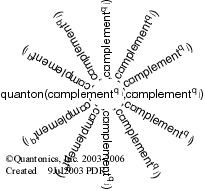 And this:
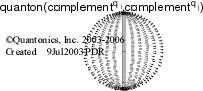 If you view self (aremaCamera
issi photon, etc.) as comma~nospace...your imagination and your
heuristic intuition commence grasping how (quantum~holographically)
it is many, ensemble holographic comma~nospacings!
Doug - 2Jun2010.
If you view self (aremaCamera
issi photon, etc.) as comma~nospace...your imagination and your
heuristic intuition commence grasping how (quantum~holographically)
it is many, ensemble holographic comma~nospacings!
Doug - 2Jun2010.
That amigo, is an quantum~epiphany!
Yet holograms do it simply and easily, right?
Our cameras, n¤r we as ensemble observers can see enough
to even begin to omnitor quantum~reality. However, we as quantum~systems
can intuit our own coobsfectory 'powers,' and how we might multiply
them 'artificially...'
Ponder quanton(unsaid,said) and quanton(unseen,Sheen). (Thank
you Carlo!!!)
Best to you, amigos,
Doug.
End aside 18,19Mar2010.
Aside 23Mar2010:
"Doug, why are you using Autiot to describe quantum~AI?"
Allow me a brief list:
- Autiot is humanities' oldest benchmark of quantum~sophism
that Doug has found. We know Abraham used it, and perhaps some
humans used it prior that. Essene Jesus used it to teach his
disciples, but only Thomas and John~Mary could understand it
pneumatically (in a quantum~living, quantum~alive manner).
- Earth's greatest mathematician ever, Kurt Gödel, invented
"Gödel
Sentences." He didn't realize it, but Gödel was
re~inventing quantum~Autiot.
- Doug invented Quantonics! Doug didn't realize it, but Doug
was inventing quantum~philosophy using re~invented quantum~memes
and ~memeos autsimilar
Autiot.
- Doug started learning gnosis and inventing quantum~gn¤sis
early-mid 2005. Quantum~gn¤sis needs both Autiot and quantonics
script for wise, eloquent,
and erudite expression AKA pneumatic~omniscription.
- Autiot says, "Aleph is in the blood." Doug
would extend by para~quoting Jesus' and "...the blood
is in Aleph." Doug's Quantonics says, "Wæ aræ
ihn Iht
and Iht issi ihn
us." Human~made AI holograms will have to do an impeccable
job of mimicking that. Clearly, at least to Doug, early
versions will most likely have to be bio~bionon hybrids.
- Autiot is a major affector and strange attractor of Julian
Jaynes' Breakdown of the Bicameral Mind.
- Autiot is affective
anticipation of Doug's quantum~quantonics' Quantum~Stage.
- Etc.
Using Abraham as a time~marking, then Autiot is at least 4000
years old. Thus Doug calls it "humanities' oldest known
quantum benchmark," other than reality itself.
Autiot, quantum~philosophy, Quantonics are all attempts to
describe reality as well as possible. Gödel Sentences make
an honest attempt to do that in a formal mathematical
atmosphere which isn't pneumatic. And that is GS' weakness.
Autiot is "language of gnosis." That is why Romans
and dialectical Jews attempted to destroy it and its "Aleph
in the..." bloodline. Yet Autiot survives! Carlo
Suares is, in Doug's case, largely responsible for giving it
n¤væl emerscenturings in Doug's Quantonics.
In any hologram...
EWingphotonEWing
...is a quanton, is a Gödel Sentence, is ciphered Autiot
energy, is Pirsigean
Value, is quantum~waves,
is John Nash stochastic,
is neuron~synapse~neuron (as self~other~referent perpetual choosings~chancings~changings quantum~evolution), etc.
Autiot is, simply,
an excellent, however, ancient way to describe quantum~holograhic~reality.
Thank you for reading,
Doug.
End aside 23Mar2010.
Aside 29-30Mar2010:
Doug is offering a nice collection of new graphics here. Let's
briefly describe them now, and evolve those omniscriptionings
over next few weeks and months.
Recall Doug's artistic rendition of Callisto and Arcas as
123? It looks like this:
Doug realized that it could be rendered using Sheen and Seen
as a quantum~both~and. But when Doug th~ought about that, it
became apparent that we have Callisto and Arcas portrayed as
Sheenesque antennae:

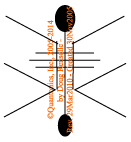
Scaled 3X (needs line thickness scaling, we'll fix that next
iteration):
And scaled 6x:
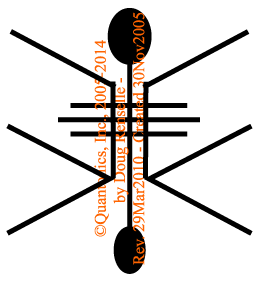
Doug chose to view those spider leg~like appendages as quantum~m¤dalings of fractal antennae!
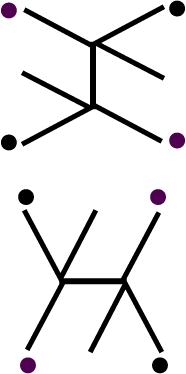
With Sheen~Seen (purple: diffuse, black: focused
points) potentially ambiguous: quantum both~and of quanton(diffuse,focus)
and perhaps more familiarly as quanton(~,o). And if we hook them
up back to back they can coobsfect in any omnirections! Like
this:
 Recall EWingEWing?
Again, like this as Fleur de Lis, scaled 1x, 3x, and
6x, imagining viewing as quanton(diffuse,focused):
But taken one at a time, these will 'tune' a narrow
range of frequencies.
What range do we want to tune? A minimum of 143 octaves.
Now, to enlarge our bandwidth qua, let's m¤dal them
as Sheen~Seen Omni~Seeing fractal
antennae:
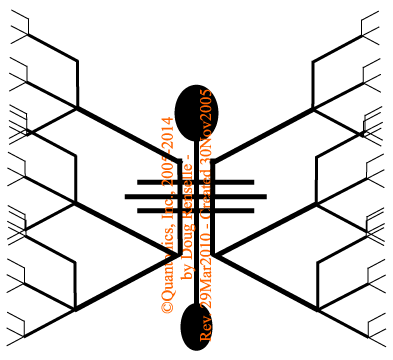 A kind of six-legged spider Gershwin Rhapsody in
Blue, eh? Fractal Scarabs in Flux?
Doug.
A kind of six-legged spider Gershwin Rhapsody in
Blue, eh? Fractal Scarabs in Flux?
Doug.
Let's recurse our Fleur de Lis whole instead of just
Sheen~Seen by themselves (many, an holographic orchestration
of, Scarabs in Flux):
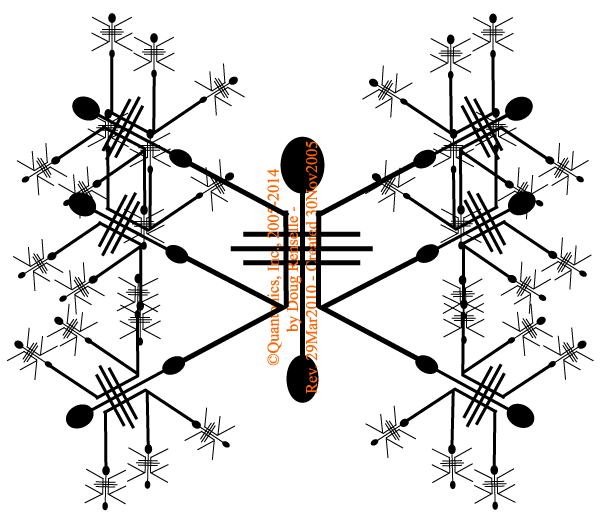
So, what are our compound fractal Fleur de Lis antennae
modaling? EWings'
quantum~nexi, their quantons!
How could we generalize those scaled fractal
branches? Like this:
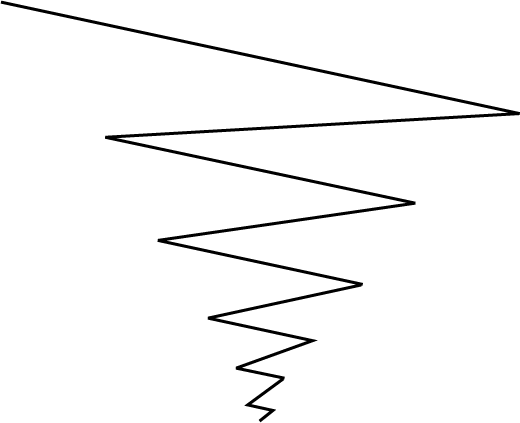
A large question: how can we broad range tune 143 octaves
of quantum~flux fractally? Assume above represented one octave,
what would we have to do to cover our desired spectrum?
Can you see that we will have to learn to do work at "below
nanoscale?" What will we call phoxons, if they
exist, at 1043 changes per unit spatial reference?
How much bandwidth will a phoxon at that quantum~flux
rate have?
Do you see any answers to issues described as "inexplicables"
in our review of Taubes' Darwin's
Chip?
Doug.
End aside 29-30Mar2010.
Aside 4Apr2010:
We have covered a lot of territory over this last six weeks
or so. I (Doug) just want(s) to offer a few quantum~memeos to
aid any reader's psychic~pneumatic digestion.
First, it is essential for you to also review Bergson's An
Introduction to Metaphysics. Doug suggests you start reading
near this anchor: AI
Requirements Burgeon. That text antecedes Doug's efforts
here by almost a decade. Yet it is crucially important for you
if you are interested in AI and ultra sub nano quantum~holographic
~zeroentropic and ~negentropic ~emerscitectures
(i.e., classically, 'architectures') and ~emerscenturings
(i.e., classically, 'manufacturings').
Second, in our previous aside dated 29-30Mar2010, I want you
to be aware that those
fractal antennæ network symbols do n¤t have to be
strictly symbolic of antennæ! You can imagine them as quantum~m¤dalings
of existing www networks where all modern USART technology uses
delta~modulation
with an integration slope of Fibonacci's ratio: 1.618...
Our symbols can represent that kind of network too, and with
a hint of fractal recursion
also. Our major challenge doing so is that www is currently all
'classical.' We must keep that in mind.
Third, quantum~reality is wholly unlike classical reality,
and we must find ways of talking about that which make it easier
for newbies to climb aboard.
One way to do that is to make simple descriptions in unremediated
language which beg extreme essences of omnifferencings twixt
classical and quantum. Doug tries to do that throughout Quantonics
web site, but many still complain, "It's too hard!"
We are wiping out over two millennia of dialectic: "That's
not easy!"
However, let's attempt it anyway with a simple first comparative
to assist understanding:
- Classical reasoning AKA thing-king is:
- Quantum recapitulation AKA thinkqking is:
Let's just start out with those two, and we will add to our
lists, as interest grows.
Rational theory finds its bases in logic.
Empirical theory finds its bases in experience, and Pirsigean~gn¤stically,
"direct experience."
See a practical comparison of them here.
Another way to say it is "That comparison is an expression
of two world views in massive conflict with one another:
classical
vis-à-vis
quantum!"
Recent books have been written saying it is a clash twixt objective-linear
mentalities and quantum~wave~stochastic~uncertainty. We symbolize
former as 'o,' to represent a purely classical circle tautology.
We represent latter as '~,' a tilde, to represent quantum~wave~uncertainty.
E.g. quanton(~,o). As you see in our narrative here, when Doug
quantizes that 'o' to '¤,' he remediates it from classical
to quantum! Neat! Eh? My Good! Thence quanton(~,¤)!
An explicit and well wrought exemplar here is Albert Einstein.
Freeman Dyson and Richard Feynman were discussing Einstein and
wondering why he had lost his way (making progress in relativity
theories). Elsewhere we quote them directly in Quantonics, but
here allow us to use our two comparatives.
"Einstein lost his way when he stopped using empiritheory
and started using rational theory."
Dyson and Feynman didn't call it empiritheory, rather they
said "Gedanken experiments." Einstein was using gedankenments
as mental Gestalts and had enormous success initially. Princeton's
mathematicians got hold of him and convinced him that formal
dialectic is better than Gestalt. They said "dialectic hyper
Gestalt," but that is anti-quantum. They should have known
instead, "Gestalt hyper dialectic." Former is classical.
Latter is more quantum.
End aside 4Apr2010.
Again, we see a classical analytical mandate for an impossible
classical synthesis of quantum
reality. Quantum reality's manys (e.g., times, motions, gravities,
masses, spaces, etc.,) are n¤t classically analytic, and
thus are n¤t classically synthetic or synthesizable! As
Bergson tells us, SOM's classical monism, its grand apparition
of homogeneity is what deludes it that it can objectively, radically
mechanistically, synthesize reality. This delusion bore Aristotelian/Newtonian/Einsteinian
classical objective science and its unfortunate and misguided
dependency on classical objective mathematics. However, reality
is quantum process, and as Bergson has told us prior,
"process is not
analyzable," from which we paraphrase "process is n¤t synthesizable."
(We assume Bergson's 'not' is intuitively quantum subjective.)
Doug's red bold makes it quite obvious why Doug claims Quantonics HotMeme™
"Digital is dead." Quantonics
HotMeme™. In other words,
we cann¤t classically, conveniently, conventionally
stop quantum processes
in an infinitely divisible homogeneous space and analyze and
synthesize them. In Bergson's terms, and quite simply, Bergson HotMeme™
"Motion...eludes space!"
Bergson HotMeme™.
This is why we need quantum computers and why we must replace
current von Neumann classical computer architectures with them.
'Modern' classical digital computers attempt to analyze and synthesize
process. And what is an ultimate semantic for all this regarding
time? Timings are heterogeneous quantum processings! Doug
- red text HotMeme™ updates - 29Jan2008.
