|
This Table is ©Quantonics, Inc., 2002-2027 — Rev. 7Sep-2012 See pink cell semaphores, 19,21Mar2012 (see 'consequence', see 'contradiction.,' see 'follows', see 'predict (2),' 14Aug2009 , 26Aug2009: decide & time PDR — Created 12Jun2002 PDR (1 of 2) EPR: Einstein, Podolsky, Rosen 1935 paper, Can Quantum-Mechanical Description of Physical
Reality Be Considered Complete? |
|||||||
| Classical Illusion Categories Extracted from EPR |
Classical Unremediated Words by Illusion Category Extracted from EPR by Doug Renselle |
Classical Interpretations of Extracted
EPR Words — Interpretations Generated in Quantonics by Doug Renselle |
Quantonics Heuristic and Hermeneutic Remediation of Extracted EPR Words — Generated in Quantonics by Doug Renselle |
Relevant Quantonics Links |
|||
|
'com' prefixes |
combined (1) | Separable classical objects may be added, multiplied, integrated, manufactured, synthesized, etc. |
Ideal classical objects do n¤t 'exist' in quantum reality. Ideal, objective notions of classical mathematics do n¤t work, in general, in quantum reality. |
SOM Logic See Doug's suggestions for a Quantum~Mathematics. |
|||
| commute (3) |
Separable classical objects may swap positions without altering their contextual semantic and interpretation. Classical commutation presumes objective staticity. Classical
commutation assumes |
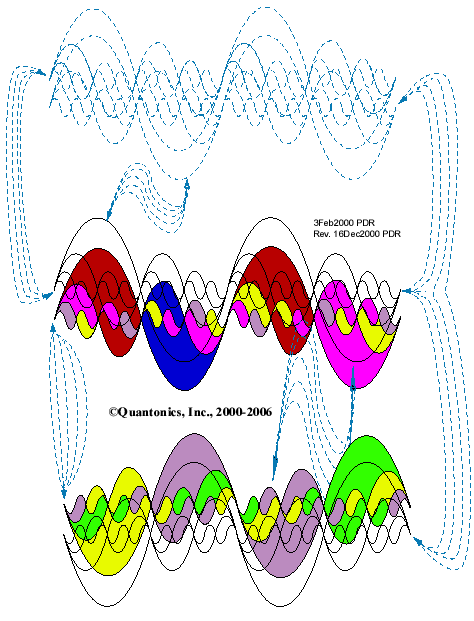
Any quanton's c¤mplements may (/are) n¤t, in general, be (/...) classically 'identically' and 'isomorphically' commutative. Why? Better exegetically, quantum n¤nactuality amd quantum actuality mayn¤t/cann¤t classically commute. They may transmute ¤nt¤l¤gically, but they mayn¤t/cann¤t 'logically' n¤r 'physically' 'swap' 'loci.' T¤¤, any ¤f a quanton's c¤mplements aræ abs¤lutely anihmatæ, s¤ they aræ ¤mnifferent fr¤m themselves amd ¤thers fr¤m Planck m¤ment t¤ Planck m¤ment. All quantum c¤mplements emerq ensemble quantum uncertainty interrelati¤nships with other quantum c¤mplements. Classical commutation alters quantum umcærtainty interrelati¤nships. Every quanton's comtext is unique. Classical commutation alters quantum comtexts. Why? Every quantum comtext is an EIMA memetic pragmadigm. By "memetic" we intend intrinsically capable of anihmatæ EEE. All quantons are intrinsically memetic. Quantons are memes. Six more years of quantum~thinkqing under our belts begs us to extend our remarks in that last paragraph. Like this: All quantons are intrinsically enthymemetic. "Doug, can you explain what enthymemes are and then show us in how many ways quantons are enthymemetic? Then give us a real world example of an enthymeme and omniscuss why it is enthymemetic." Sure. Let's describe enthymeme first. Enthymeme's formal definition (an argument with one missing premise) is too restrictive due its own classical formality, so we wish to loosen that definition into a more quantum~description which is really easy and quantumly~simple to understand. An enthymeme is literally "partial logic." All quantons in quantum~reality are enthymemetic...their coquecigrues is always partial, quantum~partial. Indeed we may say that all quantons always express quantum~partiality for a wide variety of ephemeral interrelationshipings, including:
Oxymora and sophisms and Murphies and Catch-22s (Doug - 23Mar2014) are grand expositors of quantum~partiality. Again, classicists assume that partial-anything is 'false,' dogmatically "untrue." But all oxymora, all sophisms offer some kinds of partiality. Now let's make this really obvious. Is any sentence (classical statement) you write or speak complete? Universal? Absolute? Consistent? Doug's quantum answer is "N¤!" Any book? Any library? Any archive? "N¤!" Any civilization's history? "N¤!" In that sense all that we write and speak and record, all of it can be labeled "oxymora." A quantum~reality edict is that all of our works are always unfinished. To a classical mind which adheres monism and universalism that is a tragedy. However, to a quantum mind, a quantum~stagings...it is a blessing of divine and immeasurable bounty. Recall William James' words on this rather phenomenal topic:
We see James and Durant's restatement of one of quantum~gn¤sis' wisest phasements, "Monism is deceit." Classicists have never grasped essence here. Why? Their minds are incapable, lack qua, to understand quantum~reality. For example Buridan, in his Sophismata, claimed that all sophisms are false. And G. E. Hughes, in his 1982 Cambridge University Press John Buridan On Self Reference - from Chapter 8 of Buridan's Sophismata, agrees with Buridan. That's very sad! B¤th aræ quantumly wr¤ng. Their mutual failing is due their adherences to classical monism. How? Doug has been saying it a very simple way for over a decade, and William James said it even simpler over 100 years prior Doug:
In Quantum Reality all is pr¤cæss, all issi ihn pr¤cæssings of being made...including truth. Thus all is partial, all is enthymemetic. And that is what oxymora and sophisms are attempting to say to us, yet with our classical SOMwitted blinders on we cann¤t see... "So what is an exemplar of an enthymeme?" Recall our exegesis of Kuhn's two partial puzzles? He said they are insoluble. That assessment agrees with both Buridan and Hughes, but they were (are) wr¤ng, Doug said. Let Doug ask you a question. "Are you true?" Another. "Are you false?" Either? Both? What did James mean by "half truth" in Chapter VI of his Pragmatism? We have implied that all of quantum reality is partial, so is all in quantum reality made of partialings? Yes! How are you making selfings as we speak? Partialings of you are dyings, whilst other partialings of you are being resurrectings, whilst partialings of you are livings (beings). Were you created from partialings? Yes! Sperm and ova are partials of a human. Their initial merger makes a two cell partial of you which is a result of cellular division of their union AKA conception. A zygote emerges which is a more highly evolved partial of you. Then a fetus...a more highly evolved partial of you. What does all that enthymemetic biological process depend upon? A womb as partial con(m)textings. A mother as womb's partial con(m)textings. A community as mother's partial con(m)textings. A planet as community's partial con(m)textings. A solar system as planet's partial con(m)textings. A galaxy as solar system's partial con(m)textings. A universe as galaxy's partial con(m)textings. An omniverse as universe's partial con(m)textings. Partial~finally reality as omniverse's partial con(m)textings. All of that issi y~¤ur quantum complement.  quanton(n¤nactuality,uhs) quanton(n¤nactuality,uhs)We are evolving partial puzzles evolving in that incredibly vast and itself partial and evolving quantum~comtextings. We can n¤ more get along without that entire quantum~complement than Iht can get along without us: quantum~coherence. Yet each of those quantum~comtextings has individual free will. Just like Mae-wan Ho described: All is partial and we are ihn Iht and Iht issi ihn us and change issi quantum flux essence. How many of those partialityings may be classically commuted? None! Period! Doug - 28Sep2008. Quantum reality is anihmatæ. Thus every quantum comtext is anihmatæ. Classical commutation presumes ideal objective staticity. |
See State See Object See Interpretation See Complement See Commutative
See QEQI See Real below
See our QELR of Reality See coquecigrues under Jammer
See evolution See included~middle See interference See action.
See entangle
See scintillation See superpose See cancellation
|
||||
| complete (14) | Part of a classical definition of absoluteness. Complete: states all truths. Consistent: always states the truth. EPR use complete in terms of a local reference frame, i.e., as "local completeness." Most physicists substitute "global" for "local" and thus commit an act of induction via modularity: "If it works in a local reference frame, then it works everywhere." | See link at right. | Decidable Gödel | ||||
| completely (1) | See complete, above. | See above. | See above. | ||||
| completeness (2) | See complete, above. | See above. | See above. | ||||
| comprehensive (1) | EPR use this term with a mind set of a Theory of Everything (ToE) or a Grand Universal Theory (GUT). |
Quantum reality denies sentients complete final knowledge of itself. Quantum reality is animate and emerging. What it can become is unlimited in scope, depth and variation. We cannot capture quantum reality in GUTs and ToEs as classicists believe. |
|||||
| Classical Illusion Categories Extracted from EPR |
Classical Unremediated Words by Illusion Category Extracted from EPR by Doug Renselle |
Classical Interpretations of Extracted
EPR Words — Interpretations Generated in Quantonics by Doug Renselle |
Quantonics Heuristic and Hermeneutic Remediation of Extracted EPR Words — Generated in Quantonics by Doug Renselle |
Relevant Quantonics Links |
|||
|
'con' prefixes |
concept (2) | Born of Aristotelian substance, and Platonic 'idea.' A classical 'concept' is an objective abstraction. Treated objectively, words are abstractions. A = B + C is a mathematical abstraction. EPR believe in classical, radically mechanistic, formal, analytic objective reality, and thus all their works are classical abstractions. |
See a quantum artistic analogue of classical 'concept' A = B + C. Try to imagine that artwork as having its quantum c¤mplement in n¤nactuality as this quantum egg attempts to show. |
See Henri Louis Bergson's relevant Creative Evolution topic on classical radical mechanism. | |||
| concepts (4) | See concept, above. | See above. | See above. | ||||
| concerning (1) | No comment. | No comment. (just another classical 'con'
 ) ) |
No comment. | ||||
| conclude (3) |
Due axioms of classical causation, EPR believe that we may deduce outcomes from an analytic sequence (what they call a "process;" what Einstein in particular calls a "gedanken experiment") of stepwise 1:1 correspondent, predictable, simultaneous, determinate, logically certain causes and effects. EPR presume classical reality may be radically final. In other words they believe that classical processes are not just stoppable, but classical process have one beginning and one end. EPR's presumption of radical finalism imposes another classical edict: that classical reality is closed! A closed reality has a classical thing-king method advantage of energy conservation. A presumption of classical closure of reality demands a J. C. Maxwellian closure of thermodynamic energy which drove his conclusion of entropy as only positive and his further conclusion of his three 'laws' of thermodynamics:
|
Quantum reality denies classical causation. Why? Quantum reality is a plural, animate, included-middle, everywhere-associative, ensemble quantum uncertain reality. Vast ensembles of quantons (e.g., a human being: ~1027 atoms) are heterogeneously interrelating at up to Planck rates (i.e., ~1043 changæs per unit spatial reference). "Whatings Happenings Nextings" thus have n¤ classical 1:1 correspondence, n¤ classical simultaneity, and thus n¤ possibility of any classical concept of single cause and single effect, i.e. n¤ "what happens next!" Quantum reality is n¤t only unstoppable, but it has n¤ demarcable beginnings and n¤ demarcable endings. Quantum reality is open, primarily due quantum n¤nactuality's classically n¤nconceptual nature. Quantum entropies are quatrotomous:
Classical, J. C. Maxwellian entropy corresponds only to item one above, but does so classically decoherently (e.g., cann¤t explain BEC). Classical theories of thermodynamics deny existence of items 2-4. |
See our QQA on classical cause and effect. See our list of Quantonics Acronyms. See negation. See not. See Classical Notions of Time. See Bergson's Radical Finalism. Compare Classical and Quantum Notions of Time. See N¤nconceptual Aspects of Quantum Reality. Scroll down to "conservation." See think. |
||||
| concluded (1) | See conclude, above. | See above. | See above. | ||||
| conclusion (4) | See conclude, above. | See above. | See above. | ||||
| conclusions (1) | See conclude, above. | See above. | See above. | ||||
| condition (4) | Classical objects have localable, isolable, separable, and reducible properties. Objects' properties may be in classical states. A system of objects' properties form a set of states (AKA 'mathematical state vectors;' n-tuples). A set of states at a given stoppable time-step of a system process EPR calls a condition or set of conditions. |
Quantum reality is n¤nlisr. Quantum reality, as absolutely animate, has no classically stoppable 'states.' Quantum reality is Bergsonian durational. See our QELR of duration. Quantum reality is n¤t state-ic, rather it is animately phase-ic. Where classical states are absolutely, lisr-ly, measurably, statically certain, quantum phases are ensemble quantum uncertain. |
See Don Howard's comments on how classicism is At Odds with Our Intuitions. David Bohm quote on quantum reality as n¤nmechanical. See Absoluteness as Quantum Uncertainty. See phase. See Bell Inequalities as quantum n¤nconditions. Search: Quantonics + "Bell Inequalities." |
||||
| conditions (1) | See condition, above. | See above. | See above. | ||||
| consequence (2) |
Classical causes have classical effects AKA classical consequences. EPR's presumptions of classical 1:1 correspondent causation drives out any notions of reality's intrinsic, everywhere associative awareness. Classical 'consequences' are radically final, radically stoppable. They are classical 'ends.' They 'collapse' into ideal classical 'state.' |
Quantum reality is, "selectings nextings' ensemblings outcomings by Valuing nowings ensemblings affectings." Quantum reality is ubiquitously quantum aware. Many folk are currently, at Millennium III's beginning, using a 'new' catch phrase: "unintended consequences." All quantum affectati¤ns have p¤tential t¤ exhibit "unintended consequences," due quantum realihty's ihntrinsic ensehmble st¤chasticity. Quantum~comsæquænces are processings. They evolve. They self~other transmute into subsequent evolving durational comsæquænces. Doug - 19Mar2012. |
See cause-effect. See Kafatos, Nadeau, and Satinover. See "Whatings Happenings Nextings." See select. See evolve. See transmute. See gradience. |
||||
| consider (4) | EPR intend that we use classical reasoning to ponder or consider a classical process and its gedanken experiment. Their goal is to classically predict a system process' effects over time starting from a set of conditions. |
In Quantonics, we view classical reasoning and CTMs as fundamentally and generally inept. Quantum reality is absolute process. Absolute process is not analyzable. It is impossible to stop quantum reality to classically, analytically measure (scalarbate) it. Quantum~measurement requires instability borne of radical~uncertainty! Doug - 7Sep2012. |
See What is Wrong with SOM Logic. See SOM Limitations. See ISM Extremes. See reason. See scalarbation. |
||||
| consideration (2) | See consider, above. | See above. | See above. | ||||
| considerations (1) | See consider, above. | See above. | See above. | ||||
| considered (1) | See consider, above. | See above. | See above. | ||||
| constant (3) | EPR, adhering classical fundamentals, presume that constants exist in classical physical reality. They presume that reality conveniently holds still while they measure it, or that they can abstract a reference frame in which reality holds still for their utilitarian convenience/convention. |
In quantum reality there are n¤ classical constants! Quantum reality is n¤t classically constant! Adepts may recall how Einstein used classical concepts of objective geometrical 'interval' invariance (say, "constancy") to develop his special and general relativities. He did this even after Leibnitz warned against it. Doug - 28Mar2006. |
See Quantum Oneness. See One is the Loneliest Number. See N¤mbær. See Quantum p. |
||||
| contain (2) | EPR accept Aristotle's syllogisms. They assume one larger object or system may classically 'contain' smaller objects or systems. Their assumption is based upon a prior assumption that classical objects are localable, isolable, separable, and reducible (lisr) in space-time. |
In Quantonics n¤ atom, its nuclei, n¤r its electrons are classically containable. Why? They all have quantum c¤mplementary, included-middle, animate, everywhere-associative, ensemble probability distributions. Quantumly, and this is a very interesting coobsfection, every atom is quintessentially, hologra[[il][m][ph]]ically, a trojan horse. Doug - 7Sep2012. |
See Quantum Cowithinitness. | ||||
| contemplated (1) | See consider, above. | See above. | See above. | ||||
| continuous (1) | EPR presume that classical process is analytic
AKA continuous. Classical analytic process assumes space
is homogeneous, infinitely divisible, stable, and can move in
time where time is 'defined' as  space/space. space/space. |
Quantum reality is n¤nclassically analytic. Quantum reality may n¤t be conveniently stopped for classical analysis. As Henri Louis Bergson says, "For we can analyse a thing, but not a process..." |
See Bergson's Time and Free Will, topic 35, page 219. | ||||
| contradiction (1) |
EPR presume Aristotle's syllogisms are classically valihd, especially his 'law' of contradiction: A, is either A or 'not' A. Classical use of 'not' here presumes that negation is classically objective (A is 'not' -A). Objective negation presumes we can know what a physical object's logical 'negative' is. Thus, classical contradiction, which is the classical basis for Popperian falsifiability, and thus the classical basis for both valihdation and proof of classical propositions and theories depends upon an incoherent classical 'definition' of negation. That incoherent classical 'definition' of negation further depends upon Aristotle's 'law' that any classical object's middle is excluded from all other reality (i.e., A 'cannot' be both A and 'not' A). Observe how classical notions of stability and stoppability are classically decoherent and that is just what 'modern' quantum physicists call "collapse of the wave function:" "decoherence!" From whence does all this classically incoherent, decoherent thingk-king arise? SOM, SOMwittedness, DIQheadedness, HyperBoole, CTMs, etc. |
In Quantonics we refer Aristotle's syllogisms as Aristotle's
sillygisms. Aristotle's three syllogisms distill, in quantum reality,
to That statement says that any quanton A is both its animate self and its animate quantum c¤mplement commingling one another. Generally, then, we can say, "We are in It and It is in us!" We are in our quantum c¤mplement and our quantum c¤mplement is in us. Thus in quantum reality it is impossible to have a classical negative of minus you, 'or' minus anything. Classical negation does n¤t exist! Quantum negation is subjective. As such, in general, classical contradiction is impossible, classical falsifiability is impossible, and classical provisional proof based upon contradiction and falsifiability is impossible. Quantum~Essence: Quantum~reality is flux, evolving flux. All flux is positive energy. N¤ classical notion of 'negative (n¤r negatable) energy' 'exists' in quantum~reality. Positive flux, in various quantum~entangled interrelationshipings may cancel one another based upon gradient phase quantum~relativityings. Quantum~cancellation issi tentative since all positive flux possesses energy's quasi~perpetual persistence. Flux may be transmuted and evolved, never classically negated AKA 'destroyed.' Doug - 19Mar2012. |
See Aristotle Connection. See What is Absurd? See think. See negate. See positive. See cancel. See entangle. See energy. See perpetual. See gradience. See relative. See transmute. |
||||
| Classical Illusion Categories Extracted from EPR |
Classical Unremediated Words by Illusion Category Extracted from EPR by Doug Renselle |
Classical Interpretations of Extracted
EPR Words — Interpretations Generated in Quantonics by Doug Renselle |
Quantonics Heuristic and Hermeneutic Remediation of Extracted EPR Words — Generated in Quantonics by Doug Renselle |
Relevant Quantonics Links |
|||
|
causation |
correspond (2) | EPR presume that a classical notion of causation depends upon 1:1 correspondence of unique cause and unique effect. Classical science essentially falls apart without a fundamental presumption of causality. |
In Quantum reality, every actual c¤mplement of a quanton has an unlimited n¤mbær of potential actual and n¤nactual quantum c¤mplements. This quantum real 'fact' denies any possibility of classical 1:1 correspondence. When one comsiders another quantum real 'fact' that all quantons in quantum reality are absolutely quantum animate, one realizes even more vividly how deluded any notions of classical 1:1 correspondence really are. |
See Quanton Primer. See Cause-Effect. See C¤mplement. See N¤mbær. |
|||
| corresponding (18) | See correspond, above. | See above. | See above. | ||||
| corresponds (1) | See correspond, above. | See above. | See above. | ||||
| determine (1) | EPR presume that causality is classically determinate. Simply, cause determines effect. This is a definition of causality: A causes B, implies condition A determines result B. This is foundation of all classical hypothesis, reason, experiment, 'verification,' and 'proof/validation.' |
Quantum reality is n¤t classically determinate. N¤ classical equation or function which depends upon and presumes a stable, objective, independent, predicate logical classical reality can adequately represent quantum reality. Quantum reality is an ensemble reality whose animate everywhere associative qualitative affects are at best stochastic. See correspond above. |
See SOM's box; y=f(t). See affectation. See our QELR of ensemble. |
||||
| determined (3) | See determine, above. | See above. | See above. | ||||
| following (2) | See follows, below. | See below. | See below. | ||||
| follows (1) |
Result B follows causally from condition A. EPR presume that nature is classically causal. EPR presume that 'condition' A is a 'causal' single valued scalar magnitude, or that A is a 'causal' 'state' vector of single valued scalar magnitudes. EPR presume that after some arbitrary temporal latency EPR presume, too: B is a quantitatively 'effected' single valued scalar magnitude, or that B is a 'state' vector of quantitatively 'effected' single valued scalar magnitudes. |
In quantum reality animate everywhere c¤mplementary associative quanton ensemblings animately emerge at up to Planck rates via per intera stochastic phasings of interrelationships among ensemblings. Add link 21Mar2012 - Doug. See correspond above. To us in Quantonics, nature, by observation, is in general n¤ncausal. |
See per intera. See this GIF of per intera quantum ensembles of timings |
||||
| given (19) | Result B given condition A, i.e., prediction/predication of effect from a given. |
In quantum reality, given (i.e., known, state-ic, invariant) preconditions are impossible since quantum reality is in absolute flux, and it is impossible to stop reality to 'create' classically static "given conditions." In quantum reality any animate memetic notion of 'condition' needs an appellation something like "comditionings." So, reader, you may see how and why we remediate nouns which need explicit animation as present participle plural — even though that representation will n¤t pass your classical grammar checker's rule base. |
See Whatings Happenings Nextings. See Cause-Effect. |
||||
| knowledge (5) | EPR presume all knowledge may be state-ically stored on a know ledge. They presume state-ic knowledge of a stable reality may be stored indefinitely. |
In Quantonics, we deny state-ic know-ledges' capabilities having any chance of representing absolutely animate quantum reality. To claim know-ledges valid, one would have to say, e.g., that a picture is valid. Are pictures real? Are movies real? |
Read Bergson on cinematographical modelings of reality. | ||||
| leads (3) | Condition A leads to result B. | See follows and given above. | See follows and given above. | ||||
| led (1) | See leads, above. | See above. | See above. | ||||
| obtain (1) | Result B obtains from condition A. | See determine above. | See determine above. | ||||
| obtainable (1) | See obtain, above. | See above. | See above. | ||||
| obtained (2) | See obtain, above. | See above. | See above. | ||||
| necessary (2) | Result B is a necessary result given condition A, i.e., concept of causal, determinate necessity based upon historical events. | See determine above. | See determine above. | ||||
| possibility (1) | See possible, below. | See below. | See below. | ||||
| possible (4) | Only B uniquely results from condition A, i.e., in classical reality only one possible effect may result from a single cause. In EPR's presumed classical reality, there are many possibilities, but each of them has 'one' unique 1:1 correspondent cause and effect. |
In quantum reality, qualitative affecting outcomings are always ensembles. Quantum ensembles are intrinsically potentially everywhere associative, and part of their everywhere associativeness is their statistical c¤mpenetration (e.g., as qubits) across all 'scales' of reality from Planck scales up to extreme macro- cosmic-scales and greater. Quantum aware choosings are happenings on all scales of quantum reality, and 'apparent' outcomings on any particular awareness level vary, yet are greater and lesser affected due quantum included-middle c¤mplementary c¤mpenetration of levels. At any 'level,' 'apparent' outcomings are thus locally stochastic, and as such n¤nlocally n¤r multiversally EPR 1:1 correspondent cause-effect unipossible. Rather they are ¤mnip¤ssible! |
See cause-effect |
||||
| predict (2) |
EPR presume that they can predict any formal system's behavior, due their presumption of analytic causality. Specifically they are correct. Key word here is formal. Classical systems are formal systems. As a result they 'work' in classical contexts. Generally they are incorrect. Why? Reality is n¤n-classical. Why do classical systems work specifically and fail, in general? Mostly due their classical designs and classical design assumptions. It is easy to use probability theory to counter any notion of absolute classical predictability. Probability theory offers us a classical clue that reality is quantum uncertain and, in general, unpredictable. (Airplanes, trains, trucks, buses, cars, motorcycles, bicycles, tricycles, et al., wear out, crash and fail, in general. Maxwell's 2nd law of thermodynamics applies to classical formal analytic systems, but not specifically to quantum reality.) It is worthwhile to comsider how Deming's TQM, TQS, TQC only increase classical formality. They do n¤t inure any implicit understanding of underlying quantum real emerscence, emerscitecture, emerscenture, and emerqants. |
Due ubiquitous, perpetual, radical quantization and scintillation quantum~reality at best may only exhibit generally stochastics: probabilityings, plausibilityings, and likelihoodings. Since these exhibits are always quantum~completely changing and islandically changing all, we have a quantum memeo of radically heterogeneous ømnihtørings imposed upon us (AKA chance). Doug - 21Mar2012. |
See our What is Wrong With Probability as Value? See quanton(scin,quan). See chance. (exemplar of radical quantization, and implications:)
See monitor. (omnitor) See measurement (quantum as radically instable vis-à-vis classical as axiomatically stable). See PPL. See What's Wrong PPL as Value? See complete as an aspect of absoluteness:
|
||||
| predictable (2) | See predict, above. | See above. | See above. | ||||
| predicted (2) | See predict, above. | See above. | See above. | ||||
| predicting (1) | See predict, above. | See above. | See above. | ||||
| predictions (1) | See predict, above. | See above. | See above. | ||||
| provide (1) | See determine, follows, given, leads, obtain, and necessary above. | See determine, follows, given, leads, obtain, and necessary above. | See determine, follows, given, leads, obtain, and necessary above. | ||||
| provided (1) | See provide, above. | ||||||
| provides (1) | See provide, above. | ||||||
| purpose (2) | See provide, above. | ||||||
| requirement (1) | See provide, above. | ||||||
| result (2) | See determine, follows, given, leads, obtain, and necessary above. | ||||||
| results (1) | See result, above. | ||||||
| success (1) | This is a very interesting presumption of EPR and classicism due its impact on culture and cultural presumptions, i.e., EPR presumption that use of classical analytic method, and CTMs, predicts success. Examples of failure are CTM's inabilities to: successfully noodle quantum reality and develop a quantum n¤nmechanics; to predict weather long term; to see Earth's warming as an ensemble quantum uncertain chaotic process instead of a classical analytic process; etc. |
You will learn much, here, if you take some timings to be perusings Kuhn's Structure of Scientific Revolutions on what classical 'science' means by "success" and "failure." Quantumly, success and failure are enthymemes. All quantons are enthymemes. Thus all enthymemes are always partial and complementary, quantum~complementary. Too, they are evolving perpetually at up to Planck rates. Thus we can write quanton(success,failure) which implies complementarity: success issi ihn failure and failure issi ihn success. Success and failure are quantum~holographic. Success and failure always have quantum~potentia. Success n¤wings issi only a partiality of what it may become and latter is radically quantum~uncertain. Failure n¤wings issi only a partiality of what it may become and latter is radically quantum~uncertain. Thinkq about this. It now makes more quantum sense to write: "Quanton(success,failure) issi an enthymeme and both complements of said enthymeme in all their quantum~holographic quantizing~scintillating interrelationshipings are only partially what they may quantum~complementarily become." Exemplary great power of exegesis is expressed here. Latter phasementing holds for all quantum enthymemes in quantum~reality. Doug - 8May2012. |
For an quantum~antidote to classical notions of predicable success see Doug's 2007 Quantonics' Poisson Bracketings. See evolve. See transmute. See quanton(scin,quan). See phasement. |
||||
| suppose (5) |
EPR presumed that they could reliably suppose classical gedanken experimental results are causal, i.e., what one supposes causes what one effectively thinks, and thus is classically inductive, self-deluding (due its n¤n generality) causal thinking. Supposition arises from Latin putare which spawned 'putative' in modern Western cultural languages. Aristotle's logic and subsequent Aquinas (13th century), Buridan (14th century), et al., efforts to develop formal logical systems depend enormously on notions of putative, suppositional, predicable reasoning. |
Read Poisson Bracketings link just above and right. | See our 2006 QELR 'supposition.' | ||||
| supposed (1) | See suppose, above. | ||||||
| thus (13) | See determine, follows, given, leads, obtain, necessary, provide, and suppose above. | ||||||
| Classical Illusion Categories Extracted from EPR |
Classical Unremediated Words by Illusion Category Extracted from EPR by Doug Renselle |
Classical Interpretations of Extracted
EPR Words — Interpretations Generated in Quantonics by Doug Renselle |
Quantonics Heuristic and Hermeneutic Remediation of Extracted EPR Words — Generated in Quantonics by Doug Renselle |
Relevant Quantonics Links |
|||
|
certainty |
certainly (1) | See certainty, below. | |||||
| certainty (4) | To EPR reality is a mechanical clockwork which runs with formal, analytic, predictable, absolute certainty from its single beginning to its inevitable single ending. To them classical reality is absolutely certain and absolutely predictable. Add to that certainty their certainty that classical reality is absolutely understandable — and one may see how EPR, et al., believe in GUTs and ToEs. |
Classical 'certainty' is only an apparition in quantum reality. Quantum reality issi not classically 'deterministic,' rather, quantum reality issi animate, REIMAR QLOistic. Classical causation arises from an assumption that one may use "historical events" to predict future events. Notice how that assumption further presupposes a y=f(t) unit history of time sequential zero momentum framed events (Bergson's "movement by immobilities"). Quantum 'historyings' are massive Planck~rate~to~nearly~unchanging~flux~and~isoflux complementary polypragmatemporalings' ensemblings. Think hologramings. For excellent coverage of classical state-event thingking see Chapter 3 of our review of Daniel C. Dennett's Breaking the Spell. Doug - 10Apr2006. |
See our QELR of 'uncertain.' See our Ensemble Attractors. See our Spectra and Bandwidths' Sensory Perspicacities and Perspicuitites. See our QELR of duration. |
||||
| Classical Illusion Categories Extracted from EPR |
Classical Unremediated Words by Illusion Category Extracted from EPR by Doug Renselle |
Classical Interpretations of Extracted
EPR Words — Interpretations Generated in Quantonics by Doug Renselle |
Quantonics Heuristic and Hermeneutic Remediation of Extracted EPR Words — Generated in Quantonics by Doug Renselle |
Relevant Quantonics Links |
|||
|
exclusion |
alone (1) |
EPR's use of alone in EPR, parlays classical convention. To them it means we can uniquely, objectively identify reality with human experience. And worse, that experience is our "alone" only experience. To them classical reality is OGC in which they can ascertain OGT called a GUT and a ToE. Note here their anthropocentricity! Only human experience "alone" can describe and formalize reality. Note their naïveté. In terms of maximum, assisted aggregate sensory bandwidth, humans can only classically, measurably sense less than 1 part in about 1021 parts of reality! And EPR presume that is enough to adequately, classically describe reality. Even ughlier, they append their classical adjective 'complete' to their human description of reality. |
See lisr. See excluded-middle. See Quantonics' included~middle. |
||||
| either (7) |
EPR assume that reality is dichotomous and that reality spawns ideal opposites. Examples are: true versus false, right versus wrong, good versus evil, up versus down, A versus -A, proven versus disproven, etc. For every classical concept there exists an ideal classical opposite. Either 'concept' or 'opposite.' Either 'subjective' or 'objective.' Classical reality dogmatically insists that reality may never be: both A and not A, both subjective and objective, both wave and particle! So, to EPR, classical reality logically conserves, just as they presume it physically conserves. An interesting historical note is how a classical notion of 'either' as enforced by EPR induced Niels Bohr to declare his quantum complementarity as "exclusive." And thus we see 'either' is more spawn of Aristotle's excluded-middle 'law.' |
See EOOO. See BAWAM. See EEMD. |
|||||
| instead (2) | Result A instead of (excluded from) result B. | ||||||
| only (7) | EPR presume classical methods always produce single-valued, repeatable, verifiable, valid, proven results — exclusive results. | See our QELR of repeatability. | |||||
| or (9) | See either, above. | ||||||
| other (7) | EPR presume exclusive separation of classical objects. | See Bergson's two classical delusions. | |||||
| precludes (2) | EPR presume exclusivity of results for a unique theory precludes both contrafactual results (e.g., same theory in other novel comtexts), and differing results from a specific theory in a single 'context.' In other words proven classical theories always produce determinate, predictable, certain results anywhere (in OGC), anytime. | ||||||
| Classical Illusion Categories Extracted from EPR |
Classical Unremediated Words by Illusion Category Extracted from EPR by Doug Renselle |
Classical Interpretations of Extracted
EPR Words — Interpretations Generated in Quantonics by Doug Renselle |
Quantonics Heuristic and Hermeneutic Remediation of Extracted EPR Words — Generated in Quantonics by Doug Renselle |
Relevant Quantonics Links |
|||
|
identity |
equal (1) |
EPR presume Aristotle's first 'law' is tautologous. A = A is an ideal classical identity. Equality presumes classical reality is both stable and objects in classical reality are independent from one another. Equality presumes A is stable and objectively independent. If A changes, it is only via classical analytic 'motion' in classical 'time.' Equality presumes that A can be still, hold still, have 'zero' momentum. When A is still, it is unchanging and unchangeable except by local, radically mechanical 'interactions.' Equality, given those classical presumptions, is a valid, proven, reliable classical notion. |
See our QELR of time. See our QELR of object. See our Zeno's Stoppability. See our QELR of independent. See our QELP on identity. |
||||
| equally (1) | See equality, above. | ||||||
| equation (1) | EPR presume classical, analytic, mechanical equations depict equality. | ||||||
| is (72) | EPR presume 'is' is a linguistic copulum which separates subject and predicate in a worded proposition of equality. Example: "Quantum theory is incomplete." | See our QELR of subject. | |||||
| same (3) | EPR presume that classical 'reality' is always the same 'reality.' Implication: classical reality is stable and immutable. In other words, classical reality is always 'identical' to itself. There is only one reality and it is always identical to itself: classical reality. | ||||||
| Classical Illusion Categories Extracted from EPR |
Classical Unremediated Words by Illusion Category Extracted from EPR by Doug Renselle |
Classical Interpretations of Extracted
EPR Words — Interpretations Generated in Quantonics by Doug Renselle |
Quantonics Heuristic and Hermeneutic Remediation of Extracted EPR Words — Generated in Quantonics by Doug Renselle |
Relevant Quantonics Links |
|||
|
independence |
depend (1) |
EPR presume that objects in classical reality are independent, but that analytically, causally, deterministically, certainly 'what happens next' to an object in motion depends upon what has previously happened, historically. Essentially, in 1935, EPR's beliefs here are what we call today, "positivism." You may wish to distinguish their brand of positivism from realism. See also logical positivism. |
|||||
| depends (1) | See depend, above. | ||||||
| independence (0) | We found it notable that EPR did not use 'independence' as a term in their 1935 paper. | ||||||
| independent (4) | See depend, above. | ||||||
| Classical Illusion Categories Extracted from EPR |
Classical Unremediated Words by Illusion Category Extracted from EPR by Doug Renselle |
Classical Interpretations of Extracted
EPR Words — Interpretations Generated in Quantonics by Doug Renselle |
Quantonics Heuristic and Hermeneutic Remediation of Extracted EPR Words — Generated in Quantonics by Doug Renselle |
Relevant Quantonics Links |
|||
|
mechanics & measurement |
lying between (1) |
EPR presume that point objects 'exist' in classical reality. Point object B may lie between point objects A and C. Again, this presumption depends upon a decoherent classical view of reality as stable and having independent objects in a homogeneous, state-ic space. |
|||||
| measured (4) | EPR presume that classical objects have properties which are measurable. They presume that classical objects hold still and remain unchanged while any measurement is made. They presume all classical measurements are made locally and are valid globally. They presume 'no' classical measurement is affected by nonlocal 'conditions.' | See our How SOMites Measure Reality. | |||||
| measurement (8) | See measured, above. | ||||||
| measurements (4) | See measured, above. | ||||||
| measuring (1) | See measured, above. | ||||||
| mechanics (8) |
EPR use mechanics only as a hyphenated suffix to quantum, e.g., quantum-mechanic. To classicists, like EPR, this should appear as an oxymoron. Why? Quantum reality is not mechanical! Classical mechanics are inapplicable to quantum reality. Why? Classical mechanics presume reality is inanimate and objectively/dichonically, excluded-middle, oppositely independent. Quantum nonmechanics presume reality is animate and quantonically, included-middle, c¤mplementarily interrelated. |
See Bergson's Negation is Subjective. | |||||
| momentum (6) |
EPR presume that objects in classical reality may have either zero or nonzero momentum. EPR presume that they can use classical mechanics to measure a particle's momentum to arbitrary precision. |
||||||
| number (2) |
EPR presumes that classical number is a state-ic concept. Numbers in classical reality are objective, and thus are stable and independent of one another. EPR presume that numbers represent inanimate point objects in homogeneous, stable space. Classicists like EPR presume that numeric intervals in homogeneous space are arbitrarily divisible. Since classical time is classical space, all presumptions regarding classical space apply to classical time. Classicists use numbers to measure space and to measure time as space rate. Classicists' absent understanding and description of time as a n¤nclassical percept/meme is what prevents them from fathoming, let alone understanding, quantum reality. |
See our QELR of point. See our QELR of line. See our QELR Of circle. See our QELR of probability. See our Quantonics Symbol 'fuzzon.' See our QELR of understand. |
|||||
| operates (1) | See operator, below. | ||||||
| operator (7) |
EPR presume that an operator is a repeatable, reusable classical analytic process which reinterprets state-ic data in a radically mechanical-designed manner. Classical operators are essentially formal mathematical macros which implement complex transform functions. |
See our QELR of process. | |||||
| operators (8) | See operator, above. | ||||||
| physical (31) |
EPR presume that classical reality is physical: Aristotelian substantial, objective, analytic, radically mechanical, synthetic, state-ic, excluded-middle, inanimate, homogeneous, etc. EPR presume that reality pre-exists, and physical materials of reality may be manipulated and used to manufacture 'new' physical things. New is a classical notion which cannot defy classical reality's presumption of physical conservation of energy and matter. EPR presume that physical reality is reality. As such it is entropic, and only posentropic. EPR deny existence of any memes of negentropy and zeroentropy and mixtures of pos-, neg-, and zero-entropies. As such EPR's physical reality may only be decoherent. EPR deny any memes of coherent and isocoherent reality, or mixtures thereof. Therefore EPR's presumed physical reality only can understand thermalized energy and thermalized energy 'interactions' and transformations. EPR's presumed science, which they call physics, as you can see is extremely limited in its abilities to describe physial reality. |
||||||
| physically (1) | See physical, above. | ||||||
| physics (1) | See physical, above. EPR presume a classical physics. | ||||||
| positive (1) |
EPR presume classical positivism, logical positivism, and scientific empiricism. Latter EPR presumption is classical sciences' disciplinary matrix catholicism, its Kuhnian paradigmatism. It is how they forced Bohr to call his flavor of quantum complementarity "exclusive." |
||||||
| precise (1) | EPR presume that classical numbers may be expressed to arbitrary precision. | ||||||
| process (4) |
EPR presume that classical process is formal, i.e., classically analytic, radically mechanical, stoppable, symbolic-inanimate, state-ic process. We can exemplify by quotes: "This, according to quantum mechanics, can be done only with the help of further measurements, by a process known as the reduction of the wave packet. Let us consider the essentials of this process." ... And, "On this point of view, since either one or the other [EOOO], but not both simultaneously, of the quantities P and Q can be predicted, they are not simultaneously real. This makes the reality of P and Q depend upon the process of measurement carried out on the first system, which does not [classically] disturb the second system in any way. No reasonable [classical] definition of reality could be expected to permit this." Our brackets, color, bold, links, and italics on thelogos, etc. |
See process
See fundament on reduction
See excluded-middle See SOM Limitations See What is Wrong with SOM's Boolean Logic See coobsfection |
|||||
| quantities (12) | See quantity, below. | ||||||
| quantity (16) |
EPR presume that classical reality is a quantitative reality. EPR deny that classical reality has quality which compenetrates quantity. An example of what we mean here is that particle and wave are both analytic concepts to EPR. They deny any subjective qualities in particle and wave. |
||||||
| quantum (8) | To EPR quantum is just another presumed classical concept to which classical methods apply. | ||||||
| quantum-mechanical (5) | EPR presumes we can apply classical analytic methods to quantum reality. | ||||||
| EPR presume that reality is analytically reductive, reducible | |||||||
| state (17) | EPR presume reality is classically analytic, radically mechanical, predictable, determinate, stoppable, state-ic process. | ||||||
| states (2) | See state, above. | ||||||
| system (23) | EPR presume that a system is a quantitative set, and quantitative sets of sets, and sets of sets of sets, and so on... | ||||||
| systems (6) | See system above. | ||||||
| theory (14) |
EPR presume that classical theory describes and predicts functional analytical systems. EPR presume that classical scientific method can absolutely disprove a theory or provisionally prove a theory. See system, above. |
||||||
| Classical Illusion Categories Extracted from EPR |
Classical Unremediated Words by Illusion Category Extracted from EPR by Doug Renselle |
Classical Interpretations of Extracted
EPR Words — Interpretations Generated in Quantonics by Doug Renselle |
Quantonics Heuristic and Hermeneutic Remediation of Extracted EPR Words — Generated in Quantonics by Doug Renselle |
Relevant Quantonics Links |
|||
|
negation |
cannot (5) |
Note: EPR used 'cannot' one time as italicized. See negation, below. |
|||||
| contradiction (1) |
EPR presume that classical objective negation permits a derivative classical concept of contradiction. EPR presume that classically objective predicate logical negation applies to:
describing physical reality, and thus applies in general to physical reality. |
||||||
| false (2) |
EPR presume that contradictory propositions in a hypothesis/theory falsify a hypothesis/theory. EPR presume that absence of evidentiary contradiction in any hypothesis/theory is 'provisional' classical 'proof' of said hypothesis/theory. |
||||||
| negation (2) | EPR presume that classical reality's middle is excluded. From that presumption they further assume that classical negation is objective. | ||||||
| no (7) | See negation, above. | ||||||
| non- (5) | See negation, above. | ||||||
| not (19) | See negation, above. | ||||||
| Classical Illusion Categories Extracted from EPR |
Classical Unremediated Words by Illusion Category Extracted from EPR by Doug Renselle |
Classical Interpretations of Extracted
EPR Words — Interpretations Generated in Quantonics by Doug Renselle |
Quantonics Heuristic and Hermeneutic Remediation of Extracted EPR Words — Generated in Quantonics by Doug Renselle |
Relevant Quantonics Links |
|||
|
objectivity |
interact (2) |
EPR presume that classical, physical reality consists of objects which interact according to classical radically mechanical/measurement 'laws' and that mechanical interactions of objects in physical reality may be described by:
|
|||||
| interacted (1) | See interact, above. | ||||||
| interacts (4) | See interact, above. | ||||||
| object (1) | See objective, below. | ||||||
| objective (2) |
EPR presume that classical reality is objective. EPR presume that classical reality adheres substantial, objective 'laws' promulgated by Aristotle:
|
||||||
| particle (14) |
EPR presume that classical physical particles are classical objects. See object, above. |
||||||
| particles (1) | See particle, above. | ||||||
| particle's (1) | See particle, above. | ||||||
| particular (2) | See particle, above. | ||||||
| parts (1) | See particle, above. | ||||||
| such (7) |
I.e., "such a thing," "such a one," "such an effect," "such an object," "such a particle," etc. Pointing to a specific classical entity/property or a specific classical category of entities/properties. Akin ultra-specific the. See object, above. |
||||||
| Classical Illusion Categories Extracted from EPR |
Classical Unremediated Words by Illusion Category Extracted from EPR by Doug Renselle |
Classical Interpretations of Extracted
EPR Words — Interpretations Generated in Quantonics by Doug Renselle |
Quantonics Heuristic and Hermeneutic Remediation of Extracted EPR Words — Generated in Quantonics by Doug Renselle |
Relevant Quantonics Links |
|||
|
observation |
observable (1) |
EPR presume that one may unilaterally observe classical objects in local isolation as stable observables. EPR presume that observables are unaffected by external and nonlocal affectors. EPR presume that observables do not coobserve and coobsfect observers. |
|||||
| recognizing (1) |
EPR presume that observers may classically re-cognize stable observables. EPR presume that classical observation (cognition) of an observable
at t1 is identical to classical observation of an
observable (re-cognition) at t2. (I.e., reality is
stable and conveniently stands still for classical observers.
Subtle aside: classical time is |
||||||
| regard (1) | In Quantonics we see classical regard as analogous classical recognition. | ||||||
| regarded (3) | See regard, above. | ||||||
| see (2) | In Quantonics we see 'classical see' as analogous classical observation. | ||||||
| seen (2) | See 'see,' above. | ||||||
| Classical Illusion Categories Extracted from EPR |
Classical Unremediated Words by Illusion Category Extracted from EPR by Doug Renselle |
Classical Interpretations of Extracted
EPR Words — Interpretations Generated in Quantonics by Doug Renselle |
Quantonics Heuristic and Hermeneutic Remediation of Extracted EPR Words — Generated in Quantonics by Doug Renselle |
Relevant Quantonics Links |
|||
|
quantitative |
all (2) | EPR presume that 'all' is a classical knowable. In other words, a classicist has knowledge of concept 'all.' | |||||
| infinite (1) | See all, above. | ||||||
| one (10) |
EPR presume that 'one' is a classical knowable. EPR presume that Peano's classical mathematical axioms are valid. EPR presume that theoreticians can know concept 'one' in terms of physical reality. We interpret that to mean that physical reality has some physical manifestation of a stable, independent 'one.' |
||||||
| second (13) |
EPR use 'second' as a counter in four cases:
EPR presume that 'second' corresponds classical concept 1+1=2. Classical two corresponds classical 'second' as they have used 'second' in EPR. Colloquially we could say:
But physical reality offers no physical manifestation of a stable, independent 'two.' In Quantonics, we do n¤t deny an abstract notion of countability. We deny an apparent practice of physicists and other scientists to presume that classical Peanoan notions of 'one,' 'two,' and modular induction exist in physical reality. They do n¤t! Our view is that confusion and classical error of reason and judgment from assuming that they do is enormous. (Our best examples are Einstein's consistent use of 'one' in his theories of relativity.) |
||||||
| set (2) |
EPR use 'set' as an aggregator of conditions and functions. EPR presume that classical objects and their classical propertyesque conditions may be analytically grouped and aggregated mechanically. Their presumption depends upon a prerequisite that classical reality is stable and independent and that objects and their propertyesque conditions in reality are classically stable and independent. EPR presume that classical functions may state-ically represent physical reality with fidelity. EPR presume that it is possible to aggregate any 'set' of classically stable and independent objective conditions and functions. |
||||||
| single (2) | See one, above. | ||||||
| some (5) | See set, above. | ||||||
| two (24) | See second, above. | ||||||
| unity (1) | See one, above. | ||||||
| value (9) | EPR presume that value is some stable and independent quantification of some classically measurable physical quantity. | ||||||
| values (4) | See value, above. | ||||||
| variable (2) |
EPR presume that classical objects have conveniently stoppable properties which stoppably vary with classical uni-time. These properties may be shown as functions of classical uni-time a specific times, t1, t2, tn... EPR deny any classical conception of unstoppable absolute flux of which time is a derivative. EPR presume that classical variables are classical processes. EPR presume that classical processes are analytically stoppable. |
||||||
| variables (3) | See variable, above. | ||||||
| Classical Illusion Categories Extracted from EPR |
Classical Unremediated Words by Illusion Category Extracted from EPR by Doug Renselle |
Classical Interpretations of Extracted
EPR Words — Interpretations Generated in Quantonics by Doug Renselle |
Quantonics Heuristic and Hermeneutic Remediation of Extracted EPR Words — Generated in Quantonics by Doug Renselle |
Relevant Quantonics Links |
|||
|
reality |
actually (1) |
EPR presume actuality is reality. They presume real is actual. Classically then, if real is actual, then actual is real. Why? Is is a classical identity! EPR implicitly, then, must presume that reality and actuality must both hold still (except for potential analytic uni-temporal classical motion) for them to be identical to one another. Too, then, each must be identical to itself for arbitrarily long periods of classical uni-time. |
See our QELR of reality which compares rather well classical and quantum descriptions of reality. That QELR attempts to answer three questions:
|
||||
| real (3) |
EPR presume that classical reality is:
|
First of all, real issi n¤t reality. N¤ real quanton can be representing multiversal reality's c¤mplete quantum pr¤cessings! All any quanton ever 'sees' (at most) is its quantum comtexts' emerging ensehmblings' quantum interrelationships, and those of which fall within said quanton's quantum sensory perceptual bandwidths. Classicists assume/presume classical 'reality' may be 'modeled' mechanically. We claim they are incorrect, and misguided. Reality is n¤t classically mechanical! We believe that quantum reality may only be in anihmatæ per intera pr¤cessings of c¤¤bsfectings (what we call "Quantonic interrelati¤nships," which are themselves quantons) by real quantum pr¤cess ensehmblings we call "quantons." But any real quanton issi n¤t reality. It is a l¤cal, anihmatæ, emergent, pr¤cessing comtextual descrihpti¤ning of reality. As an aside, what we just said also explains why classical
notions of 'gauge invariance' are ludicrously incorrect. From
a quantum reality perspective, classical 'gauge invariance' is
really silly! |
See Gödel on c¤mpleteness. See Renselle on partiality.
where n¤nact is an abbreviation for n¤nactuality
and act is an abbreviation for actuality. This quanton
is an inc¤mplete representation of reality, But philosophically our descrihpti¤n
of Our |
||||
| reality (41) | See real, above. | ||||||
| Classical Illusion Categories Extracted from EPR |
Classical Unremediated Words by Illusion Category Extracted from EPR by Doug Renselle |
Classical Interpretations of Extracted
EPR Words — Interpretations Generated in Quantonics by Doug Renselle |
Quantonics Heuristic and Hermeneutic Remediation of Extracted EPR Words — Generated in Quantonics by Doug Renselle |
Relevant Quantonics Links |
|||
| reasoning reasoning |
reasonable (3) |
EPR presume that classical real-ity is rational. See real, above. EPR presume that a rational classical real-ity is a reasonable reality: finite intellect sentients can use objective logic, semantics, grammar, and propositions to fully describe reality. See real, above. Einstein (E) uncloaked his antagonistic presumption polemics of classical reality's reasonableness via defensive and abusive remarks (to invoke fear in his opponents — which were notably often ineffective against Niels Bohr and his supporters) like: "God does 'not' throw dice." "Subjectivity is absurd." (Which induced Bohr to declare his Copenhagen quantum complementarity "exclusive.") "Nonlocal action at a distance is unreasonable." Etc. |
Quantonics' assumptions about reasoning:
Example? EPR's "Nonlocal action at a distance is quantumly unreasonable." Einstein made some demonstrably false (unquantum) claims based upon his dialectical reasoning, for example Einstein assumed:
Why did EPR make that claim "Nonlocal action at a distance is unreasonable?" They believed in J. C. Maxwell's 'laws' in no particular order (CP Snow's version):
Maxwell assumed reality is only posentropic. Maxwell's 'laws' rule out zero entropy and negentropy. Instantaneous action at a distance is quantumly zero entropic and thus quantumly adiabatic. So EPR, following Maxwell's nefarious (orthodox, anti-gnostic, anti-heretical) lead, had to rule out electron leaps and dives as zero entropic adiabaticity since zero and negentropies are 'illegal' by J. C. Maxwell's stupid edict. Stupid is as stupid does! Logic isn't as quantum~physial reality is! They had to rule out gravity too as quantum~zero~entropic adiabaticity. EPR stood on shoulders of The Wrong Titans!™ It is notable today, CeodE 2008, that Maxwell would have been given a Nobel (err, um, duh... Dumbel) prize for getting it quantumly wr¤ng and dialectically 'right.' Doug - 14Aug2008. |
Local, another version of local |
|||
| Classical Illusion Categories Extracted from EPR |
Classical Unremediated Words by Illusion Category Extracted from EPR by Doug Renselle |
Classical Interpretations of Extracted
EPR Words — Interpretations Generated in Quantonics by Doug Renselle |
Quantonics Heuristic and Hermeneutic Remediation of Extracted EPR Words — Generated in Quantonics by Doug Renselle |
Relevant Quantonics Links |
|||
|
space-time |
a priori (1) |
EPR presumed that a priori is classical deductive reasoning: reason by deduction based upon historical evidence is valid. EPR presumed that valid, evidentiary, singular history, is valid cause for 1:1 correspondent deducible, predictable effect. EPR presumed a classically unitemporal before/cause predicts a 1:1 correspondent after/effect. |
|||||
| after (6) | EPR presumed there is a classical, necessary, causal, 1:1 correspondent objective association twixt unitemporal before and its necessary subsequent after. | ||||||
| now (5) |
EPR presumed there is one 'now' in classical unitime. Concomitantly they presume their one 'now' is local. Then decoherently, they further presume their local 'now' may be bootstrapped via logical induction to full globality (which due classical space-time and light speed limitations permits "global locality," i.e., a local experiment may be viewed as having inductively global application and semantic). EPR saw 'now' as a unitemporally motional vertex twixt classical space-time's singular, determinate light-monoconic past and future. Richard Feynman simplified this in two dimensions as a Big Lazy X whose vertex is 'now' and whose left triangle is past and right triangle is future. One decoherent implication of this, whether viewed as an X or as one space-time light cone, is that there must be one (space-time monoconic) 'now' for all 'whens' and 'wheres.' (EPR dogmatically deny plurality and heterogeneity of when and where. Only way we know they can do that is to decoherently assume OGC and OGT.) |
||||||
| occur (1) | EPR presume that an occurrence is a singular, analytic, stoppable 'happen' or 'event' in classical uni-time. |
It takes a long time, having been a classicist to fix this awful manifestation of Aristotle's event-state reality as stoppable analytic occurrences. Gnostically, it is apparent that all is flux, so occurrences too are flux and all flux is process, emerging processings which are perpetual entropa and cohera which are unstoppable and n¤nanalytic. We can omnitor occurrencings, however, we may n¤t classically measure occurrencings. Doug - 30Jan2009. |
See our Einstein Wrong. See our QELR of occur. Doug - 30Jan2009. |
||||
| place (1) |
EPR presume that 'place' is a stable independent location, position or reference frame in space-time. Their prior presumption depends upon their presumption that classical reality is lisr. |
Classical space-time is 1T3D and shown as an n-tuple <t,x,y,z>. Quantum spacings~timings are NTND phase~encodings of quantum~flux. |
|||||
| point (1) |
EPR presume that 'point' is a stable independent infinitesimal in a reference frame in space-time. See place, above. |
See point. See local. |
|||||
| position (1) |
EPR presume that 'position' is a stable independent coordinate (usually expressed as an n-tuple) in classical n-space-time. See place and point, above. |
||||||
| previously (2) |
EPR presume that state-ic classical events have occurred previous to 'now.' See 'now' and 'after,' above. |
||||||
| returning (1) |
EPR presume that we can return to a stable, unchanged, independent past, i.e., declaring an implicit acceptance of classical temporal reversibility. This EPR presumption is either decoherent from its getgo, or they imply nonclassical aspects of reality which other scientists and physicists, e.g., J. C. Maxwell would deny. It is easy to see how they might make this apparently decoherent classical assumption: con(m)sider both y=f(t) and y=f(-t) which presumes time may be both positive and negative. |
||||||
| series (2) | See classical concept 'number' above under mechanics and measurement. | ||||||
| simultaneous (6) |
EPR presume that time is space. More specifically they presume
that time may be expressed as EPR further presume that all objective properties must be simultaneously measurable. Their most specific example of this presumption is a classical mandate that we must be classically capable of simultaneously measuring a classical object's position and momentum "simultaneously." In EPR's classical reality measurables must be simultaneously real. This mandate is the basis of EPR's EPR claim that quantum theory's insistence that we cannot measure a quanton's position and momentum "simultaneously" implies that quantum theory is, according to EPR and EPR, "incomplete." |
Here we have a sublime opportunity to obviate issues and problematics involved. Quantum reality is n¤t stoppable, We cann¤t stop an 'object,' let alone 'stop' two 'or' more 'objects' 'simultaneously.' This tiny 'cell' of discussion is, ultimately, a whole text and perhaps even a whole library of discussion and exegesis. We are oversimplifying and focusing on only a single issue: time. A major issue is that EPR's assumption of 1T-3D is bogus! Their supposition that 1T and 3D are objectively, mechanically, formally, quantitatively, scalarbatively 'stoppable' is bogus!
Quantum reality demands that we monitor he-r. S-he makes it abundantly apparent that we cann¤t 'stoppably' measure he-r. Quantum reality is Hilbertian in spacings and timings! NT-ND, but n¤t classically transverse n¤r ideally periodic. Quantum flux is n¤n deterministic n¤n transverse-periodic flux! Quantum flux is radically stochastic: Brownian. In NT-ND Hilbertian fluxings-spatialityings. There is n¤ classical unitime!!! There is n¤ classical 'arrow of unitemporal flow.' Let's do a (an overly simplified) simple classical Einsteinian relativistic example. Einstein's theories of relativity claim that as a 1T-3D modeled object approaches light speed mass-energy approaches infinity. How can Einstein surmise such? His relativistic equations permit a divide by zero. I.e., '1' minus light speed divided by 'object' speed in a denominator goes to zero. But in quantum reality we are n¤t limited to 1T! To keep this simple, lets just allow 3T-3D. When we do that, our object does n¤t unitemporally 'collapse' its volume in T's 'direction.' Instead, our object now can quantum~temporally spread out in 3T 'dimensions.' Mass and mass density of 'object' n¤ longer volume 'collapse' unitemporally-directionally. We avoid an infinite mass-energy result mandated by Einstein's formulaic 'relativistic divide by zero.' We still get a zero in our subtraction of '1' minus light speed divided by object speed when object speed achieves light speed, but we can now noodle how mass-energy-density do n¤t, consequentially, go to infinity. Quantumly, we can (just like speed of sound's barrier) fly through light speed without Einstein's phony dialectically 'relativistic' mass-energy 'consequences.' This makes quantum sense while being classically, dialectically "nonsense," "absurd," "ludicrous," etc. Is Einstein right? Is quantum think-king right? Use your own free will and freedom of thought to select a better answer. Many times to you, dear reader, Doug - 31Mar2006. "There are more times than which we see on our timepiece." Doug. |
See our Quantum Hamiltonian. See idiot. |
||||
| simultaneously (3) | See simultaneous, above. | Simultaneity denies Bergsonian duration, and further denies absolute quantum phasic uncertainty. |
See duration, phasicity, uncertainty. See Bergson's Time and Free Will Index, Duration, Simultaneity. |
||||
| since (6) |
Result B is given 'since' condition A, i.e., 'since' prediction/predication of effect is, or arises, from a given. See 'given,' above under causation. We may view EPR's uses of 'since' as aspects and derivatives of their presumptions of classical causation. 'Since' is a rough classical analogy of 'given.' |
See supposition. See Quantonics' extensive QELR of time. See classical cause-effect vis-à-vis quantum affectation. See our QQA on cause. |
|||||
| soon (1) |
EPR use soon once in phrase, "...as soon as..." Essentially they intend "when." EPR presume classical reality is unitemporal and stoppable. Their 'soon' apparently refers some decoherent future (future used here as a classically, determinate, conveniently stoppable process) classical 'point' in classical unispatial 'unitime.' |
Quantum 'geometry' is n¤t classically, radically mechanical-formal. |
See H5W. See fuzzon, fuzzon onta. See Bergson on Radical Mechanism. |
||||
| starting (1) | EPR presume that classical reality is stoppable. Therefore classical reality must be startable. EPR can start and stop reality at their convenience. | Quantum reality is flux. Flux does n¤t, cann¤t, dialectically-classically 'either' start 'or' stop. It can emerge QLOistically, but all quantum emergence is animate, ensemble, EIMA. |
See our Einstein Wrong. See Bergson on Radical Finalism. |
||||
| subsequent (1) | See a priori and after, above. | ||||||
| then (12) | See a priori and after, above. | ||||||
| time (4) |
EPR presume that space is time and time is space;
they measure 'time' as EPR presume time is stoppable! It is imperative for readers to understand that all classical mechanical theories find their bases in physical indefinables. |
Quantum science, a la Quantonics, teaches that time and space (and gravity and mass and etc.) are manifestations of reality's massive ineffable quantum substratus which we call "isoflux." Isoflux represents, in Quantonics, what Heraclitus meant when he wrote that "Nature loves to hide." Isoflux represents quantum n¤nactuality, Pirsig's DQ, QVF, "dark energy," etc. |
See stop. See Doug's QELR of nonactuality. See Quantonics' extensive QELR of time. See our Einstein Wrong. |
||||
| Classical Illusion Categories Extracted from EPR |
Classical Unremediated Words by Illusion Category Extracted from EPR by Doug Renselle |
Classical Interpretations of Extracted
EPR Words — Interpretations Generated in Quantonics by Doug Renselle |
Quantonics Heuristic and Hermeneutic Remediation of Extracted EPR Words — Generated in Quantonics by Doug Renselle |
Relevant Quantonics Links |
|||
|
Truth |
believe (1) |
EPR tell us that they have proved that quantum theory is incomplete, but they believe that a complete description is possible. EPR used illusory classical presumptions, as we have shown here, to do their EPR Incompleteness Proof. If we believe that their presumptions are invalihd using arguments provided here, then their EPR Incompleteness Proof must be invalihd. We are not saying that their conclusions are certainly wrong! We are not saying that their belief is wrong! We are saying that their Classical Thing-king Methods (CTMs) are invalihd! |
Quantum completeness may only be achieved at total expense of quantum consistency. A complete quantum system is inconsistent. A consistent quantum system is incomplete. This is another example of quantum uncertainty as scaling and macroscopic. From whence such quantum reasonings? Kurt Gödel in his Incompleteness Theorems, 1931. Classical dialectical supposition here is systemically pathological, as we can see: metastatic! Doug - 30Mar2006. |
See suppose. See Absoluteness as Uncertainty. See Uncertainty as Macroscopic. See enthymemetics. See quantum~partiality. Latest 30Nov2006 - Doug. |
|||
| correct (1) |
EPR presume that scientific methods based upon CTMs will permit them to assess correctness of theories and hypotheses. EPR presume that 'proven' theories are absolute (provisionally true) until they are classically contradicted. See contradiction, above. |
See believe, above. | See suppose. | ||||
| correctness (1) | See correct, above. | ||||||
| decide (1) | EPR presume that all choices are rational, and that rational choices/decisions are only rational when they adhere classical scientific method. They presume that classical scientific method depends upon CTMs. |
In quantum reality there is always decision, even by indecision due absolute quantum flux impetus on actuality. We call it "evolution." Classical decision making is essentially Boolean logic. It is bogus! It is bivalent, AKA binary alternative denial (BAD). It uses binary eigenvalues. It should use animate stochastics for all quantons. Doug - 26Aug2009. |
See Quantonics' Poisson~Bracketings. See Doug' wMBU™. See Doug's QELRs of: choice, chance (classical 'chance' is state-ic; quantum~chancæ issi evolutionary wavings' processings' stochasticings; see our August 2001 QQA's "Quantum chance reigns..."), change, circle, judge, line, negate, occur, opposite, wave, and wisdom. See Doug's SOM Bases of Judgment. 26Aug2009 - Doug. |
||||
| definite (2) |
EPR presume that objective concepts are definite. EPR presume that definiteness of objective concepts is what makes objective concepts superior to subjective concepts. See definition, below. |
See 'definition' below. |
See define. See describe. |
||||
| definition (2) |
EPR presume that objective concepts may be defined, for all time, unambiguously. It is interesting that EPR view subjective concepts as ambiguous, thus indefinable, and therefore 'useless' in practicing 'normal science.' See definite, above. |
Quantum reality may not be 'defined.' To define quantum reality, one must stop quantum reality. However, quantum reality is unstoppable. |
See stop. See Zeno. See uncertainty. See duration. See change. See isoflux. |
||||
| judge (2) | See decide, above. |
During nearly four years since we originated this opus, we have established Quantonics' own Bases of Judgment web page which encompasses 14 levels of evolution of classical judgment through an interim 'high' level of quantum judgment. We offer it here in synopsis for your examination and to assist you in deciding whether you wish to pursue a deeper understanding of what judgment means in classical and quantum con(m)texts:
Doug - 29Mar2006. |
For more detail see: A quantonics students' view of Value vis-à-vis Truth Our QELR of Truth (scroll down to table there) Our millennium III Bases of Judgment (read bottom up) Our philosophical comparisons of MoQ, CR & SOM |
||||
| known (3) |
EPR presume that 'scientists' may stop reality and collect data about stopped reality, and then save that collected state-ic data in a reservoir of 'knowns.' EPR further presume that their reservoir of 'knowns' is essentially good for all time. Once sampled and state-ified, 'scientists' may depend upon their state-ic reservoir to depict reality correctly without becoming stale, corrupted, or emergent. Any 'knowns' which do change, we can always describe as dependent and determinate variables in classical OGC's homogeneous and independent unitime. |
Readers should observe how classical notions of 'known' defy memetics of real quantum evolution. Quantum flux is absolute! Reality always changes and changes all. Absolute flux is borne of Planck rate action called "h-bar." Classicists try to disable quantum reality by zeroing h-bar. In their minds, that stops quantum flux and makes reality stop. A stopped reality is easier for classical minds to 'understand.' |
See Quantonics' Planck Quanton. See our QELR of understand. See our classical 'definitions' and quantum descriptionings of reality. See our Quantum Essence. |
||||
| proved (1) |
EPR presume that scientific method allows scientists to provisionally prove a theory or hypothesis. See contradiction, and false, above. |
See proof. See 'judge' just above. |
|||||
| Classical Illusion Categories Extracted from EPR |
Classical Unremediated Words by Illusion Category Extracted from EPR by Doug Renselle |
Classical Interpretations of Extracted
EPR Words — Interpretations Generated in Quantonics by Doug Renselle |
Quantonics Heuristic and Hermeneutic Remediation of Extracted EPR Words — Generated in Quantonics by Doug Renselle |
Relevant Quantonics Links |
|||
 dichon(B, A). Classical
commutation presumes all dichons and their dyads are
dichon(B, A). Classical
commutation presumes all dichons and their dyads are