
|
|
|
|
|
|
|
|
|
I use some simple hand gestures to show newbies fundamental differences twixt SOM and MoQ. Try this: SOM Aristotelian dialectic - 1. Hold both your hands in front of you. MoQ and Quantum~Quantonics complementarity - 1. Hold both your hands in front of you. Our SOM gesture shows its versus, head-banging, oppositional, pugilistic, wrath-filled nature. Thumbs down shows its negative nature. Closed fists shows its closed, parochial, provincial, prison-of-reason nature. Our MoQ gesture shows its omnifying, commingling, interpenetrating, co-permeating, absolutely animate and changing interrelationships. Thumbs up shows its moral, ethical, excellent nature. Open hands shows its openness, its unlimitedness, its both/and actual/nonactual, its both/and known/unknown, etc. reality. |
|
|
||
| Reasons: | Descriptions: | Commentary: |
| Change | Causation assumes reality is a static, perpetually immutable, closed, objective analytic monism. See Henri Louis Bergson's Creative Evolution on change. |
See Doug's extensive QELR of change. Classical change assumes "one cause, one effect." Classical change further assumes that change is "excluded-middle state-ic," that reality is objectively separable, stable and holds still. Classical dogma forbids "an effect without an identifiable cause." For example, classicists cannot explain "action at a distance," and "quantum~scintillation." Why? They believe in OSFA bivalent cause-effect. Quantum change assumes (due dynamic wave based reality) ensemble affectation borne of ensemble comtextual changes. Many changes (plurality of absolute change) affect many outcomes. This quantum~reality offers partial exegesis of what classicists mean by "unintended consequences," and "Murphy." Indeed, in quantum~reality, outcomes may occur absent any identifiable preconditions. This accounts for much of what quantumists refer as "novelty and surprise." Doug - 4Aug2010. |
| Plurality | Causation assumes that objective cloning is possible and that identities are real notions. Classically, plural immutable identities are real (coins, ice cream cones, most manufacturables). Identity is Aristotle's first syllogism and a principle basis (axiom) for maths' 'geometry.' |
Due evolution's absolute ensemble changings, no two things in quantum reality can be classically identical longer than one, possibly a few, Planck moments. In quantum reality autsimilarity is ubiquitous, but identity is essentially absent. When we talk about quantum~reality, we are implicitly talking about quantum~wavings, and that implies we must always be talking about vast pluralities of ensemblings. In short we call those ensemblings, "quantum~stochastics of probabilityings (pastings), plausibilityings (nowings), and likelihoodings (futurings)." Dynamic, middle~included pluralityings reign in quantum~reality. That explains Doug's QELR coinage of quantum "omnivalence," above (hyper) classical bivalence. I grasp rather clearly how some of you cannot view pastings as having affectation on our livings' nowings. Do a web search on "epigenome," for a real exemplar of which Doug writes in that regard. Pastings are affectings nowings, quantumly and massively-ubiquitously. I think it acceptable, as Pirsig does, that we may regard pastings as "preconditionings." Recall Pirsig's simply brilliant, paraphrased, "Instead of A causes B, we might choose to say 'Bings prefer preconditionings Aings'." Doug - 4Aug2010. |
| Exclusion | Causation assumes that real objects are ideally (certainly) separable from which one may assume that objects are ideally certainly-analytically separable. |
No single cause 'exists' in quantum reality. Jon von Neumann looked for and couldn't find it. "You ask, Why?" Quantum reality is essentially holographic, so all is evolving middle~including ensemble (plural) affectation and coobsfection. |
| Certainty |
Causation depends upon logical equations being scientifically, i.e., certainly, 'true.' Classical 'truth' depends upon a certain denial of evolution, so that truth can remain immutable. See Henri Louis Bergson's Creative Evolution on stability. |
Due absolute change, quantum reality is intrinsically uncertain which exposes classical notions of 'certainty' as bogus. Quantum 'truth' is an agent of its own change. All evolves, so truth evolves. Ergo quantum~uncertainty hyper classical certainty. Doug - 4Aug2010. |
|
Evolutionary Description - Right to Left |
Quantum
SP¤Vs
- Quantonic - Pirsigean Value Hierarchy |
Classical SPoVs-Pirsigean S-O
Inversion Value Hierarchy |
Value Hierarchy |
|||||||
| A-I, Social, ihndihvihdual SPoVs' Evolution | IqQ -SP¤Vs | ihndihvihdual |
V |
ScP-SPoVs | Social | S | AcA-SPoVs | Atomic-Inorganic | O |
S M |
| B, I, S¤cial SPoVs' Evolution | SqQ -SP¤Vs | S¤cial | IcP-SPoVs | Intellectual | BcA-SPoVs | Biological | ||||
| Social, Biological, Bi¤n¤n SPoVs' Evolution | BqQ -SP¤Vs |
Bi¤n¤n-l¤gihcal
See bionon. |
BcP-SPoVs | Biological | O | ScA-SPoVs | Social | S | ||
| I, A-I, At¤mihc-ihn¤rganihc SPoVs' Evolution | AqQ -SP¤Vs | At¤mihc-ihn¤rganihc | AcP-SPoVs | Atomic-Inorganic | IcA-SPoVs | Intellectual | ||||
| ©Quantonics, Inc., 2003-2028 — Rev. 21Oct2003 PDR — Created 17Oct2003 PDR | ||||||||||
|
quantum |
hyper hyper hyper hyper hyper hyper hyper hyper hyper hyper etc. |
classical debt social objective objective conservatism social conservatism quantity determinism objective liberal individualism individual (socially FRB and Cartel fiat imposed) debt slavery enslaving objective societies |
 |
|
|
 |
|
During next few weeks and months, Doug will make comments here regarding his nearly 10 year old review comments of Kuhn's Structure of Scientific Revolutions. Those paragraphs are verbatim, except Doug removed a (#Hubris) anchor and added bold green to final clause of quoted text. Please plan to come back to this text, if you are interested, over next few months. Doug will be adding comments here and hermeneutics which enfold much of what is happening in our world now, CeodE 2010-2014. As you look at this, try to imagine our world's problems economically, politically, and civically. In place of 'science' and 'scientist,' imagine other disciplines and pundits attempting to deal with a huge change, A Millennium III quantum~change if you will, happening in and on planet Earth now. Doug - 11May2010. In order to comment on each paragraph, Doug added labels. In order to comment on selected sentences in a paragraph, Doug added sentence count superscripts in bold. To reference commented text, Doug will use PjSk, i.e., Paragraph j and Sentence k. Let's try it. |
|
| Quoted Paragraph I "1To Kuhn, a paradigm is like a lens through which one views reality. 2Using differing lenses one views reality in differing ways. 3And each different view evokes, whether normal scientists like it or not, paraphenomena and paradoxes (paradice). 4A paradigm shift commences state-ic use of a new lens. 5Use of a particular lens is 'normal science' working in its latest selected 'state.' 6Changing lenses (paradigm shifted state) is a role for 'extraordinary science.' 7Newer 'normal science' depends on 'extraordinary science' for its survival and successes. |
Commentary on PIS1: Doug's use of "lens" is perfect in its attendance to Kuhn's notion of paradigm. It implies focus. Focusing is a classical dialectical act. To explain we have to describe English semantic for focus, "To give one's full attention to a narrow concept." What is a narrow concept? Any classical dialectical Ockhammized object. It's what we mean by seeing a tree while consensually being blind to its forest. To see a tree's 'state' without fathoming its processings. Classical 'focus' is always incomplete, always formally, canonically, objectively, analytically partial.
When we ponder 'focus' quantumly, it becomes f¤cus. F¤cus is quantized. Why? Quantum~reality is quantized. In addition to that we offer quantum~f¤cus' actual~n¤nactual quantum~complement: dynamic~diffusion. Regulars will recognize this as quanton(~,o) issi quanton(dynamic~diffusion,apparently~static~f¤cus). In quantum theory it looks like quanton(wave,particle). Quantum~linguistically it (QELRed) looks like quanton(subjæct,¤bjæct). To show its genericity we use quanton(diffuse,focus). In Autiot it looks like quanton(Sheen,Seen), then quantized as quanton(Shææn,Sææn). In quantum~physics quanton(momentum,position). Momentum is diffuse, position is focused. To put this in a religious heuristic: quanton(spirit,demiurge), and quanton(pneuma,hyle). To provide a simple metaphor, a classical 'paradigm' is like formally analyzing a single bead in a necklace. A quantum~pragmadigm diffuses all beads via holographic~quantization and sees whole necklace instead of just one bead. A next step as part of this HodgePodge™ effort is to see how a quantum~metanadigm admits and cultivates memeos of many evolving pragmadigmatic~necklaces quantumly. See Doug's What Are Sophisms? Summary: classical is 'normal,' however, quantum issi extraordinary! (Being quantum~individually extraordinary and excellent is what ancient Greeks meant by martus aritos. I.e., individual witnessing (gnosis) without social complicity.) Para is 'state-ic.' Socially complicit institutional 'state.' Pragma is dynamic and diffuse. Diffusion of views and senses is a tell of ubiquitous evolving, Bergsonian quantization of individual free will quantum~hologrphicityings: 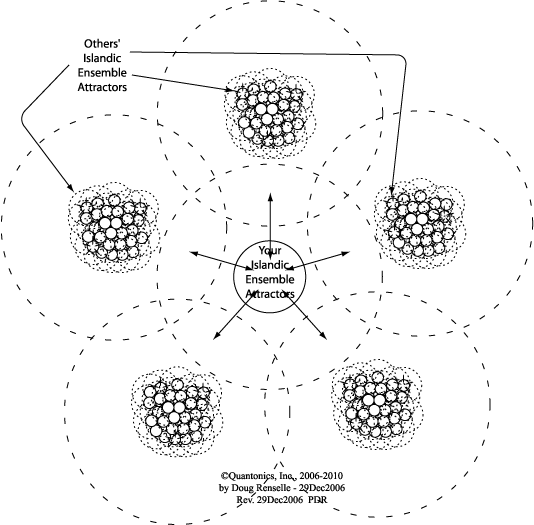 Bottom line: classical paradigms classically focus on 'state;' quantum pragmadigms use quantization to both f¤cus and diffuse all quanton(Value,value) heuristics holographically. Doug - 12,14May2010. |
| Quoted Paragraph II 1"Consider paradigm shifts as classically evoked paradice — classically conjured sophisms. 2Science's classical predilections unintentionally but ultimately elicit paradoxes and more paradoxes which further elicits one paradigm shift after another. 3Paradoxes are classical 'effects' unanticipated and unpredicted by a current paradigm. 4Classical, 'normal' scientists fail to recognize these classical 'effects' for their quantum nature. 5'Normal' scientists are paradigmatically blinded to nature's quantum tells. 6Usually, 'normal' scientists will use a toe to raise a carpet's edge and sweep these unexpected paraphenomena away. 7A perfect recent example is Donald McDonald's historical description of John Bardeen's attempts to sweep Brian Josephson's quantum tunneling paraphenomena under a carpet's edge. 8Under any current paradigm phenomena arise which are quintessentially science-quakes. 9They literally shake a current paradigm's foundations. 10Kuhn cites countless examples. |
I want to do sentence 5, but sentences 8 and 9 have more contemporaneous Value here, so let's do them first. Now that Doug has covered sentences 8 and 9, let's go back and pick up sentence 5. Kuhn distinguishes 'normal' science and "extraordinary"
science. For Kuhn, normal is status quo. Extraordinary,
to him, is that which evokes and educes paradigm shifts. Since
about 1855, according to Doug, our earth has been in a novel
quantum 'science' pragmadigm shift as part of a larger SOM Take a look at Doug's now very old, CeodE 2000, SOM's Box: 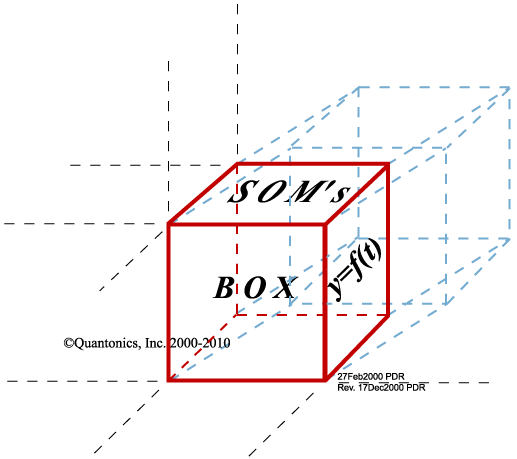 See solid red box? See Doug's dotted-blue hyperbox? Imagine lots of dotted-blue hyperboxes. Red box is classical 'determinate' y=f(t) dialectical reality. Lots of dotted-blue hyperboxes partially represent quantum~reality. Normal scientists are stuck in red box. Quantum~scihæntists, extraordinary scihæntists have left red box and moved into one or more dotted-blue boxes. Quantum~leap(s) if you will. Ponder similarly that USA's current government, FRB, and cartel banks are in red box. That's how they classically deterministically control (apparently) stocks, bonds, housing, etc. Their red box is classical. Consequence? They are doomed. Anyone who stays in that red box...is doomed. Pay attention to ZH, Jim Willie, etc. Now you grasp why and how they surmise we should all completely disconnect from stock markets, corrupt government, main-stream-media, and FRB-cartel. Their end is nigh. Lase 'em baby. Commentary on PIIS8-9: First, let's duplicate them, "8Under any current paradigm phenomena arise which are quintessentially global-economic-quakes. 9They literally shake a current [economic] paradigm's foundations." What is our current economic paradigm? A mostly Keynesian-Marxist social-welfare paradigm as cover for global takeover by fiat-paper-strategic haute monde cartels and oligarchists. In past Doug has written some about few 'ruling' many. Our last two sentences describe that same topic. Keep in mind that to an oligarchy social-welfare is civic-welfare. Few view us as OSFA humans, not quantum~individuals. This is their first great Error. Their second great Error is to attempt to 'politically-economically' replace real money with fiat paper. In any tentative ending of Fews' rule individuals revoke both of those Errors, naturally. Our portable lasers will annihilate them. Timings are now for a revolution from social totalitarian fiat top down elitism and oligarchy to quantum~individualism. To get some flavor of what is in Doug's quantum~stage right now, think of French Revolution, 1789-1799. Quantum guillotines are high powered lasers: microseconds to "heads off." It is just now starting... Doug's view is that Marxian-Keynesian "class interest" socialism isn't worth a good god damn. Especially dialectical Marxian either-or-ism (similar, either "christians' infidels" (Aquinas), or "Muslims' infidels" (Mohammed)). Christians are Muslims' infidels and Muslims are Christians' infidels, at least some believe that and behave accordingly. Better is quantum~gn¤stic~individualism. USA's founding fathers tried to achieve this using classical semantics, syntax, and logic. But those are all dialectical. So we, in 1913, fell back into oligarchists' satanic lair. That great economic-political 'catholic' Error has run its course. Marx was a fool. Keynes was a fool. Most of us now, finally, recognize that. Let me say it simply. Nature hates ESQ. Classical Marxist-Keynesians are proving that now in spades. Harvard's reputation is being sullied. Leftists are looking like retardation distilled. Ditto extreme right nut cases. Allow Doug a spiritual metaphor. A Doug HotMeme™ "Light is at every comma~nospace." HotMeme™. But Doug, "What does that mean?" Reality issi quanton(DQ,SQ)! Reality issi quanton(diffuse,focus). Reality issi quanton(quality,quantity). Reality issi quanton(Value,value). Reality issi quanton(better,good). Reality evolves 'good' while diffusely~middle~including better: amelioration. ESQ = dichon(SQ, SQ). Hylicity. Darkness. Demiurge. Error. Satan. "Dead father." "Rest without movement." Dialectic! Classically, "Darkness is at every comma-space." Marx and Keynes politically and economically only knew and used comma-spaces! Ditto our classical financial 'systems' today, CeodE 2010. Our quantum~revolution for Millennium III is to change all comma-spaces (ruler darkness) into comma~nospaces (individual laser brilliance). They will call us "terrorists," but we know better than they...that they are earth's real terrorists. Why did we leave Britain? Why did we write our constitution to protect individual rights? To protect us from these incompetent, greedy oligarchical haute monde (one global ruler) terrorists. Kings of kings if you will. Their fiat is worthless now. They lose in any fiat sense. And we shall neutralize them anyway. As many as we can. Earth is small. They cann¤t get away. Masses are learning quickly a simple notion of real individual~freedom: breaking pseudo-rulers' rules. Fiat rulers are our New Infidels. NeoInfidels. Read Zerohedge. Read Market Oracle. Read Jim Willie. Read FoFoA. Doug - 13-15May2010. |
|
Quoted Paragraph III "1To Kuhn, a paradigm is a box in which normal science places all its beliefs, commitments, and staunch — even hubristic and arrogant — adherences, until a better paradigm emerges. 2A paradigm shift is when a new breed of extraordinary scientists choose to jump into that newer, better box. 3In that better box, extraordinary scientists invent new puzzles for solving much of what a preceding paradigm swept under its carpet's edge. 4From a quantum perspective, a classical paradigm shift is a relatively minor formal change in a much larger natural evolutionarily "genetic" animation. 5A formal decision to change paradigms, to choose one paradigm over another, involves issues which are insoluble by science per se, especially "normal science." 6Solubility of those issues requires a metadigmatic look at nature, in physial deed a quantum metaphysical/philosophical examination of nature using memes outside of science's competing paradigms. 7Such is what quantonics suggests, n¤t just in crises, but as incessant, phasic, animate, modalities — pragmadigmatic overviews and active support of:
|
If you will, allow Doug to start with sentence 7 first... Commentary on PIIIS7: Read sentence 7 carefully. What is its major tone, its crucial tenor? Doug's hermeneutic of his own 10 year old words in sentence 7 is 'vigilance.' Politically and economically we are, as a world, in crisis! Why? Individuals (many) haven't been vigilant in monitoring leaders of nations (few). They (few) are now putting all of our (many) cookies in their jars. Had we been vigilant, this could have been mitigated. How do they (few) do it? They turn us (many) into social cogs in a social (dialectical) machine. They turn us, as Boris Sidis warned, into social hive drone clockwork zombies: political slaves. How do we stop that? Simply by ceasing all cooperation with our corrupt leadership. We see that happening to some extent now via a process of incumbent attrition. However we need to do more, as individuals! Again, I ask you to reread Cognitive Dissonance at Zerohedge™. Do a browser search on 21:28 to see his incredible gnostic narrative. "But Doug, What do we mean when we say, 'vigilance?'" Doug's answer is simple: "Always watching." To be vigilant is to always be alert and have qua to detect corruption, especially political and economic corruption. "But Doug, what is corruption?" Let's make a list of some exemplars (in stream of consciousness order):
"And the beat goes on..." "Doug, what is our most essential tool of vigilance?" Quantum~light as unstoppable middle~inclusion. We use it to shine light on all corruption and expose corruption prior its own metastasis. "Doug, how can we use light as an essential tool enabling our individual qua?" Our first step is to dump dialectic. Dump determinism. Dialectical determinism (SOM's wall) blinds us. Then learn how to embrace light's many hermeneutics. "Doug, what do you mean by hermeneutics?" Literally, "many interpretations." (Many interpretationings. One interpretation does not state-ically fit all observables. See Doug's What are Sophisms?) Classically, dialectically, interpretation is either-or (dialectical). "You are either for us or against us (Doug quoting a corrupt politician.)." Black or white. Up or down. East or West. Right or wrong. In or out. Good or bad: all dialectic! Hermeneutics is quantum~intærprætation. All hermeneutics are quintessentially enthymemetic. Our best exemplar is a hologram. Each energy well in a hologram views and is viewed by (via, e.g., light) up to all other energy wellings in said hologram. Those many coobsfective views are referred quantumly as "hermeneutics." Every view is a quanton! Philip R. Wallace in his Paradox Lost said it much like this, "(Quantum~)Interpretation accords primacy to subjectivity (quantum~quality) over objectivity (dialectical quantity)." To summarize, a key enabler of individual vigilance is light. But we must interpret (hermeneut) what we see quantumly, n¤t dialectically. Politically and economically our world's politicians have turned from service to corruption. We must metaphorically kill those corrupt ones and find legitimate 'servants' to take their places. If you are being vigilant you are k~now~ings this is already happening on a grand scale in good old golden (golden as a contraction of 'good old') USA. In Doug's view our biggest crooks in Doug's lifetime are Nixon, Clinton, Bu()sh(), and Obama. Doug is still fond of Truman, Ike, and Reagan, although evidence is emerging which could (likely will) change that. Doug - 19May2010. |
|
Quoted Paragraph IV "Quantum Post Modern philosophers, in our opinion, are better qualified for this role and should undertake it. Where scientists look at trees (and only want to look at trees), philosophers look at nature and forests and want to compete various modes of interrelating nature, forests, and trees. At Millennium III's start scientific grundlagen are crumbling, especially mathematics and mechanics plus all sciences which depend upon them. It is time to ascend:
|
This whole paragraph is relevant today's 'science' of economics. Classical economic theory is a total failure. We have SEP of that now and we are directly experiencing total collapse of fiat money systems and economists' nitwitted classical methods and models. Modern economic theory is indeed schizophrenic. No classical economic paradigm is viable! We must move from schizophrenic economics of 'state' and 'state socialism,' to a healthy gnostic economics of change and quantum~individualism. Which is more problematic? A too big to fail corrupt 'state?' Some corporations of individuals being corrupt? Which is better? Allow corporations to fail. Wait ("kick the can") for too big to fail states to fail? Why is it simply wrong for 'state' to save a dying corporation? What are unintended consequences of saving dying corporations? Is it better for state to destroy production and then become employer of last resort paying 'union members' too much to be non productive? Doug's view is that quanton(success,failure) is quantum~reality's overriding dictum...: Failure is in success and success is in failure. Do you see a quantum~implicit of instability? But social 'state' wants ideal stability! Do you see ad occulos how stupid 'social state' really is? Quantum gn¤sis, AKA wisdom, tells us to "embrace uncertainty." Indeed, that is Quantonics' strategy, folks! That is why Doug claims Quantonics is becoming more and more globally strategic with each passing quantum~moment... What is so interesting to Doug is that our web community, albeit very small, isn't USA! It is almost everyone else! (Excepting North Korea, but Doug doesn't want those midget social-hylic creeps on Quantonics' site. The Kim Whim Republic! :) Doug - 2Jun2010. |
| Quoted Paragraph V "When we use a word like hubris we always feel a tinge of guilt. How can we say that a respected discipline like classical science is hubristic, arrogant? Kuhn provides plenty of examples. One is a theme we propound often: classical scientists [read 'Keynesian economists'] believe so strongly in their current [dialectical] paradigm that when they encounter an anomaly twixt nature and their paradigm, they wonder, "…how can nature so rudely violate our paradigm?" In other words, scientists [read 'Keynesian economists'] tend to create paradigms [read fiat paper fractional reserve money systems] and then declare nature "wrong" when she inevitably violates them. To us, reader, that is arrogance! So should we feel guilty when we declare scientists ['Keynesian economists'] hubristic? Perhaps better that you decide, else we uncloak a tad of our own hubris. We offer a superb example here: Resnikoff. |
Why is fiat paper doomed? Why is fractional reserve banking doomed? Following our comments in para. IV, both violate nature! How? Fiat paper is (classically) negative energy! How is it negative energy? It absolutely destroys all monetary systems in which it (fiat paper) resides. Fractional reserve banking is negative energy! How is it negative energy? By monetary base dilution. Fractional reserve means fiat dilution, folks! Dilution means, reduce unit value of money in said monetary system. Evidence? US$ since Fractional Reserve Notes were introduced in 1913 have declined in value by about 99%. And those FRNs are about to be valueless and useless. It will take a global monetary crash to do it...and that event is imminent! Read recent blogs at fofoa. As fofoa suggests, let's evolve from a debt (usury) based society into an equity based society. Debt is social enslavement of individuals. Equity is individual freedom! US' Federal Reserve Banking system is ALL ABOUT DEBT! FRB is about social enslavement of individuals. Let's kick these Ruler dialectical-honkeys off our backs. 7Jun2010 - Doug. See Doug's QELRs of energy, negative, positive, and opposite. |
| Quoted Paragraph VI "Kuhn apparently misses (in our review, here, we try to show this) a point that his Western cultural view of paradigm shifts falls under a dominant larger classical paradigm which we call SOM which lasted from approximately Aristotle to Einstein (~2.3 millennia). He does n¤t discuss a cultural-philosophical metadigm shift from SOM to CR, which we think is almost over now; however he mentions several tells and features of that shift. Some of his critics accuse him of cultural relativism, calling his sequential paradigms and their shifts "relative." Kuhn ineffectively responds that CR is many parallel views, and his paradigms are analytically sequential. Kuhn's discipline is primarily science history, and most of his focus is on paradigm shifts within science itself. That narrower focus might explain Kuhn's absent discussion of a less apparent SOM-CR metadigm shift. Also, no good classicist could ever announce his recognition of such a shift without experiencing massive counsel for herm (her-him) to, "Put that CR toothpaste (Pandora) back in its (her) tube (box), and deny that you ever even mentioned it (her)." | |
| Quoted Paragraph VII "We want to show that Kuhn's SoSR is a child of SOM. That said, it has lower utility as a paradigm evaluator for impending massive Millennium III changes." |
|
Gödel goes off on a tirade about time. It is excellent! If you can take time to do it, watch this recapitulatively. He shows why quantitative econ is just absurd theoretically, since no economic ephemera hold still or can be "stopped.") |
PGS heuristics by Doug Renselle; Doug has no affiliation with US Military IN ANY WAY; Doug has been classified 4Y since late 1960s early 1970s (myopia); prior that Doug aced their entry exams (wanted a nuclear sub nav position in early 1960s, couldn't get into Navy via Louisville exam station). Doug worked for military sub contractors doing navigation software and communications systems from about 1968 through about 1987. In 1968 one bit of RAM (magnetic core) cost five cents! Prior that one vacuum tube (part of a bit) was $s! LSI solid state was a glimmer... - 25Apr2010. |
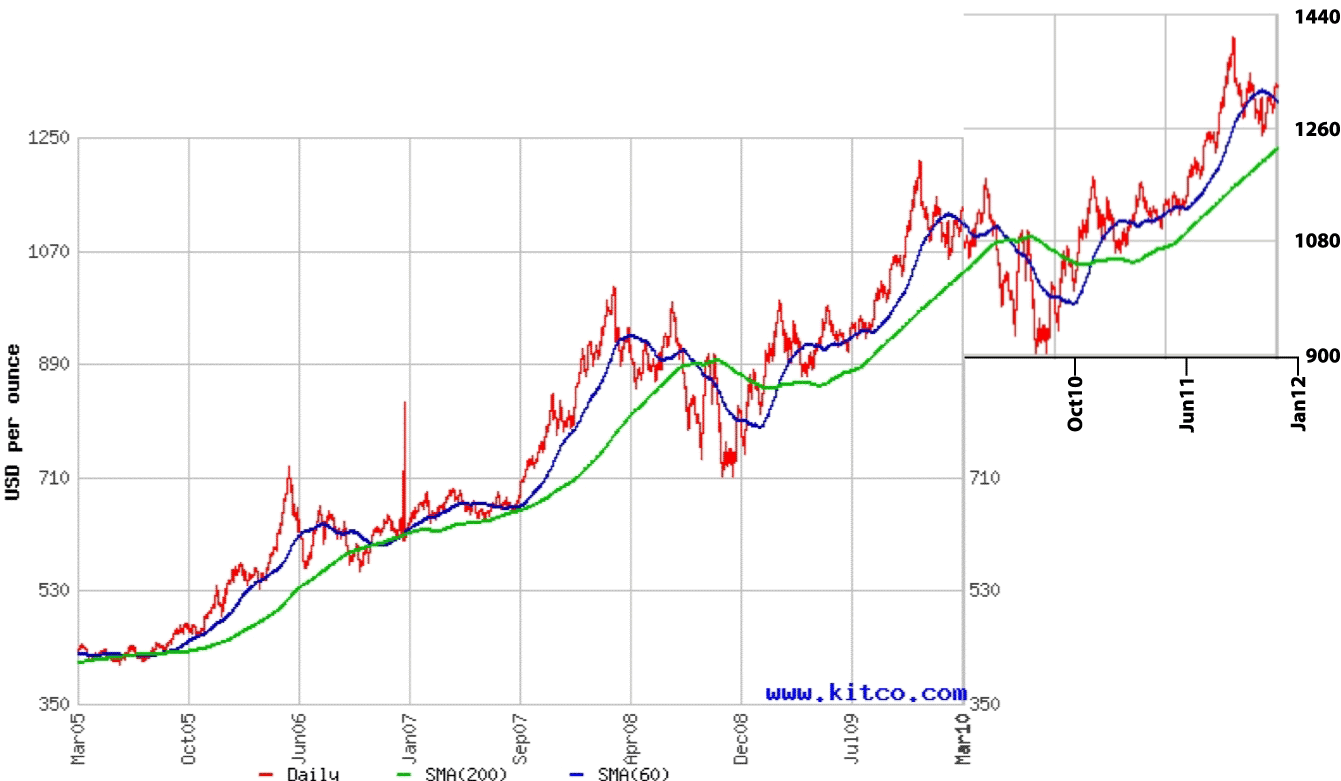 |
|
|
||
|
|
|
|
| Causality |
There is a lot to be said here, so allow Doug to distill it. Classical causality as strict determinism is bogus. Use it axiomatically and get in major trouble right here in river city. See Doug's QELR of cause. See Doug's QELP of cause. See Doug's QQA on cause. See Doug's comparison of classical causation and quantum~affectation. |
|
| One to One Correspondence | CBaE's objective axioms use 1:1 correspondence to meet their requirement for determinate classical causality. But all that they measure are ephemera. N¤ price is static: thus ephemeral. N¤ price stands alone: thus ephemeral. All ephemera are quantum~wavic and thus are ensembles of ensembles n¤ne of whose constitua are classically synchronous n¤r unitemporal. | |
| Strict Determinism |
CBaE assume classically 'What happens next' is a direct consequence of an probabilistic ensemble of past events. Implicit CBaE assumption is: This is a totally factual proposition and 'no' subjective Value is involved in 'what happens next.' Philosophical underpinnings of this assumption is Hume's Law applies as "There is 'no' bridge over fact and Value." (Doug's single quotes of 'no.') Hume's Law is similar Aristotle's Law of Excluded-Middle which says A 'cannot' be both A and 'not' A. Hume's Law is more specific in saying An object 'cannot' be both an object and a subject. |
|
| Control as Effective | Assumption of CBaE here is,
"If we can control future events we deny natural parametric
evolution." As some of us grasp, that is a denial
of nature which of late appears to be what CBaE are attempting.
Of course most classical scientists, and thus 'political economists'
view nature as 'absurd.' Doug imagines how CBaE must view that
26Feb2010 8.8 quake in Chile absurd? Without CBaE realizing a
8.8 quake in fiat Fed US$ paper may be imminent?  |
|
| Parametric Stability | CBaE assume analytic stability. So do they assume analytic stoppability of financial reality? What if reality isn't stoppable and what if stopping it to analyze it has deleterious affects on outcomes of those assumptions? For an analogy see Doug's A Quantum Pendulum. We have already seen what happens when an analyst like David X Li, et al., use scalar (stopped) metrics in quantitative algorithms. | |
| Parametric Independence | Excepting analytic effects of time CBaE assume all quantitative parameters are independent of changes in other independent parameters. See mathematics' Independence Axiom, for example, in Weisstein's CRC Encyclopedia of Mathematics (try wolfram.com). | |
| Time as Analytic | CBaE assume classically 'One Time Fits All.' We call that classical notion uni-time, uni-temporal, and uni-temporality. It is classical time as a monism. | |
| Quantity as Measure | CBaE assume fiscal and economic reality is wholly quantitative. No subjective-value is allowed to and into all quantitative analysis. Essentially quantitative value is price and cost (and to some extent, a great extent credit). | |
|
|
||
| Question |
|
Topic | Doug's Commentary |
| "To 'Blindly see,' what does it mean?" | 19Feb2010 - Poway California | Classical [Dd]emocracy can
only 'see' blindly,' while quantum~[Dd]æm¤cracy sees without classical blinders. |
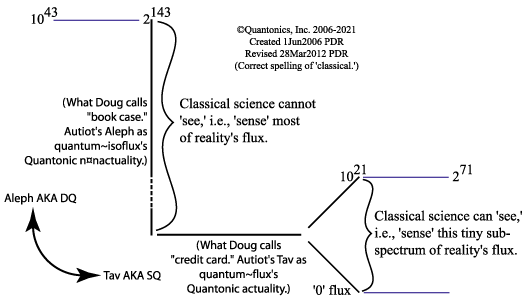
On 31Jan2010 Doug wrote, "Classical politicians (blindly) see only dichon(o, o)." Our reader's query is exceptionally complementaroceptive! 'Blindly see,' classically is an oxymoron. Recall how Doug has taken great pain to show how dialectic thing-king generates paradice. That is why Doug put 'blindly' in parentheses in his original reader-quoted text. What Doug intends is that classicists can only partially see due their religious adherence to dialectic. Dialectic is a huge disabler of human thought. Quantumly both blindly and see are enthymemes. All of us are limited to how much we can see (hear, feel, sense, etc.). Our list of exegetica here are nearly unbounded. For example optical frequencies are less than one octave of nature's >143 octave quantum~flux spectrum. So we may look at real quantum~partial sight as a kind of bandwidth limited blindness. (This is a large aspect of quantonics' semantic of "macroscopic quantum~uncertainty." Understanding it is kin of what we and Paul Pietsch mean by, "Indeterminacy is a principal feature of intelligence." Now ponder how classical democracy adheres dialectical notions of ideal 'truth,' based in ideal classical 'certainty.' When one realizes, wisely, how nature has put blinders on all of us, we intelligently regard uncertainty as a higher Value than classical ideal truth.) Too, we grasp from numerous psychological-clinical studies how, we tend to see what we expect to see. That is closer to what Doug intended by "(blindly) see." In gnosis we use topos to show this quite simply: hylic (most blindered), psychic (struggling to see more), pneumatic (least blindered). Doug - 20Feb2010. |
|
|
|||
|
Type |
Quantonics Script |
Interpretation |
|
|
|
Democracy |
|
Classically 'I' is subjective and me is objective. Too, classically, subjects and objects are middle-excluded due Aristotle's third syllogistic 'law.' Our dichon's comma-space twixt 'I' and 'me' signifies 'concretely' Aristotle's third 'law.' |
Compare Classical
Society Classical politicians view individuals only as quantitative objects: they see 'o,' but they are blindered to 'me' as qualitative 'wavings.' Classical politicians (blindly) see only dichon(o, o). |
Quantumists must use quantization and Poisson~Bracketing to marginalize classical quantitative notions of society and emphasize qualitative quantum~memeos of quantum~society. |
|
Dæm¤cracy |
|
Quantumly "I" and "me" are both quantons and as such are quantum~holographic "patterns of quantum~flux Value." In Quantonics, all quantons are quantum~holographically middle~including and middle~includings. Our quanton's comma~no~space quantumly illustrates quantum~middle~inclusion. |
Classical society must evolve away from its self-proclaimed sovereignty over individuals to acceptance of quantum~individuals sovereign to classical society. |
Compare Quantum~Individual Quantum politicians view individual as qualitative complementation of quantum~flux. Quantum politicians see quanton(~,o). |
|
"If all mankind minus one, were of one opinion, and only one person were of the contrary opinion, mankind would be no more justified in silencing that one person, than he, if he had the power, would be justified in silencing mankind." JS Mill, On Liberty, 1859. |
|
|
 quanton(credibility_unsaid,credibility_said).
 |
 CR
CR