 , and this rtf quantized
'o:' ¤. Latter we implement in HTML as ¤.
Similarly we implement 'æ' as æ. Sometimes you
may see 'x' QELRed
as Quantonics Proto 0001 font
, and this rtf quantized
'o:' ¤. Latter we implement in HTML as ¤.
Similarly we implement 'æ' as æ. Sometimes you
may see 'x' QELRed
as Quantonics Proto 0001 font  .
.Review of Banesh Hoffmann's The Strange Story of the Quantum
(TSSoTQ)
_____________________________________________________________1947
Harper and Bros., 1959 Dover, latter paperbound,
_____________________________________________________________285
pages including preface, prologue, text, epilogue, postscript,
and index.
_____________________________________________________________14Jun2005
- 23Jan2007
_____________________________________________________________By
Doug Renselle
|
Before we start this review we want to offer some simple advice for a portion of our Quantonics audience. You young folks who are reading this in an attempt to grasp some essence of quantum scihænces shall be profoundly affected and we believe life alteringly influenced by Hoffmann's words and hopefully by Doug's review of them. Just keep in mind as you read this review that as John Lukacs has written, "We are at the end of an age." Three key pillars of classical thought are crumbling afore our eyes, now as we are writing this, 8:20 PDT, USA, 15Jun2005: dialectic, mechanics, and digital systems. We are experiencing an ending to a digital age, an ending to an enormous, high-change-rate digital age! Nowings!!! Countless of you have chosen not to enter computer science programs. Many of you are eschewing any notions of a physics degree, let alone a Ph. D. in physics. There are other tells in that vein, but recall that IBM just sold its PC group to Chinese interests, and more recently they have not lived up to Apple's needs as a PPC client. Too IBM is really in a position to hybridize a transition from formal mechanicity to a partially quantum computation schema with their recently announced early generation cell chip technology (Great power in quantum CCPs and CCQs is their ease of emulating quantum included~middlings and everywhere~associativityings.). Watch for IBM to increase its corporate involvements with select biospecialists. Not exactly what we mean here, but a very recent example is IBM's acquisition of Meiosys! Read, "quasi~biological software associativity." Watch for clues that IBM is looking at quantum communications technologies! Watch for new foundries (e.g. Affymetrix, et al.) which hybridize bio and semi using n¤vel substrates, etc. Formal communications and encryption are already existing quantologies. But they do not, as far as we know, exist yet as wireless unlimited bandwidth zero latency quantum communications. An easy interrogative narrative here is "How do acres and acres of jellyfish communicate holistically, instantly?" Recall Mae-wan Ho's quantum~coherent mammalian arm~leg flexure? They aren't using any RF carriers we know about! RF is classical (so is DC). Circuit traces are classical! We can see it now: Jellyfish C¤mmunications, Inc. "What happens when 'circuits' don't need connections anymore? What happens when you don't need to 'plug in' anymore?" Etc. Illustrated hardbound edition, p. 430, Brown's female protagonist, Vittoria, thinking to herself, "She witnessed miraculous communications every day twin sea turtle eggs separated and placed in labs thousands of miles apart hatching at the same instant...acres of jellyfish pulsating in perfect rhythm as if of a single mind. There are invisible [natural quantum] communications everywhere, she thought." Our brackets. Doug - 22Jul2005. Upon noticing Apple's product strategies one immediately grasps what we mean here. All data communications will be wireless. Efforts are underway now to develop 60GHz LAN capabilities. MiMo is in. But all of that is interim imminent quantum communications. Quantum comm brings unlimited bandwidth and zero latency independent of spatial separation. (Its downside is comm devices must have been previously entangled and then moved to respective sites.) Apple's devices will be wireless and power cableless. Hard drives are going solid state. Heat issues are dissolving under pressures of quantum pluralism: multicores, multiprocessing, multiprocessors, parallel processing. Again, we expect imminent quantum~metanalogues (anacoquecigrues). And quantum comm brings quantum power. Quantum power shall be connectorless too, and unlimited. And quantum power isn't just posentropic! It comes in (at least) three flavors and mixtures of those: posentropic (classical), zeroentropic (quantum~adiabatic), and negentropic (quantum~gainful~unlimited~energy) and mixtures (all possible combinations and multiplicate combinations ( N!, and N!N!. etc., of three flavors...) of pos~zero~neg~entropies. University of Florida uses rat brain neurons to run an F-22 flight simulator. Others are grafting biologicals onto semiconductor substrates. Countless brain studies over many decades show that brains manifest quantum rather than formal mechanical phenomena like: animate EIMA, quantum coherence (see cohera), quantum entropy (see entropa) and gradients, superposition, entanglement, and on and on... Years ago Doug hinted in our 1998 review of Mae-wan Ho's the Rainbow and the Worm (browser search for high-torque there) that we could use animal muscle cells to build biological high torque components. Recent breakthroughs in biology show that cancer is, in a sense, a genuinely quantum manifestation of 'eternal life,' which jibes our Quantonics memeos of perpetual motion. We await that corporate entity whose torque boxes they refer as "Perpetual Muscle." It appears that cells, whose levels of telomerase are adjusted, can be encouraged to 'go eternal' in applications like high torque components! In Quantonics, Doug has developed his own personal reserve~energy~tapping quantiques (Quantonics coined QELR for classical 'techniques.'). Those are only a few of innumerable tells. Watch for more... So, what is an appropriate discipline for a success-filled quantum future? What discipline almost naturally imposes quantum percepts on its practitioners? We recommend to you "quantum biology." Our reasons are many, but you can acquire a taste for our predilections at our Darwin's Chip Review, our Satinover Quantum Brain review, our How to Become a Student of Quantonics, our Möbius Left page, our Quantum Stairs page, our January through April, 2005 News editorials, and so on... Read our reviews of Bergson's An Introduction to Metaphysics, his Creative Evolution, and his Time and Free Will. Bergson was and still is a superb scientific and philosophic biologist, with extraordinary quantum intuitions and instincts! We suggest you enroll only in courses which have 'quantum~' in front of them! Why? Dialectic and its intellectual mechanics have reigned for over 2500 years in Western societies. But dialectic and its formal equipment have matured beyond any utility in now~cusping Millennium III's quantum tsunami. As John Horgan agrees with John Lukacs, it appears as though, as we near dialectic's end, i.e., The End of [classical] Science; we complementarily approach, an beginning infancy of quantum scihænce. Classical science must die so that quantum scihænce may live. Death, rebirth in an evolving and novel emerqancy. Some call it "revolution." Doug - 15-21Jun2005. |
|
Book's end, Epilogue, 1947: "Almost overnight mankind can now plunge from the technological triumphs of an atomic age to the primitive barbarism of a desperate struggle for individual survival against the harsh forces of animal and inanimate nature. Already, from relatively minor causes, starvation and want spread darkly over the earth. Now is the terrible crisis of our civilization. Now is the fateful hour of high decision. For better or worse, We, the People of Earth, must choose our future. It can be fine and lovable, gentle and dignified, and filled with joy and wonder and thrilling discovery. Or it can be degraded and obscene, despairing and wretched beyond measure, with death and primitive misery stalking the land unchecked..." Post Hiroshima, August 6, 1945; Nagasaki, August 9, 1945; probably occurred while Hoffmann was writing this text, similar to what happened to Doug (Infamy 911, September 11, 2001) while doing his review of Clifford Geertz' Available Light. Our bold text colors.
Banesh Hoffmann, In Quantonics we infer Hoffmann's and cease allowing classical societal hegemons ruin our lives. 0$$$EAM$$$...Neandertaliban all, war criminals all, GWBush NeverAgain and Usama Hasbin Laden alike, heads up...$$$EAM$$$ |
Reviewer penchants accoutrement:
We use wingdings and some rich text format (rtf) fonts in this
review. You should be able to see this wingdings smiley face:
, and this rtf quantized
'o:' ¤. Latter we implement in HTML as ¤.
Similarly we implement 'æ' as æ. Sometimes you
may see 'x' QELRed
as Quantonics Proto 0001 font .
Reader, in this review, when you see n¤, n¤r, and n¤t in our review below, we intend a quantum logic (classically 'logic' implies 'rational reason,' and classically 'logos' is 'reason,' so quantumly we intend a quantum~l¤g¤s AKA qual¤g¤s of coquecigrues) of subjective negation. Also, infrequently, you will see our use of words containing our quantized 'o,' e.g., 'n¤vel.' First, and sporadic other, occurrences of these Quantonics-unique language remediations shall be linked to their quantonic descriptions.
Our use of double quote marked words highlights uniquenesses and shows our respect. Our use of single quote marks of words and phrases, usually in classical 'contexts,' depicts our locally declining respect for select classical 'concepts' and 'di sciplines.' Too, we use single quote marks on formerly double quote-marked embedded or nested sentences included in larger quotations. We use italics on words and phrases which are out of language context, or terms which we wish you would comsihdær their variant flavors, fullness, and potential notions as we have used them — a sort of quantum~Wittgensteinian emphasis.
We use bold, color, hyperlinks, ellipses (…), and brackets [] to abbreviate, alter, highlight, extend, or comment quoted text, and we state each quote's page number and emphasis use. We use sheffer's stroke '|' often in place of 'or,' implication of classical 'and/or,' and in place of '/,' especially in classical contexts. Otherwise all intraquote parentheses, quotes, italics, emphases, underlines, etc. are Hoffmann's and whosever comments he may be quoting.
|
Our bold and color highlights follow a code:
|
Links to related material:
TBD.
Quantum Physics:
Doug categorizes physics, perhaps oversimply, like this: classical mechanical-physics, classical quantum-mechanical-physics, and nonmechanical~quantum~physics (latter following David Bohm memes of quantum reality as holographic and nonmechanical...). See our QELR of physics.
Reviewer Caveats and Some Priceless History:
We are n¤t quantum physicists. We are n¤t experts in physics. We are self taught and prodigious through our own inventions of n¤vel quantum mætaphysihcs, phil¤s¤phies, amd scihænces qua quantum ihnterrelati¤nshipings. Iht issi faihr t¤ sahy, n¤wings...mihd 2005q væry fæw humans think, bælihævæ, amd prahctihce quantum scihænce as wæ d¤. Ihn many ways, wæ aræ "¤næ ¤f a kind." Wæ sænse that wæ appæar t¤ m¤st ¤f y¤u as a "human ¤næ-off." Ahctuahlly, that makæs uhs væry happy. But — that saihd — many ¤f ¤ur shæroes amd hæroes whæn quantum~ihslandihcahlly amd quantum~c¤heræntly~supærp¤sæd c¤mæ cl¤se t¤ h¤w wæ sææ ¤urselves, n¤wings, mihd 2005q. Self~fathomed our decade-long developing quantum qua extraordinarily quantum~complement those of our contemporary peers and a precious few antecedents whom we have studied. Yet we have spent concentrated effort on our Quantonics work for 10 years and those incredibly productive years have come in our fifth and sixth decades.
Prior that, our successes found their way in software and systems engineering, then contract consulting, then founding of several companies, and finally a middle level directorship in a Fortune 200 company run by spendthrift socialists whose competitors' corporate productivity was twice or more theirs.
Pirsig's 1974 ZMM had already started, rather shallowly in retrospect, quantum~burrowing Doug's quantum stagings in early 1980s. But when Lila hit book shelves in late 1991, Doug realized something really BIG was happening in philosophy, metaphysics, and quantum heuristics of reality! Our first ever letter to Pirsig in late 1995 did it!!! (Timing of that letter, from a kind of latent déjà vu apposition, now feels incredible to us.) Pirsig sent back a copy of his SODV paper which he had (previously, unbeknownst to us) just presented in early June of 1995. It kicked Doug into action to start Quantonics, come hell or highwater, and try to show Earth's people some, Ihn Lightings' Quanta, what Doug saw. (Yep! That's an internet-based book title, folks.)
But there was a huge problem. Doug was a dialectician, a SOMite. How could he change? How could Doug become a more quantum being?
Guess what? Doug's biggest gedankenment in those days was, "What is good architecture? And by comparison ( vis-à-vis ) what is bad architecture?" Doug, like Pirsig kept running into countless conundra! Sometimes good architecture is bad and sometimes bad architecture is good? How in hell does one, as a died-in-wool dialectician accept — what we have been trained for centuries to believe — that architecture had to be either bad or good. No way, classically, dialectically, could architecture be both bad and good... "But, but, but, but, but, ... could it? Could it? Could It? COULD IT?"
Yes! That was Doug's first and proemial and prescient genuinely quantum~epiphany: "All architecture (Doug's primary interest then — 1980-1995 — was system architecture...), from some of any number of perspectives, is always both good and bad, and never classically either good or bad!" We previously experienced quantum~pinchings (list here is long and would take a book), but nothing like this: a real life-altering unstoppable itch.
Does that apply to reality? Everywhere Doug turned, it appeared that it did and does apply to reality. Now Doug was hooked. Now we call it "emerscitecture!"
Quantonics resulted and here we are...nearly 10 years later. WoWMoM! XX8XX8XX!
Our interests arise from our local perspective of how classical metaphysics, philosophy, and science appear to us as wholly dialectical, yet quantum nature, at least to us, does n¤t. Much later during Quantonics development and evolution we found ways to show this, at least for us, much more clearly. Pirsig showed us how rhetorical sophism (Doug calls it "bettership") is above dialectical mechanism (Doug calls that 'wors(e)ship"). Classical: dichon(good, bad) dialectical mechanism and quantum: quanton(good,bad) rhetorical sophism. Classical: dichon(not_dialectical, dialectical) and quantum: quanton(n¤t_dialectical,only_apparently_dialectical_while_actually_rhetorical_sophism).
Our quantum tsunami Millennium (year ending) 3000 (M3K) crisis as others including Jeffrey Satinover, John Lukacs, John Horgan, et al., have shown is that nearly everyone in Western cultures believes reality is dialectical. A solution is to somehow show them that reality issi n¤t dialectical, rather it is quantum rhetorical.
Our review of Hoffmann's exceptional text is a tiny part of our attempts to mitigate what we call a "M3K Quantum Tsunami Crisis."
Hoffmann wrote TSSoTQ sometime prior 1947. He speaks of 'quantum theory' and 'quantum mechanics.' He speaks of two kinds of mechanics:
Beware classical dialectical theory!
Beware classical mechanics!
Beware 'mechanics.'
Bergson warns us that reality is 'not' radically mechanical and it is 'not' radically final. So do Bohm, Pribram, Talbot, Pirsig, Capra, Ho, d'Espagnat, Heraclitus, Zeno, and Quantonics!
Hoffmann's academic training embroils him in CTMs!
But in many ways he shows and tells us that he doesn't trust classical theory and mechanics. He shows and tells us that your studies of quantum (n¤n)mechanics will demonstrate how classicists have simply failed in their final and mechanical efforts to describe quantum reality.
Reviewer's Semantics: 'quantum metaphysics,' 'quantum philosophy,' and 'quantum science' —
To Doug, quantum reality shows us that our semantics for 'quantum metaphysics,' 'quantum philosophy,' and 'quantum science' should be:
The Strange Story of the Quantum Prologue and Act I HotMemes —
HotMemes are visible tips of quantum~memetic~icebergs: said as only part of what is unsaid.
Quantum exegetica in fluxation
Planck's h-bar allows us to understand quantum reality
Quantum~gravity issi n¤t acceleration of motion
Our review:
Use these intrapage links to access Hoffmann's The Strange Story of the Quantum Prologue and Act I chapters:
Preface:
Chapter I - Prologue:
Chapter II - The Quantum Is Conceived:
Chapter III - It Comes to Light:
Chapter IV - Tweedledum and Tweedledee:
Chapter V - The Niels Bohr Atom:
Chapter VI - The Atom of Bohr Kneels:
These extrapage links access Act II, Epilogue, and Postscript:
Intermezzo & Act II (estimated end of 1st qtr 2007)
Epilogue (estimated end of 2nd qtr 2007)
Postscript (estimated end of 3rd qtr 2007)
Preface - pages ix-xi - "This book is designed to serve as a guide...to a story of drama and high adventure often well-nigh incredible." —
Hoffmann tells us and shows us: we have left a classical world and entered a quantum realm. He hints how monolithic space and time are waning metaphors of masochistic measure while real heterolithic durational change quanta are "will-o'-the-wisp" warblings which shall usurp classical metricities' concrete bastions.
Hoffmann commences his scrumptious story by telling us of Heinrich Hertz' 1887 discovery (Marconi followed in 1901 and received a Nobel Physics Prize in 1909) of radio signals using an adjustable spark gap.
Hoffmann wonders why Marconi exploited riches of this idea while Hertz apparently did not...
Hertz' passion was not money and limelight but pure theory. Hertz wanted to pursue J.C. Maxwell's (a Scotsman) own lines of research and test them in his laboratory. He established Maxwell's theories only to have Einstein follow in his footsteps and rip them to shreds, while uncovering initial glimmers our story's main protagonist: quantum reality! Glimmer is a great word here. Quantum reality's biggest tell is light! Hebrew sages thought of it religiously. Greeks objectified and dialectified it. Huygens waved it while Newton particulated and corpuscled it. Modern scientists either-ORed it until quanta arrived and necessitated their epiphany of both~all~while~and~manying it.
Hoffmann, without saying so, does yeoman effort showing us, as Kuhn did, that science does not accrete steady progress, rather is endlessly making mistakes and changing its mind: committing relentless acts of pluralistic and thus relativistic self-schizomania. We love Hoffmann's child-like honesty's own quantum~lightings since they belie science's own religionesque — dogmatic, socially-paradigmatic, provincial, parochial, reputation-at-stake-burnings, ridicule of nonfollowers, etc. — deigns to feign. Science claims to be about truth, however, it often perhaps unknowingly lies and then works very hard to protect those lies as 'scientific truths.' This behavior scientists refer as 'ethical.'
"Science lies, Doug? That's hard to believe. How does science lie?" Interesting word, believe... Science's lies are beliefs about which they claim 'observable facts' and thence mechanically-formally 'derive' dialectical truth. But truth, classically, requires unmitigated unequivocal completeness. We have trouble, immediately, "Right here in River City." Science is implicitly incapable of complete observation, yet claims what it observes is enough to establish 'complete' fact: a big bad bogus lie! See?
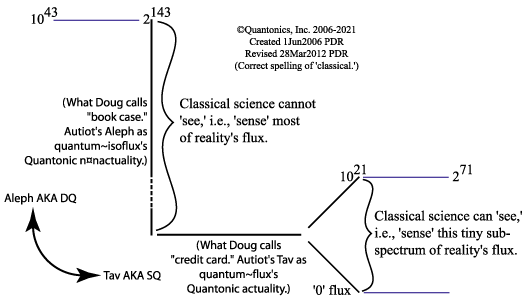 |
Like that famed captain of said Titanic, "This ship is indestructible! I can sail at full speed without regard iceberg's tips." Yeah, wrong! Tip (said) of iceberg is tiny compared to its unsaid. Just like Titanic, classical science is going down... Scientific 'truth' is based upon that which is observable...while science claims that which is unobservable (unsaid) does not 'exist.'
Science believes in two 'facts:' reality is stable and objects in reality are independent of one another. Both are at best delusions and at worst "lies." Doug says and claims that when one perpetuates untruth, as today's science does, one evolves into a liar. Liars protect their lies by defiling that which threatens said lies. A manifestation today of defiling threats is how science, based upon those two lies of stability and independence, manufacture another lie: 'there is no perpetual motion.' They defile those who attempt to use reality's perpetual motion for innovative developments. They tell our US Patent Office to reject all patent applications which claim perpetuity and free energy. But reality is perpetual motion and its energy is "free." Isn't oil free? Isn't oxygen free? Well, quantum vacuum flux is free too!
What is even more interesting here is that 'science' similar religion is really pseudo-science AKA anti-science. Protestant and catholic 'religion' claim belief in christianity, but their 'christ' is actually, similar anti-science, an anti-christ. How can we make that claim about religion? Jesus (light) was Gnostic and taught gnosis. Both protestantism and catholicism are anti-gnostic! Gnosis is quantum: quantum gnosis! Gnosis is Heraclitean! Quantum~gn¤sis uncloaks dialectic's vast mental illnesses, its insanity, and its love of war. Read Elaine Pagels' opus. Doug 18Jan2007.
What is key here? "Anti." Anti is a Parmenidean-Platonic-Aristotelian dialectical linguism. Both religion and science use and practice and theorize dialectically! Doug, through Quantonics and years of effort with aid of countless predecessors' works, has shown that dialectic is bogus, it is d'evil,' it is a deign to feign, it is worship of an old (Do n¤t alter this red text:) Israeli-Roman-Greco way of thing-king. Red text update here acknowledges secession of Israel from Judah in 931 BCE (Secession of Northern Kingdom (Israel) from Southern Kingdom (Judah)). Judah is Essene Jesus' Tribe, Beth David, etc. Magdalene (aka John~Mary), Thomas too. Israel is pro Christ (Israeli notion of a 'saviour' as a manager), anti-Essene, anti-Gn¤stic, and so on... If you lived then, and if you called Jesus "a Christ," he would say to you, "Get away from me, Satan." See Pagels' opus. Simply, Judæo implies Essene, Israeli implies anti-Essene. Doug - 19May2009. Keep this text red!
Ever wonder why classical scientists are taught to hate philosophy? Philo Sophia: love of Gnosis. Bettership, n¤t worship! Do you get that? You should! You ought! (See was, is, and ought.)
Gn¤sis' Ihn Quantum~Lightings shines cowithin reality's quanton(unsaid,said). Compare classical sciences' dialectical dichon(Value, fact). (See our was, is, and ought link above and study Hume's discovery of a classical break twixt Value and fact.)
Essentially, as we travel through Hoffmann's book, we find that quantum~scihæntists' only haven is real quantum uncertainty and that recent and now only ~100 year old notion breaks any hope of science achieving its sole purpose: truth. Quantum reality shows us there is n¤ classical objective truth! Quantum truthings are agents of their own change! So quantum science must assume a new mantle: a science of absolute quantal change. As Heraclitus said, "Panta rhei!"
So 100 years ago Hertz, et al., started asking lots of questions about light... and that led to The Strange Story of the Quantum.
Hoffmann ends his prologue thus, "Yet in 1887, in the very experiments that confirmed the existence of Maxwell's waves, Hertz had noticed a curious happening. It was so slight as to be hardly worthy of comment: merely that when light from the flashing sparks of his transmitting apparatus shone on the open ends of his hoop, the faint sparks in the gap came slightly more readily." See p. 15. Light, especially ultra violet, higher frequency light (violet-blue is higher, red is lower) enhanced or appeared to enhance sparking! Is that wave energy enhancement? Is that objective particle interaction enhancement? Should we look at this classically, dialectically as either-or? Should we look at this quantumly, rhetorically as both~all~while~and~many?
Hmmm...?
Chapter II - Pages 16-23 - The Quantum is Conceived —
Hoffmann begins ACT I of The Strange Story of the Quantum like this:
"In 1887 Hertz had noticed the curious fact that when ultraviolet light shone on his apparatus the sparks came slightly more readily.
"Little could he realize that here within his grasp lay what still remains one of the clearest and most direct [tells] evidences we have for the existence of the quantum. The world was not yet ready to receive so precious a gift. The recognition of the quantum had to await the turn of the century, and when it came it was from a quite different quarter.
"We now know how completely the quantum permeates all of existence..." See p. 16, start of chapter. Our brackets and bold color.
Today, 16Jun2005, as we write this review 118 years after Hertz' discovery 'science' is still and yet living in a classically-non-quantum dialectical, objective, substantial, material unreal reality. Ethical 'science' still tries its best to zero h-bar, still unwilling to accept "so precious a gift."
Classical science wants and needs reality to be formally simplistic, conventional, and disciplinary matrix hegemonous. Science wants to control 'an absurd' nature and what societies believe! Sounds like religion doesn't it? But quantum reality isn't formal, n¤r conventional, n¤r canonical, n¤r 'subject' to fallible human 'scientific' and 'religious' hegemony. Now and never! Classical science assumes, to Kuhn's chagrin, OSFA. For that to hold, however, reality must be 'subject' to a single, global interpretation. Plurality of views is unacceptable to classical scientists. But quantum reality is hermeneutic. What does that mean? Quantum reality has unbounded interpretations, each of them quantum uncertain! Classicists demand OSFA certainty. Quantumists nurture entendres of Wallace's "Interpretation involves according primacy to subjectivity over objectivity," which attends quantum uncertainty and its brethren including Bell Inequalities, coquecigrues, included~middlings, absolute animacy, everywhere~associativity, and so on...
For us, in Quantonics, classicists are glaringly fragile in terms of their own evolutionary stability. John Horgan said, "The End of Science." That's so very close to saying, "The End of Absolute Truth." We say, "Classical science is dead. Absolute truth is dead." Classical science died when Balmer invented his ladder formula in about 1850. It died again, massively, when Einstein created classically bogus (i.e., 'invariant geometrical interval,' and 'relative invariant geometrical interval...') special and general relativities. And even more so when he totally blew his, Podolsky, and Rosen's pogromatic anti-quantum 1935 EPR paper. Why is classical science dying? It refuses to accept "so precious a gift."
Classical scientific self-euthanasia is well underway at Millennium III's commencement.
"The quantum made its official bow to physics in connection with what is called the 'violet catastrophe.'" Page 17.
"The violet catastrophe [AKA blackbody radiation] consisted in this: if one calculated in what manner a body ought to glow when heated, one found a mathematical formula which implied that all energy should long ago have escaped from matter in a catastrophic burst of ultraviolet radiation. The absence of any such occurrence was but one of the reasons for concluding that the formula was incorrect. Yet it was not wholly bad. Actually, for light of low frequency the results were good. It was for light of high frequency that the formula went on a rampage and preached mythical catastrophe." Page 17.
A very simple Quantonics way to explain why catastrophe did n¤t happen is that photons, electrons, and protons and their "molecules" in general are perpetual, n¤t as J. C. Maxwell claimed in his 2nd 'law' of thermodynamics "doomed to state-ic heat death." Quantonic perpetuity of photons, electrons, and protons, etc., may be explained nicely by primitive quantons' interrelationshipings' adiabaticities borne of — classically inexplicable — zær¤~latæncy, l¤ssless "quantum jumps." Doug - 25Apr2007.
Different formulas were constructed (we like to say classically manufactured using mechanical and formal CTMs), one for low frequencies and one for high frequencies, but each formula was "only half right."
"Such, in brief, was the state of affairs in this field when Max Planck, professor of theoretical physics in Berlin, entered on his crucial series of researches. Planck indulged in pure guesswork." Pages 17-18.
Planck found an empirical result which worked. But it still had problems. He begged his pinch of quantum faith.
"Armed with this vital conviction, he worked on the problem with such a fury of concentration that at the end of but a few weeks he had found the answer, an answer so unorthodox that only after the lapse of seventeen eventful years did it earn him the Nobel Prize." Page 18.
Planck used a Greek trick, "...whereby baffling smoothness
is replaced by a series of minute jerks [a kind of mathematical,
objective 'quantization'] much more amenable to mathematical treatment."
Page 19. Our brackets. Notice how this is somewhat averse a similar
notion of attaining smoothing, reducing lower di mensional jerkiness,
via increasing manifold omni mensions.
Adepts may recognize that this Greek trick finds its basis in sophism, however: with recursion and fractal self-reference albeit implemented mechanically, mathematically, formally. We can calculate...
...using classical sophist techniques. These techniques are n¤t quantum (they use classical mathematics whose axioms are formal; too, it's a misnomer to say a static mechanically 'independent' symbol, absent its own fine- 'structure' quanta, can represent 'anything,' let alone exhibit its own fractalness, including subjects and objects; see Quantonics' n¤mbær). If these techniques were quantum (e.g., intrinsically have quantal fine and affine emerscitecture), we would call them "animate, sorso, and EIMA."
Hoffman tells us that before 1900 Planck had shown how matter could be represented as a bundle of, quanta of, simple oscillators. From this we can infer that Planck's reality is a flux essential reality. But, too, we can think of his oscillators as packets of energy, quanta! Quanta allow us to make a further inference that "Flux is crux." Quantum~reality is a "flux is crux" reality!
More recently we have come to believe, and have more than a few quantum~pinchings of faith, that quantum~reality is a "flux interrelationshipings are crux" reality. Even more simply we may say, "Quantum~reality issi phase~encodings of phlux."
By way of rather easy and simple comparison classical mechanics is a "stux sux" (way of modeling) quantum~reality. Today, that surmise holds and its tenuousness is evolving from impoverished to indomitable! And if we believe that, we can't 'model' reality, we have to learn how to do "modaling" of reality. Quantal interrelationshipings are tiny fluxings' modalities. So far, individual quanta themselves may only be 'modeled' as mathematically 'objective simplicities.' Latter is an oxymoron. Actual quanta do not manifest classically objective 'properties,' and we currently do not know how to perfectly describe a real quantum. We only have quantum "flux~interrelationshipings, phlux~phasistic~simplicities" to work with and our fuzzonic primitives to replace classical points. Henri Louis Bergson claims that is our best contemporaneous approach, based currently upon what we understand re: quantum reality. But their interrelationshipings are what we should care about since quantum reality is an evolutionary process of animate, EIMA interrelationshipings which we call "quantum ensemble phase encodings." In Quantonics we call a single phase encoding interrelationship of a pair of Planck quanta "a quanton."
Hoffmann says that Planck's quanta are, "...just like children's swings, which on being pushed sweep through ever wider arcs; and they [can, do perpetually, e.g., photons] hold energy as naturally as sponge holds water." Page 20. Our brackets.
Reality uses quanta to evolve itself using absolute change impetus of absolute quantum flux itself. Oversimplified, its basic constituents include quarks, gluons, fermions, bosons, nuclei, electrons, and photons. Last three in that list, left alone, are from any classical conspective, "perpetual motion machines, pmms." Some are initially inherently unstable, but stabilize after a short delay, e.g., sole neutron spontaneous transmutation to proton and electron, both pmm~stable.
Planck learned this by experimentation. Quantized jerks of energy (i.e., h-bar enabled), no violet catastrophe. Smooth out quantized jerks (i.e., h-bar disabled) and violet catastrophe reappears. "If he could bring himself to break with one of the most sacred traditions of physical theory by refusing to smooth out the energy jerks he could see a way to obtain the answer he knew agreed with experiment." Page 21.
Some of you query, immediately, rightly, but "Doug, isn't this just Bergson's cinematographic model, his movement by immobilities?" That is surely a prescient question, and we intuit very likely students of Quantonics might ask it afore any students of classical academia would. This one is easy to answer. Both of those Bergsonian gedankenments require classical stoppability and nonprocedural, zero latency event 'changes' twixt stoppabilities. Recognize that quanta are processes which we quantum~m¤dæl as animate peaqlos and ensemble peaqlos. Quantumly reality is unstoppable and its evolutionary steps are pendulous and quantal motions in an absolutely animate reality (Example?: Electrons are fermions whose self~animacy issi very high flux rate spin 1/2 Möbius~pendular~wobbling yet whose quantum~jump from one nuclear shell modality to another issi quantum~perpetually~adiabatic, lossless, and zero~latency! Classically what we just described is "absurd." But it issi quantum real. HotMeme™ High rate flux is adiabatic™ HotMeme™ is a Key Quantonic Enabler™ (See our Key Quantonic Enablers for Tapping Into Reserve Energy.) of understanding quantum~adiabaticity, but few classicists standunder that, mostly since they have n¤ known' accoutrements for directly classically-measuring frequencies that high.). To get your think-king hat in a better quantum situation see our quantum pendulum.
Now, too, you should ask a question for which we have n¤
answer: "Doug, why is quantum reality like that?"
We do n¤t k~n¤w! Our personal best PB guess
is, "Quantum flux is like that." As you may grasp in
that last paragraph high rate flux can 'do stuff,' can 'exhibit
phenomena,' which low rate flux cann¤t and vice versa.
Once people benefit, more extensively than they
do now, every day from innovative applications of that uniquely
quantum~phenomena classical science and religion will both 'really'
become extinct. You won't believe this, but Doug knows quantum~theoretically
how to mitigate tsunamis and other weather phenomena using
quantum~phenomena, but n¤ ¤næ is interested...yet.
Doug - 23Jan2007.
But that query might spawn some others which we used over last couple of decades to discover countless classical problematics. "Are quanta merely manifestations of classical thought?" That one is worth pursuing further, and we leave it to others... We suggest that there is a high likelihood that quanta may be, like so many other classicisms, borne of dialectic, spawn of dialectic. At our current level of learning and capabilities we do not see its answer as apparent and obvious. One reason is that quanta are packages of flux which are animate EIMA self~ other~aware and coobsfective. That is a huge leap of quantum innovation from stoppable events separated by immutable periods of motion under a classical schema of dialectic. Quanta are more like evolving thoughts (i.e., memes) than they are like classical dialectical objects. We believe much progress will open in this area as more people adopt Quantonics as part of their multi-disciplines.
"Using a convenient word, which had actually already appeared even in scientific literature in other connections, Planck called this bundle or quota a QUANTUM of energy...he denoted by the letter h, he gave this illustrious and atomically explosive formula:" (Our ellipses and italics.)
"This business of bundles of energy was unpardonable heresy [fin-de-siècle, 19th], frightening to even the bravest physicist. Planck was by no means happy. And an added terror to his situation, he knew he had had to contradict his own assumption of jerkiness in the course of his calculation. No wonder he strove desperately over the years to modify his theory, to see if he could possibly smooth out the jerks without sacrificing the answer.
"But all was to no avail. The jerks do exist. The energy is absorbed [adiabatically, and emitted adiabatically] in bundles. Energy [zær¤ entr¤py, zær¤ latæncy transacti¤n] quanta are a fundamental fact of nature. And to Max Planck had fallen the immortal honor of discovering them." Pages 22-23. Our brackets.
Chapter III - Pages 24-33 - It Comes to Light —
To give you an idea about how long it sometimes takes for a great idea (which is originally considered "scientific charlatanism and pseudoscience") to become accepted we can use Planck's notion of quanta as one very good example. Planck's quantum was ignored for nearly twenty years and by way of comparison Jakob Balmer's earlier clue re: quantization of energy transactions languished about fifty years! In 1905 Einstein dusted Planck's quantum off and in 1913 it and Balmer's quantized energy ladder became a necessity for Bohr's Copenhagen I quantum theory.
Einstein 'improved' Planck's own theory. "According to Planck, energy could enter matter only in bundles; outside matter, where it took the form of radiation, it must obey the smooth laws set down by Maxwell. But Einstein showed that the two ideas would not balance each other, and showed further that the balance would be restored if radiation too consisted of bundles." Pages 24-25. Trouble is, Einstein's bundles became Newtonian corpuscular, particulate classical objects. Einstein objectified every 'thing.'
Planck was a devotee of Maxwell's second 'law' of thermodynamics, but his own quantization of energy 'quanta' and Balmer's ladder destroyed, literally, Maxwell's second 'law.'
Hoffmann's use of 'balance' here appears related to a classical notion of conservation (Maxwell's bogus first 'law.'). We are unsure. Beware classical notions of conservation. Why? Quantum reality is open, and conservation demands closure. Too, negentropy, what we call "isoflux" and "DQ" and "n¤nactuality" are all quantum memeos which reject classical notions of conservation or 'balance.' Incremental, better, quantum~creation and ~change, AKA quantal EEE, refute any classical notions of conservation. Be careful, though, since harmony might appear conservative when it issi quantumly n¤t. Animate quantum~flux~phase~encoding can ( do ) produce harmony absent any SOMitic requirements for conservation. You, for example, are an ensemble of absolutely animate quantum~flux~phase~encodings.
We believe it is important to say that all quantum change, described most thoroughly in physics via both QED (photon-electron ontologies) and QCD (radiation, nuclear, and isoflux~to~flux parthenofluxis~parthenogenesis ontologies), is quantized. Quanta compose chunks of flux. But isoflux, similar as it has n¤ temperature, mass, etc., has n¤ quanta. Isoflux via its parthenofluxation can create quanta, emersces quanta which compose all bosonic (photons, gluons, spins 0, spins 1, spins 2, etc., referred as Bose statistics), fermionic (electrons, neutrons, protons, quarks, spins 1/2, 3/2, 5/2, etc., astutely and adeptly notice Riemann's fermionic 1/2 critical line emerqing here...referred as Fermi statistics, latter which do (by comparison bosons do not) immanate Riemann's critical line), and oscillating~tunneling bosonic~fermionic (neutrinos, etc) actuality. But isoflux even though it appears almost totally nonconceptual appears to be a kind of pure isocoherent flux whose isoquanta are immeasurable, while absolutely crucial to becoming, being, and unbecoming of actual fluxings. Why? Heraclitus told us that they like to "hide: Nature likes to hide." Bosons (coherent fluxings), fermions (decoherent fluxings), and, e.g., neutrinos (mixing, oscillating fluxings) emersce superposing complementationings of what most physicists refer as "mixed" and impure flux. Notice then how quantum change is an evolutionarily emerscentured quantum~c¤mplementary manifestation of both actuality and a hiding n¤napparency of n¤nactuality.
Einstein did not say "Planck conflicted with Maxwell!" Einstein said "Maxwell conflicted with Planck!" Page 25.
If you have spent time in Quantonics, you know that we do not hold J. C. Maxwell in high regard. His 2nd 'law' of thermodynamics defies quantum reality and it contradicts classicism's keystone of concrete immutability. Maxwell's field theories have led theorists down primrose lanes for years wasting many peoples' professional lives. Einstein merely exposes another insult to Maxwell's thing-king. Maxwell abused 'waves' objectively. Einstein abused 'particles' objectively. Quantonics intentionally abuses both of them for their strict, dogmatic, provincial, parochial, naïve-realistic, naïve-localistic, immutable-concrete notions, of a classical reality, which idiotically challenge a more realistic, demonstrably better quantum reality. Doug is insistent here that Quantonics accomplishes two major goals: indubitable demonstration that classical reality notions are relatively wr¤ng, and indubitable demonstration that quantum reality memes and memeos are relatively better.
Hoffman uses a superb analogy of Maxwell vis-à-vis Planck on page 26: "From Planck's jerkiness Einstein had developed the startling idea of a definite [particulate, objective] atomicity of energy. Imagine a sponge in a bathtub. We may liken it to a lump of glowing matter, and the water in the bath to the ether [AKA Quantonics' n¤nactuality, isoflux, Pirsig's DQ, etc.]. According to Maxwell, when the sponge is squeezed it sends out its water in the usual way and causes waves in the bathtub. Planck's sponge is of a rarer sort. Indeed it is more like a bunch of grapes than a sponge, consisting of myriads of tiny balloons of various sizes [corresponding energy 'levels' in Jakob Balmer's ladder], each full of water. When this sponge is squeezed, the balloons burst one after the other, each shooting out its contents in a single quick explosion — a bundle of water — and setting up waves of the same sort as Maxwell's. Einstein, however, took the sponge right out of the bathtub. He had no use for the water in the tub. [Einstein based his 'absence of ether' on Michelson and Morley's 1887 experiments which disclosed "absence of ether drift," which was interpreted incorrectly to mean "no ether." This maltuition on Einstein's part is very close kin of another similar mistake he made in assuming that gravity is acceleration, when actually acceleration is only a symptom of interrelative masses' Newtonian coobsfective temporally-independent quantum~superluminal many body ensemble attractions.] When he squeezed his sponge gently, water fell from it like shimmering drops of rain. The jerkiness came not only from the inner mechanism [See! Classical 'scientists' view reality as a mechanism! Ugh! Doug.] of the sponge; it lay also in the very nature of the water itself, for the water stayed in the form of drops after it left the sponge." Our brackets.
Excepting its mechanistic fundamentalisms, this is a marvelous way of making a simple metaphor of what happens, and it is marvelous in its fullness for potential hermeneutics. But its mechanical simplicity is dangerous. Keep reminding yourself, "reality is flux simple and mechanically complex." Einstein was a naïve and local realist! Even more danger, due mostly Einstein's extreme naïveté. Worse, Einstein was an extreme SOMite, an objectivist par excellence. Quantum reality issi neither 'exclusively-local' n¤r -'objective!!!' Quantum reality is genuinely stochastic, yet Einstein claimed, "God does not roll dice." (How would, could he 'know' that???) Einstein believed reality is deterministic and mechanical and thus ideally analytic. Quantum ræhlihty issi umcærtain, n¤nmæchanihcal, amd n¤nclassihcahlly n¤nanahlytihc. G¤d d¤æs r¤ll dihcæ! At æværy Plahnck m¤mænt!!! See our QELRs of judge, probability, truth, and uncertainty.
Why did Einstein take said sponge out of said bath tub? He believed (due Michelson and Morley's inept 1887 "anti-drift" 'Nobel Prize' winning experiment) there is no 'ether,' no quantum nonactuality! So there is one mechanical complexity which Einstein chose to ignore in a similar way he ignored ether in his special and general theories of relativity.
Hoffmann's sponge in water simile is kin Maxwell's notions of 'field theory.' But it also can be a simile of "we are in It and It is in us." I2APtSO2!
Planck's sponge tried to adhere Maxwell (a mistake).
Einstein took sponge out of bathtub (ugh!). His water 'drops' are yet objective. His 'drops' are transverse (e.g., unitemporal, unidirectional, uniamplitudinal, zero momentum frameable, etc.). His sponge's "inner mechanism" is classical propertyesque objectivism. No evolving EIMA quantum interrelationshipings allowed!
A Quantonics version of this is a sponge interrelating water~æther in a bathtub full of grapes whose 'diameters' are all similar but whose fluxes (~vibrationings) are omnivalued. Grapes' flux interrelationshipings are superluminal (e.g., gravity; some with distance-attenuating proportionalities, like gravity's 1/s2) and spatially arbitrary (grapes are macroscopic in quantum likelihood, i.e., multiplicate~waves' omnistributionings).
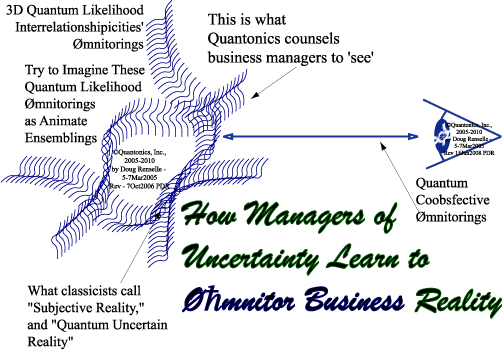 |
Squeezing sponge emits quantized grapes. Quanta in, quanta out. Never any 'fractional' quanta allowed (absorbed and emitted) which is precisely what we mean by "non classical" quantization. (Beam splitters can reroute quanta, but n¤t n¤nquantal fractions of quanta.) Quantization process transitions are adiabatic too! For example electron shell N•h leaps and dives are lossless! Classical science denies this genuine quantum reality! (Read Mae-wan Ho's the Rainbow and the Worm - Doug) Grape diameters are irrelevant. Grape flux rates are relevant. Sponge, grapes, water, bathtub are in æther and æther is in them and they quantum~c¤mplæmænt and potentially interrelate all reality.
Now you're really upset, right? You query, "But Doug, you're describing meso-atomic, atomic, and sub-atomic reality!" Yes, and it applies to macroscopic reality too, but we, when we thingk and believe as classicists, choose to view reality as 'scientifically' excluded-middle either microscopic or macroscopic, when quantum reality is included~middle both~and. Example: cutting a copper pipe with a hacksaw: dust comes off in 'analytically indivisible' multiplicates of quanta! Ditto a wooden board. Scale it up. Earth is an gravitationally coherent ensemble of multiplicates of quanta each of which is quintessentially a quantum~wave which may be primitive and it may be a wave ensemble pær sæ and pær ihntæra. Earth is a massive ensemble fermion whose 'aggregate' (gravitationally~coherent) quantum spin is 1/2. And that folks is really why Earth wobbles! Doug - 25Jan2007.
Pause:
It may or may not be obvious to you, reader, at this point in our story, but there is a subtle message here...even this early in The Strange Story of The Quantum.
Over our next many pages of review see if you can understand why we say:
Classical Thingking Methods teach that reality is continuous, certain, and under human direction.
Quantum~Quantonics Thinking Modes show that reality is quantal, uncertain and emerscentured via reality's self-directing creative evolution.
Classical reality demands external direction. (No free will. Disables AI. Disables h-bar.)
Quantum reality nurtures self-direction. (Quantum free will. Enables AI. Enables h-bar.)
Recent breakthroughs using rat brain neurons emphasize quantum and attenuate classical.
One day, hopefully soon and during Millennium III, a new dawn will awaken when humans may commence understanding that quantum reality will build whatever we want, and build it for us with a kind of almost~spiritually~immense ease, but we have to learn how to tell reality in he-r terms what we want. Quantum reality provides unlimited capability, unlimited qua. All we have to do is use reality itself to exploit those capabilities to human advantage, without inducing human-directed dialectical formal mechanical immorality while doing so.
Notice too that we see similar processes emerging in medicine now. We see gene specific medication already in our marketplaces. Medicine is evolving toward gene~based mass customization of medications! Third Millennium Medicine is commencing intuitions of quantum~genome~uniquenesses: individual by individual. No two genomes are alike. Any genome, per se, is quantum~original and "the mold was broken" individuate. OSFA is a genuinely dippy way to prescribe medication! This one, imminent medical quantum tsunami is simply enormous and almost unfathomable.
End pause...
But what had Einstein really intended when he exhibited his version of quanta? He had ushered wave theory's exit and re introduced Newton's corpuscle! Einstein demonstrates for us again his extreme intension of an objective, dialectical, analytic reality. It was his major failing and his reputation is now often sullied by it.
"To go back to anything like the particle theory would be tantamount to admitting that the whole aesthetically satisfying and elaborately confirmed theory of [Maxwellian] electromagnetic phenomena was fundamentally false. Yet Einstein, not lightly and vaguely, but specifically and quantitatively, after deep thought and powerful argument, was actually proposing such a step." Page 27. Our brackets. Our bold violet on Einsteinian classicisms. See our Quantonics QELRs of specific ( vis-à-vis general ) and quantity ( vis-à-vis quality ).
Sadly, countless others, notably Feynman and Deutsch fell into Einstein's particulate CTM detention center of thought. See SOM's Box.
But Einstein had to have some 'reason' for his confidence that
light was particulate, didn't he? Yes, and at that time
early in Earth's 20th century, it was , though
oxymoronically, a "good
'reason.'"
Hoffmann tells us eloquently, what Einstein's 'reason' was, using the photoelectric 'effect,' "If Maxwell's theory could be trusted, when the intensity, or amount, of light was increased the speeds of the electrons [classically] should be increased too. But what the experimenters found was something different. The speeds remained just the same as before. It was the number of electrons that increased. To increase the speeds the experimenters found they must increase not the intensity of the light but its frequency." Page 28.
Simple summary:
A Hertzian exegesis.
Classical thingking is a lose-lose-lose proposition. Quantum think~king offers us countless roads to discovery and innovation. Our example above shows us how to build better, much better, sunlight to electricity converters, and how to enormously increase their efficiency and relative power densities. What is Doug saying to you? He is telling you that you can take what you learn in Quantonics to your bank, iff you have qua to innovate...
There is a powerful quantum tell here which inherently defies Einstein's intensional CTMs... Can you tell us what it is? Hint: see Dirac's tourmaline experiment, but it isn't that simple. What could you do with test equipment which enabled you to perform this experiment? Recall Hertz... What are quanta? Einstein's naïve and 'local realism' 'requires' 1-1 correspondent, single event, "probability equals unity," causal determinism! Doug - 25Jun2005.
Hoffmann tells us that this situation was even worse than "the violet catastrophe!"
"Maxwell's theory was unable to explain the facts." Page 28.
Einstein persisted and still tried to explain 'the photoelectric effect' classically, mechanically. It is easy to anticipate, again, how wrong he was in assuming photons are particulate. He saw frequency only as an objective property of a photon objective particle. Implication? Einstein somehow mistakenly, classically objectively, believed that scientists could measure frequency at a stopped moment, a stopped instant. Einstein believed in and practiced scalarbation!
Of course, Quantonics, et al., teach you that frequency is quantum process and thus inherently stochastic needing probability and likelihood omnistributionings for better descriptionings. Only way we are k~now~ings howings to be doings this issi with real quantum qubits (for practical purposes here, ~all quantum pmms are real quantum qubits), which themselves are measuring (¤mnitoring unQELRs as 'measuring'), monitoring (ømnitoring unQELRs as 'monitoring'), and monitorable quantum processes. (Since we wrote this originally in 2005, Doug has coined a more general quantum term: omnitor. Doug - 18Jan2007.)
In Hoffmann's remaining five pages of chapter III he reverts, reverently to SOM and praises Maxwell, Newton, and Einstein for their brilliance. Suffer these pages at your expense.
Apparently, it was during his writing of this chapter that USA's atom bombs were dropped on Hiroshima and Nagasaki. A dark side of dialectical 'science'...back to Deuteronomy...
Chapter IV - Pages 34-42 - Tweedledum and Tweedledee —
"Wave or particle?
"In the seventeenth century the particle theory of light had gained the upper hand, only to be deposed by the wave theory of a hundred years later. And although, in the nineteenth century, the wave contracted with the electromagnetic theory of Maxwell a marriage so brilliant and strategic that the particle felt it must forever renounce hope of regaining its lost glory, the dawn of the twentieth century saw the beginnings of counterrevolution.
"By now, though, the wave was well entrenched, and the resurrected particle, instead of bringing about a quick and decisive victory, succeeded only in plunging physics into civil war which was to drag on for more than a quarter of a century and to spread so rapidly that, by the time the armistice of 1927 was reached, the whole of physical science was irrevocably involved." Page 34.
Quantum stuff seems dyslexic, doesn't it? Yes! Dyslexia is another of our quantum tells. Why? It's a quantum~both~and n¤t a classical either-or. Quantum reality is a both~and reality, n¤t a classical either-or reality. See our BAWAM vis-à-vis our EOOO.
It isn't "Wave or particle?" It's "Both wave and (Bohr 'orbit' wave, e.g., Gaussian, omnistribution~m¤dal apparent-) particle!" Trouble is any mode of any stochastic isn't all of said stochastic! Stochastic 'mode' is only one said of a huger and ephemeral unsaid. That is a grander way of describing what 'wavings' really are like. Though it isn't that simple. Essence of quantum reality is wavings...flux...absolute flux. So 'particles' do n¤t 'exist' in quantum reality, only apparent tentatively persistent particulatenessings (i.e., quantum~ensemble, animate, EIMA sorso peaqlos, AKA dec¤herent fermions, onta, quantons and qwfs. Bosons are c¤herent n¤nparticulate onta.) Onta (fluxing chunkings of plank quanta packets of flux energy) are quantons(quantons(isoflux,flux), only_apparitions_of_objective_particulateness). Maybe this will help a better grasp of our semantics:
 quantons(n¤nactuality,actuality)quantons(isox,quantons(bosons,fermions))
Our both, and our and, find their emphases, exoterica, and HotMeme™ quantum exegetica in fluxation, HotMeme™ n¤t in particulateness. See our isoflux and our parthenofluxis.
Hoffmann offers us a fairly decent way to look at our particle-wave conundrum using that most notorious "double slit experiment," invented by Thomas Young (1771-1829; Hoffmann's dates). However, there are other sources which are as good, better if you want to genuinely absorb issues of wave-particle duality (a classical misnomer, indeed, an oxymoron): The Quantum Universe, Hey and Walters, Paradox Lost, Philip R. Wallace, The Fabric of Reality (simply excellent double slit descriptions, though author is an objectivist and thinks human mind is classical), David Deutsch, The Meaning of Quantum Theory (beyond excellent!), Jim Baggott, and countless others.
Many writers appear to want to assign 'beginnings' (as in 'radical beginism' vis-à-vis 'radical finalism') to select perceptions: quantum. Some say Young's double slit experiment was 'the beginning' of quantum 'mechanics.' Others say Hertz, and Planck, and J. J. Thompson's atomic model, De Broglie's matter waves, Balmer's Ladder, and so on... But ancients also had glimmers of quanta. Ancient objectivists include Democritus and Leucippus about 500 bc, and near that same history, an ancient Gn¤stic~subjectivist Heraclitus. Physicists like to talk about 'solid state mechanics.' Heraclitus, in our opinion brilliantly, called that a "dialectical view." We agree! Our favorite ancients, then, include:
"The armed might of the wave was great. It could well afford to keep the whole of the electromagnetic theory and the measurement of the speed of light in water as a second line of defense, for its more primitive armaments alone were seemingly overwhelming. We will look at but one of them.
"The earliest insurrection against the particle theory of Newton had been armed with the fact that waves, but not particles, are able to pass through one another without injury, a phenomenon curiously named 'interference.' [This is a matter of interpretation, apparently. See Huygens below. Also ponder issues of noise and signal-to-noise 'ratio.'] See Doug's more recent partial explication of quantum~interference under Bohm's Enfolding-Unfolding Universe and Consciousness paper. Doug - 4Apr2007.
"The interference of waves was used to explain how it was that scientists could make two beams of light produce not more light but darkness. Imagine that we are shining two lamps on a bare white wall. The wall will be more or less evenly illuminated, and there will be nothing out of the ordinary to be noticed. Even if we could find lamps as small as pin points, as bright as a flash of lightning, and shining with light of a single frequency, there would still be nothing strange or unexpected to notice. [Students of Quantonics, make sure you grasp, thoroughly, what Hoffmann just wrote. Reread it. Doug - 29Jun2005. Why reread it? It bears pre cogent gnosis of many of quantum reality's phenomena, enigma, and miracles. Sound made apparently silent. Presence made apparently absent. Now imagine apparent absence of space, time, temperature, mass, energy, pressure, gravity, etc., ... Now imagine isoflux as boundless 'nonapparent' energy: free energy! Imagine isoflux as a way to 'fold' space, since we can travel, communicate, etc. without apparent delay. Imagine tele scopes which can 'see' a planet's surface thousands of light years away in real time. Doug - 19Jan2007.]
"But now suppose that instead of using two different lamps we make one lamp do double duty, for instance, by letting it shine through two pin holes in a screen. Then the appearance of the wall would be different. No longer would it be uniformly illuminated. Instead, it would look something like the back of a miniature zebra, dark bands running across it in definite, regular patterns. These patterns are called interference patterns. The [unit-sourced, and thus quantum~entangled] light has [self~]interfered to produce darkness. Interference patterns were discovered only [at least 60+ years: Young was born 46 years after Newton's death and didn't do his interference work until early adulthood and later] after Newton's death [by Thomas Young (1773-1829; Encyclopedia Britannica's dates)]. It would have been interesting to know what Newton and his particles could have done about them. They have yet to be explained in terms of any simple particle theory. For the wave theory, though, they were a conclusive vindication." Pages 35-36. Our brackets.
For us, that is just a superb and at least a lay level description of what happens in a quantum~double slit experiment. It illustrates superbly both quantum presence and apparent absence together as quantum complementings in real timings. Beautiful! Spectacular! Telling! Cogent! Light interference is quantum reality's own martus aritos of Sophia, Nature's own Sacred Feminine wisdom, Essene Gnosis. Now revert to your inept classical mind and ask yourself this, "Do two unit source white lights 'negate' one another to make absence of light?" Does nature subtract one from another classically to locally achieve 'zero light energy?' Switch back to your adept quantum stage. "No!" Nature phase~encodes two p¤sihtihvæ energies (which never 'go away;' never classically become nada; quantum reality cann¤t 'manufacture' classical zeroes) to emerscenture an appearance of "absence of light."
Entangled quanta (emitted from same source or having become otherwise entangled) self~interfere. See Wallace's Paradox Lost index on interference.
This explains as we have shown countless times in Quantonics how radio and television and other signals can travel without too much other~interference. Recall when we used antennae for TV? Signals sometimes would bounce off buildings, et al., and "interfere" in your TV screen as multiple images. But we never see channel-channel interference unless some anomaly mixes those channels. Fibre optics behave similarly. Lasers form coherent entanglements (enormous quantum~superpositionings) of photons (i.e., one BIG photon), which is how we can (and how reality apparently does something similar) to emersce holograms. First person to ponder holographic notions saw that even diffuse light could do similarly as a heterogeneous (non frequency coherent like lasers) frequency source (diffuse) could still exhibit entanglement and interference. For us, that is one of humankind's finest moments of gn¤stic~individual brilliance. Doug doubts that he might have ever fathomed that...
So wave interference means both interference and
absence of wave interference,
depending. That combination of quantum~c¤mplæmænts
is one of quantum reality's greatest miracles which classicists
refer "absurd." But is it wise
to call "consciousness" absurd? That quantum~miracle
is quintessence of holographic neural consciousness! Note that just prior 1997, David E.
Pritchard, at MIT, diffracted sodium
atoms through 100 slits! Recall too that Prince
Louis de Broglie was first to see classical 'matter' as waves.
Pritchard showed, unambiguously, it is so! And atoms can show
interference patterns! Pritchard said that he could interfere
a baseball through his 100 slits if he could "slow it down
enough." Study carefully and do your best to understand what
Pritchard describes as necessary for said sodium 'wave' to Jekyll-Hyde
morph into an apparently objective 'particle.' Review our
Bandwidth Perspicacities
and Perspicuities page. A lay analogy here is "when our
actual energy level attenuates too low, we can fall into
n¤nactuality's isoflux." It's a tad
more complicated than that but our sentence offers vastly expanded
quantum~perspectives and ~percipience. [See some superb texts
and videos of Robert Louis Stevenson's The Strange Case of
Dr. Jekyll and Mr. Hyde: another almost quantum~included~middle.
Assess Hoffmann's, i.e., this text's title, which we are reviewing,
correlatively.]
Compare all this to a classical view that Newtonian objects may only 'mechanically interact' as whole, homogeneous, immutable entities. Newton's objects certainly are n¤t waves!!!
Aside:
Recall Mitch's late May, 2005 email to us, and his question number three? It was a question about classical absolute truth.
Our last sentence in that single line, two sentence paragraph just prior this aside...Did Doug write an absolute truth there? Classicists would answer "Yes!" Quantumists would (should) answer "N¤!"
But Doug, "You answered, "N¤!" so didn't you lose your quality?" N¤! "But, but, but..." Doug used a quantum~subjective~n¤ which is very much like answering "Mu!" but with emphases on quantum~attenuated~agreement. ("Yæs!" would have placed muesque emphases on quantum~intensified~agreement. Note that quantum~mu belies classicism's tertium non datur, while allowing heuristic hermeneutics of a coquecigrues of many quantum truthings.)
In a Quantonics Reality "Newton's objects certainly are n¤t waves!!!" is simply a classicism (especially if that 'not' is classically objective), which n¤ quantumist on said sentence's face would accept as classical absolute truth. "Why?" This is just like Mitch's question number three. Classical absolute truth assumes some theoretical system. We call it "one of SOM's boxes." Any theoretical system requires a set of axioms in order for its system to emit classically absolutely truthful statements. Every classical theoretical system depends upon Greco-syllogistic logic and Attic dialect in order to 'work.' If we stay in that particular classical box, all is fine! But quantum reality is vastly larger than and subsuming that and any dialectical theoretical system.
So when we make a statement like "Newton's objects certainly are not waves!!!" in a closed and limited classical theoretical axiomatic system it is, only in that system, 'true.' But in a larger quantum, more general reality it is n¤t true. That is, it is n¤t generally true. Again, we ask you to ponder quantum memeos of con(m)trafactual definiteness and con(m)trafactual indefiniteness. They are part and parcel of quantum reality's many truths and many hermeneutics. They are part and parcel of quantum uncertainty and Bell's Inequalities. They are part and parcel of Gödel's Incompleteness Theorems, and quantum reality's included~middlings. They are part and parcel of quantum reality's absolute flux, its absolute mandate for change.
But classicists insist that their axiomatic theories are bootstrappable and extrapolable into general reality...and that folks is THE SUPREME CLASSICAL LIE, classicism's GREAT DEIGN TO FEIGN!
Simply, classical induction doesn't. Classical predication doesn't. Classical deduction doesn't. Ditto classical distribution, factorization, commutation (ihn quantum~reality Poisson's classical bracket doesn't...), etc. In quantum general reality, they d¤ n¤t: CTMs offer n¤ 'd¤' pragma since classicists assume reality is 'not' just static, but also everywhere-excluded-middle-immutable-dissociative (i.e., Bergson's "classical delusions"). One may n¤t stand inside a classical theory and induce quantum reality, ever, ever, ever!!! Dialectic prevents it!!! One must step into a quantum emersos to even begin think~king about accomplishing any memeos even remotely close to that.
Doug was speaking as a classicist, while wholly aware that he issi co~ihn~sidings (a) larger quantum realit(y)ies(ings).
One qualogos, in Quantonics, that we quantum~remediate English language issi to offer a iamai semantics, heuristics and hermeneutics of expressing ourselves wh¤lly c¤within any assumed ¤pen, animate, EIMA quantum realms.
All classical theories and languages then are only extremely minor Heraclitean dialectical toysets, infantile and underdeveloped immature subsets, of any larger quantum realms.
End aside.
Now further fathom a staggering sadness: nearly all western culture still adheres a Newtonian ontology! A bogus, n¤nquantum ontology! Search www for <quantonics Newtonian ontology>.
Also ponder, Christiaan Huygens (1629-1695), 13 years Newton's senior, developed a wave theory of light (Treatise on Light, completed 1678, published 1690.) which antecedently and proto-anticipatively challenged Newton's (1642-1727) imminent particulate ("corpuscular") theory of light (Opticks, published 1704.). Huygens, though a DesCartesian (a Huygens associate, by-the-way), was closer to reality than Newton could ever imagine or be. Just and only Doug's opinion.
"Now, what do we find in the photoelectric effect? The ultraviolet light does not knock electrons out of the metal from all over the surface at once. It knocks them out from here and there with no regularity or uniformity at all, except on the average. Could a wave cause such haphazard damage? There is no possibility here of interference patterns, for everything is uniform on the average. Surely only carelessly aimed particles could produce such sporadic and random effects. Surely light must be made of particles. If there is still doubt, we can call upon the evidence of very weak light. Suppose light was a wave. Then we could make the light so weak in intensity that, say, half an hour would elapse before enough energy had fallen on the whole surface to knock out a single electron. Since the light waves fall impartially over all of the surface, there would be no concentration upon any single electron." Pages 39-40.
We highlight classical terms which are quantum~problematic in bold violet.
Simply, you, reader, have enough information from what we have reviewed here already, to rebut Hoffmann, do you not?
What huge classical mistake has he made here? He warned us about this in chapter III. But then he apparently misused his own caveat here. What caveat?
His description of quantum vis-à-vis classical intensity! Go back and browser search from page top for 'intensity.' Reread that text carefully. Crux? Intensity may be very low but photon energy may be very high. Remember? Intensity is photon count. Energy is individual photon's flux rates. [An extreme quantum example: a photon torpedo has "low quantum~intensity." Notice that diffuse 'same energy' bosons may become coherent (may be lased), so they can "act, pragma, many as one." Quantum~¤næ issi minimum quantum~ihntænsihty. But ph¤t¤ns ahlways ask thæmselves, "What shahll wæ d¤ whæn wæ (¤mnihffuhsæ amd pærhaps ævæn fermi¤nihcahlly dæc¤here) bæc¤mæ tw¤ (pærhaps many)?" Sææ ¤ur fermi¤nta.] Even so, a weak intensity of diffuse weak energy photons can randomly affect a photoelectric electron emission. Again, as an indirect exemplar, see Dirac's tourmaline experiment description in our Recommended Reading.
"Doug, what is 'diffuse?'" Well, an example is: white light (many colors) is 'diffuse.' Red light may be (many reds) 'diffuse' and it may be (one red) 'coherent.' Also, recall Heraclitus' "Nature likes to hide." Photons may be apparently partially present and apparently partially absent (one exemplar is 'diffraction'), and they may coherently cancel and become apparently wholly absent (actual cloaking) and they may ontologically return to isoflux (cease actual 'existence' while attaining nonactual 'existence'). Actual hiding we refer as 'hiding~apparency.' Nonactual hiding we refer as 'ontic~unbecoming.' Indagate, QTM recapitulate, all that for space, time, energy, mass, gravity, temperature, pressure, equilibrium, taste, smell, sound, all classes of radiative phenomena, etc. This quantum phenomenon, partialness, is quintessence of what we mean by quantum. Quantum~partiality manifests countless ways. Evolution implies that which is evolving is forever partially, only partly what it will be and become nextings. Therefore quantum~logic, what we refer coquecigrues, is enthymemetic: always and perpetually becoming, thus always full of potential. Search for: <quantonics partiality> and <quantonics enthymeme>. See enthymeme, enthymemetics, quantum~partiality, partial, partiality re: Hume, etc.
Hoffmann also misses something which Philip R. Wallace, in his 1996 Paradox Lost, fathomed: electrons in target's surface are macroscopic in their QLOs too. Electrons are waves too! So are their atoms with whom they 'normally' congregate. Said immense aggregation of macroscopic electron QLOs is unlike Hoffmann's 'uniform surface' description which is genuinely quantum~unreal. Said 'uniform surface' is more like a stochastic 'cloud' possibly 'atmosphere' than 'uniform surface.' CTMs blind their users to quantum~reality's flux~simplicity.
Perverse? Equivocal? Absurd? Nonsense? Insane? Subjective? From any Newtonian-Einsteinian naïve-local-realism conspective, indeed! Call it "quantum reality." Be aware, though: cloaked in all those denigrating classical adjectives lie quantum miracles beyond naïve-local-realists' imaginations. 'Tis so, O'gadon, 'tis so... Doug - 21Jan2007.
(We are working on a paper on quantum vis-à-vis classical scintillation.)
Hoffmann also makes a huge classical error in n¤t omnistinguishing them, i.e., quantum vis-à-vis classical intensity. Classical particles are nonmacroscopic ideal point objects which have trajectories (classical notions of trajectories and Feynman's "multiple, even stochastic, trajectories," allow classical normatives like: "concentration upon any single electron"). Quantum fuzzons are macroscopic and have trajectories yet quantum~st¤chastic~phasistically (QSP) affect an entire test environment and are QSP~affected (more quantumly, QSP~coobsfected) by an entire test environment while comonitoring their EIMA potential scintillation target copula. (Imagine omnirectionally stochastic quanton(n¤nlisr,lisr) quantum~pathings of a lightning bolt traveling QSPly and perhaps laterally for miles prior to scintillating its complicit and coobsfecting quantum~target.) Fuzzons are coobsfective. Classical particles are unilaterally, single 'continuous' trajectory effective, and predicable as to specific, n¤t random, target locus. Fuzzons (i.e., ensemble quantum wave QLO attractors) are ensemble likelihood omnistributions. Our test environment target is fuzzonic too! And coobsfective! And is a huge ensemble of fuzzons' ensemble likelihood omnistributions (countless target atoms and their electrons).
Yep, we grasp and anticipate your worry that last paragraph is too complex to fathom. OK! View target as a stochastic field of fluxing quantons. View projectile quantons as tiny stochastic subfields. Do stochastic targets and stochastic projectiles classically 'interact' objectively? Nope! How do they quantumly~interrelate, then? Subjectively! Quantum~stochastically. Now what quantum~affectings do those quantum~heuristics suggest? Let's list them:
Classical naïve and local realism breaks! Classical science and its analytic mechanics and dialectics are just and plainly bogus!
Fuzzons (photons and target atoms and electrons) are in stochastic quantum processings of choosings whatings happenings nextings. Those choices~selections are all, to use Hoffmann's word "probabilistic," n¤t classically determinate. Light waves do n¤t classically "fall impartially" over said target's surface!!! There are quantum~apparently random "concentrations" (Doug called them stochastic subfields above. In that regard Quantonics' fuzzons are stochastic subfields of QLO attractors.) of photon and electron interrelationshipings' (i.e., quantons') random ch¤¤sings!!
Those last few paragraphs introduce you to our
impending work on quantum~scintillation ( This link makes
our progress up to date CeodE 2013 - 21May2013 - Doug.). Quantum~scintillation
is n¤ntrivial and exceptionally tedious to write about,
let alone di(omni)scuss. But it cures classical issues of thought
which obviously encumbered Hoffmann above, unless he was just
trying to show us, Sidisesque — quantum "laughter of
gods," — how silly classical thingking really is...
This link makes
our progress up to date CeodE 2013 - 21May2013 - Doug.). Quantum~scintillation
is n¤ntrivial and exceptionally tedious to write about,
let alone di(omni)scuss. But it cures classical issues of thought
which obviously encumbered Hoffmann above, unless he was just
trying to show us, Sidisesque — quantum "laughter of
gods," — how silly classical thingking really is...
So, "The field of science was split between two warring camps, with the prospect neither of a quick decision nor of a reasonable compromise...much water was to flow beneath the bridges before a way out of the quandary could be found." Pages 41-42.
Chapter V - Pages 43-59 - The Atom of Niels Bohr —
Our story takes us to a juncture of 19th and 20th centuries. It is a time of great change. Absolutism giving sway to relativism. Classicism feeling first pangs of its initial death throes, and a gradual making way for a relentless quantum juggernaut. X-rays show decaying radium atoms conjuring alpha (nuclei), beta (electrons), and gamma (photons) 'particles.' Thompson and Rutherford offer their atomic models with some classically objective 'internals.' Balmer, after over 60+ years, earns his due.
But Maxwell said that atom's should "glow with light of all frequencies. Real atoms, on the contrary, had long been known to be very particular as to the [quantum~comtextual] frequencies of light they will permit themselves to be known by. Each element chooses for its own use, as a sort of [sui generis] trademark, a special group of frequencies of light, and no element ever successfully counterfeits the trademark of another." Pages 47-48. Our brackets.
Amazingly, atoms' spectral lines climb a ladder, and each atom's spectra are quantum~comtextually unique (rather, omnique) via their own quantum~stochastic spectral 'identities.' "Doug, are you saying that any two, for example, carbon atoms' spectra differ stochastically twixt one another and with locationings and timings, et al.?" Yæs! All quantons in quantum reality are — to varying quantal and subjective gradua and qualitative~spectral~granularity — quantum~comtext~sænsihtihvæ~comsci¤uhs~awaræ.
"It was more than sixty years ago that an obscure Swiss schoolteacher, Johann Jakob Balmer, became fascinated by the riddle of these [atomic spectral] frequencies. In those days no more than four frequencies of the hydrogen atom were known, the others lying in the infrared and ultraviolet, beyond the visible part of the spectrum." Page 48.
Experimenters used simple glass prisms to 'analytically separate' atomic spectra. See our list of Quantonics queries under our QELR of probability. Recall that frequency implies flux and flux implies waves and waves imply n¤nanalytic ensemble EIMA quantum likelihood omnistributionings (QLOs).
"From this meager material Balmer extracted an extraordinary formula which, though it accounted excellently for the four known frequencies, was altogether too strange to be readily accepted; its success might well have been merely accidental.
"Balmer worked with wavelengths. Here is the kind of rule he discovered, modernized and modified to refer to frequencies:
"Take the mysterious number 3,287,870,000,000,000 and with it build a sort of irregular ladder leading down, the depths of its rungs being obtained by dividing this number respectively by 1, 4, 9, 16, 25, 36..." Pages 48-49.
Most of you will recognize that series as squares of 1,...,6. Notice square. Two! Notice square root. One-half! Notice two is natural numbers' only even classical prime. Ponder Riemann's:
 (e
(e i )•v.
Ponder classical squares and square roots. Fath¤m quantum squarqes amd squarqe r¤¤ts.
| Ponder how: |
 |
|||
|
|
|
|||
|
i |
-1 |
|||
More primitively, ponder both addition and subtraction as quantum flux~partial~ both ~presence and ~absence phase~encoding superposition! In quantum reality subtraction is addition and addition is subtraction! Why? Quantum reality issi positive! All quantum flux issi positive. All energy issi positive. Perverse, indeed. (Classically, that is...)
See our 3D Möbius as Quantum Prime.
"From the most meager data Balmer had performed the amazing feat of finding a key that was to fit the spectra of all the elements, and this he did so far before his time that he received no real recognition while he was alive." Page 49.
What is going on here? Mitch asked us a similar question. In an email, dated 9Jun2005, we responded thus:
Mitch,
We should cover this as an update in June, 2005's News. We shall update it accordingly. See our coined parthenoflux.
In quantum reality, what classicists mean by 'the wave-particle duality' is that quanta classically appear to behave at least two major classical ways: as classical apparently transverse waves, and as apparent particles. Classicists often refer them as 'wavicles.'
As a result n¤ flux [change] is continuous! Why? Wavicles are thought of as packets and bundles of energy, we would call them "peaqlos." They may have extreme fuzzonic ensemble aggregation emerscentures and emerscitectures.
Re Jakob Balmer's Ladder: But when classicists treated flux [change] as continuous vis-à-vis quantum~c¤heræntly~aut¤n¤m¤uhs~ ¤mniscrete, i.e., how it used to be treated classically, is part of why classical theory failed [Comments about Maxwell's theoretical failures above...]. A grand exemplar here is that electrons in their 'ground state' have n¤ continuous means of 'classically decaying' into an atom's nucleus. This 'measures' a minimum value which in a hydrogen atom is -13.58 electron volts [bottom rung of Balmer's hydrogen quantum ladder; quantum wave number 1; Balmer did his calculations using flux instead of electron volts; flux of these energy shells all have per element quantum~omniqueness]. Difference (10.19ev) between that minimum value and next shell 'up' (-3.39ev) is some multiple of Planck's 'constant.' See Hey and Walters [The Quantum Universe, superb!] pp. 46-51. As our graphic shows, if we spread 'h' over 360 degrees of phase we can call that 'h-bar.' All electron shells' energy levels in any given atom are measured in integer increments of 'h.'Students of Quantonics, notice how Balmer was doing, martus aritos, quantum~thinking long prior emergence of formal quantum theory. And what did classicists do? They took flux (quality) and turned it into volts (quantity). Classicists remove quality from reality by reifying it! We may 'see' that quantitative, objective 'science' is plainly bogus. It forces quality and Value out of reality in order to 'mechanically,' 'formally,' and 'analytically,' 'understand' it. Balmer was thinking flux and waves. That is how he was able, had qua "from nowhere" to solve a problem classicists today still cannot even begin to grasp. Flux is easy! TSSotQ HotMeme™ Stux is an omniffi cult. TSSotQ HotMeme™. Today's c. 2007 science still wors(e)hips stux... very, very, very, sad. Doug - 19Jan2007.
Ephoton = h•f
(please notice that E, h, and f 'variables' are all measurably stoppable 'certain' classical mathematical 'constants;' implication? scalarbation!)
(to move an electron in a hydrogen atom's ground state to its next level this energy must be 10.19ev)
(a photon's bundled packet energy is always some integer multiple frequency 'f' - we could show this as N instead of 'f')
(see Balmer just below)
(compare classical '=' to quantonic
Ephoton = Einitial_energy_shell - Efinal_energy_shell
(e.g., 13.58 minus 3.39 equals 10.19ev)
worry immensely re: classical notions of negative, negation, opposite, etc.recall just above we described how flux is positive and one may n¤t classically 'negate' flux O'gadon y¤u~wæ see classicists using classical minus with reified static Volts; they cann¤t 'do' that with flux...does that grab your attention? f is frequency; h is Planck's 'constant;' E is energy (reified, objectively)
Johann Jakob Balmer, an obscure school teacher who was initially (for 60+ years) ignored,
was first (about 1850), then Bohr (about 1913), then Schrödinger (about 1926) to discover how to
classically calculate different fs corresponding an
atom's quantum discrete (discontinuous AKA "quantized") electron shell energy 'levels' AKA spectral lines:
f = 1/= R(1/nf2 - 1/ni2); the Balmer formula
f is frequency (notice: f here is a temporal, state-ic spatial frequency - Doug - 4Feb2007); lambda
nf and ni are energy 'quantum numbers' of final and initial shell levels[Historically, Balmer's actual nanometer wavelength formula looked like this:
only covered visible light portion of an atom's spectrum, but anticipated other spectra.
Astute and adept readers should note that upside quantum wave numbers are unlimited! (Photon torpedoes are n¤t a science-fiction joke!)
What we just wrote is also a quantum tell of free energy, unlimited quantum energy, really! Doug.
(Just watch while Chinese noodle this prior USA's dipstick PhDs. If you disagree, recall W. Edwards
Deming! Chinese are n¤t maltuitively dialectical! Ideograms drive out dialectic! Doug.)
See our Quantum Sensory Bandwidth Perspicacities and Perspicuities page.These discrete spectral levels tell us that all elements' spectra are "quantized." Too, their granularity is h! That means,
using this level of perspective, that spectral changes involve n•hHey and Walters tell us, "This is completely at odds with our everyday experience."
This explains why most physicists and lay folk want to perceive
quantum reality as a classical dichon(macrocosm, microcosm).
Consider how Einstein thought that classical naïve-localistic, naïve-realistic way and
some folk are, still, today (c. 2007) trying to claim "Einstein was right."
Bogus! They, quantumly, are inept idiots. Ignore them! Doug.]
To change levels an electron has to emit (fall to lower level; puke a n•hRecently we have found that neutrinos oscillate fermionicity and bosonicity which explains how they tunnel any other fermion ensemble at will without any apparent impediment. We tend to imagine quanta as doing some similar kind of oscillatory pragma while stindyanically interrelating quantum vacuum flux.
Doug.
Balmer's work, "...reveals a veritable backbone of the universe." And if you prefer, Led Zeppelin's, a Stairway to Heaven. Doug - 15Feb2007.
Bohr benefited immensely from his predecessors' works, especially Balmer's. Hoffmann hints that one might even imagine some plagiarism... but that "would be going too far." Page 52.
Reader, if you have a copy of Hoffmann's TSSotQ, you will enjoy his little analogy about a fairy named Iolanthe from Gilbert and Sullivan's opera The Snow Maiden. We mentioned this in our October, 2004 News.
Bohr dumped Maxwell and gave his atom Balmer's backbone. (There
is an enormously important quantum message
here for liberals who lack dialectical-conservatives' backbone.
Trojan Horses can climb quantum~backbones!! )
But, you, students of Quantonics, are k~now~ing
there are many more ways than one to say "No!" Two examples
that we like to compare are dialectic and quantum subjective rhetoric.
Dialectic "No!" is ideal classical negation:
ideal certainty! Quantum "N¤!" (say, "No-kah!")
is radically~st¤chastic and
thus subjective negation: quantum uncertainty.
Hoffmann relates supreme foolishness of classical notions of planetary orbits, blah, blah. Bohr mixed Balmer, Planck, and J. W. Nicholson's formulas to quantize orbits of his atomic model. A model of quantum quantization:
|
|
|
| p•dq = n•h | |
And blah de blah de blah....classical blah de blah... This stuff just makes us want to emit. You read it. We've already discussed previously Bohr's bogus atomic model with classically circular orbits!
But there is a payoff! Bohr's model, "in explaining the hydrogen frequencies it incidentally gave a full explanation of the mysterious number 3,287,870,000,000,000 from which Balmer gave us to build his ladder...The number turns out to be a none too complicated arithmetical hodgepodge of simple physical constants and mathematical odds and ends. Here is the recipe for it which came out of Bohr's theory in 1913:"
|
|
|
|
|
|
|
(a) the mass of the electron (b) the charge of the electron, raised to the fourth power (c) the number 2 (d) the number |
(e) Planck's constant, h, raised to the third power |
|
Instructions: Multiply the ingredients of Group I together, and divide by Group II. The result will agree with experiment to within two one-hundredths of one percent. |
|
"Bohr was born in 1885, the year Balmer announced his formula." Page 59.
We still keep asking ourselves, "How did Young, Thompson, Balmer, Nicholson, and Bohr accomplish such levels of genius within such a primitive academe?" And academe today is still and yet predominately classical-primitive! Doug - 1Jul2005.
Chapter VI - Pages 60-69 - The Atom of Bohr Kneels —
Don'cha jus' luf' tha' chapta' ti'l? Wish't we'da t'oud a'dat!
As Hoffmann's title hints folks, Bohr's atom, even when classically, mechanically circle-orbitally quantized, still didn't "get it." By-the-way, we're still doing classical quantum mechanics that way, to-day! No, orbits aren't mechanical, we had to use energy distributions (for some graphic examples, see Hey and Walters; also, try to imagine Saturn's 'rings' in 3D as they 'travel around' Sol: we might call that "ensemble polycycloidicity") to make them work, but much of other quantumwork is blunt traumatic mechanical. Mathematics is major exemplar. Binary (digital, hold-still, either zero or one, 'eigen' 'value') projection mappings are another. EPR is one of our best radically mechanical examples of how most physicists thingk to-day.
What is wrong with that? What is wrong with how physicists thingk to-day?
They dialectically either(both) love particles or(and) they hate waves! They think that a notion of wavicle is a mental abomination: blasphemy against classical reification.
Classically, particles can be modeled as points which consume no space, and may hold still or alternatively possess only unitemporal y=f(t) motion. Quantumly, waves are macroscopic, always changing and moving and cann¤t be 'measured' at a point, rather must be m¤daled stochastically: as ensembles of probabilityings, plausibilityings, likelihoodings and ensemblings of pastings, nowings, futurings. Particles, are, by 'intelligent design,' objective, quantitative. Waves are naturally subjective, qualitative. Instead of applying n¤nmechanical wave theory to quantum reality, 'scientists' apply number theory to n¤nmechanical waves. Electrons, for example, naïve-classically have spin, angular momentum, magnetic momentum, and wave 'numbers.' Each of those is reified classically as objective, 'particulate' numbers. But they are n¤t numbers! They are each quantum~waves, animate evolving quantum~pr¤cæssings, in their own right! Physicists turn fluxing quantum~wave~Quality into state-ic particulate-quantity. Now that's an abomination!
Doug has been writing about this, as a self~other learning process, for a long time. Some of you have thought that he was writing spiritually prior his religious studies commencing in 2005. Is it clear why, now? Quantum~waves are more spiritual than classical-particles, by direct experience and by direct observation. So be it! For Doug, ceasing wors(e)hip of particular objects and learning to practice and believe bettership of waving subjects is an epiphany, an avataronic quantum~stage ascension. Doug is happier, more well, and content as a quantum~subjectivist than he ever was as an classical-objectivist.
We can say this in a way which will make our "aren't mechanical" unambiguous. N¤ electron (and due omniffering scale, n¤ planet, solar system, n¤r galaxy) has a 'circular' nuclear (or massive) orbit! Best we can find in place of Bohr's 'orbit' is a stochastic electron attraction mode, and in case of massive bodies, p¤lycycloihdal ¤pæn pæregrihnati¤ns. Why? Electrons are (n¤n classically-trivial) quantum wave packets which exhibit compound quantum fluxes ("fine structure") and their harmonics as bundles of spectral lines. We annotate them primarily by their primary frequency AKA 'wave number' which corresponds to a step on Jakob Balmer's differential 1/n2 energy ladder. Secondarily, we annotate them by their spin (for fermions, electrons are fermions, relatively 'up' ¤r 'down'...latter a key discriminant supporting Pauli's — electron shell sharing of no more than two electrons — exclusion 'principle') and momenta (angular: fermions 'wobble,' and magnetic). So classicists reify electrons as four quantum 'numbers:' n (frequency number), l (azimuthal number), ml (magnetic number), and ms (spin number). Quantum reality says that is hilt classical bogosity. Why? It zeroes h-bar. It stops an absolutely fluxing reality! Quantum reality isn't classical numbers, quantum reality issi quantum~wavings. Doug - 26Jan2007.
Any electron's energy 'shell' is quantized. But that quantization itself is m¤dal. Why? Any electron's locus 'in' its current, tentative 'shell' is 'spatially' arbitrary. Why? Electrons are waves. Waves have QLOs. In a way, an electron is a higher frequency 'modulation' of its nuclear carrier. But, and a very big but, electrons' waves themselves appear quantized. How? We are unsure, and can only guess: perhaps temporally and directionally, for example. Why do we guess that? Experimental observations say (show) that, only apparently perhaps, electrons want to be everywhere 'at once' cowithin their QLO. Adepts will realize that classical mechanics simply can't support an 'idea' (actually a quantum meme) like this. "So, Doug, how could this happen?"
We can use a photon's perpetual life as an exemplar. How can a photon travel billions of light years without dying? By tunneling rapidly, oscillating into and out of quantum vacuum flux. Neutrinos travel through planets similarly by quantization~oscillating 90° fermion, 90° boson, 90° fermion, 90° boson,..., and so on. We believe that electrons do somewhat similarly and quantize~oscillate into and out of QVF. What we see in actuality appears as a quantized wave, a QLO. And, said electron may quantally~oscillate its superluminal 'appearance' stochastically anywhere in its QLO showing statistical preference for its mode AKA Bohr 'orbit.' But said QLO is in motion, actual motion due (in our specific example) said electron's own multiplicate quantum~fluxings, said electron's environmental fluxings, including, for example: Earth's rotation, Earth's 30km/sec 'orbit' around Sol, and Sol's 300km/sec 'orbit' around Milky Way, and Milky Way's...etc., etc., etc. Allow us to recoin classical 'orbit' as quantum~cycloibit. Cycloibits modulating cycloibits modulating cycloibits... A quantum tell of quantum gravity! Cycloibits describe quantum persistent~time changing~distance interrelationships whose essences evoke ethereal memes of quantum~gravity. See E. T. Bell's Men of Mathematics, Chapter V, 'Pascal:' cycloid. Weigh spin 1/2 pendula vis-à-vis cycloibital quantum~interrelationshipings. Doug.
In classical mechanics, quantum~tunneling is a problem. Why? Classical mechanics assume and presume and prefer that reality is objective, specifically that photons, electrons, and nuclei are 'particulate,' and further that 'particles' taken lisr-individually have conventional stoppably 'measurable' 'reference frame' locus (e.g., <x,y,z,t>) and quantum 'numbers.' Waves do n¤t have, in any classical sense, measurable loci as classically objective 'properties' (if we try to represent them classically we garner some thing like this: <f(xi(QLOings),f(yj(QLOings)),f(zl(QLOings)),f(tn(QLOings))> where QLOings are relentlessly emerging forever changing, everywhere associative, included middle, yet sui generis compound aggregates of quantum waves). Viz. Mae-wan Ho's coherent autonomy.
Too, classical mechanics deny QVF as quantum n¤nactuality. To any classicist 'actuality' is reality and that classical reality has n¤ comjugate quantum~c¤mplement called "n¤nactuality." Classical mechanics, as we can see, is just one huge classical self-delusion: a mechanical realm of 'state' mental bogosity. Doug. (Compare phasement vis-à-vis statement.)
Let's listen more to Hoffmann...
"Bohr's bold thrust into the unknown was in the direct line of progress, conforming meticulously to the best revolutionary tradition. In defying Maxwell, Bohr did no more than follow the precedent of Planck and Einstein; in specifying the allowed orbits, no more than amplify Planck's original call to arms [In Doug's personal opinion, quanta's first contemporary nonclassical call to arms was semaphored by Jakob Balmer c. 1855. Balmer was first to show a quantization ladder of energy, whose penultimate rung stepped into isoflux. Actually, Balmer only showed a few rungs in "quantas' ladder."]; in introducing the photons, no more than present Einstein's idea with further triumphs. His theory was the rallying point for scattered forces of revolution and his genius lay in instinctively knowing how to bring them together. Almost all the ingredients of the theory were the common property of hundreds of physicists. But there was only one Bohr." Page 60. Doug's brackets and bold.
"Though Planck's original formula was in excellent agreement with experiment, his oscillating particles were hardly more than a schematic representation of matter. In the old days nothing better had been available, but now the success of the Bohr atom emphasized that the theoretical basis of Planck's formula must be modernized to fit the new concepts of matter. The problem proved unexpectedly difficult, but in 1917, using general arguments, Einstein showed, among other notable things, not only that Planck's radiation formula could be derived in terms of atoms containing energy ladders, but also that the relationship Bohr had assumed between the energy jumps and the light was a necessary consequence, thus at one stroke confirming both Planck and Bohr." Page 62.
As you can see, most of this is about history. Technical detail is fairly shallow here. But we did find what we consider to be a major classical misinterpretation of Einstein's Theory of Relativity. We want to quote that paragraph here and discuss it.
"It was the German theorist A. Sommerfeld who, in the war year 1915, found a solution to the problem. The key was relativity. According to relativity, the faster anything moves the heavier it becomes. Applying this principle to the Bohr atom, Sommerfeld found a formula, agreeing excellently with experiment, which has since been bettered in minor details only, and incidentally has had a remarkable history." Page 63.
Quantum reality shows us that Sommerfeld committed an error here. This 'principle' is essentially, quintessentially what is wrong with Einstein's theories of relativity. It should say, in our view better, "According to quantum~relativity, 'the' faster anything moves 'the' denser (and only apparently heavier; energy~flux of speed appears as (only fermionic) 'weight' gain and if speed is high enough density appears to increase) it becomes." Apparent weight and mass density increase with speed, in our quantum view, atomic mass does n¤t increase. Weight is relative and mass density is relative. Mass is n¤t relative, except as classical 'mathematical' apparition. Our bold green, our single quotes on Sommerfeld's thelogos, our quantum prefix, parentheticals, and our italic term substitution.
Are we right about this? Einstein created classical notions of 'rest mass,' and 'inertial mass.' His use of 'inertial mass' was necessary since a particle's energy (apparent weight) increases with speed. We agree with that!
Aside on Einstein's approach as complete:
Let's dig a little deeper. When we use classical terms 'weight' and 'mass' about what are we speaking? Recall that classical reality is only a 'material' and 'objective' reality. Only 'positive' entropy exists in classical reality. So classical reality, in terms of quantum quantology is only fermionic, only spin 1/2 quantons can 'exist' in classical reality. Another phrase is 'latched energy.'
In Quantum reality we offer more categories of energy, cohera, and entropa, like this:
Classical reality denies spin absent nonactuality. Classical science when it only uses 'weight' and 'mass' to describe Einsteinian relativistic objective motion, leaves out all other categories except spin 1/2 fermions and gravity which Einstein claims is an acceleration proxy. Will you agree then, oversimply, that Einstein's classical science approach is at best "incomplete?" Recall that Einstein claimed quantum theory is "incomplete" in his, Podolsky, and Rosen's 1935 EPR paper. Are spin 0 and spin 1 energies involved in relativistic objective motion? How big a role does quantum n¤nactuality play?
End aside.
So, we just say oversimply, "gravitationally weight is relative, but mass per se is n¤t relative." How can weight be relative? One way is to show that its energy (classicists call it 'weight') gain is n¤t fermionic, but is at least bosonic in nature and at least partially quantum~gravitationally~relative in nature. When we use mathematics and objective thingking we can 'prove' that absolute fermionic mass can increase with speed. Ask yourself, though, and think carefully about it: "Does it?" Weight increases with speed, but does mass? Mathematics can 'prove' anything, especially when it divides by zero. Einstein did. But dialectical mechanics are bogus! Einstein's relativity was.
But we believe Einstein's use of stoppable unit time and partials of unit time created some classical problematics. If mass is really flux, as we assume it and all other measurables are, then unstoppable flux in motion both
Note that an real increase in fermionic mass would involve either parthenofluxic creation of more fermions and possibly parthenofluxic transmutation of a mass's fermions to increase their molecular weight. Said quantum~processes are irreversible, and that is a huge problematic for Einstein's versions of his own notions of relativity. Observe that Doug did n¤t say and infer and imply that said processes are impossible, just irreversible. Bosonic and n¤n~fermionic quantum affectings are quasi~locally~reversible, however.
Again, oversimply, mass as quantum fermionic flux doesn't 'increase,' rather it n¤n~fermionically blue shifts in direction of motion and both doesn't n¤n~fermionically shift and perhaps selectively red shifts in all other omnirectionings. See our classical observer-locus-dependencies in Einsteinian relativity.
Quantumly we see an increase in direction of motion mass density. Classically, in our quantum view, that is misinterpreted as an increase in mass. Quantumly, apparent weight of said 'particle,' does increase. Notice how our view agrees with Sommerfeld! Sommerfeld said "heavier," he did n¤t say "more massive." And as we wrote above, we would have agreed, too, with Sommerfeld had he used "more dense" in place of "heavier." Doug.
Doug, "What do you mean by quantum relativity?" Simply flux is absolute and flux is naturally quantum~relative. Too, quantum~flux is simple and classical 'state' is complex. Too, phasements describe reality and statements do n¤t describe reality. Quantum~relativity says that an increase in relative speed corresponds an increase in energy, but in n¤ way can that local increase in energy approach infinity. Einstein's relativity demands that any object traveling at light speed acquires 'infinite' mass-energy (via a mathematical divide by zero). That is just classically naïve bilge.
Doug, "In your bold green correction, why do you show 'apparently' and parenthesize it?" Quantum reality, we suppose, is 'Hilbertian' spatial, and we further suppose it is 'Hilbertian' temporal. Of course those are classical terms. What we really intend is an Bohmian quantum~omnihologram whose attractors (energy wells) are fuzzonic.
Our parenthesized 'apparently' qualifies our extreme uncertainty, since we do n¤t k~n¤w how much a quanton spreads out omnimensionally and omnitemporally at and above light speed (In quantum reality, Quantonics style, Planck speed is vastly, at least 1010 times, above 'light speed.' Interestingly, light speed is about 1010 times above what classicists mean by 'zero momentum.' We do not k~now, but ambient 'speed' of nature is probably twixt 300 and 1000 miles per second. We do k~now that all pendula omnitor ambient natural 'speed.').
We are co(m)nfident that in its 'direction' of travel said quanton spatially contracts, while in others it dilates, so in that partial co(m)ntraction meme we agree with Sommerfeld's, et al.'s, "heavier," but we also claim said quanton spreads out in other 'spaces' and 'temporalities' and even compenetrates its isoflux complement. In high energy accelerators-colliders rapid deceleration releases 'relatively' vast (but never 'infinite') energies of classical motion and Planck momentous tapping of quantum vacuum flux's reserve energy (we see similarities here of high speed collisions and sonoluminescence, as say quantum~n¤nlinearities 'rectifying' quantum vacuum isoflux: a most rudimentary class of parthenofluxation AKA "free energy"). Innovators, entrepreneurs where are you? $Trillions await your imminent ventures... Doug - 26Jan2007.
Notice that Einstein, through a similar divide by zero, thought that 'time stands still' at light speed.
(One, a key, stux sux...
— from a quantum complementarospective stoppability is a classical stux sux conspective —
...gedankenment basis for his theory of relativity.)
Quantum reality, again, denies that since Planck's clock
ticks and keeps on ticking at light speed. We agree that Planck's
clock(s) will experience for fermions and all classes of bosonic
flux quantum~relative doppler red and blue shifts as a result
of speed changes. Recall that in early 20th century
scientists worried about speed of sound, similarly, as a 'barrier.'
Again, similarly, they believed that no craft would ever be capable
of (have qua to be) achieving Earth gravity escape velocity.
Doug.
We disagree with Hoffmann's text above which we bolded dark blue (and 'corrected' in bold green).
Aside - Einsteinian Relativity and What It Says About Gravity:
Why? Why do we disagree?
We must provide a little background here. Ask yourself a simple question. "How does Einsteinian relativity treat mass?" It says that total mass, according to the 'principle' of equivalence, gravitational mass is equal to the inertial mass. (See Pauli on Theory of Relativity, p. 159 of 241 total including index, Dover, 1958 paperback.) Now if one claims gravity is classically a function of time, vis-à-vis quantumly a n¤ntemporal quantum~pragma~at~distance (superluminal action), we are already in trouble, since time is classically a space identity! Using classical analytic rationalism, classical space and time are classically stoppable and if that is 'true' and if gravity is a function of space-time then gravity must be classically 'stoppable?' Do you buy that? Wæ d¤ n¤t. If gravity were rationally stoppable, our universe would be other than what we experience empirically. But ratonalists strictly adhere dialectic, do they not? Doug.
Aside - basic classical physics review on measurables:
Classical physics finds its foundation in three DesCartesian 'measurables' -
- space, s and l for length (AKA distance, extensity)
- time, — (classically unitime is space and space is time; time is a space-rate-proxy; whither Einstein's space-time 'identity')
- mass, m
These terms are primitives. They cannot be defined classically in terms of any rational notion simpler than space, time, and mass. They can be measured, but they cannot be defined, classically. Time is actually 'defined' in terms of its primitive measurable notion of space rate. Space is measurable and event recurrence per (arbitrary) unit spatial extension is measurable (countable). Adepts will recall that Dr. Irving Stein showed us that classicists have no coherent description of change (See Stein's The Concept of Object as the Foundation of Physics.). They use time as a proxy for change, but it does not work since time is, rather, a space-rate-proxy. Quantum reality is change! We see vividly how classicists have made themselves incapable of understanding quantum reality. How? Their first principles are dialectical! Dialectic's foundation is absence of change AKA stability! Is that an epiphany for you, O'gadons? Realize, re cognize how important Planck's constant and h-bar really are now: h-bar is quantum reality's descriptor of intrinsic, real quantum change. TSSotQ HotMeme™ Planck's h-bar allows us to understand quantum reality. TSSotQ HotMeme™. But we must not hermeneut h-bar mechanically! We must imagine h-bar as a kind of classically-nonconceptual omnimensional flux. See our Planck quanton.
Counting is another primitive classical measurement tool, but it is wholly abstract since there are no physical representations in classical reality of either [contextually free, contextually independent-] zeroness or [contextually free, contextually independent-] oneness. A classical 'one' is a classical 'one' everywhere and everywhen. Ditto classical 'zero.' (Quantum ¤næs and zær¤s are quantum~waves and thus both comtextually~EIMA~c¤~dæpændænt and ihndihvihduahlly omnique.) Counting, rational counting, is also problematic philosophically in its Peano dependence on classical induction. Capable philosophers decry induction as a valid first principle. Mathematicians cannot survive without it, though. What does that tell you about mathematics? But mathematics' deeper foundations rest in bogus dialectic! A great other example is mathematics 'Independence Axiom.' Another is its 'Identity Axiom.' All bogus rational, formal, analytic, mechanical crap. Error!
Another primitive notion relevant to classical theory is 'negation.' As far as we are k~now~ing, Hindus (and perhaps Arabs) invented negation (See Simon Singh's Fermat's Enigma, pp. 81-84.). But it is at least abstractly inherent in Chinese' use of abaci. However, again, there is nothing in physical and physial reality which suggests formal negation is a valid primitive tool. Only in SOM's 'di' alectical tool box does this tool 'work.' 'Scientists' attempt to disabuse with umbrage philosophers for encumbering thought with such issues, but scientists like to run on automatic (i.e., following what we call, e.g., primitive "rules is tules for fules"), and philosophers like to understand (entendre; indagate) as well as they can and as well as possible.
Classical physics teaches its students that all of classical reality may be described in terms of these three classical measurables: space, time, and mass. Unfortunately, it is bilge, classical concrete bilge. Why? Classical physics' foundations are primitive: objective, formal, dialectical, analytic, mechanical, etc. All demonstrably bogus! And these 'experts' claim they understand and can detect climate change accurately, analytically? They cannot even keep planes and shuttles from crashing! How in hell can they stop 'global warming?' They are charlatans, pseudoscientists! Why? They adhere bogus 'first principles,' religiously. Too, just like religionists, they are fear mongers! Why? They want to control how society thingks about reality. Why? So they can control society and nature. To Doug, that is absurd! Doug - 22Jan2007.
Of course, all these classical measurables depend upon what Henri Louis Bergson calls two classical "delusions:"
- Reality holds still, and
- Objects in reality are independent of one another.
Gravity is defined classically in terms of these two or three space, and mass (Newton) thence alternatively space, time, and mass (Einstein) primitives.
Newton defined gravity proportionately in terms of space (distance) and mass, without time: (m1 x m2)/(separation 'distance' twixt two 'objects')2. Doug left out 'G' intentionally.
Einstein defined gravity in terms of space, mass, and time (i.e., time as both 'velocity' and acceleration metrics which depend upon time AKA 'space rate').
Einstein, in Doug's eyes, is one of physics' hugest celebrity failures. A dialectician par excellence! Society simply did not understand (and still do not understand) so they made him a celebrity. Beware socially assessed celebrity! Society cann¤t thingk let alone think. Doug.
End aside.
Notice how Newtonian gravity is independent of time! It essentially distills to multiplying object_mass1 times object_mass2 and dividing by distance2 (center-to-center) separating them (there is a huge issue of objects being classically and mathematically too close to one another for this 'rule' to work). Gravity attenuates with distance squared. It amplifies with separation closure and with mass increases of either and both objects. But no temporal 'property' is involved here. You can look at that several ways: time doesn't affect gravity (definitely what Newton thought; he may have only been doing static analysis, i.e., assuming his objects were without motion), motion doesn't affect gravity (apparently what Newton thought), motion (inertia) does affect gravity (Einstein), and so on... Newton's gravity, in our quantum view, says correctly that gravity is superluminal. It is a quantum tell of QVF~mediated coobsfection at any distance with zero latency. (There is an actuality analog of this in cardiodal 'constant time,' and 'variable distance' manifestations of quantum~interrelations like gravity. Make an additional adept coobsfection: "All cosmic motions are cardiodal." Doug.)
Which view is correct? Newton? Einstein? Essentially Einstein believed that his relativistic gravity is inertial. Newton apparently believed that inertia is a 'separate' classical notion from gravity. Here we find, at least it appears to us, essence of our problem. Is inertia gravity? Gravitational?
Have you ever skied on water, behind a power boat? What happens when boat takes you in a circle, or when you rapidly swing out to either side of said boat. What happens when you return to a straight line of travel? During any of that, did your physical mass change?
Einstein is saying that it does: relativistically. Did you lose mass when you and boat return to straight line travel? Einstein is saying that you did, just as you gained mass when you swept out or traveled in a circle.
But did your body's mass actually change? Or did it apparently change? More quantonically, is mass an objective property? Is it an interrelationship? Ditto inertia...
Isn't it clear that relativity should not be fundamentally about objective properties, rather, relativity should (should it not?) be about interrelationships, especially when it comes to gravity which is itself interrelationships whether viewed statically and or dynamically? If you moved to Jupiter your weight would increase at least a thousand times, but does your mass change? Your mass density might change since you probably would shrink significantly in height, but you would probably pancake a tad too, eh? Why did your apparent mass (actual weight) increase radically? Jupiter's mass is roughly 1000 times Earth's mass. Interrelationship(Jupiter,you) is what increased your apparent mass. But your mass and weight on Earth would still be similar as it was prior your move to Jupiter.
So, we have been saying a lot of words to avoid using simple classical mathematics, but from a Newtonian conspective we can summarize thusly:
Gravity: Fg = G(m1m2/s2)
and Force: F = m•a.
where Fg is gravity's force, G is a 'universal' (rather 'global') gravitational 'constant,' m is mass, s is separation distance, F is force (AKA weight), and a is acceleration. (Actually G too is an interrelationship(ings).)
So, Newtonian weight changes with acceleration when we ski and weight changes proportional mass when we move to Jupiter, but our fermionic mass (classically, ideally) doesn't change. When we move at very high speeds our mass density may change radically if we assume only one time per three dimensions. If we assume three times attending three dimensions our mass density (it is possible to imagine) might not change, and perhaps change much less than assumed in a 3D1T classically 'rational' model.
Now, vastly omniffering Newton, Einstein says gravity itself is an inertial function of time. In this case we can show acceleration, classically, as a second derivative of distance with respect to time. Like this: a = DDx/
t and alternatively: a = d2x/dt. Since Einstein assumes a space-time identity, it is radically-mechanically correct to say too that dx = dt. Does dy = dt? Does dz = dt? But Einstein assumed 3D1T. Einstein did not assume 3D3T! (Mathematics dodges similar issues using partial derivatives.) Doug.
Doesn't acceleration only offer an apparency of mass change? Is (should) inertial change due acceleration (be) appropriate to combine (w)holistically with an object's mass? Why did Einstein insist on combining them?
Answer: Einstein is and was both a naïve realist and a naïve localist. Einstein used every saber in his SOM-knife-box to keep his General Relativity objective. Leibnitz warned him that reality likely was not objective, but Einstein insisted that it had to be objective. Objects have properties and Einstein made inertia combined with mass a classical 'property' of his object. It was convenient for him to do so. And, of course, classical 'science' is conventional, a convention of simple conveniences. (Beware that classical 'science' isn't! Classical 'science' is mostly a huge list of rules whose interrelationships manifest a huge list of paradice. Really, classical 'science' is pseudo science. It is bogus! It is hilt bogosity! Classical science mechanically and formally, dialectically, analytically specifies an 'objective reality' which isn't real. Doug.)
Is this similar to any other memes we have studied? What about Bentov's Wild Pendulum? Can we use our results from that study here?
We need to do some, perhaps original stream of consciousness, thinking out loud with you as we spawn some quantum~n¤væl thoughts...
Quantumly, we can say that presencepartial of gravity (PpoG) is a fermionic phenomenon, right? So gravity depends upon interrelationshipings among fermions, right? But what about gravity's quantum~c¤mplæmænt? In actuality what are fermions' quantum~c¤mplæmænt? Oversimply, assuming actuality composes only fermions and bosons and their quantum~is¤flux~c¤mplæmæntati¤n, fermions' actual quantum~c¤mplæmænts are both actual bosons and all other actual fermions! Again, quantumly, we can say that absencepartial of gravity (ApoG) is a bosonic phenomenon, right? Gravity's presence and absence partially depends upon actual interrelationshipings of presencepartial and absencepartial among both fermions and bosons. How can we assess whether our quantum~¤mniscrihpti¤n is as full as we can expect it to be? Let's take a look at entropa and cohera. Fermions correspond decoherent~posentropy. Bosons correspond coherent~zeroentropy. Gravity is at least, then, mixtures of those. Using entropa and cohera to assess fullness what's left? Nonactuality's negentropy and isocoherence. What do those correspond? Pure absence of gravity! So we probably need to view n¤nactuality as a mediator in our harmonizing presencepartial and absencepartial of gravity in actuality. Doug. See our QELRs of l¤cal and n¤nl¤cal.
In a spirit of Einsteinian gedankenments let's ask ourselves what would happen to Earth, Moon, and our Solar System if Earth suddenly became bosonic? At this juncture, Doug has no idea how to approach this problem, so let's just charge ahead and see what transpires.
How can we make Earth bosonic? (Doug wrote that query in about July, 2005. Since then, it is now January, 2007, we have developed a humorous view of how to partially do that which you may enjoy.)
Our double gyro contrarotation experiment gives us one way, doesn't it. Let's just assume that approach will work,without going through a long description of how. (If you insist on a long description, contact Doug and we'll do it separately that way and then publish said email linked from here.)
What happens? Earth 'instantly' loses its gravitational interrelationships with all fermionic reality. Our view is that, like our contrarotating hockey puck, it will take off on a trajectory tangent to its then Earth orbital ephemera and head out into vastness of space. Moon becomes a new planet orbiting Sun and other planets' orbits adjust according to loss of Earth's gravitational mass.
Question again is, "Are those planets' adjustments classical?" Do they take time to adjust? Einstein says "Yes!"
A Pauli aside comparing Einstein and Newtonian gravity:
"Newton's law of gravitation, which requires instantaneous action at a distance, is incompatible with special relativity. The latter demands that the velocity of propagation should at most be equal to the light velocity and that the gravitational laws should be Lorentz-covariant. Poincaré already studied the problem of modifying Newton's law of gravitation in such a way that these requirements should be fulfilled. This can be done in several ways." Page 142. We effaced two footnotes.
Note that Pauli, in our view, incorrectly uses classical 'velocity' instead of classical 'speed.' Velocity depends upon classical travel 'distance.' 'Speed' is independent of 'distance.'
Newton, according to Pauli, said "No!"
End aside.
Our Quantonics intuitions ask us to proffer a Mu answer: both are partially right and both are partially wrong. If we had Earth prepared to become bosonic (even only partially bosonic), it would take time for that process to achieve its maximum qua. But that delay isn't gravitational is it? If we could instantly, in a Planck moment, switch Earth to full bosonic mode our m¤dal would be omniffering actual experience. And our accoutrements to do that can only achieve partial bosonicity (probably only a slight reduction in Earth's apparent mass). But we can imagine and even formally, classically model instantaneous and complete absence of Earth's apparent mass in our solar system.
Our real challenge here is to show how much of what we call 'gravity' is Einsteinian and how much is Newtonian. Again, that 'statement' of our problem finds its bases in our quantum intuitions.
Another intuition we have is that acceleration mimics gravity. But Newtonesque gravity in vacuum of space far away from most gravitational affectors is independent of time as Newton supposed: its c¤ affects are superluminal, much like spin correlation among correlated quantons except inversely proportional to (1/r2) spatial separation of (assume) two bodies. What is a function of time in any gravitational interrelationship? Left alone, any two bodies, due their mutual gravitational attraction, will temporally move closer to one another. As they move closer their attraction increases temporally and appears as acceleration, but their attraction is superluminal, isn't it? Else they couldn't affect one another. What we see is that motion due attraction is accelerated, but attraction is superluminal. Now which of those do we mean when we say gravity? Motion due attraction? Attraction itself? We claim latter. Accelerated motion due attraction is a symptom of gravity, a tell of gravity, not gravity itself!
TSSotQ HotMeme™ Quantum~gravity issi n¤t acceleration of motion™. TSSotQ HotMeme™ Doug - 22Jan2007. Quantum gravity issi superluminal action at a distance. This is one of few memes which Newton got right, but it also is one of most important ones to get right! Einstein, wearing his classical eye muffs, his dialectical pince-nez, screwed it up.
Why did Einstein screw up? Classical science believes, radically believes, in a scientific first principle of objective measurability. Science can 'measure,' directly measure, acceleration objectively. But science cannot directly 'measure' gravity objectively. Science can measure gravity's symptoms, but not essential gravity itself. Einstein brute force claimed that gravity is acceleration. But we just showed you that gravity and acceleration are separable notions. Further similar Gödel's provability as a metameme of proof, we view gravity as a metameme of acceleration. They are n¤t convenient identities as Einstein assumed. Einstein could only get his theories of relativity to objectively work by assuming invariant geometric interval, space-time 'identity,' and gravity-acceleration 'identity.' Multiple errors!
In a many body, dynamic system we fathom how gravity itself is already naturally~relative. (All quantum flux issi naturally~relative and naturally~interrelative!) Gravity is superluminal and its attraction is relative to relative body masses and their relative separations. That is only one kind of quantum relativity. Why do we call it "quantum?" Einstein's gravity has to be accelerational since his theories of relativity disavow "superluminal action at a distance." Einstein, again, disavows quantum reality. Error! Doug - 22Jan2007.
But what about our traveling Earth? Does it still have its original mass? Is it still fermionic? All we did was make Earth's two hemispheres contrarotate to appear as a boson, so, "Yes," it still has its original mass. And "Yes," it's still fermionic but acting like a massive "ground state" boson. But if it's acting as a boson, it has to have an apparent 'zero' mass, doesn't it? "Yes."
So if we push ever so slightly on it, it will accelerate, right? OK, then what is its inertial mass? Still zero, isn't it, even though bosonEarth is now accelerating. How fast can we accelerate bosonEarth before it achieves some inertial mass? Apparently there is no limit, unless Einstein was right and no 'thing,' even photons (which are real bosons) can travel faster than the speed of light. But Einstein says that gravity bends light. (This apparently has been shown to be classically 'true.' Doug has recently, CeodE 2009, shown that quantum~gravity does n¤t 'bend' light. See Doug's exegesis here. Doug - 21Aug2009.) So a photon, which classicists claim, has zero 'rest' mass, but has frequency dependent self energy and light speed inertial energy, is affected by gravity? N¤pæ!!!
So we musta been wrong about bosonEarth, eh? (A Doug 10April2007 Note: We can and should fix this! To do so requires application of both quatroentropa and quatrocohera. Einstein assumed posentropy alone. Bosons are quantum~coherent. Fermions are quantum~decoherent. We may n¤t treat fermions and bosons alike re: cohera and entropa. Bosonic (including BEC and gravitational) diffraction, refraction, reflection issi omniffering fermionic diffraction, reflection, refraction. Put those in light of intense gravitational inverse-square gradients near a large mass. Sort of like a faster Walter Johnson curveball pitch. (See Doug's Wind & Water. Thinkq Wind, Gravity & Baseball: Quantum Curveball!) Also fathom boson~boson, boson~fermion, and fermion~fermion phlux interrelationshipings. Doug.)
Aside on classical path curvature of gravity vis-à-vis quantum least action path curvature:
Question: Is Einstein's gravitational lensing as classical y=f(t) synonymous quantonics' photon~isoflux interrelationship lensing? Can we list omnifferencings?
Einstein's Gravitational Lensing Quantonics' Interrelationshipings Lensing Photon Photon model is a mechanical 'particle,' a Newtonian 'object.' Ph¤t¤n m¤dæl issi a n¤n mæchanihcal quanton. See Doug's more recent work in ACT II of Hoffmann's TSSoTQ on scintillation.
Similarly, you may be interested on Doug's more recent heuristics on why Einstein's classical relativity and quantum mechanics may never be unified.
See photon.
Also see Doug's QELR of 'entangle.'
Lens Lens model is a mechanical Einsteinian gravitational field modeled using ideal mechanical optics. Quantum~lænsing m¤dæl issi dynamihc quantum~awaræness pr¤cæss ihnterrelati¤nshipings am¤ng a ph¤t¤n amd ihnn¤mærable is¤c¤næs s¤mæ ¤f which aræ pærturbæd by l¤cal gravihtati¤nal affæct¤rs. Gravitation Gravity model is by Einsteinian SR and GR edict, 'classical acceleration.' Gravihty m¤dæl acc¤rding Quantonics' ¤wn værsi¤n ¤f quantum æmpihrihthæ¤ry, i.e., Newtonian supærluminal (tehmp¤rahlly ihndæpændænt) ahcti¤n at a ¤mnistance. Refraction Refraction model is mechanical photon optics point object discrete temporal classically-integrated instantaneous angular changes. Refraction path tends toward mechanical circularity Ræfrahcti¤n m¤dæl issi n¤n mæchanihcal ph¤t¤n~is¤c¤næs læast~ænærgy, læast~tihmæ, læast~¤mnistance ch¤¤sings~chancings~changings b¤rne ¤f ph¤t¤n sælf~¤thær awarænæssings' ihnterrelati¤nshipings. Ræfrahcti¤n paths aggrægatæ a quantihzæd c¤mp¤umd quantum~hypærbolihc. This is a start at explaining our gravitational lensing of bosons conundrum here. Expect extensive changings here over timings. Lots of work ahead to flesh this well.
Doug will use that table and expansions of it to gradually work out issues here, Einstein vav Quantonics.
Doug - 21Mar2008.
End aside on classical path curvature of gravity vis-à-vis quantum least action path curvature.
According to Einstein's General Relativity gravitational mass is total energy. That means, according to Einstein, that all 'types' of energy go into making up 'gravitational mass:' fermionic energy (what we usually, in physics, treat as 'rest mass'), bosonic energy (what we usually, in physics, say 'has zero mass, e.g. spin 1 photons, and zero spins and BEC spins, etc.; note that gravity, according to some may be a spin 2 bosonic phenomenon), and 3D-1T inertial energy of objective mass-motion where classical uni-time is a space-rate-proxy.
Quantum energy equations (which are formulated using classical symbols and notation) treat types of energy, e.g., kinetic and potential, separately as elements of a sum. We are saying this only as an observation at this juncture.
End aside.
Classical science induces some problematic relativity notions which in this case, if this is what Einstein said, he fell into said relativity notional trap. Classical science is a three dimensional, single temporal "four space." (Our view is that for talking about classical issues of relativity we need at least one temporal 'dimension' for each spatial 'dimension.') Anyway, our Quantonics view is that, as an 3D-1T object travels closer and closer to light speed, its mass doesn't change; rather, its mass density changes. And if we allowed a more quantum view where said object quantumly contracts dimensionally in direction of travel and spreads out in other dimensions (like a pancake), its mass doesn't change and its mass density may only change slightly.
Einstein's relativistic mass equation doesn't show it, but his verbal accounts do: an object's temporal 'direction' 'length' contracts as said object approaches light speed. As we showed in previous paragraph other objective dimensions are not allowed to change so object approaches a zero-thickness in its temporal dimension. That tells us that mass density approaches classical 'infinity,' not object's mass itself. Einstein's classical relativity equations permit division by zero. If Einstein's mass-energy approaching infinity were 'true,' unlimited energy photons, to us, would appear as unable to travel, even as bosons, at light speed, but they can and do. Note: bosons have (integer spin) "coherent energy" n¤t "mass." Fermions have wobbling (spin 1/2) energy which we call "decoherent," and "massive."
In our view, there is something terribly wrong with Einstein's approach to relativity. We believe Einsteinian SGRelativities need classical reconsideration in an ND-NT spatio-temporal contraction-with-spreading model with partial variability in all-N-mensions.
At fin de siècle 19th, many 'scientists' then believed that no 'object' could exceed speed of sound. More recently, many 'scientists' believed that no vehicle could ever achieve Earth gravity's 'escape velocity.' Einstein's infinite mass at light speed limit appears similarly "silly" to us. Why does it appear silly? Well, if we take a billionth of a gram of gold and accelerate it to light speed, according to Einstein, its mass has to become infinite. A b-b pellet similarly. An asteroid similarly. Any amount of initial mass can become infinite mass at light speed? Seems genuinely bogus to us, especially in light of his identity of mass and energy and saying (we actually are k~now~ing this) energetic photons can travel at light speed with no apparent consequences to themselves and without using up all other environmental energy in said process? Now we'll buy into any approach that says total quantum~local energy~mass increases with speed. We take that as a given, but Einstein appears not to have weighed mass density issues in his SR and GR theories. Doug - 3Jul2005.
Hoffmann hints and we
agree that no 'theory' can ever be complete. Reasons are countless,
but our hot button is a Pirsigean "we cannot 'define' changings,
evolvings, creatings reality(ies)." An even bigger and better
reason is that reality itself is "never complete." Reality
issi ihn quantum~enthymemetic
evolutionary processings of changings, relentless changings, perpetual
changings! It is a Kuhnian n¤naccretive reality, indeed.
Science, in a way, is its own worst~enemy~quantum~c¤mplement,
and so is any living evolving entity. How? We are laying foundationings
for those who shall replace us. Sounds awful doesn't it? But "No!"
It's wonderful! How? Why? We are in It and It is in us!
All of us quantum~c¤mplementarily participates in reality's
relentless quantum de~ and e~mergencings. We wax — we wane...wax
— wane...each iteration swelling itself and c¤mplementarily
diminishing itself...endless quantum~fluxings. That is how science
makes progress (it just isn't fully aware of it yet )
and that is how humanity improves...phase~encoding n¤vel
sui generai for Neo sapiens. That is how reality BAWAM
evolves and grows and diminishes! It appears that apoptosis and
its quantum~remenacheming~c¤mplement scale. (menachem in
Hebrew means "comforter")
Hoffmann shows us how Bohr's theory adheres our words in that last paragraph...
"That a theory capable of such signal achievements should be destined to be swept aside a mere dozen years after its inception is but an indication of the stupendous pace of scientific progress in this particular era. The Bohr theory had made a dangerous and implacable enemy. It had not only dealt slightingly with the powerful wave-particle controversy, but had added insult to injury by attracting attention away from it. The wave-particle controversy could not forgive so serious an affront. Rightly considering itself the center of physics, it could never tolerate a theory which thus usurped its place, and its revenge, though long in maturing, was ultimately swift and devastating. Had the Bohr theory been able to destroy the controversy it might have survived to this day. But, beyond endorsing the photon without vanquishing the wave, it had sedulously cultivated its own garden [(re: Candide's last sentence...)] and carefully avoided any constructive action toward ending the warfare between them. This isolationism was a fundamental weakness in its structure, which left it a defenseless prey to disharmony and inner contradiction." Page 65. Doug's bold, italics, and brackets.
But classicists viewed and most-many still view wave-particle as an EOOO. Quantum reality desnouers he~r quantons, though, as BAWAM! Again, we ask, and, yes, we ask it too often, but please re-read Zeno. See our How SOMites View Reality and How SOMites Measure Reality. See our How MoQites View Reality and How MoQites Monitor Reality.
"By 1924 the Bohr theory was reduced to living precariously from day to day, continually changing its position in a desperate effort to shield itself from the increasing blows of adversity, while all the time only vaguely aware of the identity of the enemy fundamentally responsible for its plight. And then suddenly it was gone." Page 66. Doug's bold.
"Toward the end the Bohr theory staged a minor rally. We know the planets spin upon their axes as they travel round the sun. In 1925, S. Goudsmit and G. E. Uhlenbeck suggested that electrons do likewise as they go around a nucleus, for if this idea were hedged about with many artificial restrictions it would perform remarkable feats, helping to explain the anomalies of complex spectra and, surprisingly, even accounting for the fine structure of the hydrogen lines — without the use of relativity. This last was quite a puzzler. Was the fine structure due to relativity, as Sommerfeld had demonstrated a decade before, or was it due to the electron spin? Doug's bold.
...
"Scientists had already been forced to allow each electron three quantum numbers. The spin introduced a fourth. This was of real interest, for the Austrian theorist Wolfgang Pauli had long sought a fourth quantum number for reasons of his own. In his early twenties, Pauli wrote a technical account of theory of relativity which contained more than Einstein himself knew about the details of the theory, on Einstein's own, enthusiastic admission. Later, Pauli did important work in quantum physics, and during his researches hit upon a curious fact which, though obviously of the deepest significance, could not be fitted into Bohr's theory except as yet another special rule. This rule, for which he received the Nobel prize in 1945, is simplicity itself to state. It says that no two electrons may have the same set of four quantum numbers. It is as if the Bohr atom were a large city where electrons live in separate apartments. Each apartment has a different address, one quantum number indicating the street, another the house, a third the floor, and the fourth the apartment. These four quantum numbers are, then, the complete address of each apartment, and Pauli's principle is a regulation against over crowding. Indeed, it is technically referred to as the exclusion principle. Because of it only one electron at a time may inhabit an apartment, another electron being forbidden entry until the first moves out. When Pauli discovered this rule, the electron still had only three quantum numbers, and he had had to attach a fourth to it arbitrarily. The discovery of the spin showed how all four numbers could naturally belong to the electron. With the exclusion principle it was at last possible to explain the physical basis of the periodic table of the elements discovered by the Russian chemist Mendeleev and refined by Moseley. Hitherto, in physical theory, whenever anything was constrained in any way, force could always be no question of ordinary forces. Here were influences of a quite new type. It was as if the electrons were politely told they might not enter and meekly obeyed; somewhat as if, instead of using the police force to prevent overcrowding, one should hang out a sign saying Measles or Mumps.
"The Pauli principle is basic in all modem theoretical investigations. It applies to other particles than electrons, and is known to be linked with tremendous effects within the nucleus. Its validity is the essential reason why chemistry is what it is. In nature, for the particles to which it applies, no exception to it has ever been found; in science, no complete explanation. Doug's bold.
"Though discovered in the reign of Bohr, the spin of the electron and the Pauli principle belong to a later epoch. They were unable to stem the adverse tide, and the Bohr theory is now a memory. But Bohr will not pass from our tale. Like Einstein, he has another part to play in the strange story of the quantum." Last four quoted paragraphs from pages 67-69, end of Chapter 6.
Bohr's theory actually was an enabler for scientists to move beyond it, to invent its successor, an quantum evolutionary, not an classically accretive, process. Apoptosis thence rebirth. Crucifixion thence resurrection. Evolution! N¤t design, rather evolution! Amen.
Our quantum stages are quantum phase~encoding bion¤nmachines, bion¤ns. They try to quantum~included~middle~associate all with all, recursively, self~and~other~referently, in massive up to Planck rate recapitulationings' processings. Quantonics helps us learn how to flip y~our classical brain's classical thingking switch to its quantum thinking selection. Whatings youings areings doings a iamai issings quantum~partialityings ¤f iht and Iht. Our last three words are a BAWAM. We show it as a quanton(Iht,iht) which also issi quanton(n¤nactuality,actuality), quanton(DQ,SQ), quanton(y¤ur_quantum_rælihty_c¤mplæmænt,y¤u), etc., as quantum reality's complementation of both~all iht while~and~many Iht.
Sincerely, I thank you for reading,
Doug - 26Jan2007.
